
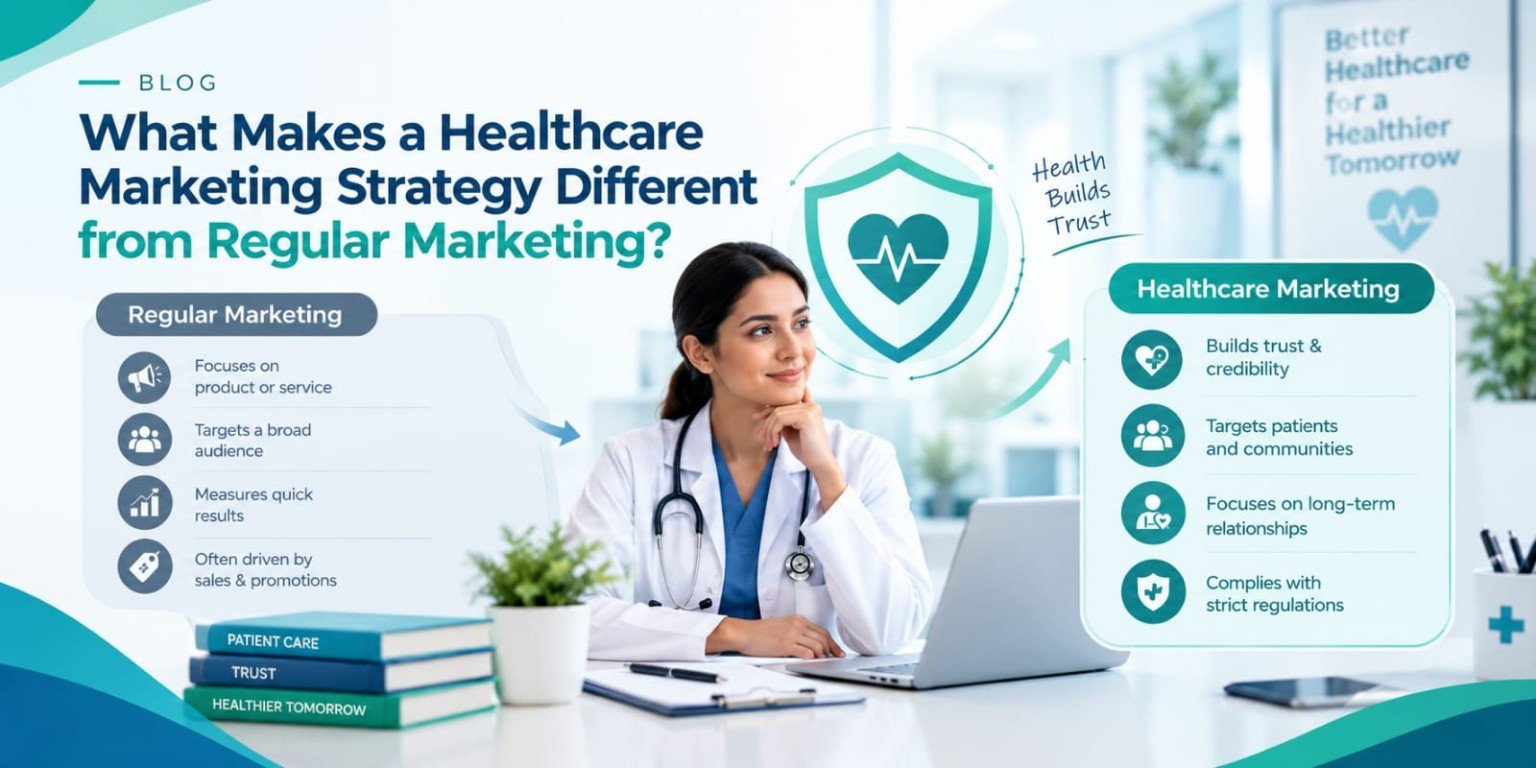
Marketing is used by almost every industry to attract attention, build awareness, generate enquiries, and grow a business. But the way marketing works can vary significantly depending on what a business offers.
Healthcare is one of the clearest examples.
A person choosing a restaurant may compare menus, prices, reviews, and location before making a decision. Someone looking for a healthcare provider may also compare reviews and location, but the decision can involve much more: medical information, professional qualifications, trust, privacy, service quality, and the seriousness of the healthcare need.
That is why healthcare marketing cannot simply copy strategies used for retail, hospitality, real estate, or other industries.
A healthcare marketing strategy needs to balance visibility with responsibility, communication with accuracy, and business objectives with patient needs.
For clinics, hospitals, diagnostic centres, specialty practices, and healthcare brands in India, this difference becomes particularly important as more people use digital channels to research healthcare services and providers.
What Is Healthcare Marketing?
Healthcare marketing is the process of communicating a healthcare organization’s services, expertise, facilities, and useful information to relevant audiences through appropriate channels.
It can include:
- Search engine optimization
- Healthcare content marketing
- Local SEO
- Social media marketing
- Paid advertising
- Website development
- Reputation management
- Doctor and specialist profiles
- Patient education
- Lead generation
- Email communication
- Analytics and conversion optimization
The purpose is not simply to promote a service.
A healthcare marketing strategy should help people find reliable information, understand available services, identify relevant providers, and decide when and how to contact the organization.
This creates a different marketing environment from many conventional industries.
Why Healthcare Marketing Is Different From Regular Marketing
The biggest difference is the nature of the decision being made.
Healthcare decisions can involve personal circumstances, sensitive information, medical concerns, and significant emotional or practical considerations.
This changes how a healthcare brand should approach:
- Content
- Advertising
- SEO
- Social media
- Reputation
- Lead generation
- Data collection
- Website communication
A strategy that focuses only on clicks, impressions, or sales can miss the broader requirements of healthcare marketing.
1. Trust Matters More Than Attention
In many industries, marketing starts by trying to capture attention.
Healthcare also needs attention, but attention alone is not enough.
A healthcare brand needs to communicate information in a way that helps people feel confident about exploring its services.
Trust can be influenced by:
- Professional website presentation
- Accurate information
- Doctor qualifications
- Clear service descriptions
- Genuine reviews
- Consistent business details
- Educational content
- Professional communication
This does not mean marketing should promise that a particular provider will deliver a specific medical outcome.
Instead, the digital presence should make relevant information easier to understand and verify.
This is one reason healthcare brands need a more careful approach to content and communication.
2. Healthcare Content Has Greater Responsibility
Content marketing is common across industries, but healthcare content carries additional responsibility because people may use it while making decisions about their health.
A generic marketing article can focus heavily on persuasion.
Healthcare content should focus much more on usefulness and accuracy.
For example, a healthcare article may explain:
- What a particular medical service involves
- What questions a patient may want to ask a specialist
- What a diagnostic test is generally used for
- What services a department provides
- What patients can expect from a consultation process
The content should avoid unsupported claims, exaggerated promises, fear-based messaging, and language that presents general information as personalized medical advice.
The Ministry of Health and Family Welfare’s digital-health materials also emphasize privacy, consent, confidentiality, and responsible handling of health information.
This makes editorial quality an important part of healthcare marketing.
3. Search Intent Is More Complex
Regular marketing may often focus on commercial searches such as:
“Buy running shoes online.”
Healthcare searches can happen at several stages.
A person may search:
“What is physiotherapy?”
Then:
“Physiotherapy benefits.”
Then:
“Physiotherapy clinic in Jaipur.”
And eventually:
“Physiotherapist near me.”
These searches represent different levels of intent.
A healthcare marketing strategy needs to understand this journey.
Informational Intent
The user wants to understand a topic.
Service Intent
The user is researching a particular healthcare service.
Provider Intent
The user is looking for a doctor, clinic, hospital, or specialist.
Local Intent
The user wants a healthcare provider in a specific area.
Action Intent
The user is ready to contact, enquire, or request an appointment.
Each stage may require different content and conversion options.
4. Healthcare SEO Requires More Than Keyword Optimization
SEO is important for both healthcare and non-healthcare businesses.
But healthcare SEO needs a broader approach because the website may contain medical information that users rely on during research.
Healthcare SEO can include:
- Technical SEO
- Search-intent research
- Service-page optimization
- Doctor profiles
- Department pages
- Healthcare content
- Local SEO
- Internal linking
- Website architecture
- FAQ content
- AEO
The goal should be to create useful pages that answer genuine search needs.
For example, a hospital should not create dozens of pages simply by replacing one city name with another.
A location page should provide meaningful information about the actual facility, services, and audience in that location.
5. Local SEO Has a Major Role
Healthcare services are often geographically connected.
Someone looking for a cardiologist, dentist, diagnostic centre, fertility clinic, physiotherapist, or hospital may specifically want a provider within a practical distance.
This makes local SEO particularly valuable.
Healthcare organizations should pay attention to:
- Google Business Profile
- Address accuracy
- Phone numbers
- Working hours
- Location pages
- Reviews
- Local search queries
- Maps visibility
- Local citations
The Indian healthcare system also places importance on structured information about healthcare facilities. The Clinical Establishments framework includes provisions around registration and digital records of clinical facilities.
For marketers, the practical takeaway is simple: healthcare businesses need accurate and consistent information wherever potential patients may encounter them online.
6. Reputation Can Directly Affect Consideration
Online reputation matters in most industries, but healthcare reputation can carry particular weight.
Before contacting a provider, people may look at:
- Google reviews
- Doctor profiles
- Website information
- Social media
- Patient feedback
- Facility information
- Online discussions
A healthcare brand therefore needs an active reputation management approach.
This can involve:
- Monitoring reviews
- Responding professionally
- Encouraging genuine feedback
- Identifying recurring service concerns
- Correcting inaccurate information
- Protecting patient privacy
Reputation management should not mean attempting to create an artificially perfect image.
Authentic feedback and professional responses provide a more sustainable approach.
7. Patient Privacy Changes How Data Should Be Handled
One of the most important differences between healthcare and many other industries is the sensitivity of health-related information.
A marketing team may collect basic enquiry information through forms, calls, appointment requests, or campaigns. But healthcare organizations should be especially careful about what information they collect, why they collect it, how it is stored, and who can access it.
Government healthcare privacy guidance emphasizes principles such as informed consent, purpose limitation, transparency, data minimization, privacy by design, and security safeguards.
This has practical implications for digital marketing.
For example, a healthcare enquiry form should not unnecessarily ask for sensitive information simply because the marketing team wants more data.
The marketing process should be designed around the minimum information needed for the stated purpose and applicable requirements.
8. Healthcare Advertising Needs Responsible Messaging
Advertising is designed to persuade people to take action.
Healthcare advertising still has that objective, but the messaging needs to be responsible.
Healthcare brands should be cautious with statements such as:
- Guaranteed results
- Absolute claims
- Fear-based messages
- Unsupported superiority claims
- Unrealistic recovery promises
- Misleading before-and-after communication
Instead, healthcare advertising can focus on factual information such as:
- Services offered
- Location
- Appointment options
- Specialist information
- Facilities
- Relevant healthcare programs
- General educational information
The goal is to make the advertisement informative enough for the audience to understand the offering without creating unrealistic expectations.
9. The Patient Journey Can Be Longer
Regular purchases can sometimes happen within minutes.
Healthcare decisions may take much longer.
A person might discover a healthcare provider today but contact it several days later.
During that period, they may:
- Read a blog.
- Visit a service page.
- Check a doctor profile.
- Search the brand name.
- Read reviews.
- Visit Google Maps.
- Return to the website.
- Make a call or request an appointment.
This means healthcare marketing should not judge every channel only by immediate conversions.
Some channels contribute earlier in the decision-making journey.
10. Doctors Are Often Part of the Brand
In many industries, the company itself is the primary brand.
Healthcare can be different.
Doctors, specialists, surgeons, departments, and clinical teams may all influence how people evaluate a healthcare organization.
That makes doctor profiles important digital assets.
A professional profile may include:
- Name
- Specialty
- Qualifications
- Relevant professional experience
- Areas of practice
- Associated location
- Consultation information
The information should be accurate and updated when necessary.
Doctor-focused SEO can also help users find relevant professionals through search.
11. Website Design Has a Different Purpose
A regular business website may prioritize product presentation, promotions, or direct sales.
A healthcare website needs to prioritize clarity and confidence.
A visitor may want to quickly find:
- Services
- Doctors
- Departments
- Locations
- Contact information
- Appointment options
- Facilities
- Frequently asked questions
The website should not make visitors work to find essential information.
A clear structure can improve both user experience and search visibility.
At World SEO Services , healthcare website strategy can be connected with SEO, content, local visibility, and conversion requirements instead of treating website development as a completely separate activity.
12. Social Media Should Educate, Not Only Promote
Social media marketing often focuses on engagement and promotion.
Healthcare brands can certainly promote services, but educational communication can be equally valuable.
Healthcare social media content can include:
- General health awareness
- Educational videos
- Doctor introductions
- Service explanations
- Frequently asked questions
- Facility information
- Awareness campaigns
- General wellness information
This approach can help healthcare organizations maintain a useful presence without turning every post into an advertisement.
Patient privacy should also be considered carefully when creating social media content involving real patients, medical situations, testimonials, or identifiable information.
13. Lead Generation Needs More Context
Generating leads is a common marketing objective.
But healthcare lead generation should not be judged only by volume.
Suppose a clinic receives 100 enquiries.
If most are outside the clinic’s location, unrelated to its services, or unable to proceed, the number 100 does not tell the complete story.
Healthcare marketers should therefore consider:
- Relevant enquiries
- Location relevance
- Service relevance
- Appointment requests
- Call quality
- Conversion to appointments
- Source of enquiries
This allows marketing teams to distinguish between activity and meaningful acquisition.
14. Analytics Should Measure the Whole Journey
A healthcare marketing report should go beyond impressions and clicks.
Depending on the organization’s objectives, useful metrics can include:
- Organic search traffic
- Local search visibility
- Service-page visits
- Doctor-profile visits
- Phone calls
- Form submissions
- Appointment requests
- Cost per lead
- Relevant lead rate
- Campaign conversion rate
The right metrics depend on the business model.
For example, a hospital may want to understand which departments generate online interest, while a specialist clinic may focus more heavily on consultation enquiries.
15. AEO Is Becoming Relevant to Healthcare Search
People are increasingly using conversational queries to find information.
Instead of entering only:
“dermatologist Jaipur”
a user may ask:
“What should I consider when choosing a dermatologist in Jaipur?”
This means healthcare websites can benefit from content structured around real questions.
Answer Engine Optimization can include:
- Question-based headings
- Direct answers
- Clear definitions
- Concise explanations
- FAQ sections
- Structured information
- Natural language
The objective is to make information easy for users and modern search systems to understand.
AEO should complement traditional SEO rather than replace it.
16. Healthcare Marketing Must Balance Growth With Ethics
Every marketing strategy has a commercial objective.
Healthcare organizations also need growth, visibility, and patient acquisition.
But healthcare marketing should maintain an appropriate balance between commercial goals and responsible communication.
This means avoiding:
- Misleading claims
- Unnecessary fear
- False urgency
- Unsupported medical promises
- Manipulative messaging
- Misuse of patient information
The Ministry of Health and Family Welfare’s digital-health privacy guidance highlights the importance of clear communication, consent, purpose limitation, and security when personal information is handled.
Responsible marketing is therefore not separate from good healthcare marketing. It is part of building a sustainable digital presence.
17. Healthcare Marketing Requires Cross-Functional Coordination
Another difference is that healthcare marketing cannot always operate independently.
Marketing teams may need information from:
- Doctors
- Hospital administration
- Front-desk teams
- Patient support teams
- IT teams
- Compliance or legal teams
- Management
For example, a marketing team cannot responsibly create a detailed service page without confirming the actual service information.
Similarly, a campaign promising a particular appointment process needs to match what the hospital’s operational team can actually provide.
Better coordination helps prevent inaccurate information from reaching patients.
18. Why Generic Marketing Strategies Often Fall Short
A generic marketing strategy may focus on:
Traffic → Leads → Sales
Healthcare requires a broader framework:
Discovery → Information → Trust → Evaluation → Enquiry → Appointment → Experience → Reputation
This does not mean traditional marketing techniques have no place in healthcare.
SEO, PPC, social media, branding, conversion optimization, and analytics can all be useful.
The difference is how these tools are applied.
The healthcare context changes the messaging, content standards, audience journey, data considerations, and trust requirements.
Healthcare Marketing vs Regular Marketing: Key Differences
The differences can be understood through several practical areas.
Audience
Regular marketing may target consumers based on interests, demographics, or purchasing behaviour.
Healthcare marketing also considers health-related search intent, location, specialty, and the information needs of potential patients.
Content
Regular marketing can be strongly promotional.
Healthcare content needs greater emphasis on accuracy, usefulness, and responsible communication.
Trust
Trust matters across industries, but healthcare decisions often require a deeper level of confidence.
Privacy
Healthcare marketing may interact with sensitive personal or health-related information, making responsible data handling particularly important.
Conversion
A conversion may not simply mean a purchase. It could be an enquiry, call, appointment request, or other appropriate action.
Reputation
Reviews and professional credibility can play an important role in healthcare provider selection.
Local Search
Location is often highly relevant because healthcare services are delivered at specific facilities or by professionals in particular areas.
How a Healthcare Marketing Agency Can Approach These Differences
A healthcare marketing agency needs to understand both marketing fundamentals and the specific environment in which healthcare organizations operate.
When evaluating a Top Healthcare Marketing Agency in India, healthcare businesses can look at factors such as:
- Healthcare industry experience
- SEO capabilities
- Content quality
- Local SEO expertise
- Website development
- PPC management
- Reputation management
- Lead-generation systems
- Analytics and reporting
- AEO understanding
- Data-handling awareness
- Communication process
Rather than selecting a marketing partner based only on broad claims, healthcare organizations can review the actual strategy, deliverables, reporting process, and relevant experience being offered.
How World SEO Services Can Support Healthcare Marketing
At World SEO Services, healthcare marketing can be approached as a combination of visibility, information, trust, and measurable digital performance.
Depending on the organization’s needs, this may include:
- Healthcare SEO
- Healthcare content marketing
- Local SEO
- Website optimization
- Social media marketing
- PPC advertising
- Reputation management
- Lead generation
- Conversion optimization
- AEO
- Analytics and reporting
The strategy can be adapted for hospitals, clinics, diagnostic centres, specialty practices, and other healthcare organizations.
For example, a local clinic may need stronger local search visibility and appointment-focused website optimization, while a multi-specialty hospital may require a larger content structure covering departments, doctors, services, and multiple locations.
The important point is that healthcare marketing should be built around the organization’s actual audience, services, location, and goals rather than applying the same campaign structure everywhere.
A Practical Framework for Healthcare Marketing
Healthcare organizations can use five broad stages when planning their digital strategy.
1. Understand
Identify the audience, services, locations, competitors, and common search questions.
2. Inform
Create useful website pages, educational content, FAQs, and specialist information.
3. Build Trust
Maintain accurate information, professional presentation, genuine reviews, and responsible communication.
4. Connect
Use SEO, local search, social media, PPC, and other relevant channels to reach the intended audience.
5. Measure
Track meaningful actions such as enquiries, calls, appointment requests, lead quality, and channel performance.
This framework keeps marketing focused on the complete healthcare journey rather than only short-term visibility.
Common Mistakes in Healthcare Marketing
Healthcare brands should be careful about several common mistakes.
Treating Healthcare Like Any Other Industry
Using generic promotional strategies without considering healthcare-specific trust and information requirements can weaken the digital experience.
Overusing Medical Keywords
Keyword stuffing can make healthcare content difficult to read and reduce its usefulness.
Making Unsupported Claims
Promises about guaranteed outcomes can create unrealistic expectations and undermine credibility.
Ignoring Local SEO
A clinic may have a strong website but still miss nearby searches if its local presence is poorly managed.
Collecting Unnecessary Information
Marketing forms should not request sensitive information without a clear reason and appropriate handling process.
Focusing Only on Lead Volume
A large number of irrelevant enquiries does not necessarily represent successful patient acquisition.
Publishing Without Expert Review
Healthcare content should be checked for accuracy and relevance before publication, particularly when it discusses medical topics.
Conclusion
Healthcare marketing is different from regular marketing because the product being communicated is connected to people’s health, wellbeing, and personal circumstances.
The strategy therefore needs to go beyond attention and lead generation.
Healthcare brands need accurate information, responsible content, strong search visibility, local discovery, professional websites, credible doctor profiles, reputation management, careful data handling, and a patient-focused conversion journey.
SEO, PPC, social media, content marketing, and analytics can all play important roles. But their application should reflect the specific nature of healthcare.
For organizations working with World SEO Services, the focus can be on developing an integrated healthcare marketing strategy that connects search visibility, useful information, local presence, reputation, website experience, lead generation, and measurable performance.
A healthcare marketing strategy does not need to be complicated for the sake of being complicated. It needs to be relevant, responsible, useful, and aligned with how people actually research healthcare services.
That is the fundamental difference between simply marketing a healthcare business and building a healthcare marketing strategy.
FAQs
1. How is healthcare marketing different from regular marketing?
Healthcare marketing has many of the same tools as regular marketing, including SEO, PPC, content, social media, and websites. The difference is that healthcare requires greater attention to trust, medical information accuracy, patient privacy, reputation, and the longer decision-making journey.
2. Why is trust so important in healthcare marketing?
People may consider professional qualifications, service information, reviews, reputation, and the quality of information available before contacting a healthcare provider. Clear and accurate communication can therefore play an important role in the evaluation process.
3. Is SEO important for healthcare marketing?
Yes. Healthcare SEO can help clinics, hospitals, specialists, and other healthcare organizations become visible for relevant informational, service, provider, and local searches. It should focus on useful content and search intent rather than keyword repetition.
4. What type of content should healthcare brands publish?
Healthcare brands can publish educational articles, service explainers, FAQs, doctor information, department guides, general awareness content, and location-specific information. Content should be accurate, useful, responsible, and appropriate for the intended audience.
5. How can a healthcare marketing agency help a clinic or hospital?
A healthcare marketing agency can support areas such as SEO, healthcare content, local SEO, website optimization, PPC, social media, reputation management, lead generation, AEO, and analytics. The specific services should be selected according to the healthcare organization’s goals, audience, services, and locations.