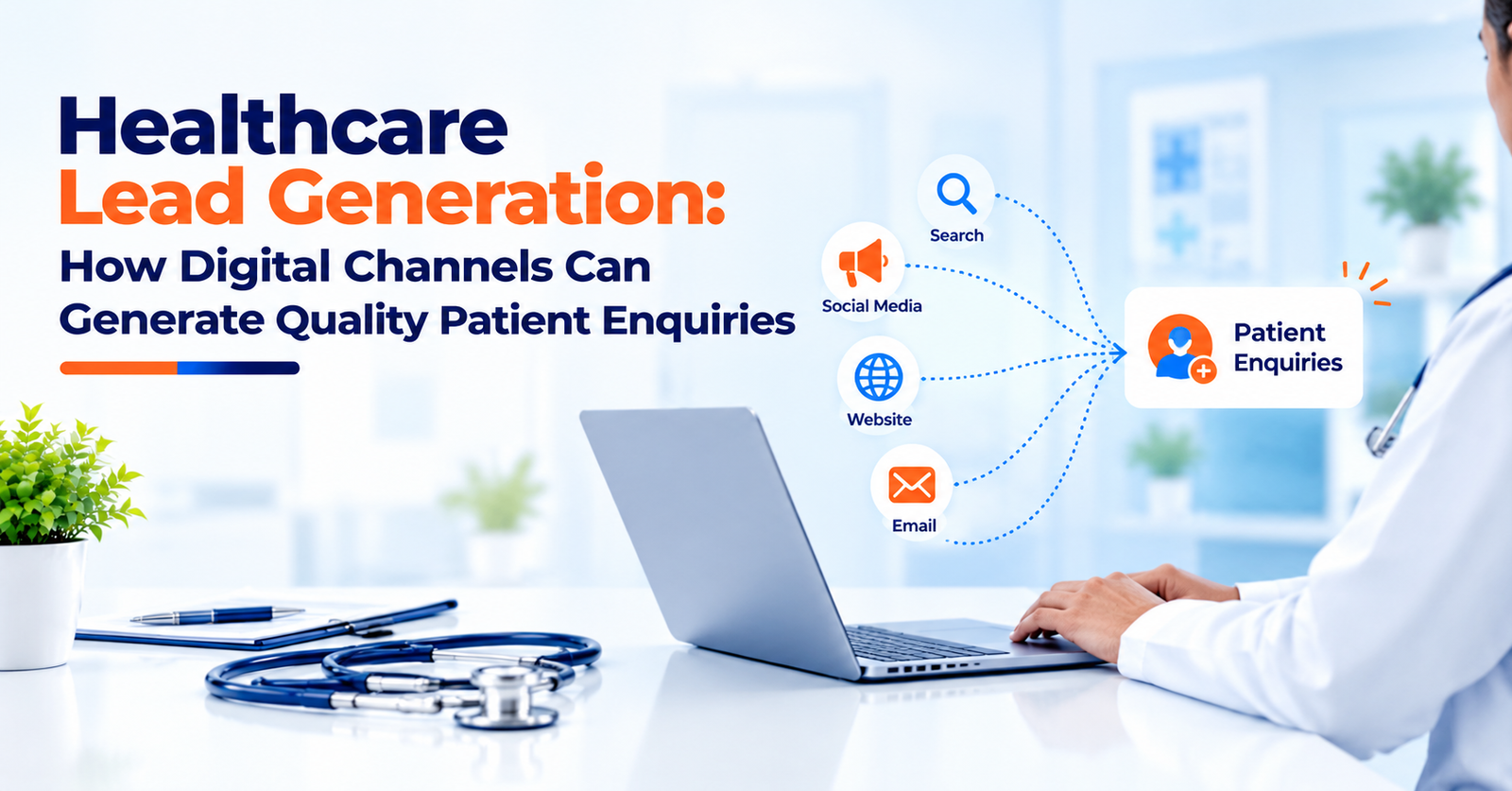
For hospitals, clinics, diagnostic centres, and other healthcare organisations, attracting people to a website is only one part of digital marketing. The next challenge is helping interested visitors take a meaningful step, such as requesting appointment information, contacting a clinic, or enquiring about an available medical service.
This is where healthcare lead generation becomes important. A structured strategy helps healthcare businesses connect their digital marketing activities with relevant patient enquiries while making it easier for people to find accurate information about available services.
However, generating a large number of enquiries does not automatically mean a campaign is successful. Some enquiries may be unrelated to the clinic’s services, some people may only be researching, and others may need more information before deciding whether to contact a provider.
Healthcare businesses therefore need to focus on lead quality, relevant communication, patient privacy, and measurable outcomes rather than simply increasing enquiry volume.
This guide explores how digital channels can support healthcare lead generation, how to improve the quality of incoming enquiries, and how to build a responsible process for turning online interest into meaningful patient interactions.
What Is Healthcare Lead Generation?
Healthcare lead generation is the process of attracting people who may be interested in a healthcare service and providing appropriate ways for them to make an enquiry.
Depending on the organisation and its services, an enquiry may involve requesting appointment information, asking about consultation availability, contacting a diagnostic centre, or seeking details about a hospital department.
Digital lead generation uses online channels to connect potential patients with relevant information and suitable contact options.
Common channels include:
- Search engine optimisation (SEO).
- Google Business Profile and local SEO.
- Google Ads and other permitted paid advertising.
- Healthcare content marketing and blogging.
- Social media marketing.
- Healthcare websites and landing pages.
- Email communication with appropriate consent.
- Calls, contact forms, and other enquiry channels.
The most suitable combination depends on the healthcare organisation’s services, audience, location, marketing objectives, and applicable advertising requirements.
Why Quality Matters More Than Lead Volume
A campaign may generate hundreds of enquiries but still perform poorly if most enquiries are irrelevant, incomplete, or unrelated to the services being promoted.
For example, a fertility centre may receive enquiries from people looking for services it does not provide. A diagnostic laboratory may attract visitors searching for general medical information rather than testing services.
These enquiries can consume staff time without contributing meaningfully to the organisation’s objectives.
A quality-focused approach evaluates whether an enquiry is relevant to the service, comes through an appropriate contact channel, and contains enough information for the organisation to respond appropriately.
What Makes a Healthcare Enquiry Relevant?
A useful enquiry may indicate that:
- The person is asking about a service the organisation actually provides.
- The enquiry relates to the correct location or department.
- The person has requested information or contact.
- The contact details are sufficient for an appropriate response.
- The enquiry can be handled within the organisation’s available services and processes.
A person does not need to book an appointment immediately to be considered a relevant enquiry. Some people need general information before deciding what to do next.
Healthcare marketers should avoid treating medical details or a person’s health status as ordinary marketing qualification data. Collect only the information necessary for the requested interaction and handle it through appropriate privacy and security safeguards.
1. Use Healthcare SEO to Attract Relevant Search Traffic
Search engine optimisation helps healthcare websites appear for relevant searches when people look for medical services or healthcare information.
For example, someone searching for a dental clinic in Jaipur may be looking for a provider they can contact. Someone searching for information about a dental procedure may still be in the research stage.
An effective SEO strategy addresses different types of search intent without assuming that every website visitor is ready to make an appointment.
Key SEO Activities for Healthcare Lead Generation
- Target relevant keywords: Research terms related to the organisation’s genuine services, specialities, and locations.
- Optimise service pages: Explain what each service involves, where it is available, and how visitors can obtain further information.
- Improve local search visibility: Maintain accurate Google Business Profile information and create useful location pages where appropriate.
- Publish educational content: Answer common questions through clear, accurate, and appropriately reviewed healthcare information.
- Improve technical SEO: Make important pages accessible, mobile-friendly, and easy to navigate.
Organic search can support sustainable discovery over time, although rankings and traffic levels cannot be guaranteed. SEO should be evaluated through relevant traffic, enquiries, and the usefulness of the information provided.
2. Use Google Ads to Reach Relevant Searchers
Paid search advertising can help healthcare organisations reach people searching for relevant services. Depending on the service, location, and campaign setup, ads may direct visitors to a service page, an information page, or an appropriate contact option.
For example, a clinic may advertise an eligible consultation service to people searching for that service in its operating area.
How to Improve Healthcare PPC Campaigns
- Group campaigns around relevant services and search intent.
- Use clear, accurate ad copy.
- Direct visitors to relevant landing pages.
- Monitor search terms and exclude irrelevant traffic where appropriate.
- Track meaningful enquiry actions.
- Review campaign spending and enquiry quality regularly.
Healthcare advertising requires particular attention to platform policies and applicable regulations. Some healthcare-related content may be prohibited, while other categories may be restricted by location or require additional approval.
Before launching campaigns, healthcare businesses should check the rules that apply to their specific services, advertising location, and landing pages. An advertisement being eligible to run does not automatically mean every claim or promotional approach is appropriate under local professional regulations.
3. Optimise Healthcare Landing Pages for Enquiries
A landing page is often where a visitor decides whether to contact a healthcare organisation or continue searching elsewhere.
Even when an advertising campaign attracts relevant traffic, an unclear landing page can prevent visitors from finding the information they need.
A useful healthcare landing page should communicate the service clearly and provide a straightforward path to further information.
Essential Landing Page Elements
- Clear service information: Explain the relevant speciality or service in plain language.
- Location details: Display the correct clinic address and indicate where the service is available.
- Contact options: Provide working phone numbers, appropriate enquiry forms, or other suitable contact methods.
- Professional information: Present accurate information about the organisation and relevant practitioners.
- Mobile-friendly design: Make text readable, buttons easy to use, and navigation simple on smaller screens.
- Trustworthy content: Avoid unsupported claims, misleading comparisons, and guaranteed treatment outcomes.
Keep Enquiry Forms Simple
Long forms can create unnecessary friction. Ask only for information required to respond to the enquiry.
For an initial general enquiry, a name and preferred contact method may be sufficient. More detailed information should be collected only when necessary and through an appropriate process.
Avoid requesting detailed medical histories, diagnoses, or other sensitive health information through ordinary marketing forms unless there is a justified need and suitable safeguards are in place.
4. Use Google Business Profile and Local SEO
For healthcare businesses serving specific geographical areas, local SEO can help connect nearby searchers with relevant services.
Google Business Profile allows eligible organisations to manage information displayed on Google Search and Google Maps. Accurate details can help people identify the correct clinic and find practical information before contacting it.
Local Lead Generation Activities
- Maintain the correct business name, address, and contact number.
- Choose relevant business categories.
- Keep opening hours updated.
- Link to the correct website or location page.
- Ensure available services are represented accurately.
- Monitor available profile performance data.
- Make it easy for visitors to find the appropriate contact details.
Local search visibility does not guarantee enquiries. However, accurate information and a useful local presence can reduce the effort required for people to discover and contact the organisation.
5. Use Healthcare Content Marketing to Build Interest
Not every potential patient is ready to contact a healthcare provider immediately. Some people need reliable information to understand a service, prepare for a consultation, or decide which questions to ask.
Content marketing can support this research process by providing helpful information before a person makes an enquiry.
Useful Healthcare Content Formats
- Educational blog articles.
- Frequently asked questions about available services.
- Doctor and department information.
- Guides explaining what to expect during a consultation.
- General explanations of diagnostic procedures.
- Informational videos.
- Service-specific guides and downloadable resources, where appropriate.
For example, a diagnostic centre could publish a general guide explaining how patients can prepare for a particular test, provided the information is accurate and appropriately reviewed.
Content should inform rather than pressure readers into seeking unnecessary services. Medical information should be presented responsibly, with suitable professional review when required.
Useful content can contribute to organic visibility and help visitors understand whether a service is relevant to their needs.
6. Use Social Media to Direct People to Relevant Information
Social media can help healthcare organisations distribute educational content, share operational updates, and make relevant service information easier to discover.
Platforms such as Instagram, Facebook, and YouTube may support different communication formats depending on the audience and the nature of the organisation.
Social Media Lead Generation Practices
- Publish useful information: Share educational content that accurately represents the organisation’s services.
- Maintain consistent branding: Keep contact details and business information consistent across relevant profiles.
- Provide appropriate contact options: Direct interested users to a suitable website page or official enquiry channel.
- Respond professionally: Ensure public comments and direct messages are handled respectfully.
- Monitor relevant actions: Track website visits and legitimate enquiries where appropriate.
Social media should not be used to pressure people into medical decisions or make exaggerated claims about treatment outcomes. Healthcare businesses should also avoid encouraging people to share private health information in public comments or unsecured direct messages.
7. Build a Responsible Follow-Up Process
Generating an enquiry is only the beginning of the communication process. A clear follow-up system helps healthcare organisations respond consistently and avoid leaving legitimate requests unanswered.
A Practical Enquiry Management Process
- Receive the enquiry: Capture it through the relevant website form, phone call, or approved communication channel.
- Identify the requested service: Determine which department or contact team should handle the request.
- Respond appropriately: Provide the information requested or explain the next administrative step.
- Record the outcome: Track whether the enquiry was answered, redirected, or resolved.
- Follow up when appropriate: Contact the person again only when justified and consistent with their preferences and applicable consent requirements.
For example, if someone requests information about consultation timings, the clinic can provide the relevant schedule and explain how to request an appointment.
Follow-up communication should be relevant to the original request. Permission to respond to an enquiry should not automatically be treated as permission to send unrelated promotional messages indefinitely.
Healthcare businesses should establish clear rules for access, data retention, and handling sensitive information.
8. Use CRM Systems to Organise Enquiries
A customer relationship management (CRM) system can help healthcare organisations manage enquiries from different digital channels in one place.
Depending on the organisation’s needs and privacy requirements, a CRM may support administrative activities such as assigning enquiries, tracking response times, and identifying unresolved requests.
Useful CRM Capabilities
- Recording the source of an enquiry.
- Assigning requests to the appropriate team.
- Tracking response and resolution status.
- Identifying duplicate or incomplete contact records.
- Monitoring administrative follow-up.
- Producing aggregate performance reports.
Healthcare businesses should choose systems appropriate to the sensitivity of the information they handle. Access controls, security measures, retention policies, and applicable privacy requirements should be considered before storing personal information.
Avoid collecting unnecessary medical details simply to improve marketing reports. Aggregate campaign data is often sufficient for evaluating channel performance.
9. Measure Healthcare Lead Generation Performance
A lead generation strategy should be evaluated using metrics that reflect both marketing efficiency and the relevance of incoming enquiries.
Important Metrics to Track
- Enquiry volume: The number of enquiries received through a particular channel.
- Qualified enquiry rate: The proportion of enquiries that are relevant to the service and can appropriately be handled by the organisation.
- Cost per enquiry: The marketing cost associated with generating an enquiry through a particular campaign or channel.
- Cost per qualified enquiry: The campaign cost divided by the number of relevant enquiries, where reliable data is available.
- Response time: How quickly the organisation responds to incoming requests.
- Enquiry-to-appointment rate: The proportion of relevant enquiries that proceed to an appointment, where this can be measured appropriately.
- Channel performance: How SEO, paid search, local search, and other channels contribute to relevant enquiries.
- Website conversion rate: The proportion of eligible website visits that result in a defined enquiry action.
These metrics should be interpreted in context. A lower cost per enquiry is not necessarily better if the enquiries are irrelevant or the campaign attracts the wrong audience.
Healthcare organisations should also avoid making unsupported claims about patient acquisition or treatment outcomes based solely on marketing data.
10. Protect Patient Privacy and Follow Advertising Requirements
Healthcare lead generation involves additional responsibilities because enquiries may reveal sensitive personal or health-related information.
Marketing teams should collect only the information needed for a legitimate purpose, explain how contact information will be used, and apply suitable security and access controls.
They should also review applicable data protection requirements and relevant professional advertising rules before launching campaigns.
Advertising platforms may restrict certain medical services, keywords, audience-targeting approaches, or landing-page content. Requirements can vary by service and location, so campaign eligibility should be checked before launch.
In India, healthcare organisations should also review current professional and institutional advertising requirements applicable to their activities. Rules concerning claims, testimonials, inducements, and promotional content may differ according to the type of organisation and service.
A responsible strategy prioritises factual communication, appropriate consent, and respect for people’s healthcare decisions.
Common Healthcare Lead Generation Mistakes
Healthcare businesses can lose valuable opportunities when their digital marketing and enquiry management processes are poorly aligned.
Common mistakes include:
- Focusing only on enquiry volume: Ignoring whether enquiries are relevant to the service.
- Using generic landing pages: Sending all campaign traffic to a homepage that does not address the searcher’s needs.
- Making exaggerated claims: Using unsupported promises or misleading medical statements.
- Collecting excessive information: Requesting sensitive details that are unnecessary for an initial enquiry.
- Neglecting follow-up: Leaving incoming requests unanswered or routing them to the wrong team.
- Ignoring mobile users: Making phone numbers, forms, or service details difficult to access.
- Tracking incomplete metrics: Measuring clicks without evaluating meaningful enquiry actions.
- Overlooking platform policies: Launching campaigns without checking healthcare advertising restrictions.
Addressing these issues helps create a more consistent experience from the first online interaction through the initial enquiry.
How World SEO Services Can Support Healthcare Lead Generation
Healthcare lead generation requires a coordinated strategy that connects digital visibility, relevant website content, suitable advertising, and effective enquiry management.
As a healthcare-focused digital marketing agency, World SEO Services can support healthcare businesses with digital activities designed around their services, locations, and marketing objectives.
Potential areas of support include:
- Healthcare SEO and local search optimisation.
- Google Business Profile optimisation.
- Google Ads campaign planning, subject to applicable policies.
- Healthcare landing page and website optimisation.
- Content marketing strategy.
- Social media marketing.
- Conversion tracking and performance reporting.
- Enquiry funnel analysis and improvement recommendations.
The objective is to help healthcare organisations attract relevant online attention, provide clear service information, and make appropriate contact options easier to access.
The right strategy depends on the organisation’s audience, competition, website, advertising eligibility, and operational capacity. Results should be measured over time, and no specific enquiry volume, cost, or conversion rate can be guaranteed.
Conclusion
Healthcare lead generation is most effective when digital marketing channels work together to attract relevant visitors, provide trustworthy information, and make it easy to enquire about appropriate services.
SEO, local search, permitted paid advertising, content marketing, social media, and well-designed landing pages can each contribute to this process. Clear enquiry management, privacy-conscious data handling, and meaningful performance measurement help ensure that the strategy focuses on quality rather than volume alone.
By combining these activities with accurate communication and responsible follow-up, healthcare organisations can build a more structured digital enquiry process.
World SEO Services can help healthcare businesses develop a coordinated digital marketing approach that supports relevant patient enquiries while keeping accuracy, trust, and responsible communication at the centre of the strategy.
FAQs
1. What is healthcare lead generation?
Healthcare lead generation is the process of attracting people interested in a healthcare service and providing appropriate ways for them to make an enquiry. It can involve SEO, local search, permitted paid advertising, content marketing, social media, and website contact forms.
2. Which digital channel is best for healthcare lead generation?
The best channel depends on the service, audience, location, competition, and marketing objective. SEO can support long-term organic discovery, paid search may reach people with relevant search intent, and content or social media can help people find useful information before making an enquiry.
3. How can healthcare businesses improve lead quality?
Healthcare businesses can improve lead quality by targeting relevant search intent, creating service-specific landing pages, providing accurate information, making contact options clear, and evaluating whether enquiries relate to services the organisation actually provides.
4. Which metrics should healthcare businesses track for lead generation?
Useful metrics include enquiry volume, qualified enquiry rate, cost per enquiry, cost per qualified enquiry, response time, website conversion rate, and enquiry-to-appointment rate where appropriate. These measures should be interpreted alongside privacy requirements and the quality of incoming enquiries.
5. Why is patient privacy important in healthcare lead generation?
Healthcare enquiries may contain personal or sensitive information. Organisations should collect only necessary data, explain how contact information will be used, apply appropriate security controls, and follow applicable privacy and advertising requirements when managing enquiries or conducting follow-up communication.