The way people search for healthcare information is changing. Patients still use search engines to find hospitals, doctors, clinics, and treatment information, but they are also asking questions through AI-powered tools and looking for direct answers instead of browsing multiple websites.
For healthcare marketing teams, this change raises an important question: should they focus on traditional search engine optimisation (SEO), Answer Engine Optimisation (AEO), or Generative Engine Optimisation (GEO)?
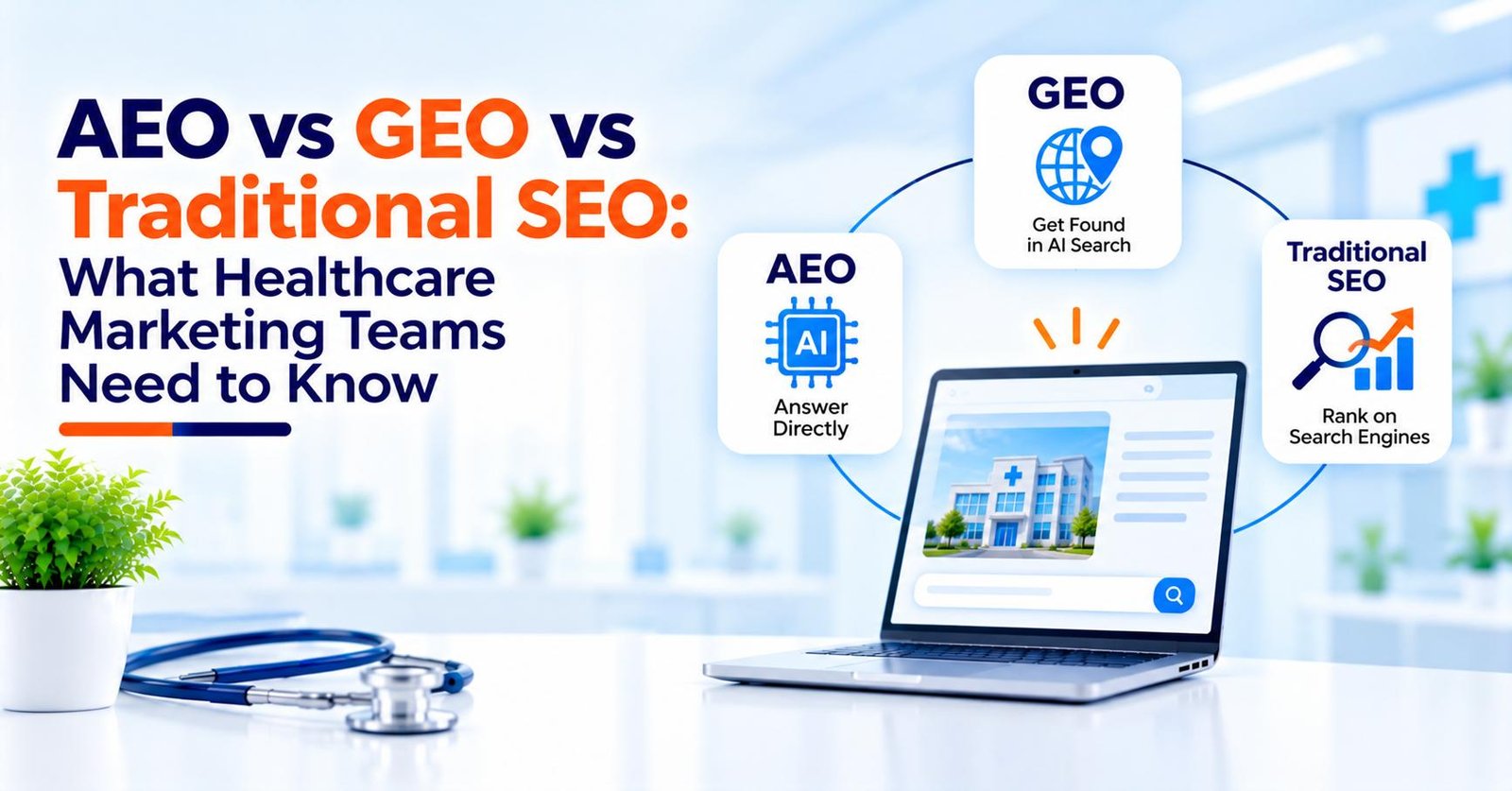
The answer is that each approach serves a different purpose, and all three can contribute to a well-rounded digital marketing strategy. Traditional SEO helps healthcare websites become discoverable in search results. AEO focuses on making information easy for search systems to understand and present as direct answers. GEO focuses on improving the clarity, credibility, and usefulness of content so that AI-powered search experiences can understand and potentially reference it.
At World SEO Services, we recognise that healthcare organisations need a search strategy that goes beyond rankings alone. Effective Healthcare SEO Services in India can combine technical optimisation, trustworthy medical content, clear answers to patient questions, and a strong online presence to help healthcare brands remain discoverable across different search experiences.
In this guide, we will explain the differences between SEO, AEO, and GEO, how they work together, and what healthcare marketing teams should prioritise.
What Is Traditional SEO in Healthcare?
Traditional SEO is the process of improving a website’s visibility in organic search engine results. It helps search engines discover, crawl, understand, and evaluate website content so that relevant pages can appear for suitable search queries.
For a hospital, clinic, or specialist, traditional SEO can help people find information about services, doctors, locations, and medical conditions.
For example, a person searching for “cardiology clinic in Jaipur” may see relevant clinic pages, local business listings, directories, and other resources in the results.
A healthcare SEO strategy generally includes the following activities:
- Keyword research: Understanding what patients and healthcare decision-makers search for.
- On-page SEO: Improving titles, headings, page content, and internal navigation.
- Technical SEO: Ensuring that pages can be crawled, indexed, and accessed efficiently.
- Local SEO: Improving visibility for location-based searches.
- Content development: Publishing accurate, relevant, and useful healthcare information.
- Website performance: Improving mobile usability, loading speed, and navigation.
- Reputation and authority: Building a credible online presence through legitimate references and professional information.
Traditional SEO remains important because search engines still provide a major route through which people discover healthcare services and educational resources.
However, rankings are only one part of the picture. Search experiences may also display maps, featured snippets, knowledge panels, or AI-generated summaries. This is where AEO and GEO become relevant.
What Is Answer Engine Optimisation (AEO)?
Answer Engine Optimisation, or AEO, focuses on making website content clear, direct, and well structured so that search systems and answer-oriented platforms can understand it and potentially use it to answer a question.
Rather than focusing only on whether a page ranks for a broad keyword, AEO considers whether the page provides a useful answer to a specific question.
For example, a healthcare website might address questions such as:
- What does a cardiologist treat?
- When should someone seek medical advice for persistent knee pain?
- What happens during a routine dental consultation?
- How can a patient prepare for a diagnostic appointment?
AEO encourages healthcare teams to organise content around real questions and provide understandable answers.
Key elements of AEO
1. Direct answers
Start relevant sections with a concise answer before expanding on the details. This helps readers understand the main point quickly.
2. Question-based headings
Use headings that reflect genuine questions people may ask. For example, “What Happens During an Eye Examination?” is more specific than a generic heading such as “Our Services.”
3. Clear content structure
Use descriptive headings, short paragraphs, lists, and logical sections. These elements help both readers and automated systems understand the relationship between topics.
4. Helpful FAQs
Answer common questions accurately. FAQs should address real information needs rather than simply repeat keywords.
5. Structured data where appropriate
Relevant schema markup can help search engines interpret information about an organisation, physician, or other eligible entity. Structured data must accurately represent visible page content and does not guarantee special search-result features.
For healthcare organisations, AEO is particularly useful when explaining medical services, appointment procedures, treatment basics, and general health topics. Medical information should be reviewed appropriately, with individual diagnosis and treatment decisions left to qualified healthcare professionals.
What Is Generative Engine Optimisation (GEO)?
Generative Engine Optimisation, or GEO, refers to improving content and a website’s broader information quality so that generative AI search experiences can understand, summarise, and potentially reference the information.
Some AI-powered search experiences generate responses by combining information from multiple sources. Instead of presenting only a list of traditional links, they may provide a summary with supporting references.
For healthcare brands, this creates another way for people to encounter medical information and learn about providers. However, inclusion in AI-generated answers is not guaranteed, and the methods used by different platforms can vary.
GEO focuses on making information clear, reliable, distinctive, and easy to verify.
Key elements of GEO
1. Evidence-based healthcare content
Publish accurate explanations that are supported by reliable medical sources where appropriate. Avoid unsupported statistics, sensational claims, and unverified treatment promises.
2. Clear and specific information
Explain medical concepts, services, and processes in straightforward language. Avoid vague statements that provide little practical value.
3. Demonstrable expertise
Provide relevant author or reviewer details, professional qualifications, review dates, and appropriate references. These details help readers assess the credibility of healthcare information.
4. Original insights
Go beyond generic definitions by addressing practical questions, explaining processes, or presenting useful information that reflects the organisation’s genuine expertise.
5. Consistent organisation information
Maintain accurate details about the healthcare organisation, its services, doctors, and locations across its website and relevant external profiles.
6. Accessible technical foundations
Ensure important content is available in a format that search systems can access and interpret. Useful headings, descriptive page titles, crawlable links, and sound technical SEO remain valuable.
GEO should not be treated as a collection of tricks for forcing an AI system to mention a brand. A more sustainable approach is to publish genuinely useful content and maintain a trustworthy, technically accessible website.
AEO vs GEO vs Traditional SEO: Key Differences
Although the three approaches overlap, their primary emphasis differs.
Traditional SEO: Improve search visibility
Traditional SEO focuses on helping relevant pages appear in organic search results. Its work includes keyword targeting, technical accessibility, content quality, internal linking, and other established optimisation practices.
A healthcare team might use it to improve the visibility of a hospital’s cardiology service page for relevant search terms.
AEO: Make answers easier to understand
AEO focuses on providing direct, well-structured responses to questions. It can support search features and answer-oriented experiences that surface concise information.
A healthcare team might use it to explain what happens during a cardiology consultation in a clear question-and-answer format.
GEO: Improve the usefulness of content in AI-generated search
GEO focuses on making content understandable, credible, distinctive, and potentially useful to generative AI systems.
A healthcare team might publish a medically reviewed guide explaining how a particular diagnostic process works, including its purpose, general stages, limitations, and questions patients can discuss with their doctor.
The distinction is not absolute. A single well-researched service page may support all three approaches when it is technically sound, directly answers patient questions, and provides trustworthy information.
Why Healthcare Marketing Teams Need All Three
Healthcare is a high-trust industry. People may use online information when researching symptoms, comparing providers, or preparing for an appointment. They need content that is easy to find, understandable, and medically responsible.
Using SEO, AEO, and GEO together can help healthcare organisations build a more complete search strategy.
1. Patients use different search methods
One person may type a service keyword into a search engine, while another may ask a conversational question or use an AI-powered search tool.
A strategy that supports different search behaviours can make useful healthcare information accessible through multiple discovery paths.
2. Healthcare searches require clear answers
People often have practical questions before contacting a clinic. Clear service pages, appointment instructions, and medically reviewed educational content can help address these questions.
AEO encourages healthcare teams to answer relevant questions directly, while traditional SEO helps people discover those pages.
3. Trust matters as much as visibility
Medical information can influence decisions about health and care. Content should be accurate, appropriately sourced, transparent about its limitations, and reviewed by qualified professionals when necessary.
GEO reinforces the value of clear, credible information, while traditional SEO and AEO help make that information accessible and understandable.
4. Search performance involves more than rankings
Organic clicks remain important, but healthcare teams may also need to evaluate qualified enquiries, appointment requests, local visibility, and referral traffic from different discovery channels.
The right measurement approach depends on the platform and the data available. AI visibility can be difficult to measure consistently, so teams should avoid relying on a single tool or an isolated AI mention.
How to Build a Combined SEO, AEO, and GEO Strategy for Healthcare
Healthcare marketing teams do not necessarily need three separate content strategies. In many cases, one coordinated approach can support all three objectives.
Step 1: Understand the audience’s search intent
Start by identifying what the audience wants to accomplish.
For a hospital, search intent may include finding a nearby specialist, understanding a medical procedure, checking consultation details, or learning about diagnostic services.
Group queries into useful categories:
- Service searches: People looking for a particular medical service.
- Informational searches: People seeking general health information.
- Local searches: People looking for healthcare providers in a specific area.
- Appointment-related searches: People who want to contact or visit a provider.
This helps the team choose the right page type and avoid forcing every keyword onto the same page.
Step 2: Strengthen important service pages
Each major service should have a page that explains the offering clearly.
Include the relevant department or treatment information, verified doctor details where appropriate, location and contact information, and a clear next step for visitors.
Avoid creating multiple pages that differ only by city name or minor keyword changes. Location-specific pages should provide genuinely useful and accurate information about the service available in each location.
Step 3: Create useful question-led content
Identify recurring questions from search data, patient enquiries, and conversations with the healthcare team.
Develop content that answers these questions directly and expands on the details readers need to understand the topic.
For example, an article about preparing for a diagnostic test could explain the test’s purpose, general preparation steps, and why instructions may vary. Any medical guidance should be checked by an appropriately qualified professional.
This structure can support AEO while giving traditional SEO a useful, relevant page to work with.
Step 4: Demonstrate medical credibility
Healthcare content should clearly communicate who created or reviewed it and why readers can consider it credible.
Where relevant, include:
- Author and medical reviewer details.
- Verified qualifications and professional roles.
- References to reliable medical sources.
- Publication and review dates.
- Clear explanations of limitations.
- Links between related educational content and service pages, where appropriate.
These practices support transparency and help readers evaluate information. They do not guarantee rankings or AI-generated citations.
Step 5: Improve technical accessibility
Review whether important pages can be crawled and indexed, whether internal links work, and whether the mobile experience is usable.
Check for broken links, duplicate pages, slow loading, incorrect canonical tags, and accidental indexing restrictions.
Use appropriate structured data where it accurately describes the page. Do not assume that adding schema alone will make content appear in AI answers.
Step 6: Monitor results and improve content
Review traditional search performance, organic traffic, relevant enquiries, and appointment-related outcomes where tracking is available.
For AEO and GEO, teams may also monitor whether important questions are answered well on their own website and whether their content appears in relevant answer-oriented experiences. Platform checks should be conducted carefully because responses can vary by query, location, time, and user context.
Use these findings to update content, improve weak pages, and identify unanswered questions.
Common Mistakes Healthcare Teams Should Avoid
A combined search strategy can lose effectiveness when teams focus on shortcuts instead of content quality.
Avoid these common mistakes:
- Treating SEO, AEO, and GEO as completely separate disciplines: Their practices overlap, and they can often be supported by the same strong content.
- Publishing AI-generated content without proper review: Medical inaccuracies can harm credibility and mislead readers.
- Stuffing pages with keywords: Repetitive wording makes content less useful and less natural.
- Adding FAQs only for search engines: Every question should serve a real reader need.
- Using unsupported medical claims: Never promise guaranteed outcomes or present uncertain information as established fact.
- Ignoring technical SEO: Useful content still needs to be accessible and properly organised.
- Chasing AI mentions without measuring business outcomes: Brand visibility is not the same as a qualified enquiry or appointment.
- Expecting guaranteed AI citations: No agency or content format can guarantee that a generative system will select or mention a particular website.
The focus should remain on building a reliable information resource that serves patients and supports the healthcare organisation’s objectives.
How World SEO Services Supports Healthcare Search Visibility
Healthcare organisations need a search strategy that considers how people discover information, evaluate providers, and decide what to do next.
World SEO Services approaches healthcare digital marketing by connecting search optimisation with content quality, technical website performance, and audience needs. Its healthcare SEO work can support keyword research, on-page optimisation, technical audits, local search visibility, and the development of relevant healthcare content.
For organisations exploring Healthcare SEO Services in India, a coordinated strategy can help establish stronger search foundations while preparing content for answer-oriented and generative search experiences.
The right priorities will depend on the organisation’s existing website, target audience, services, location, and available resources. The objective is not to chase every new search trend, but to build an accurate, accessible, and useful digital presence that can adapt as search experiences evolve.
Conclusion
Traditional SEO, AEO, and GEO address different aspects of online discovery, but they work best when considered together.
Traditional SEO helps healthcare websites become discoverable in organic search. AEO encourages clear, direct answers to common questions. GEO focuses on creating credible, well-structured, and useful information that generative AI systems may be able to understand and reference.
For healthcare marketing teams, the practical starting point is straightforward: maintain a technically sound website, publish accurate medical information, answer genuine audience questions, demonstrate expertise, and measure meaningful outcomes.
With a coordinated approach, World SEO Services can help healthcare organisations strengthen their search foundations and adapt their content strategy to changing discovery behaviours. Consistent quality and trust should remain the priorities, regardless of how search technology develops.
Frequently Asked Questions
1. What is the main difference between SEO, AEO, and GEO?
Traditional SEO focuses on improving visibility in organic search results. AEO focuses on structuring content to provide clear answers to specific questions. GEO focuses on making content useful, understandable, and credible for generative AI search experiences. These approaches overlap and can be combined in one strategy.
2. Is traditional SEO still important for healthcare websites?
Yes. Traditional SEO remains important for helping search engines discover and understand healthcare pages. Technical accessibility, relevant content, internal linking, and local optimisation continue to support online visibility, even as search experiences evolve.
3. How can AEO help hospitals and clinics?
AEO can help hospitals and clinics present clear answers to common questions about their services, departments, appointment processes, and general health topics. Well-structured content can improve usability and may be suitable for certain answer-oriented search features, although inclusion is not guaranteed.
4. Does GEO guarantee that a healthcare website will appear in AI-generated answers?
No. GEO does not guarantee that a website will be cited, recommended, or mentioned by an AI system. Different platforms use different retrieval and response processes. Healthcare organisations should focus on accurate information, clear structure, technical accessibility, and demonstrable credibility rather than guaranteed AI visibility.
5. Should healthcare businesses invest in SEO, AEO, and GEO separately?
Not necessarily. Many foundational activities support all three, including technical SEO, trustworthy medical content, clear headings, useful FAQs, and accurate organisation information. A healthcare business can begin with these shared priorities and then adjust its strategy according to its audience, resources, and performance data.