Choosing the right marketing approach is an important decision for hospitals, clinics, doctors, and other healthcare businesses. A strong digital presence can help people discover medical services, understand available treatments, and contact the right healthcare provider. However, building and managing an effective marketing strategy requires time, specialised skills, consistent content, and regular performance monitoring.
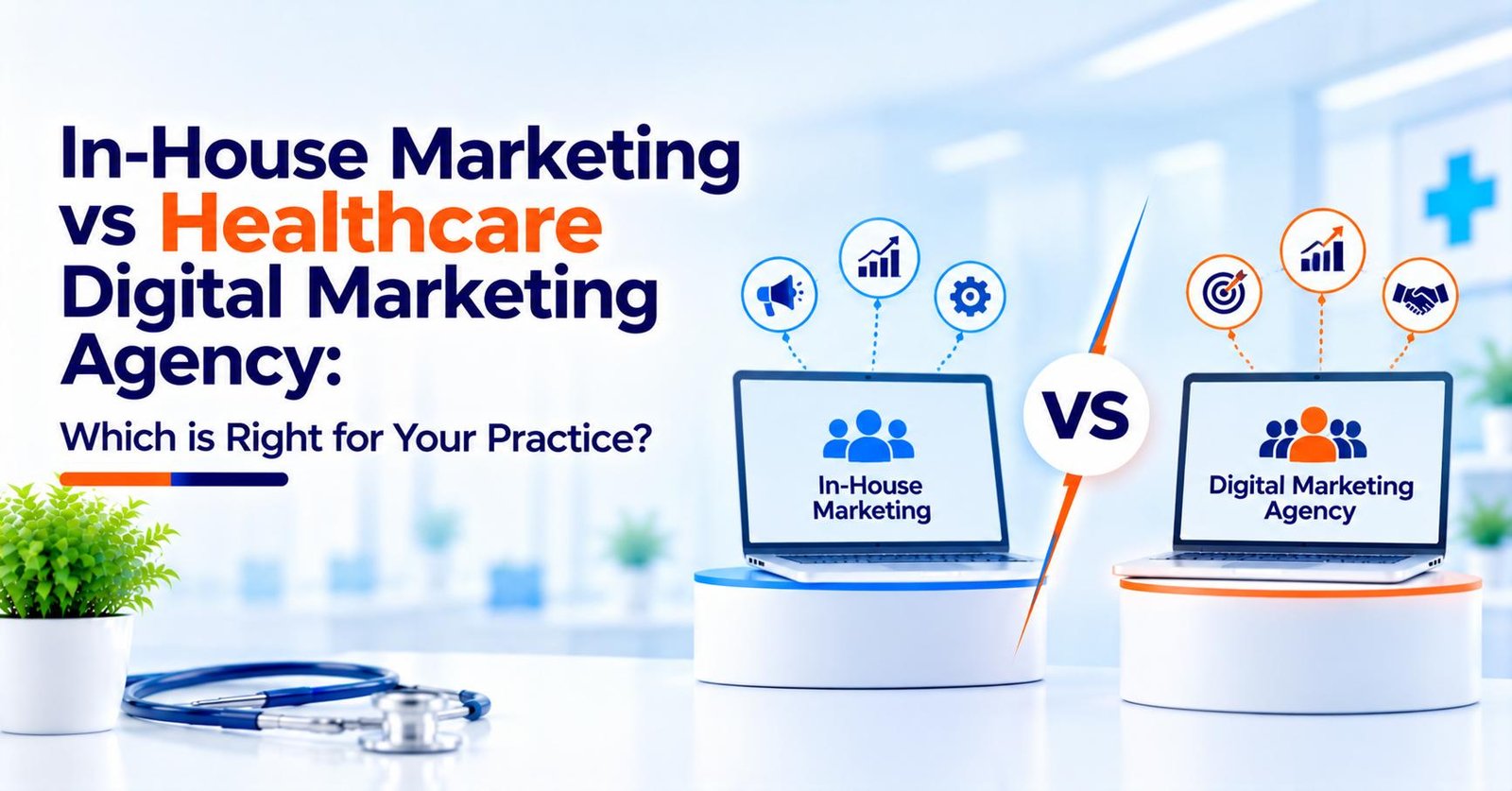
Healthcare organisations generally have two options: build an in-house marketing team or work with a Healthcare Digital Marketing Agency. An in-house team offers direct control over daily marketing activities, while an agency can provide access to specialists across multiple digital marketing disciplines.
Neither option is automatically better for every practice. The right choice depends on your goals, budget, internal resources, service requirements, and the level of support your organisation needs.
At World SEO Services, we understand that healthcare marketing requires more than simply publishing social media posts or running advertisements. It involves building trust, communicating medical information responsibly, improving online visibility, and attracting relevant enquiries. Understanding the differences between in-house marketing and agency support can help your practice make a more informed decision.
In this guide, we will compare both approaches, explain their advantages and limitations, and help you determine which model may suit your healthcare organisation.
What Is In-House Healthcare Marketing?
In-house healthcare marketing means managing marketing activities through employees who work directly for your hospital, clinic, or healthcare organisation.
Depending on the size of the practice, the team may include a marketing manager, content writer, graphic designer, social media executive, SEO specialist, or performance marketing professional.
Smaller clinics may assign marketing responsibilities to one employee or divide them among existing staff members. Larger hospitals may maintain a dedicated marketing department with separate roles for different activities.
Common responsibilities of an in-house team
An in-house healthcare marketing team may manage:
- Website content and updates.
- Search engine optimisation.
- Social media planning and publishing.
- Paid advertising campaigns.
- Doctor profiles and department information.
- Email marketing and patient communication.
- Online reputation monitoring.
- Marketing reports and lead tracking.
- Coordination with doctors, administrators, and reception teams.
The main advantage is that the team works closely with the organisation and can develop a detailed understanding of its services, internal processes, and communication preferences.
However, managing all digital marketing activities internally may require more resources than a practice initially expects.
What Is a Healthcare Digital Marketing Agency?
A Healthcare Digital Marketing Agency is an external service provider that helps hospitals, clinics, doctors, and other healthcare businesses plan and execute digital marketing activities.
Depending on the agency’s services, its team may include SEO specialists, content strategists, website developers, designers, social media professionals, paid advertising managers, and analytics experts.
Instead of recruiting every specialist internally, a healthcare organisation can engage an agency for selected services or a broader marketing programme.
What can an agency help with?
A healthcare-focused agency may provide support with:
- Healthcare SEO: Improving website structure, relevant organic search visibility, and content optimisation.
- Content marketing: Developing educational articles, service pages, and other useful website content.
- Social media marketing: Planning and managing relevant social media communication.
- PPC advertising: Setting up and optimising paid campaigns.
- Website development: Improving website usability, mobile performance, and enquiry pathways.
- Local SEO: Maintaining accurate business information and improving local search visibility.
- Reputation management: Monitoring public feedback and supporting appropriate responses.
- Lead generation: Improving the journey from marketing activity to relevant enquiries.
- Analytics and reporting: Evaluating campaign performance and identifying opportunities for improvement.
The exact services available vary by provider. Healthcare businesses should assess an agency’s experience, working process, reporting practices, and understanding of healthcare communication before making a decision.
In-House Marketing vs Healthcare Digital Marketing Agency: Key Differences
Both models can support business growth, but they differ in how resources, responsibilities, and expertise are organised.
1. Cost and Budget Management
In-house marketing
Building an internal team involves more than paying salaries. Costs may include recruitment, employee training, software subscriptions, design tools, analytics platforms, advertising management tools, and ongoing professional development.
For example, a clinic that needs SEO, social media, paid advertising, and website development may require several different skill sets. One employee may not have the expertise or capacity to manage every activity effectively.
An in-house team can make sense when marketing work is consistent, the organisation has sufficient resources, and there is enough ongoing work to justify dedicated employees.
Agency marketing
Working with an agency generally involves a service fee based on the agreed scope of work. The practice may gain access to several specialists without employing each one directly.
However, an agency is not automatically cheaper. Fees vary according to the services, campaign complexity, deliverables, and level of support. Advertising spend, website development, and other additional costs may also be charged separately.
What should you choose?
Compare the complete cost of both options rather than comparing an agency’s monthly fee with one employee’s salary. Include the resources needed to deliver your desired marketing activities consistently.
2. Access to Specialised Expertise
In-house marketing
An internal employee may become highly familiar with the practice’s services, doctors, audience, and communication style. This knowledge can improve coordination and help the team respond quickly to internal requirements.
However, a small team may have limited expertise across technical SEO, content strategy, website development, paid advertising, and analytics.
Training can help address these gaps, but it requires time and ongoing investment.
Agency marketing
A suitable agency can provide access to professionals with different areas of expertise. This can be useful when a practice needs several marketing activities managed together.
For example, a hospital planning to improve organic visibility while launching a new department may need keyword research, service-page development, technical website improvements, and a campaign strategy.
An agency with the relevant capabilities can coordinate these activities under an agreed plan.
What should you choose?
If your practice needs specialised support across several digital channels, an agency may be a practical option. If your marketing requirements are narrow and your internal employee already has the necessary skills, an in-house approach may be sufficient.
3. Understanding Your Healthcare Practice
In-house marketing
Internal employees work closely with doctors, administrators, and other staff members. They can learn how appointments are handled, which services are available, what questions patients commonly ask, and how the practice operates.
This knowledge is valuable because healthcare marketing must accurately reflect the services the organisation can provide.
The challenge is that internal teams may be too busy with routine tasks to explore new strategies or evaluate performance in depth.
Agency marketing
An agency brings an external perspective and may identify gaps that internal teams have overlooked. It can help organise marketing priorities and suggest improvements based on website data, audience behaviour, and campaign performance.
However, an agency will not automatically understand every detail of your practice. It needs accurate information, timely feedback, and regular communication with your team.
What should you choose?
Both models require collaboration. An in-house team has direct organisational access, while an agency needs a clear onboarding process and a reliable point of contact.
4. Flexibility and Scalability
In-house marketing
Expanding an internal team often requires additional recruitment, training, and management. If your practice suddenly needs a new campaign, additional content, or website redevelopment, the existing team may not have enough capacity.
On the other hand, an internal team can offer strong day-to-day control when priorities change frequently.
Agency marketing
An agency may offer greater flexibility when the practice needs to add services, launch campaigns, or increase support for a specific project.
For example, a clinic preparing to open another branch may need location-specific service pages, local search optimisation, social media communication, and paid advertising support.
The agency’s ability to accommodate these requirements depends on its resources, contract, and agreed timelines.
What should you choose?
Consider an agency if your marketing workload changes frequently or requires multiple specialists. An in-house team may suit an organisation with stable, ongoing requirements and sufficient internal capacity.
5. Control and Communication
In-house marketing
An internal team usually provides direct access to the people managing marketing activities. Approvals, content changes, and internal discussions can be easier to coordinate because employees work within the organisation.
However, quick access does not always mean quick execution. Delays can still occur because of competing responsibilities or approval requirements.
Agency marketing
An agency typically works according to agreed deliverables, reporting schedules, and communication channels. This structure can create accountability, but it may also introduce delays if approvals, feedback, or information are not shared on time.
Before hiring an agency, clarify who will approve medical content, how urgent changes will be handled, and how frequently performance updates will be provided.
What should you choose?
Choose the model that fits your working style and operational needs. If you prefer close internal coordination, an in-house team may be useful. If you want defined deliverables and access to external specialists, an agency may be a better fit.
6. Performance Tracking and Accountability
In-house marketing
An internal team can work closely with reception, appointment coordinators, and management to understand what happens after an enquiry arrives.
This connection can help the practice identify whether marketing enquiries are relevant and whether staff members are following up appropriately.
The limitation is that reporting quality depends on the team’s analytical skills, tools, and available time.
Agency marketing
An agency may provide structured reporting on website traffic, search visibility, advertising costs, conversion activity, and other agreed metrics.
However, reports should connect marketing activity to business objectives. A large number of clicks or form submissions does not necessarily mean the practice is attracting relevant enquiries.
What should you choose?
Whichever model you select, establish clear performance measures. Depending on your goals, these may include relevant enquiries, cost per enquiry, appointment requests, local search performance, and the proportion of enquiries that progress to appointments.
When Should a Healthcare Practice Choose In-House Marketing?
An in-house team may be suitable when the organisation has stable marketing needs and wants employees to manage daily activities directly.
Consider this approach if:
- Your hospital or clinic has enough ongoing marketing work to justify dedicated employees.
- You can recruit and retain people with the required skills.
- Your team needs frequent interaction with doctors and internal departments.
- You want direct control over everyday marketing decisions.
- You have the budget for salaries, software, training, and professional development.
- You can manage campaign strategy, technical work, and performance reporting effectively.
For example, a multi-specialty hospital with an established marketing department may benefit from having employees who understand its departments, operational priorities, and internal approval procedures.
However, the organisation should regularly assess whether its team has the right capabilities and sufficient time to manage all required activities.
When Should You Hire a Healthcare Digital Marketing Agency?
An agency may be a strong option for healthcare practices that need specialised marketing support without building a complete internal department.
Consider an agency if:
- You need expertise in several digital marketing channels.
- Your current team lacks technical SEO or paid advertising experience.
- You want support with a new website or marketing campaign.
- Your practice needs a more structured content and optimisation plan.
- You need help evaluating campaign performance.
- You want to expand marketing activities without recruiting multiple specialists.
- Your internal staff already have substantial clinical or administrative responsibilities.
For example, a growing clinic may have one employee managing basic social media communication but need professional support for website optimisation, local SEO, and advertising campaigns.
A suitable agency can help address these gaps while the clinic continues to manage its clinical services and internal operations.
Should You Choose a Hybrid Marketing Model?
For many healthcare organisations, the decision does not have to be entirely in-house or entirely outsourced.
A hybrid model combines internal knowledge with external expertise. The practice retains responsibility for its services, clinical accuracy, approvals, and internal coordination, while an agency supports selected digital marketing activities.
A hybrid arrangement may work like this:
- Internal team: Shares service information, coordinates with doctors, manages approvals, and communicates operational changes.
- External agency: Supports SEO, website development, content strategy, paid advertising, or analytics.
- Practice management: Defines business objectives, approves budgets, and reviews performance.
- Reception or enquiry team: Handles incoming enquiries and records follow-up outcomes.
This arrangement can be especially useful when a healthcare organisation needs specialised expertise but also wants to maintain close control over its brand and daily operations.
The key is to define responsibilities clearly. Without a shared plan, both teams may duplicate work or assume that the other team is responsible for an important task.
How to Evaluate a Healthcare Digital Marketing Agency
If you decide to work with an agency, assess its capabilities carefully rather than selecting a provider based only on price or promises.
1. Review relevant experience
Ask how the agency approaches healthcare websites, medical content, local search, and patient enquiry journeys. Relevant experience is useful, but the provider should also explain how its proposed approach fits your practice.
2. Understand the strategy
The agency should be able to explain its priorities, expected deliverables, measurement approach, and the reasoning behind its recommendations.
Be cautious of guarantees of specific rankings, fixed enquiry volumes, or guaranteed placement in AI-generated answers.
3. Check content quality and medical review
Ask how medical information is researched, written, checked, and approved. Your practice should have a clear process for reviewing clinical claims and confirming that service information is accurate.
4. Clarify reporting
Understand which metrics will be reported, how often reports will be delivered, and how campaign outcomes will be evaluated.
The agency should explain both progress and problems, not just present positive numbers.
5. Confirm ownership and access
Your organisation should understand who controls its website, domain, advertising accounts, analytics setup, and published content. Establish appropriate account access and ownership arrangements before work begins.
6. Discuss privacy and compliance
Healthcare marketing may involve sensitive information. Confirm how forms, analytics, tracking technologies, and enquiry data will be handled, and ensure the arrangement meets applicable privacy, data-protection, and professional advertising requirements.
How World SEO Services Can Support Your Practice
Choosing a marketing model is easier when you first understand what your practice needs to achieve and which capabilities are currently missing.
World SEO Services supports healthcare organisations with digital marketing activities such as SEO, content marketing, social media marketing, PPC advertising, website development, local SEO, reputation management, and lead generation.
For a practice considering a Healthcare Digital Marketing Agency, the first step should be to identify its main challenges. These may include limited organic visibility, an outdated website, inconsistent content, poorly targeted advertising, or difficulty measuring relevant enquiries.
A structured marketing plan can help prioritise these issues according to business goals, available resources, and the current performance of the website and campaigns.
Whether your practice chooses an in-house team, an external agency, or a hybrid model, clear objectives and consistent measurement should guide the decision.
Conclusion
The choice between in-house marketing and a healthcare digital marketing agency depends on your practice’s size, budget, expertise, and long-term goals.
An in-house team can provide direct control, internal knowledge, and close coordination. An agency can offer access to specialised skills, structured support, and flexibility across different digital marketing channels. A hybrid model can combine the advantages of both.
Before making a decision, evaluate the complete cost of each option, the capabilities your practice needs, and the outcomes you want to measure. Prioritise accurate healthcare communication, patient trust, responsible data handling, and a clear approach to performance evaluation.
World SEO Services can help healthcare businesses assess their digital marketing requirements and explore suitable strategies for improving online visibility and attracting relevant enquiries. The best solution is the one that fits your practice’s needs and can be managed consistently over time.
Frequently Asked Questions
1. Is a healthcare digital marketing agency better than an in-house team?
Neither option is universally better. An in-house team may be suitable when a practice needs direct control and has the resources to employ skilled marketers. An agency may be more appropriate when the organisation needs specialised expertise across several digital marketing channels without hiring multiple employees.
2. Is hiring a healthcare digital marketing agency cost-effective?
It can be cost-effective when the agency provides the skills and services the practice needs at a suitable price. However, costs depend on the scope of work, service fees, advertising budgets, and additional requirements. Compare the complete cost of outsourcing with the total cost of recruiting, training, and managing an internal team.
3. Can a small clinic benefit from a healthcare digital marketing agency?
Yes. A small clinic may benefit from external support for activities such as local SEO, website improvements, content development, and paid advertising. The right service scope depends on the clinic’s goals, budget, competition, and existing marketing resources.
4. What should a healthcare business check before hiring a digital marketing agency?
Review the agency’s relevant experience, proposed strategy, deliverables, reporting process, content quality, account ownership arrangements, and approach to privacy and healthcare compliance. Avoid providers that promise guaranteed rankings or guaranteed medical outcomes.
5. Can a healthcare practice combine in-house marketing with an agency?
Yes. A hybrid model allows internal employees to manage clinical coordination, service information, and approvals while an agency supports specialised activities such as SEO, website development, content strategy, or paid advertising. Clearly defined roles and regular communication help both teams work effectively together.