
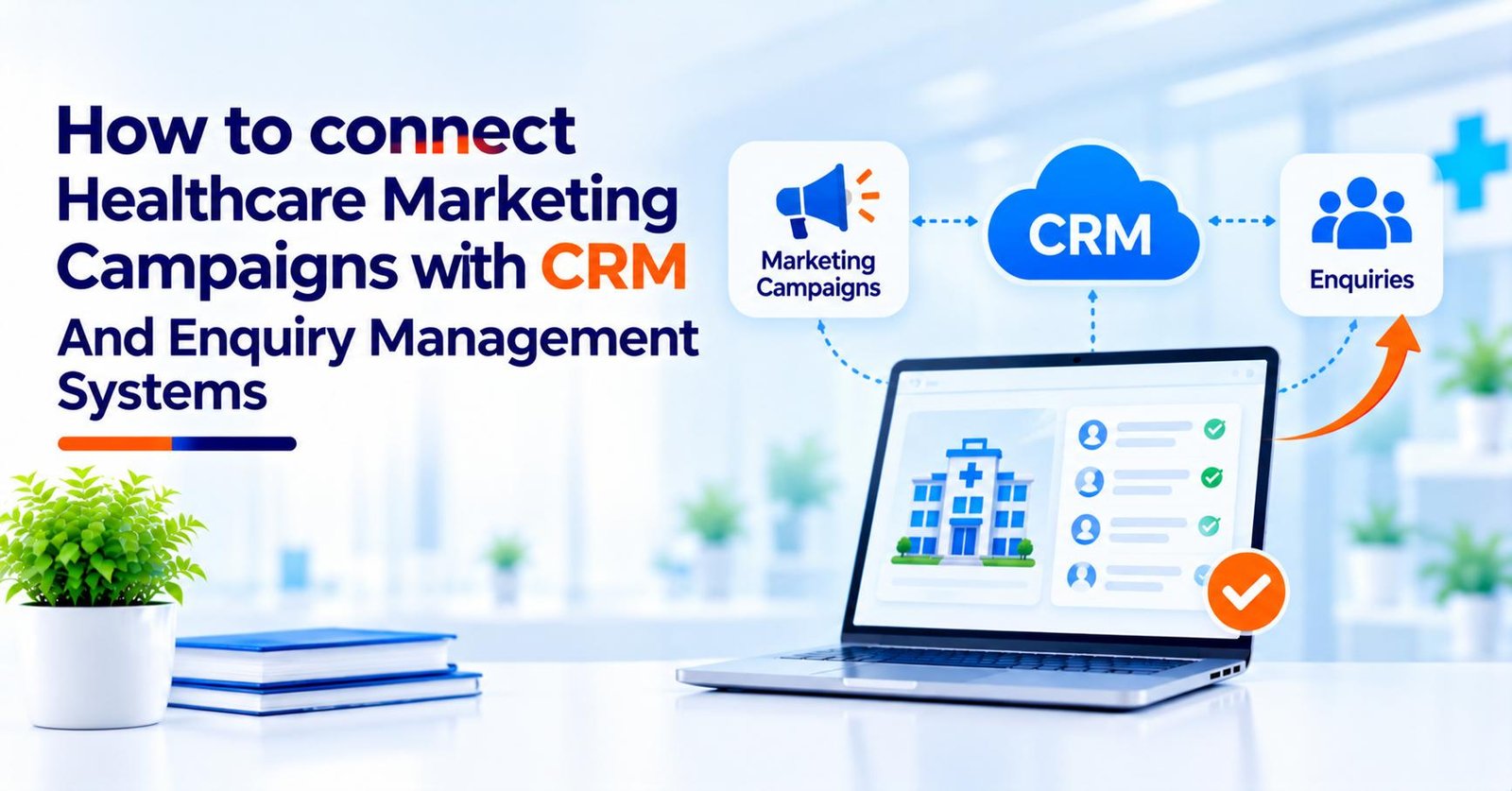
Healthcare marketing campaigns can help hospitals, clinics, and medical practices reach people who are searching for relevant services. However, generating enquiries is only one part of the process. Healthcare organisations also need a reliable way to record incoming enquiries, assign them to the right team, follow up on time, and understand which marketing activities are producing meaningful results.
When marketing campaigns operate separately from customer relationship management (CRM) and enquiry management systems, important information can become scattered across spreadsheets, phone calls, emails, and different advertising platforms. Staff may struggle to identify the source of an enquiry, follow up consistently, or determine whether a campaign is generating relevant appointment requests.
Connecting marketing campaigns with a CRM and enquiry management system can help bring these activities into a more organised workflow.
At World SEO Services, we understand that successful healthcare marketing involves more than increasing website traffic or generating form submissions. It also requires a clear process for managing enquiries and evaluating campaign performance. A well-planned Healthcare Lead Management strategy can help healthcare organisations connect their marketing activities with the processes that turn initial interest into meaningful conversations and appointment opportunities.
In this guide, we will explain how healthcare marketing campaigns can be connected with CRM and enquiry management systems, which data should be tracked, and how hospitals and clinics can build a more effective lead management process.
What Is Healthcare Lead Management?
Healthcare Lead Management is the process of recording, organising, assigning, tracking, and following up on enquiries received through marketing and other communication channels.
A healthcare enquiry may come from someone who wants to book a consultation, learn about a medical service, ask about appointment availability, or understand the process for visiting a hospital.
Lead management helps the organisation handle these enquiries systematically instead of relying on disconnected records or individual staff members to remember every follow-up.
A typical healthcare lead management process includes:
- Capturing enquiries from websites, advertisements, calls, and other channels.
- Recording relevant contact and campaign information.
- Assigning enquiries to the appropriate department or team.
- Tracking contact attempts and follow-up activities.
- Updating enquiry status as the process progresses.
- Recording appointment outcomes where appropriate.
- Reviewing reports to understand campaign performance.
The objective is to create a consistent process while protecting personal information and ensuring that enquiries are handled by authorised staff.
Understanding CRM and Enquiry Management Systems
Although CRM and enquiry management systems can overlap, they often serve slightly different purposes.
What Is a CRM System?
A customer relationship management system stores and organises information about contacts and interactions. It can help a healthcare organisation maintain communication records, track enquiry status, manage tasks, and coordinate follow-ups.
Depending on the platform and configuration, a CRM may support:
- Contact and enquiry records.
- Follow-up reminders.
- Communication history.
- Staff assignments.
- Appointment-related workflows.
- Reporting and performance dashboards.
- Integration with marketing tools.
Some healthcare organisations use general-purpose CRMs, while others use specialised healthcare platforms. The right option depends on the organisation’s operational requirements, privacy obligations, and existing technology.
What Is an Enquiry Management System?
An enquiry management system focuses on receiving, assigning, tracking, and resolving incoming enquiries.
For example, a hospital may receive enquiries through a website form, a paid advertising campaign, a telephone call, and a social media message. An enquiry management system can help bring these requests into a structured workflow so that the responsible team can respond and update their status.
Some enquiry management systems operate independently, while others are integrated into a CRM or hospital management platform.
The important consideration is not whether the organisation uses one product or several. It is whether the systems work together to provide accurate records, clear responsibilities, and reliable follow-up.
Why Healthcare Marketing Campaigns Should Be Connected With CRM
Marketing platforms can show how many people clicked an advertisement or visited a landing page. However, these numbers do not always explain what happened after someone submitted an enquiry.
Connecting campaigns with CRM and enquiry management systems can provide a clearer view of the complete journey.
1. Understand Where Enquiries Come From
Healthcare organisations may receive enquiries from search engines, social media advertisements, paid search campaigns, website forms, referral sources, and local business listings.
Without consistent source tracking, it can be difficult to identify which channels generate relevant enquiries.
A connected system can record information such as:
- Original marketing source.
- Campaign name.
- Advertisement or landing page, where available.
- Date and time of enquiry.
- Relevant service or department.
- Enquiry status.
For example, a clinic may run separate campaigns for dermatology consultations and dental services. Tracking the campaign source and requested service can help the team understand which activities are attracting relevant interest.
Campaign tracking should be implemented consistently, using suitable analytics tools, URL parameters, form fields, and integrations.
2. Reduce Delays in Follow-Up
An enquiry may lose relevance if it remains unattended for too long. Delays can occur when submissions are sent to an unmonitored email inbox or when staff members are unsure who should respond.
A connected workflow can automatically assign enquiries to the appropriate team, create a follow-up task, or notify authorised staff when a new request arrives.
For example, a website enquiry about an orthopaedic consultation could be routed to the team responsible for handling orthopaedic appointments.
Automated reminders can support staff, but they should not replace clear responsibilities and human oversight. The organisation should also define how urgent requests are handled and how missed follow-ups are escalated.
3. Improve Enquiry Organisation
When information is spread across multiple systems, staff may create duplicate records or lose track of previous interactions.
A centralised process can make it easier to review an enquiry’s status and identify the next required action.
Common enquiry statuses include:
- New enquiry.
- Assigned.
- Contact attempted.
- Contact established.
- Appointment requested.
- Appointment booked.
- Closed or not proceeding.
The exact stages should reflect the organisation’s actual workflow. Avoid creating too many statuses, as overly complicated processes can make the system difficult to maintain.
4. Measure More Meaningful Marketing Outcomes
A campaign that generates many form submissions may not necessarily produce relevant appointment requests.
Connecting marketing data with enquiry outcomes can help healthcare organisations assess the quality of incoming enquiries rather than relying only on clicks or raw lead volume.
Depending on the data available, teams may evaluate:
- Total enquiries by campaign.
- Relevant enquiries by service.
- Cost per enquiry.
- Time taken to respond.
- Contact and follow-up rates.
- Appointment requests and bookings.
- Cost per qualified enquiry.
These measures help connect marketing activity with operational outcomes. They should be interpreted carefully because campaign performance can also depend on service availability, audience needs, staff capacity, and the follow-up process.
How to Connect Healthcare Marketing Campaigns With CRM and Enquiry Systems
A successful integration begins with a clear process. Connecting tools without defining how the data will be used can create more complexity rather than improving lead management.
Step 1: Map the Existing Enquiry Journey
Before selecting an integration method, document how an enquiry currently moves through the organisation.
Start by identifying the main entry points:
- Website contact forms.
- Appointment request forms.
- Paid search campaigns.
- Social media campaigns.
- Click-to-call advertisements.
- Telephone enquiries.
- Relevant referral channels.
Then document what happens after an enquiry arrives. Who receives it? Who contacts the person? How is the outcome recorded? When is the enquiry considered closed?
Involve marketing staff, reception teams, enquiry coordinators, and relevant administrators in this exercise.
A clear workflow will help identify where information is lost, where duplicate work occurs, and which activities can be automated.
Step 2: Choose the Right CRM and Integration Method
The integration approach depends on the organisation’s existing tools, technical capabilities, and data requirements.
Common options include:
Native integrations: Some advertising, website, and CRM platforms offer built-in connections. These can be suitable when the systems already support the required data fields and workflows.
Integration platforms: Middleware or automation tools can transfer selected information between compatible applications. These tools may be useful when direct integrations are unavailable.
APIs and custom development: Application programming interfaces can support more tailored integrations when a healthcare organisation has specific routing, reporting, or system requirements.
Manual imports: Smaller practices may begin with controlled data imports while evaluating a more automated process. Manual methods require careful access controls and procedures to prevent errors and unnecessary duplication.
Choose the simplest approach that meets the organisation’s needs reliably. Consider integration maintenance, security, costs, and the technical support available before committing to a solution.
Step 3: Standardise Enquiry Data Fields
Consistent data is essential for reliable reporting and follow-up.
Define the fields that should be captured when an enquiry is created. These may include:
- Unique enquiry identifier.
- Date and time received.
- Contact details required for follow-up.
- Requested service or department.
- Marketing source and campaign.
- Assigned team member.
- Current enquiry status.
- Next follow-up date.
- Outcome, where applicable.
Not every field is necessary for every enquiry. Collect only the information needed for the defined purpose.
Avoid collecting detailed medical histories or sensitive health information through general advertising forms unless there is a clear, appropriate, and secure process for doing so.
Also establish consistent naming conventions for campaigns, sources, and services. If one team labels a campaign “Dental Leads” while another records it as “Dental Consultation Campaign,” reports may treat the same activity as separate sources.
Step 4: Connect Website Forms to the CRM
Website forms are often a major source of healthcare enquiries. Connecting them to the CRM can reduce manual data entry and help staff receive new requests more consistently.
A typical workflow may look like this:
- A visitor submits a form on a healthcare website.
- The website validates the required fields.
- The integration sends the necessary information to the CRM.
- The CRM checks for possible duplicate records.
- The enquiry is assigned to the appropriate team.
- A task or notification is created.
- The system records the enquiry source and status.
- An authorised team member follows up and updates the outcome.
The website should provide a clear confirmation message after successful submission. If the integration fails, the organisation needs an appropriate error-handling and recovery process so that enquiries are not silently lost.
Test the entire workflow before making it live. A form that appears to work on the website may still fail to create a CRM record or notify the responsible staff member.
Step 5: Set Up Campaign Source Tracking
Campaign source tracking helps the marketing team understand which activities contribute to enquiries.
For digital campaigns, URL parameters such as UTM tags can identify the source, medium, and campaign associated with a visit. These values can be captured through website forms and stored in the CRM where appropriate.
For example, a hospital may use consistent campaign parameters to distinguish paid search from social media advertising.
The tracking setup should answer questions such as:
- Which campaign generated the visit?
- Which landing page did the visitor use?
- Which service was requested?
- Was the enquiry relevant?
- Did the enquiry progress to an appointment?
Source tracking requires careful configuration. Redirects, consent settings, cross-domain journeys, and form implementations can affect whether campaign information is preserved.
Use clear naming conventions and test the tracking process before relying on its reports.
Step 6: Create Clear Assignment and Follow-Up Rules
Once enquiries enter the CRM, the organisation needs rules for assigning responsibility.
Routing can be based on factors such as service, location, enquiry type, operating hours, or staff availability.
For example, enquiries about a specific hospital branch can be assigned to the relevant location’s enquiry team. Requests for a particular department can be routed to the staff responsible for coordinating those appointments.
Define:
- Who receives new enquiries.
- Who is responsible for follow-up.
- How quickly the team should attempt contact.
- What happens when the assigned person is unavailable.
- How missed follow-ups are escalated.
- When an enquiry can be marked as closed.
Response-time targets should be realistic and appropriate for the organisation. They should not imply that every medical concern can be handled through a marketing enquiry process.
Automated messages should also be carefully worded. A confirmation that a request has been received is different from confirming an appointment or providing medical advice.
Step 7: Connect Advertising Data Carefully
Some organisations want to understand whether advertising campaigns lead to enquiries and appointments, rather than measuring only clicks or form submissions.
Where supported and appropriate, campaign platforms may be connected to CRM reporting or receive limited conversion signals from the organisation’s systems.
However, healthcare data requires particular care. Information about a person’s medical interests, requested treatment, or patient status may be sensitive.
Before enabling advertising integrations or offline conversion tracking:
- Review the applicable privacy and data-protection requirements.
- Confirm what data the platform receives.
- Avoid sending patient names, contact details, medical conditions, or other sensitive information to advertising platforms unless a specific, lawful, and appropriate basis and safeguards exist.
- Review platform policies for healthcare-related data.
- Use data minimisation, access controls, and suitable retention rules.
- Ensure that consent and other legal requirements are addressed where applicable.
Do not assume that removing a person’s name makes health-related data safe to share. Combinations of identifiers and service details can still create privacy risks.
In some situations, aggregate reporting or privacy-preserving measurement may be more appropriate than sharing individual-level conversion data.
Step 8: Build Useful Reporting Dashboards
A dashboard can bring marketing and enquiry management information together in a format that supports decision-making.
Useful reports may show:
- Enquiries by marketing source.
- Enquiries by service or location.
- Relevant enquiry rate.
- Cost per enquiry.
- Cost per qualified enquiry.
- Follow-up completion rate.
- Appointment booking outcomes.
- Trends over time.
For example, if one campaign generates substantial traffic but few relevant enquiries, the marketing team may need to review audience targeting, advertisement wording, or the landing page.
If relevant enquiries are being generated but follow-up completion is low, the issue may involve staffing, routing, or the internal process rather than advertising performance.
Reports should use clearly defined metrics and consistent attribution rules. Avoid counting duplicate submissions as separate people or comparing campaigns using different measurement methods.
Common Challenges When Integrating Healthcare Marketing Systems
Connecting multiple systems can improve visibility, but it also introduces technical and operational challenges.
Duplicate Records
The same person may submit a form more than once or contact the clinic through different channels. Establish appropriate duplicate-detection rules while avoiding accidental merging of different individuals who share similar details.
Inconsistent Campaign Names
Different naming conventions can make reporting confusing. Use a documented campaign naming system and apply it consistently across marketing platforms and CRM records.
Failed Integrations
A website update, expired connection, or API change may interrupt data transfer. Configure error alerts, maintain logs where appropriate, and test the workflow regularly.
Poorly Defined Responsibilities
Even a well-integrated system cannot guarantee timely follow-up if staff do not know who owns each enquiry. Assign clear responsibility and review unhandled records regularly.
Privacy and Access Risks
Not every marketing employee needs access to every record. Use role-based permissions, secure authentication, appropriate retention policies, and staff training to limit unnecessary access to personal information.
Addressing these challenges early can make the integration easier to maintain and more useful over time.
How World SEO Services Can Support Healthcare Lead Management
Connecting marketing campaigns with CRM and enquiry management systems requires coordination between marketing strategy, website functionality, tracking, and internal processes.
World SEO Services supports healthcare organisations through digital marketing activities such as SEO, content marketing, paid advertising, website development, local SEO, and lead generation.
For a healthcare business improving its Healthcare Lead Management process, the first step is to understand how enquiries currently arrive, how they are handled, and which information is needed to measure outcomes.
Based on these requirements, a suitable plan may include improving website forms, standardising campaign tracking, defining conversion events, strengthening landing pages, or coordinating with technical teams responsible for CRM integrations.
The specific solution will depend on the organisation’s existing software, operational workflows, privacy obligations, and reporting requirements. Marketing integrations should be planned around the systems and safeguards the healthcare business can maintain reliably.
Conclusion
Connecting healthcare marketing campaigns with CRM and enquiry management systems can help hospitals and clinics build a more organised process for handling incoming enquiries. It can improve campaign attribution, reduce manual work, clarify follow-up responsibilities, and provide better insight into whether marketing activities are producing relevant outcomes.
The process begins with mapping the existing enquiry journey, selecting a suitable integration method, standardising data fields, connecting website forms, and establishing clear assignment rules. From there, healthcare organisations can improve reporting and assess campaign performance more meaningfully.
Privacy and security must remain central throughout the process. Healthcare businesses should collect only necessary information, limit access to authorised staff, and carefully review any integration that shares data with external advertising platforms.
With a clear workflow and appropriate technical safeguards World SEO Services can help healthcare organisations strengthen their digital marketing processes and build a more measurable approach to lead management.
Frequently Asked Questions
1. What is Healthcare Lead Management?
Healthcare Lead Management is the process of capturing, organising, assigning, tracking, and following up on enquiries received by a hospital, clinic, or healthcare provider. It helps teams manage incoming requests consistently and understand how enquiries progress toward appointments or other relevant outcomes.
2. Why should healthcare marketing campaigns be connected to a CRM?
Connecting campaigns to a CRM can help healthcare organisations record enquiry sources, assign follow-up responsibilities, reduce manual data entry, and evaluate campaign outcomes. It provides a more complete view of the enquiry process than measuring clicks or form submissions alone.
3. Can website forms automatically send enquiries to a CRM?
Yes. Website forms can be connected to compatible CRMs through native integrations, automation platforms, APIs, or custom development. The setup should be tested to ensure that submissions are recorded correctly, duplicate records are handled appropriately, and authorised staff receive the required notifications.
4. What information should a healthcare CRM capture from marketing campaigns?
Depending on the organisation’s needs, it may capture the enquiry date, contact information required for follow-up, requested service, campaign source, assigned team member, enquiry status, and outcome. Healthcare organisations should minimise data collection and avoid unnecessary sensitive medical information in general marketing systems.
5. How can healthcare organisations measure marketing performance through a CRM?
A CRM can help connect campaign sources with enquiry outcomes. Depending on the available data, teams can review enquiry volume, relevant enquiry rates, follow-up completion, appointment bookings, and cost per qualified enquiry. Reporting should use consistent definitions, reliable attribution, and appropriate privacy safeguards.