
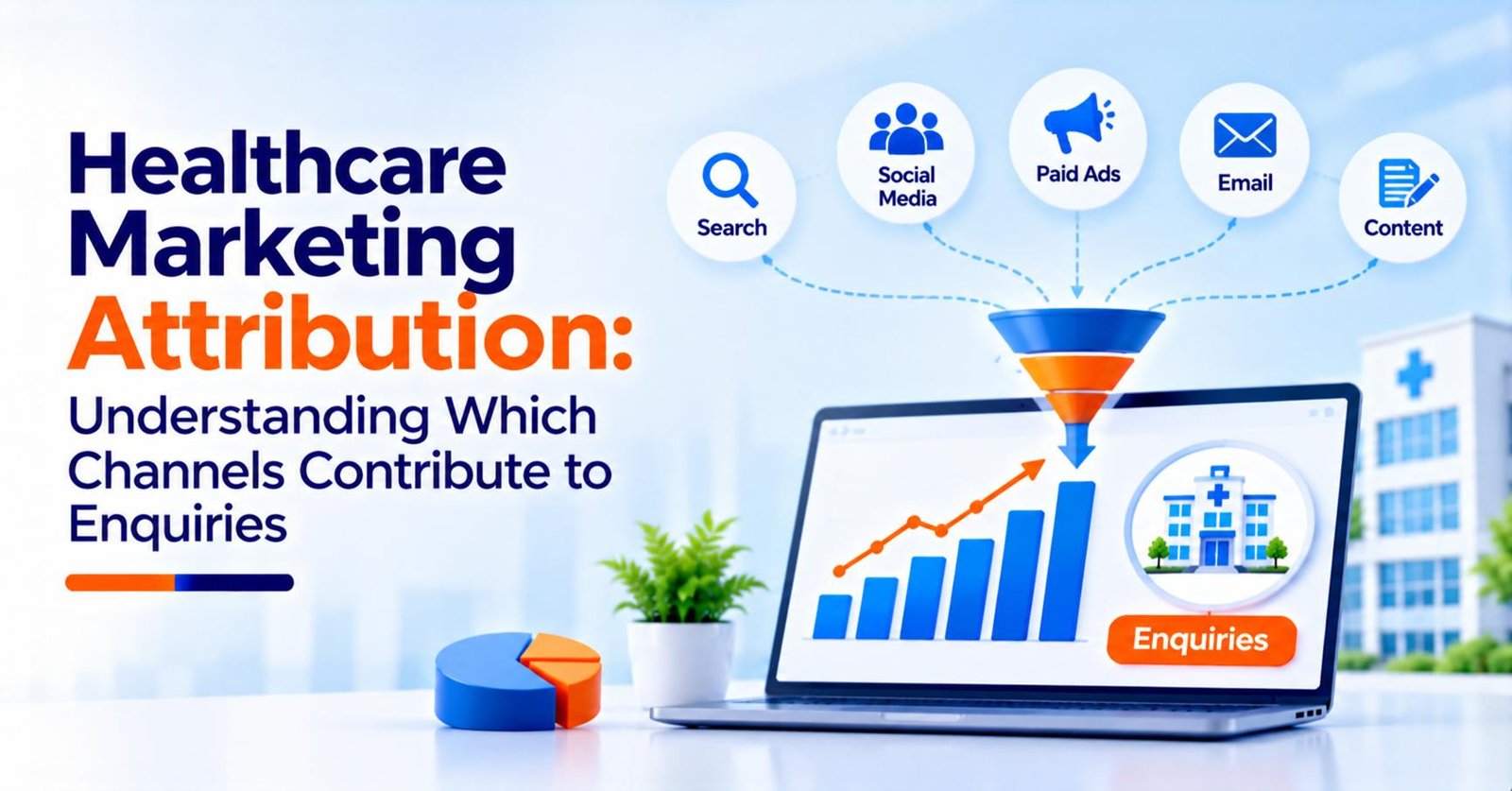
A healthcare organisation may invest in search engie optimisation, paid advertising, social media, content marketing, and local search to reach people looking for medical services. But when enquiries start coming in, an important question arises: which marketing activities actually contributed to those enquiries?
For example, someone might discover a hospital through Google Search, read an educational blog a few days later, visit its social media profile, and finally submit an appointment request after clicking a paid advertisement. If the hospital measures only the last interaction, it may give all the credit to paid advertising and overlook the other channels that helped the person make a decision.
This is where Healthcare Marketing Analytics becomes valuable. Marketing attribution helps healthcare organisations understand how different channels and interactions contribute to enquiries, allowing them to evaluate campaigns and make more informed budget decisions.
At World SEO Services, healthcare digital marketing combines activities such as SEO, content marketing, PPC advertising, social media marketing, website development, and lead generation. Measuring how these activities work together can help healthcare businesses understand their marketing performance more clearly.
In this guide, we will explain healthcare marketing attribution, the common attribution models, the data hospitals should track, and practical ways to improve measurement while respecting patient privacy.
1. What Is Healthcare Marketing Attribution?
Healthcare marketing attribution is the process of understanding which marketing channels, campaigns, or interactions contributed to a particular enquiry or conversion.
A conversion might be a completed appointment request, an enquiry submitted through a website form, or a relevant phone call. The exact definition depends on the organisation’s goals.
Attribution connects marketing activity with measurable outcomes. Instead of looking only at impressions, clicks, or website visits, it helps teams examine how people move from discovering a healthcare provider to contacting the organisation.
A simple example
Imagine a patient researching a hospital’s orthopaedics department.
Their journey might look like this:
- They discover the hospital through an organic Google search.
- They read a blog about preparing for an orthopaedic consultation.
- They revisit the website after seeing a social media post.
- They submit an enquiry through the department’s appointment page.
Which channel deserves credit for the enquiry?
SEO helped the person discover the hospital. The blog provided useful information. Social media supported another interaction, and the appointment page enabled the final action.
Attribution helps marketing teams understand these contributions rather than assuming that one interaction explains the entire journey.
However, attribution does not prove that a particular channel caused an enquiry. It provides a structured way to interpret available evidence and make better-informed decisions.
2. Why Marketing Attribution Matters for Healthcare Organisations
Healthcare marketing can involve several channels, departments, services, and audience groups. Without a clear measurement system, it becomes difficult to understand which activities are performing well and where improvements are needed.
A structured attribution process can help hospitals, clinics, diagnostic centres, and other healthcare organisations in several ways.
Make better marketing budget decisions
If a hospital spends money on SEO, paid search, and social media, it needs to understand how each channel contributes to relevant enquiries.
Attribution can reveal whether a channel is supporting discovery, encouraging further engagement, or generating the final contact action.
This information helps teams review budget allocation based on evidence rather than assumptions.
Understand the complete enquiry journey
A person may interact with a healthcare brand several times before making contact. Attribution helps teams examine these touchpoints and identify common patterns.
For example, educational content might attract visitors who later return through branded search. If the hospital tracks only the final visit, the earlier content’s contribution may be overlooked.
Identify underperforming campaigns
A campaign may generate a large number of clicks but very few relevant enquiries. Another may attract fewer visitors but produce more qualified contacts.
Attribution, combined with lead-quality reporting, helps teams distinguish between activity and meaningful outcomes.
Improve planning across departments
Multi-specialty hospitals may promote cardiology, orthopaedics, gynaecology, diagnostics, and other services.
Department-level attribution can help identify which campaigns and content activities contribute to enquiries for each service, provided tracking is configured consistently.
Support more informed decisions
Attribution data gives marketing teams a stronger basis for planning. It should be considered alongside service capacity, enquiry quality, patient experience, campaign costs, and other operational factors.
3. Understand the Main Healthcare Marketing Channels
Before choosing an attribution model, healthcare organisations should understand which channels they use and what role each channel may play.
Search engine optimisation (SEO)
SEO helps people discover relevant healthcare information through organic search results.
A visitor might find a hospital while searching for a medical speciality, doctor profile, diagnostic service, or general healthcare information.
SEO performance can be evaluated using organic impressions, clicks, relevant landing-page visits, and enquiries associated with organic sessions where measurement permits.
Because SEO often supports discovery and research over time, its contribution may not be fully represented by the last click.
Paid search and PPC advertising
Paid search allows healthcare organisations to promote eligible services through advertising platforms.
A visitor may click an advertisement, explore a department page, and submit an enquiry.
Useful measurements include advertising spend, clicks, conversion rate, cost per enquiry, and lead quality.
Paid campaign reports should be interpreted carefully because a platform’s reported conversions may use different attribution windows or models from the organisation’s analytics system.
Social media marketing
Social media can introduce a healthcare brand, distribute educational content, communicate service information, and encourage visitors to explore the website.
Some users may click directly from a post or advertisement. Others may remember the hospital and search for it later.
As a result, direct click tracking may not capture every possible contribution from social media.
Content marketing
Blogs, service explainers, frequently asked questions, and educational resources can help people understand healthcare services.
A visitor may read an article during the research stage and return to the website later through another channel.
Content performance should therefore be evaluated using relevant engagement and assisted interactions, as well as direct conversions where appropriate.
Local SEO and Google Business Profile
Local search helps people discover healthcare providers, contact details, locations, and available services.
Depending on the reporting capabilities and configuration, organisations may track website visits, calls, direction requests, and other relevant actions.
These measurements need careful interpretation. A click on a phone number, for example, does not necessarily mean that a call was completed or an appointment was scheduled.
4. Common Marketing Attribution Models Explained
An attribution model determines how credit for a conversion is assigned to marketing interactions.
Different models answer different questions. No single model explains every part of a healthcare marketing journey.
First-touch attribution
First-touch attribution assigns all conversion credit to the first recorded marketing interaction.
For example, if a visitor first discovers a hospital through an organic search and later converts through paid advertising, the organic search receives the credit.
When it helps: Understanding which channels introduce new visitors to the organisation.
Limitation: It ignores the interactions that occur after the first visit.
Last-touch attribution
Last-touch attribution assigns all credit to the final recorded interaction before conversion.
If someone reads a blog, returns through a social media campaign, and then submits an enquiry after clicking a paid advertisement, the paid advertisement receives the credit.
When it helps: Identifying the channel associated with the final recorded step.
Limitation: It can undervalue channels that supported earlier research and consideration.
Linear attribution
Linear attribution distributes credit equally across the recorded interactions in the journey.
If four interactions are included, each receives 25% of the attribution credit.
When it helps: Providing a simple view of how multiple recorded touchpoints participated in a conversion journey.
Limitation: It assumes all interactions are equally valuable, which may not reflect reality.
Time-decay attribution
Time-decay attribution gives greater credit to interactions closer to the conversion and less credit to earlier interactions.
When it helps: Analysing journeys in which recent interactions may be particularly relevant to the final decision.
Limitation: Earlier interactions can still be important, especially when people spend time researching healthcare services.
Data-driven attribution
Data-driven attribution uses available data and a platform’s modelling approach to estimate the contribution of different interactions.
It can provide a more nuanced view than assigning all credit to one touchpoint, but the quality and interpretation of its results depend on the available data, methodology, and platform limitations.
When it helps: Organisations with sufficient reliable conversion data and a need for more advanced analysis.
Limitation: Results may not be comparable across platforms, and modelled credit should not be treated as proof of causation.
The best model depends on the question being asked. A hospital evaluating discovery channels may use a different view from one analysing the final steps before an enquiry.
5. How to Set Up a Healthcare Marketing Attribution System
Attribution becomes useful when tracking is consistent across channels and conversion events are clearly defined.
A practical setup does not need to begin with a complicated analytics system. Healthcare organisations can start with a small number of meaningful events and expand as their measurement improves.
Step 1: Define what counts as an enquiry
Decide which actions should be counted as conversions.
Examples include:
- A successfully submitted appointment request.
- A completed contact form.
- A relevant phone call.
- A service enquiry received through an approved contact channel.
- A completed online booking, if the system supports it.
Avoid counting every button click as a completed enquiry. A click may indicate interest, but it does not always mean the intended action occurred.
Step 2: Standardise campaign tracking
Use consistent campaign parameters, such as UTM parameters, where appropriate.
These parameters can help identify the source, medium, and campaign associated with a website visit.
For example, a campaign might identify traffic from a particular newsletter or social media promotion.
Create naming rules before campaigns launch. Inconsistent names such as social, SocialMedia, and social-media can fragment reports and make comparisons more difficult.
Step 3: Configure analytics events
Use an appropriate analytics platform to measure relevant website actions.
Events might include successful form submissions, appointment confirmation views, or clicks on contact options.
Where possible, distinguish between an interaction and a completed conversion. Test each event to confirm that it fires correctly and does not record duplicate conversions.
Step 4: Connect enquiry records with marketing data carefully
A hospital may use a customer relationship management system or enquiry management platform to record contact status and follow-up outcomes.
When integration is appropriate, campaign-level information can help the organisation understand whether recorded enquiries were relevant and whether they progressed through the enquiry process.
Healthcare organisations should not send identifiable patient information or sensitive health details to advertising or general analytics platforms unless the specific use is lawful, permitted by the platform, and appropriately safeguarded. In many situations, aggregated or appropriately de-identified reporting is preferable.
Step 5: Validate the data
Before making budget decisions, confirm that tracking works as intended.
Check for duplicate form events, missing campaign parameters, incorrect referral sources, broken confirmation pages, and discrepancies between analytics reports and actual enquiry records.
A simple, accurate measurement system is more useful than a sophisticated system built on unreliable data.
6. Important Metrics for Healthcare Marketing Analytics
Attribution is only one part of performance measurement. To understand whether marketing contributes to useful outcomes, hospitals should review several related metrics.
Enquiry volume
This measures how many recorded enquiries are associated with a channel, campaign, or department.
It is useful for understanding activity but does not reveal whether every enquiry is relevant.
Conversion rate
Conversion rate measures the proportion of visitors or sessions that complete a defined action.
The calculation depends on the denominator selected. For example, form submissions divided by relevant landing-page sessions is different from form submissions divided by all website sessions.
Use a consistent definition when comparing campaigns.
Cost per enquiry
Cost per enquiry is calculated by dividing the relevant marketing spend by the number of attributable enquiries.
For example, if a campaign spends ₹20,000 and generates 40 attributable enquiries, its cost per enquiry is ₹500.
This figure does not establish profitability or lead quality. Those need to be assessed separately.
Qualified enquiry rate
This measures the proportion of enquiries that meet predefined criteria, such as a relevant service request or a contact within the organisation’s service area.
Define qualification criteria consistently and avoid using unnecessary sensitive patient information for marketing classification.
Appointment conversion rate
Where appropriate records are available, organisations can measure how many enquiries progress to scheduled appointments.
This provides a view beyond the initial contact, although the result may also depend on appointment availability, follow-up procedures, and service demand.
Assisted conversions
An assisted conversion is one in which a channel contributed an earlier recorded interaction but was not necessarily the final touchpoint.
Reviewing assisted interactions can help teams understand why some channels support the enquiry journey without receiving last-click credit.
7. Common Healthcare Marketing Attribution Mistakes
Even well-intentioned tracking systems can produce misleading conclusions if their limitations are ignored.
Giving all credit to the last click
Last-touch reporting is easy to understand, but it may undervalue organic search, educational content, and other earlier interactions.
Better approach: Compare last-touch reporting with another attribution view and examine the sequence of recorded interactions.
Counting clicks as enquiries
A phone-button click does not necessarily mean that a call connected. A form-start event does not necessarily mean that a form was submitted.
Better approach: Track completed actions wherever technically possible and label intermediate events separately.
Comparing reports from different platforms without context
An advertising platform and an analytics platform may use different conversion windows, attribution models, and counting methods.
Better approach: Document each system’s definitions and use a consistent primary reporting method for internal comparisons.
Ignoring offline interactions
Some people may see an online campaign and later contact a hospital through a different channel. These journeys may not be fully visible in digital analytics.
Better approach: Use appropriate, privacy-conscious processes to record relevant enquiry sources where the information is available and reliable. Accept that some journeys will remain unattributed.
Making decisions from small amounts of data
A department may receive relatively few enquiries, making short-term results unstable.
Better approach: Consider longer reporting periods, campaign context, and operational factors before making major budget changes.
Assuming attribution proves causation
A channel receiving conversion credit does not prove that the conversion would not have happened without it.
Better approach: Treat attribution as one source of evidence and consider controlled experiments or other suitable methods when evaluating incremental impact.
8. Protect Patient Privacy When Measuring Marketing Performance
Healthcare marketing analytics requires particular care because website interactions may reveal sensitive information about a person’s health interests or circumstances.
Measurement practices should follow applicable privacy laws, professional requirements, and platform policies.
Important precautions include:
- Collect only the information necessary for a clearly defined purpose.
- Explain relevant data practices through appropriate privacy notices.
- Restrict access to enquiry records.
- Use suitable retention and deletion procedures.
- Avoid placing sensitive medical details in URLs, campaign parameters, or analytics event labels.
- Do not transmit patient names, phone numbers, diagnoses, or treatment details to general analytics and advertising systems without an appropriate lawful basis and safeguards.
- Review tracking pixels, cookies, session-recording tools, and third-party integrations before deployment.
- Use aggregated reporting where it can answer the marketing question.
For example, a hospital may need to know that a particular department page generated a certain number of enquiries. It generally does not need to send a visitor’s diagnosis or detailed medical history to an advertising platform to answer that question.
Privacy should be part of the measurement design from the beginning, not an afterthought.
9. How to Use Attribution Insights to Improve Marketing Strategy
Once tracking is reliable, the next step is turning reports into practical decisions.
Review channel performance by objective
A channel designed to introduce a hospital to new audiences should not always be judged by the same immediate-conversion metrics as a campaign focused on appointment enquiries.
Consider the role of each activity and evaluate it against an appropriate objective.
Identify gaps in the enquiry journey
If a department page attracts relevant visitors but few people submit enquiries, review the page’s content, contact options, usability, and service information.
If paid campaigns generate many clicks but few relevant contacts, check keyword relevance, audience targeting, landing pages, and conversion tracking.
Attribution can help identify where to investigate, although it may not reveal the exact cause of the problem.
Compare channels with lead quality and cost
A channel that produces a high volume of low-relevance enquiries may be less useful than one that produces fewer but more relevant contacts.
Review enquiry quality, cost, and operational capacity together before reallocating budget.
Reassess the strategy regularly
Review campaign results at consistent intervals. Update tracking when website forms, booking systems, campaign structures, or analytics configurations change.
Document important decisions and the evidence supporting them. This helps the team understand whether future results reflect a genuine change or a measurement difference.
World SEO Services can support healthcare organisations with SEO, PPC, content marketing, analytics-related planning, and lead generation activities that contribute to a more structured digital marketing strategy.
Conclusion
Healthcare marketing attribution helps hospitals and clinics understand how different marketing channels contribute to enquiries. By examining the customer journey, choosing appropriate attribution models, tracking meaningful conversions, and evaluating lead quality, organisations can make more informed marketing decisions.
The most useful Healthcare Marketing Analytics approach combines reliable tracking with practical business context. It recognises that SEO, paid advertising, social media, and educational content may serve different roles, and that no single attribution model captures every influence on a person’s decision.
Healthcare organisations should begin with clear conversion definitions, consistent campaign tracking, validated data, and privacy-conscious reporting. They can then use the findings to identify weaknesses, improve the enquiry journey, and plan marketing budgets more effectively.
With a structured approach, World SEO Services can help healthcare businesses connect their digital marketing activities with measurable outcomes while keeping accuracy, transparency, and responsible data practices at the centre of their strategy.
Frequently Asked Questions
1. What is healthcare marketing attribution?
Healthcare marketing attribution is the process of assigning credit to marketing channels or interactions that contributed to an enquiry or conversion. It helps healthcare organisations understand how people discover and engage with their services before making contact.
2. Which attribution model is best for healthcare marketing?
There is no single best model for every organisation. First-touch attribution helps evaluate discovery, last-touch attribution identifies the final recorded interaction, linear attribution distributes credit across recorded touchpoints, and data-driven models estimate contributions using available data. The appropriate choice depends on the organisation’s goals, data quality, and reporting requirements.
3. How can hospitals track enquiries from different marketing channels?
Hospitals can use consistent campaign parameters, analytics events, website form tracking, suitable call measurement, and enquiry management systems. Tracking should distinguish between an initial interaction and a completed enquiry, and the organisation should validate that its data is accurate.
4. What is the difference between marketing attribution and marketing analytics?
Marketing analytics is the broader process of collecting and analysing performance data, including traffic, engagement, costs, and conversions. Marketing attribution is one part of analytics that focuses on how credit for a conversion is assigned to marketing interactions or channels.
5. How can healthcare organisations protect patient privacy while measuring marketing performance?
Healthcare organisations should collect only necessary data, restrict access to records, review third-party tracking tools, and follow applicable privacy requirements and platform policies. Sensitive medical information and identifiable patient details should not be sent to general analytics or advertising platforms without an appropriate lawful basis and safeguards. Aggregated reporting can often provide useful marketing insights without exposing individual health information.