
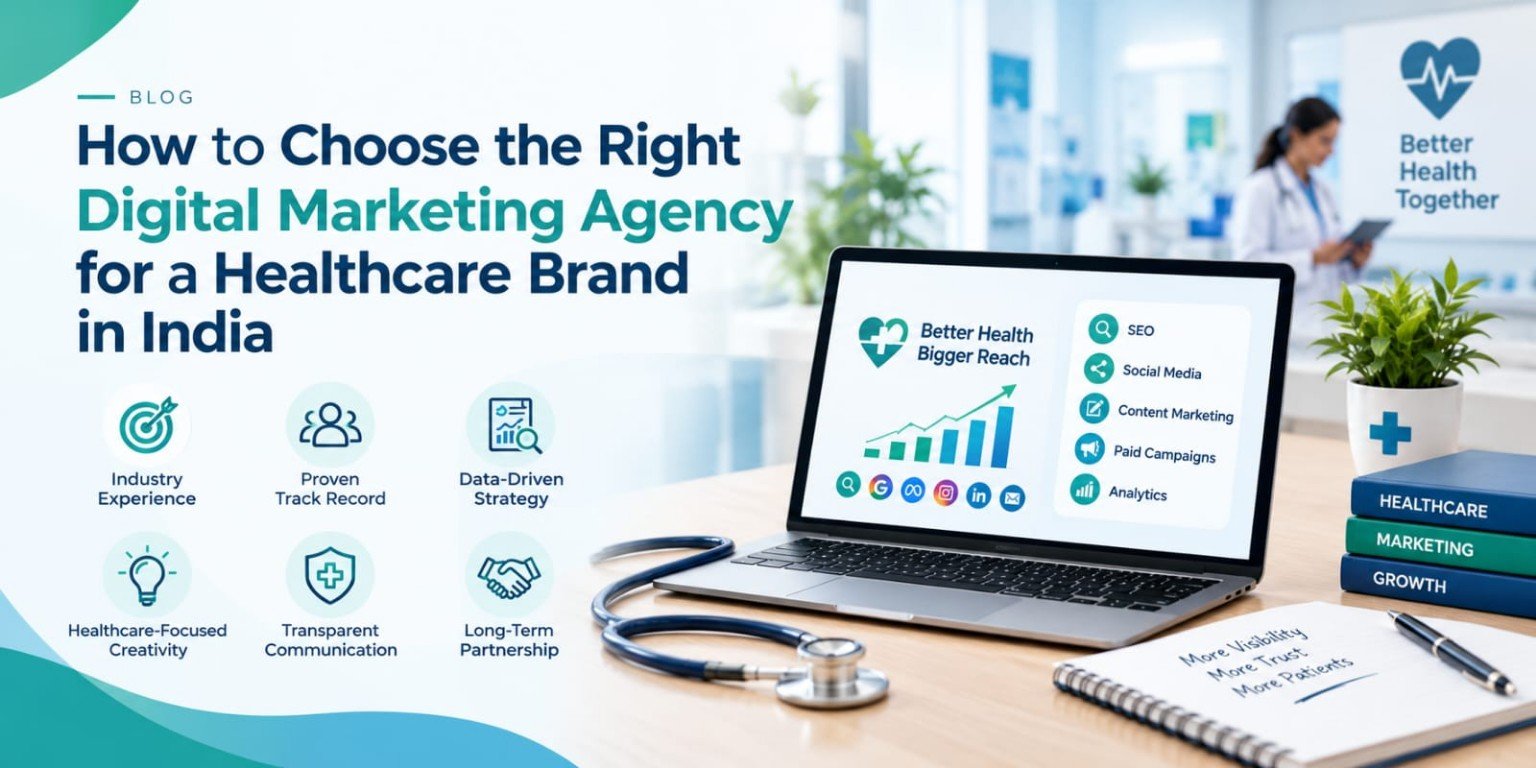
Choosing a digital marketing agency for a healthcare brand is not the same as choosing an agency for a general business.
Hospitals, clinics, diagnostic centres, dental practices, fertility centres, specialty healthcare providers, and other medical organizations deal with audiences who often need detailed information before taking action. A person searching for a healthcare provider may compare services, research specialists, check reviews, look at locations, and evaluate the credibility of a brand before making an enquiry.
This makes the choice of a digital marketing partner particularly important.
A healthcare brand in India should not select an agency only because it offers SEO, social media, Google Ads, or an attractive monthly package. The agency should understand healthcare search behaviour, patient-focused content, local visibility, website experience, reputation, data privacy, lead generation, and the Indian digital market.
The right selection process starts with understanding what the healthcare organization actually needs and then evaluating agencies against those requirements.
Why Healthcare Brands Need a Specialized Digital Marketing Approach
Healthcare marketing has several characteristics that make it different from ordinary service marketing.
A patient may search for a general health topic before searching for a specialist. Someone else may already know the exact service they need and immediately look for a nearby provider.
For example, searches may include:
- “What is cataract surgery?”
- “Best eye hospital in Jaipur”
- “Cardiologist near me”
- “Dental clinic in Udaipur”
- “Fertility specialist in Delhi”
- “Diagnostic centre near me”
Each search represents a different level of intent.
A healthcare digital marketing agency should therefore understand how to connect search intent, content, SEO, website experience, local search, reputation, and conversion opportunities.
This is one of the first things a healthcare brand should evaluate when comparing agencies in India.
Start With Your Own Healthcare Marketing Goals
Before approaching agencies, define what you actually want digital marketing to achieve.
A hospital may want to increase visibility for multiple departments. A specialty clinic may want more relevant appointment enquiries. A diagnostic centre may focus heavily on local searches. A healthcare startup may need to build its online presence from the beginning.
Your goals could include:
- Increasing organic search visibility
- Improving local SEO
- Generating relevant enquiries
- Increasing appointment requests
- Building healthcare brand awareness
- Improving website performance
- Growing social media engagement
- Running targeted PPC campaigns
- Building online reputation
- Creating educational content
- Improving visibility in AI and answer-based search
Having clear goals makes agency comparison much easier.
Instead of asking only, “How much does SEO cost?”, you can ask, “How will this strategy help us achieve our specific objective?”
1. Check Healthcare Industry Experience
One of the first things to investigate is whether the agency understands healthcare.
Ask potential agencies about their experience with:
- Hospitals
- Clinics
- Doctors and specialists
- Diagnostic centres
- Dental practices
- Fertility centres
- Healthcare startups
- Multi-location healthcare brands
Industry experience does not automatically guarantee a successful campaign, but it can help an agency understand the specific challenges involved.
Healthcare content, for example, needs a different approach from content written for fashion, real estate, or e-commerce.
The agency should understand the importance of accurate information, patient trust, privacy, responsible communication, and healthcare-specific search intent.
2. Evaluate Their Healthcare SEO Strategy
SEO should be evaluated based on the actual process, not just the number of keywords an agency promises to target.
Ask how the agency approaches:
- Keyword research
- Search intent
- Technical SEO
- On-page optimization
- Service pages
- Doctor or specialist pages
- Location pages
- Internal linking
- Healthcare content
- Local SEO
- Competitor research
- Performance tracking
A strong strategy should not simply repeat keywords across multiple pages.
For example, if a hospital has several departments, each department may require useful, well-structured information rather than multiple pages that differ only by a keyword.
The agency should be able to explain why particular keywords are being targeted and which page should satisfy each search intent.
3. Look Closely at Their Healthcare Content Process
Healthcare content is one of the most important areas to evaluate.
A digital marketing agency may promise hundreds of blogs, but quantity alone does not make a healthcare content strategy effective.
Ask:
- Who writes the content?
- How is medical information researched?
- Is content reviewed before publishing?
- How are keywords integrated?
- Does the content answer actual user questions?
- How are service pages different from blogs?
- How are FAQs selected?
Good healthcare content should be understandable, useful, and responsible.
It should avoid unsupported claims, guaranteed treatment outcomes, misleading promises, and unnecessary fear-based messaging.
For sensitive healthcare information, privacy and responsible data handling also deserve attention. Indian government health-digital guidance emphasizes privacy, security, consent, and responsible handling of health-related data.
4. Ask How They Understand Patient Search Intent
A good agency should be able to explain the difference between different types of searches.
Consider these examples:
Informational:
“What are the symptoms of diabetes?”
Service-focused:
“Diabetes treatment clinic in Jaipur”
Provider-focused:
“Endocrinologist in Jaipur”
Local:
“Endocrinologist near me”
Action-oriented:
“Book endocrinologist appointment Jaipur”
These searches should not necessarily be handled with the same page.
An agency that understands search intent can build content and landing pages around the different stages of the patient journey.
This is particularly important for healthcare brands because people may move from general research to provider comparison before becoming ready to contact a clinic or hospital.
5. Check Their Local SEO Expertise
Local SEO is particularly relevant for healthcare businesses because many services require patients to visit a physical location.
When evaluating an agency, ask how it manages:
- Google Business Profile
- Local keyword research
- Location pages
- Business information
- Local citations
- Reviews
- Location-specific content
- Multi-location SEO
For example, a hospital with branches in several cities may need a different strategy from a single-location dental clinic.
Each location should have accurate information about its address, phone number, working hours, services, and other relevant details.
A strong local SEO strategy should make it easier for people to discover the correct healthcare facility when searching in their area.
6. Review Their Website Development and UX Capabilities
Your website is often the central point connecting different digital marketing channels.
SEO may bring visitors to the website. Social media may introduce people to the brand. PPC may send users to a landing page. Local search may lead them to a location page.
What happens after they arrive matters.
A healthcare website should make important information easy to find, including:
- Services
- Doctors and specialists
- Locations
- Contact information
- Appointment options
- FAQs
- Educational resources
- Facilities
- Relevant trust information
It should also provide a good mobile experience and clear navigation.
When comparing agencies, ask whether website development, technical SEO, content, and conversion optimization are handled as connected activities.
At World SEO Services, this integrated approach can help align website structure with SEO, healthcare content, local visibility, and patient-focused conversion paths.
7. Understand How They Approach Online Reputation
A healthcare brand’s online reputation can influence how potential patients perceive it.
Before contacting a provider, people may look at reviews, search results, social media profiles, and information available across different platforms.
Ask potential agencies whether they can help with:
- Review monitoring
- Genuine feedback strategies
- Professional review responses
- Brand mention monitoring
- Reputation analysis
- Handling negative feedback appropriately
The objective should not be to manufacture a perfect reputation.
A sustainable approach focuses on genuine feedback, professional communication, accurate information, and appropriate privacy practices.
Healthcare organizations should be particularly careful not to reveal identifiable patient information when responding publicly.
8. Evaluate Their Google Ads and PPC Knowledge
Paid advertising can be useful when a healthcare organization wants to reach people searching for specific services.
However, simply increasing the advertising budget does not automatically improve lead quality.
Ask the agency about:
- Keyword selection
- Geographic targeting
- Campaign structure
- Search intent
- Landing pages
- Conversion tracking
- Budget allocation
- Negative keywords
- Lead quality
- Applicable platform policies
For example, a clinic targeting a specific service in one city may need a very different campaign structure from a hospital promoting several departments across multiple locations.
A good agency should be able to explain how paid campaigns fit into the wider marketing strategy.
9. Ask How Leads Will Be Measured
Healthcare brands should not judge digital marketing only by website traffic.
Traffic is useful, but the more important question may be whether relevant users are taking meaningful actions.
Ask how the agency plans to track:
- Phone calls
- Enquiry forms
- Appointment requests
- WhatsApp or other contact actions where applicable
- Lead sources
- Conversion rates
- Cost per lead
- Lead quality
For example, 500 enquiries may sound impressive, but if most are irrelevant to the healthcare service, the number alone does not provide much insight.
A healthcare brand should therefore understand how the agency separates traffic, leads, relevant leads, and actual business outcomes.
10. Look for Transparent Reporting
Before signing a contract, ask to see an example of the type of report the agency provides.
A useful report should help answer:
- What work was completed?
- What changed?
- What improved?
- Which pages performed well?
- What happened to organic visibility?
- How did local search perform?
- How many relevant enquiries were generated?
- What problems were identified?
- What is planned next?
Reports should not simply contain screenshots and lists of keywords.
The agency should explain the meaning behind the data.
At World SEO Services, reporting can be structured around the selected goals of the healthcare brand, allowing SEO, content, website, local search, and lead-generation performance to be reviewed together.
11. Check Whether the Agency Offers a Customized Strategy
Healthcare brands should be cautious about one-size-fits-all marketing packages.
A dental clinic, fertility centre, diagnostic laboratory, specialty hospital, and healthcare technology company may all need different strategies.
A customized strategy should consider:
- Services offered
- Target audience
- Geographic coverage
- Existing website
- Current search visibility
- Competitors
- Budget
- Business objectives
- Existing marketing channels
Ask the agency:
“Why are you recommending these specific activities for our business?”
The answer can tell you a lot about whether the agency has actually studied your business.
12. Ask About AEO and AI Search
Search behaviour is changing as users increasingly ask longer and more conversational questions.
Instead of searching only for:
“Best cardiologist in Jaipur”
a person might ask:
“What should I consider before choosing a cardiologist in Jaipur?”
Healthcare brands should therefore consider how their content can answer questions clearly.
AEO, or Answer Engine Optimization, can support this through:
- Question-based headings
- Direct answers
- Clear definitions
- Structured content
- Related questions
- Natural language
- Comprehensive topic coverage
When comparing agencies, ask whether they understand both traditional SEO and newer answer-focused search experiences.
AEO should complement SEO rather than replace the fundamentals of technical optimization, useful content, and good website structure.
13. Pay Attention to Data Privacy and Security
Healthcare websites can collect sensitive information through contact forms, appointment requests, consultation enquiries, and other digital interactions.
This makes data handling an important point when evaluating an agency.
Ask:
- What information is collected through forms?
- Where is lead information stored?
- Who can access it?
- How is it transferred?
- What tracking tools are installed?
- How are analytics and marketing tools configured?
- What privacy information is displayed to users?
Indian government digital-health guidance places emphasis on privacy, security, transparency, consent, and appropriate handling of personal information.
The exact legal and compliance requirements can vary depending on the healthcare organization, systems used, and applicable laws, so businesses should obtain appropriate professional advice for their specific situation.
14. Evaluate Communication and Account Management
Even a technically strong agency can become difficult to work with if communication is unclear.
Before selecting an agency, ask:
- Who will manage the account?
- How frequently will meetings happen?
- Who approves content?
- How are urgent issues handled?
- How quickly are questions answered?
- Who manages SEO, content, ads, and website work?
- How are strategy changes communicated?
Clear communication helps avoid delays in content approvals, website updates, campaign changes, and reporting.
A healthcare organization should know who is responsible for what.
15. Compare Pricing Based on Scope, Not Just Monthly Cost
Pricing is naturally an important consideration, but comparing agencies only on monthly fees can be misleading.
One agency may charge less but offer limited SEO, minimal content, and basic reporting. Another may include technical SEO, content strategy, local SEO, website optimization, analytics, and regular strategy reviews.
Instead of asking only:
“Which agency is cheaper?”
compare:
- Services included
- Number and type of deliverables
- Strategy depth
- Reporting
- Account management
- Technical support
- Content quality
- Contract terms
- Revision and approval process
- Expected timelines
The goal is to understand what you are actually receiving for the investment.
16. Be Careful With Guaranteed Results
Healthcare brands should be cautious when an agency promises guaranteed rankings, guaranteed appointment numbers, or instant results.
Search performance depends on many factors, including competition, website condition, search demand, content quality, technical performance, location, and ongoing search changes.
A professional agency should instead explain:
- What can be improved
- What will be measured
- What timeline is realistic
- Which factors are outside the agency’s control
- How the strategy will be adjusted based on results
Clear expectations are more useful than unrealistic promises.
17. Ask for a 90-Day Action Plan
A 90-day plan can help a healthcare brand understand how the agency intends to begin the engagement.
Month 1: Research and Audit
The initial phase may include:
- Website audit
- Technical SEO review
- Keyword research
- Search-intent analysis
- Competitor research
- Local SEO audit
- Content review
- Conversion-path analysis
Month 2: Implementation
The next phase may focus on:
- Technical improvements
- On-page optimization
- Service-page improvements
- Content creation
- Internal linking
- Local SEO updates
- Website improvements
Month 3: Analysis and Optimization
The agency can then review:
- Search visibility
- Organic traffic
- Local performance
- Content engagement
- Conversion data
- Lead quality
- Areas requiring further optimization
The exact plan will depend on the size, condition, and goals of the healthcare website.
A Practical Checklist for Comparing Agencies
Before choosing a digital marketing agency, healthcare brands in India can compare potential partners using a simple checklist.
Look for an agency that can demonstrate:
- Healthcare industry understanding
- Clear SEO methodology
- Search-intent research
- Strong healthcare content practices
- Local SEO capabilities
- Website and technical expertise
- PPC knowledge
- Reputation management
- Lead tracking
- Transparent reporting
- AEO awareness
- Data-conscious processes
- Clear communication
- Customized strategy
- Realistic expectations
This checklist does not identify a single universally suitable agency. Instead, it gives healthcare businesses a practical framework for evaluating which agency’s approach fits their specific needs.
How World SEO Services Can Support Healthcare Brands
For healthcare organizations looking for an integrated digital marketing approach, World SEO Services can bring together multiple areas of online marketing under one broader strategy.
These areas can include healthcare SEO, content marketing, website development and optimization, local SEO, social media, PPC advertising, reputation management, lead generation, analytics, and AEO.
The strategy should be adapted to the healthcare organization’s services, target audience, location, competition, current online presence, and business objectives.
For example, a local clinic may require greater emphasis on local SEO, Google Business Profile, service pages, reviews, and appointment enquiries. A large hospital may need a broader strategy covering departments, specialties, multiple locations, educational content, and complex website architecture.
This is why the agency selection process should focus not only on the list of services an agency provides, but also on how those services will be connected to the healthcare brand’s actual goals.
Questions to Ask Before Signing With an Agency
Before finalizing a digital marketing partner, a healthcare brand can ask:
- How much healthcare industry experience do you have?
- How will you research our patient search behaviour?
- What SEO strategy would you recommend for our website?
- How will you handle healthcare content?
- How will you improve local visibility?
- How will you track relevant leads?
- What will our monthly report include?
- Who will manage our account?
- What is included in the monthly fee?
- What will the first 90 days look like?
- How do you approach AEO and AI search?
- How do you handle data and privacy considerations?
- What results should we reasonably expect?
- How will the strategy change if performance is below expectations?
The answers should give you a clearer understanding of the agency’s process, expertise, communication style, and expectations.
Conclusion
Choosing the right digital marketing agency for a healthcare brand in India requires more than comparing prices or selecting the agency with the longest list of services.
A healthcare business should look for a partner that understands patient search behaviour, healthcare content, SEO, local visibility, website experience, reputation management, paid advertising, lead quality, and emerging search practices.
The agency should also provide transparent reporting, realistic expectations, clear communication, and a strategy tailored to the organization’s services and audience.
Healthcare digital marketing works best when different activities are connected. SEO can bring relevant visitors, content can answer their questions, local SEO can help them find the right facility, reputation can support trust, and a well-designed website can make the next step easier.
For healthcare organizations considering World SEO Services, the focus can be on creating this connected digital ecosystem while keeping the strategy aligned with the organization’s specific goals and market.
Ultimately, the right selection process is about asking better questions, reviewing the agency’s methodology, understanding the scope of work, and choosing a digital marketing approach that fits the healthcare brand’s long-term requirements.
FAQs
A healthcare brand should evaluate an agency based on healthcare experience, SEO capabilities, content quality, local SEO, website expertise, PPC, reputation management, reporting, communication, lead tracking, and its ability to create a customized strategy.
Healthcare involves specialized search behaviour, patient trust, sensitive information, privacy considerations, and responsible communication. An agency familiar with these requirements can build a more relevant digital marketing strategy.
Depending on the organization’s goals, important services can include healthcare SEO, local SEO, content marketing, website development, social media marketing, PPC advertising, reputation management, lead generation, analytics, and AEO.
There is no single suitable budget for every healthcare organization. The investment depends on factors such as business size, locations, competition, services, website condition, marketing objectives, SEO requirements, content needs, and paid advertising plans. Healthcare brands should compare the complete scope of work rather than choosing an agency only by price.
A business should ask about healthcare experience, SEO methodology, content processes, local SEO, PPC, lead tracking, reporting, communication, pricing, contract terms, data handling, AEO, expected timelines, and the first 90-day action plan. These questions can help the organization evaluate whether the agency’s approach matches its requirements.