
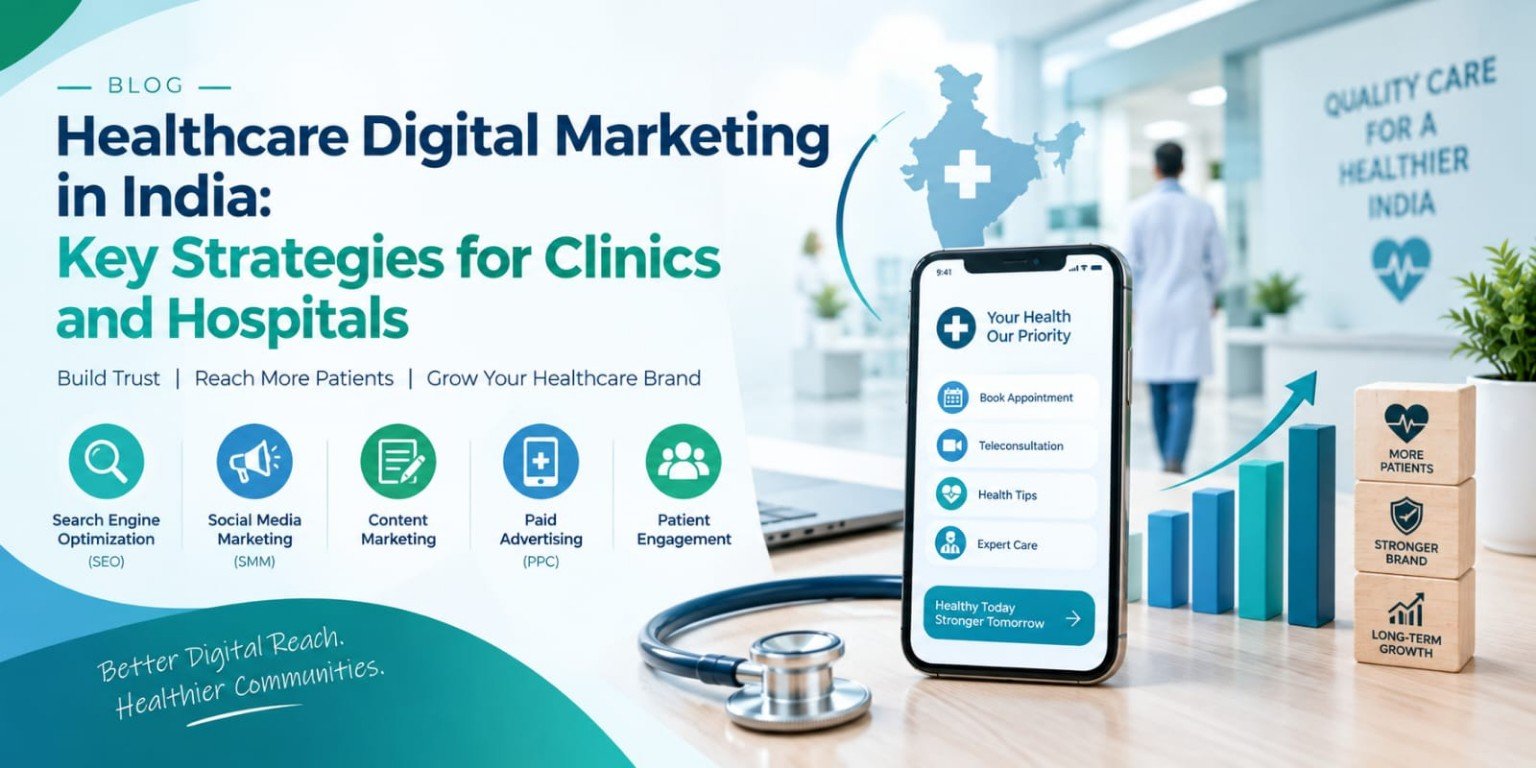
Healthcare discovery in India is increasingly connected to the internet. Before visiting a hospital, clinic, diagnostic centre, or specialist, people may search online to understand a service, find a provider, check a location, read reviews, or compare available options.
For clinics and hospitals, this means having a digital presence is no longer limited to maintaining a website or posting regularly on social media. Healthcare organizations need a structured strategy that connects search visibility, useful content, local discovery, website experience, reputation, paid advertising, and patient enquiries.
However, healthcare digital marketing in India has its own challenges. A multi-specialty hospital in a major city may have very different requirements from a single-location clinic in a smaller city. Similarly, a diagnostic centre, dental practice, fertility centre, and specialty hospital may target different audiences and search behaviours.
A successful approach should therefore be built around the organization’s services, locations, audience, competition, and business objectives.
What Is Healthcare Digital Marketing?
Healthcare digital marketing refers to the use of online channels and strategies to help healthcare organizations reach relevant audiences and communicate their services.
It can include:
- Search engine optimization
- Local SEO
- Healthcare content marketing
- Website development
- Social media marketing
- Google Ads and PPC
- Online reputation management
- Lead generation
- Analytics and conversion tracking
- Answer Engine Optimization
The objective is not simply to increase online visibility.
A well-planned healthcare strategy should help people:
Discover → Understand → Evaluate → Trust → Contact
Different digital channels can support different stages of this journey.
Why Digital Marketing Matters for Indian Healthcare Businesses
India has a diverse healthcare market with large hospitals, independent clinics, specialty centres, diagnostic providers, and healthcare brands operating across cities and regions.
People may use different search methods depending on their needs.
Someone may search for a general health topic first. Another person may directly search for a specialist in their city. Someone else may find a clinic through Google Maps, social media, a recommendation, or an online review.
This creates multiple digital touchpoints.
For clinics and hospitals, a strong online strategy can help improve:
- Search visibility
- Local discovery
- Website engagement
- Brand awareness
- Patient education
- Relevant enquiries
- Online reputation
The exact priorities depend on the organization.
1. Build a Healthcare Website Around Patient Needs
The website should be the foundation of the digital marketing strategy.
A healthcare website should not only look professional. It should make important information easy to find.
Visitors may want to know:
- What services are available?
- Which specialists are available?
- Where is the hospital or clinic located?
- What facilities are offered?
- How can the organization be contacted?
- How can an appointment be requested?
- What questions do patients commonly ask?
Important website sections can include:
- Service pages
- Department pages
- Doctor profiles
- Location pages
- About information
- FAQs
- Contact details
- Appointment options
- Educational resources
The structure should be simple enough for users to navigate without confusion.
Mobile usability is also important because many people begin their healthcare search from smartphones.
At World SEO Services, website strategy can be connected with SEO, content, local search, and conversion requirements so that the website supports more than just the visual side of a healthcare brand.
2. Develop a Healthcare SEO Strategy
SEO helps healthcare organizations become discoverable when people search for relevant information and services.
However, healthcare SEO should not be reduced to inserting keywords into blogs.
A broader strategy can include:
- Keyword research
- Search-intent analysis
- Technical SEO
- On-page optimization
- Service-page optimization
- Internal linking
- Content development
- Local SEO
- Location pages
- Website performance
- Topic and entity coverage
For example, a hospital may need separate pages for cardiology, orthopaedics, neurology, gastroenterology, and other departments.
Each page should have a clear purpose and provide useful information rather than being created simply to target another keyword.
3. Focus on Search Intent Instead of Keywords Alone
Understanding why someone is searching is just as important as knowing what they are searching for.
Healthcare searches can be divided broadly into several categories.
Informational Searches
The user wants to understand a health-related topic.
Examples:
- What is physiotherapy?
- What does an MRI scan show?
- What is cataract surgery?
Educational content can help answer these questions.
Service Searches
The person already knows what service they are looking for.
Examples:
- MRI centre in Jaipur
- Dental implants clinic in Delhi
- IVF centre in Udaipur
Service pages and local landing pages may be more appropriate for these searches.
Provider Searches
The user is looking for a particular type of healthcare professional.
Examples:
- Cardiologist in Jaipur
- Dermatologist near me
- Orthopaedic doctor in Delhi
Doctor profiles and specialty pages can support these searches.
Action-Oriented Searches
The person may already be ready to contact a provider.
Examples:
- Book cardiologist appointment
- Dental clinic appointment near me
- Diagnostic centre phone number
These searches require clear contact and conversion options.
4. Strengthen Local SEO for Clinics and Hospitals
Healthcare is often location-dependent.
A patient looking for a clinic or hospital usually needs to know where the facility is and how to reach it.
This makes local SEO particularly important for healthcare organizations.
A local SEO strategy can include:
- Google Business Profile optimization
- Accurate business information
- Local keyword research
- Location pages
- Local citations
- Genuine reviews
- Local content
- Internal linking
For example, a clinic serving Jaipur should provide clear information about its location and the healthcare services available there.
A hospital with multiple branches should make each location easy to identify.
5. Optimize Google Business Profile
For many local healthcare searches, Google Business Profile can become an important discovery point.
Potential patients may check:
- Address
- Phone number
- Website
- Working hours
- Directions
- Reviews
- Photos
- Services
Incorrect information can create unnecessary problems.
If the listed phone number is outdated or the working hours are incorrect, a person may struggle to contact the provider even if the website itself is well optimized.
Healthcare businesses should therefore regularly review their local information.
6. Create Useful Healthcare Content
Content marketing can help healthcare organizations answer questions before people contact them.
Useful healthcare content may include:
- Educational blogs
- Service explainers
- FAQs
- Health awareness articles
- Doctor-related content
- Department guides
- Procedure explainers
- Location guides
- Short-form educational videos
The purpose should not be to publish as many articles as possible.
The focus should be on answering genuine questions clearly and responsibly.
Healthcare content should avoid unsupported medical claims, guaranteed outcomes, fear-based messaging, and language that presents general information as personalized medical advice.
A strong content strategy should also connect blogs with relevant service pages through natural internal linking.
7. Use AEO for Changing Search Behaviour
People are increasingly asking longer and more conversational questions through search engines and AI-powered tools.
Instead of typing:
“Cardiologist Jaipur”
a user may ask:
“What should I consider when choosing a cardiologist in Jaipur?”
This creates an opportunity for healthcare websites to structure content around real questions.
Answer Engine Optimization, or AEO, can include:
- Question-based headings
- Direct answers
- Clear definitions
- Concise explanations
- Related questions
- Natural language
- Logical content structure
AEO should work alongside traditional SEO rather than replacing it.
For World SEO Services, incorporating AEO into healthcare content can be part of a broader strategy designed to make information easier for both users and modern search systems to understand.
8. Build Strong Doctor and Specialist Profiles
For hospitals and clinics, doctors are often an important part of the patient’s research process.
A useful doctor profile can include appropriate information such as:
- Name
- Specialty
- Professional qualifications
- Areas of practice
- Relevant experience
- Available location
- Consultation information
- Appointment options
The information should be accurate and professionally presented.
Doctor profiles can also help visitors understand which specialist may be relevant to the service they are researching.
9. Use Social Media for Education and Awareness
Social media gives healthcare organizations another way to communicate with their audiences.
However, healthcare social media should not become a continuous stream of promotional posts.
Useful content can include:
- Health awareness topics
- Educational videos
- Frequently asked questions
- Doctor introductions
- General wellness information
- Facility updates
- Healthcare service explanations
- Awareness-day content
Different platforms may suit different audiences, so the strategy should be based on the organization’s target users rather than simply trying to maintain every social account.
Patient privacy should also remain an important consideration when creating and publishing healthcare content.
10. Use PPC Advertising Strategically
Paid advertising can help healthcare organizations gain visibility for relevant searches, particularly when they want to promote specific services or reach audiences in selected locations.
A healthcare PPC strategy may consider:
- Relevant search terms
- Geographic targeting
- Campaign structure
- Landing pages
- Conversion tracking
- Budget allocation
- Negative keywords
- Lead quality
- Applicable advertising policies
For example, a clinic may run a campaign for a specific service in its city rather than using one broad campaign for every service.
The goal should not simply be to maximize clicks.
Relevant traffic and meaningful enquiries are more useful measures of campaign quality.
11. Manage Online Reputation
People may check reviews before contacting a healthcare provider.
Reviews can provide insight into experiences related to communication, appointment processes, staff interactions, facilities, and general service experience.
Healthcare reputation management can include:
- Monitoring reviews
- Encouraging genuine feedback
- Responding professionally
- Addressing legitimate concerns
- Monitoring brand mentions
- Protecting patient confidentiality
The goal should be to maintain an authentic and professional online reputation rather than attempting to create an artificially perfect profile.
12. Create a Patient-Friendly Conversion Journey
Getting visitors to a healthcare website is only one part of digital marketing.
The next question is:
What should they do after arriving?
A healthcare website should make relevant next steps easy to understand.
Depending on the organization, these may include:
- Call the clinic
- Request an appointment
- Submit an enquiry
- Find a location
- Contact the hospital
- Learn about a service
Calls to action should be visible without being overly aggressive.
A person researching a health service may not be ready to book immediately. The website should therefore support both information seekers and visitors who are ready to contact the organization.
13. Connect Digital Marketing With Lead Generation
Healthcare marketing should distinguish between website traffic and meaningful enquiries.
A strong lead-generation strategy can track actions such as:
- Phone calls
- Appointment requests
- Contact forms
- Enquiry submissions
- Relevant campaign conversions
It is also important to understand lead quality.
For example, a clinic may receive many enquiries, but some may come from outside its service area or relate to services it does not provide.
This is why lead-generation campaigns should be evaluated using both quantity and relevance.
14. Use Analytics to Understand Performance
Digital marketing decisions should be based on data rather than assumptions.
Healthcare organizations can monitor relevant metrics such as:
- Organic traffic
- Search visibility
- Keyword performance
- Local search visibility
- Website engagement
- Service-page visits
- Calls
- Form submissions
- Appointment requests
- Lead quality
- PPC performance
The most useful metrics depend on the organization’s objectives.
For example, a hospital focused on organic growth may pay more attention to search visibility and relevant organic traffic, while a clinic running PPC may focus more heavily on conversions and cost per relevant lead.
15. Build a Mobile-Friendly Experience
A large part of online search happens on mobile devices, making mobile experience important for healthcare websites.
Visitors should be able to:
- Read content comfortably
- Navigate between pages
- Find phone numbers
- Locate addresses
- Submit forms
- Access appointment options
- View doctor information
A website that works well on desktop but becomes difficult to use on mobile can create unnecessary friction.
Mobile usability should therefore be considered during both website development and ongoing SEO.
16. Develop Location-Specific Strategies for India
India’s healthcare market is geographically diverse.
A healthcare organization serving Mumbai may have very different search patterns and competition from one serving Jaipur, Ahmedabad, Delhi, Bengaluru, or a smaller regional city.
For multi-location healthcare organizations, the strategy may need:
- Location-specific keyword research
- Dedicated location pages
- Separate Google Business Profiles where appropriate
- Local content
- Accurate location information
- Local reviews
- Regional search analysis
The strategy should reflect the actual market rather than applying the same keywords and content structure to every city.
17. Combine Brand Building With Performance Marketing
Healthcare digital marketing should not focus exclusively on immediate enquiries.
Long-term brand visibility also matters.
SEO and content can help people discover a healthcare organization over time. Social media can support familiarity. Reputation management can influence perception. PPC can capture specific high-intent searches.
These activities can work together.
For example, someone may first discover a hospital through an educational article, later see its social media content, then search for the hospital by name, read reviews, and eventually contact the organization.
This is why a connected strategy is often more useful than treating every channel as an isolated campaign.
Common Digital Marketing Mistakes Healthcare Businesses Should Avoid
Several common mistakes can reduce the effectiveness of healthcare marketing.
Keyword Stuffing
Repeating healthcare keywords unnaturally can reduce content quality and create a poor user experience.
Duplicate Location Pages
Creating almost identical pages for multiple cities without meaningful local information can weaken the overall website.
Overly Promotional Content
Healthcare audiences often need information before they are ready to contact a provider.
Ignoring Local SEO
A strong website may still miss nearby search opportunities if local visibility is not managed properly.
Poor Mobile Experience
Difficult navigation can cause visitors to leave before finding important information.
Measuring Only Traffic
High traffic does not automatically mean high-quality enquiries.
Inconsistent Information
Different phone numbers, addresses, or working hours across platforms can create confusion.
How World SEO Services Can Support Healthcare Digital Marketing in India
Healthcare organizations often need several digital marketing activities working together rather than separate campaigns managed without a common direction.
At World SEO Services, a healthcare digital marketing strategy can bring together SEO, content marketing, website development, local SEO, social media, PPC, reputation management, lead generation, analytics, and AEO.
The exact strategy should be customized according to the healthcare organization’s services, audience, locations, competition, existing digital presence, and business goals.
For example, a single-location clinic may require strong local SEO and service-page optimization, while a large hospital may need a broader strategy covering multiple departments, doctors, locations, educational content, and complex website architecture.
The objective is to build a digital presence that supports discovery, information, trust, and relevant enquiries.
A Practical Healthcare Digital Marketing Plan
Clinics and hospitals can approach their digital marketing strategy in stages.
Step 1: Audit the Existing Presence
Review the website, SEO, Google Business Profile, social media, content, reviews, and existing advertising.
Step 2: Understand the Audience
Identify who the organization wants to reach and what services or information they are searching for.
Step 3: Map Search Intent
Separate informational, service-focused, provider-focused, local, and action-oriented searches.
Step 4: Improve the Website
Make important services, specialists, locations, and contact options easy to find.
Step 5: Build SEO and Content
Create useful pages and content around genuine search demand.
Step 6: Strengthen Local Visibility
Optimize local profiles, location pages, reviews, and business information.
Step 7: Add Paid Campaigns Where Appropriate
Use PPC to reach relevant high-intent audiences while monitoring conversion quality.
Step 8: Track Results
Measure search visibility, website behaviour, enquiries, lead quality, and other relevant goals.
Step 9: Continuously Improve
Use performance data to refine content, SEO, campaigns, website experience, and conversion paths.
Conclusion
Healthcare digital marketing in India requires more than simply creating a website, posting on social media, or running advertisements.
Clinics and hospitals need a connected strategy that considers how people search, what information they need, how they evaluate providers, and what encourages them to take the next appropriate step.
SEO can improve discovery. Healthcare content can answer important questions. Local SEO can help people find nearby providers. A professional website can make information easier to access. Social media can support education and awareness. PPC can target relevant searches. Reputation management can support trust, while AEO can prepare healthcare content for changing search behaviour.
The most effective approach depends on the healthcare organization’s specific services, locations, audience, competition, and objectives.
For healthcare brands working with World SEO Services, the focus can be on building an integrated digital marketing strategy that connects visibility, useful information, patient-focused website experience, local presence, reputation, and measurable enquiries.
When these elements work together, digital marketing becomes more than a collection of online activities. It becomes a structured way for healthcare organizations to be discovered, understood, and considered by the people they are trying to reach.
FAQs
1. What is healthcare digital marketing in India?
Healthcare digital marketing in India involves using online channels such as SEO, healthcare content, local SEO, websites, social media, PPC, reputation management, and AEO to help healthcare organizations reach and communicate with relevant audiences.
2. Which digital marketing strategies are important for hospitals and clinics?
Important strategies can include healthcare SEO, local SEO, useful content marketing, website optimization, Google Business Profile management, social media, PPC advertising, reputation management, lead generation, analytics, and AEO. The right mix depends on the organization’s goals.
3. Why is local SEO important for healthcare businesses?
Many healthcare services are location-dependent. Local SEO can help clinics, hospitals, diagnostic centres, and specialists become more visible when people search for healthcare services in a specific city or nearby area.
4. How can healthcare content improve online visibility?
Useful healthcare content can answer common questions, support search visibility, build topical depth, and help visitors understand services. Content should be clear, accurate, responsible, and written around genuine audience needs rather than keyword repetition.
5. How can clinics and hospitals measure digital marketing performance?
Healthcare organizations can track metrics such as organic traffic, search visibility, local performance, website engagement, service-page visits, calls, enquiry forms, appointment requests, PPC conversions, and lead quality. The most relevant metrics depend on the organization’s marketing objectives.