
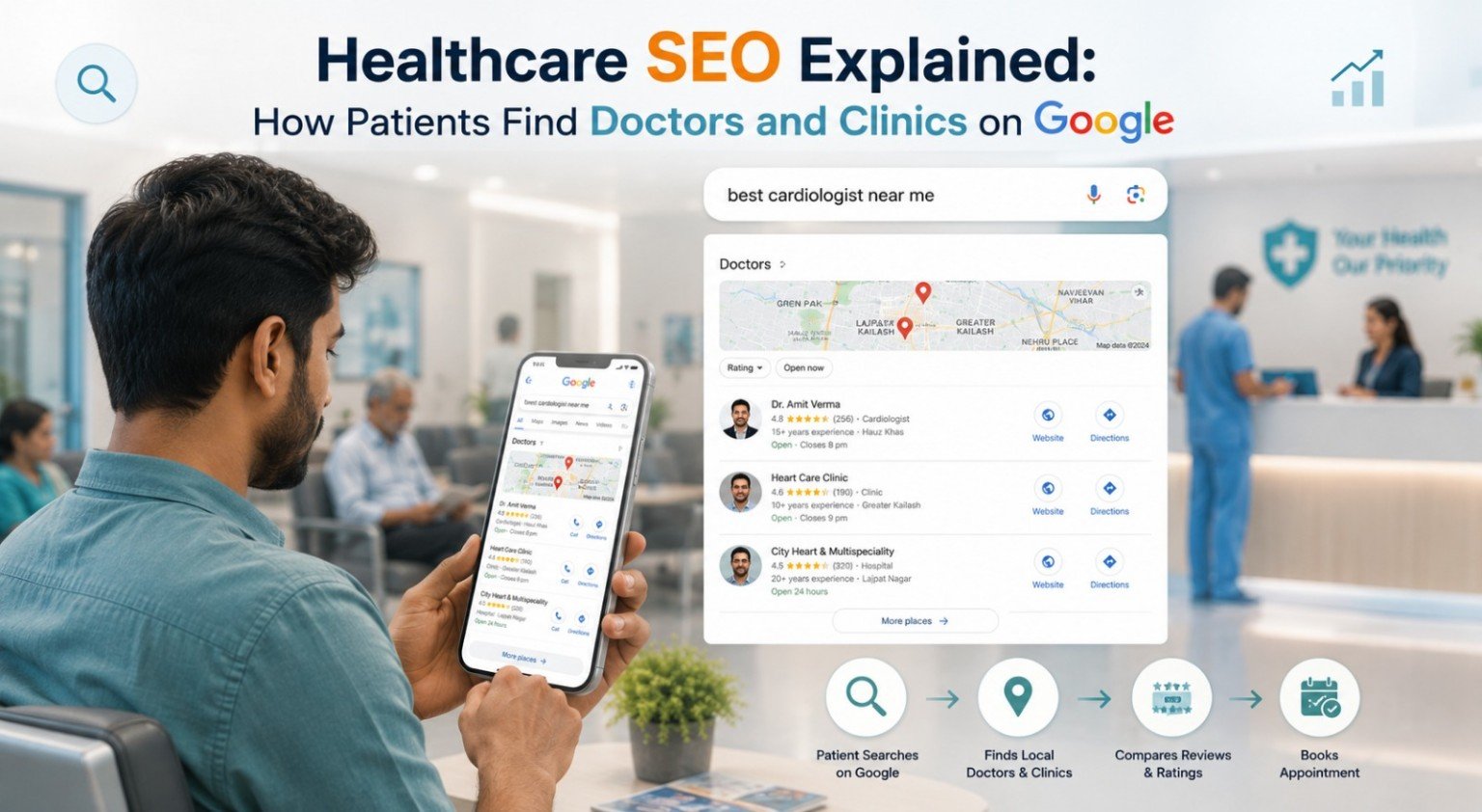
When people need a doctor, clinic, hospital, diagnostic centre, or healthcare service, Google is often one of the first places they turn to.
A person may search for a specialist in their city, look for a nearby clinic, read about a medical service, check a doctor’s qualifications, compare reviews, or simply find the phone number and location of a healthcare provider.
This is where Healthcare SEO becomes important.
Healthcare SEO is not simply about adding medical keywords to a website. It is about helping healthcare organizations become discoverable when people search for relevant information and services, while making sure the website provides clear, useful, and trustworthy information.
For clinics and hospitals, SEO can connect several parts of the digital patient journey:
Search → Information → Provider Discovery → Evaluation → Contact
Understanding how this process works can help healthcare organizations create a stronger presence on Google without relying only on paid advertising.
What Is Healthcare SEO?
Healthcare SEO is the process of optimizing a healthcare website and its online presence so that relevant users can discover it through search engines.
It can involve:
- Keyword research
- Search-intent analysis
- Technical SEO
- On-page SEO
- Healthcare content
- Local SEO
- Google Business Profile optimization
- Doctor profile optimization
- Service pages
- Internal linking
- Website performance
- Structured data
- Conversion optimization
The objective is not to guarantee a particular ranking.
Instead, the aim is to make the healthcare organization’s information easier for search engines to understand and easier for people to find and use.
Google’s current Search guidance emphasizes technical requirements, spam policies, and people-first content as important parts of search visibility.
How Patients Actually Search for Healthcare Providers
Healthcare searches do not all have the same intent.
Someone researching a health topic may behave very differently from someone who is already looking for a doctor.
A typical search journey can include several stages.
Stage 1: The Information Search
The person may start with a question.
Examples:
- What does physiotherapy involve?
- What is an MRI scan?
- What does a dermatologist treat?
- When should someone consult a cardiologist?
At this stage, the person may not be looking for a specific provider.
Educational content can help healthcare brands become visible during this early research stage.
Stage 2: The Service Search
The user becomes more specific.
Examples:
- IVF treatment
- Dental implants
- Physiotherapy clinic
- MRI scan centre
Now, service pages become more relevant.
Stage 3: The Provider Search
The person starts looking for a doctor, clinic, or hospital.
Examples:
- Cardiologist in Jaipur
- Dermatologist in Delhi
- Dental clinic in Udaipur
Doctor profiles, clinic pages, and location-focused content can support this type of search.
Stage 4: The Local Search
The person may want a provider nearby.
Examples:
- Dentist near me
- Hospital near me
- Diagnostic centre near me
Google’s local results use factors including relevance, distance, and prominence to determine which businesses are relevant to a local search.
Stage 5: The Action Search
The user may already be ready to contact the provider.
Examples:
- Book dermatologist appointment
- Hospital phone number
- Clinic appointment near me
At this stage, the website and Google Business Profile should make the next step easy.
Why Healthcare SEO Is Different
SEO principles apply across industries, but healthcare websites require additional care.
People may use healthcare content while researching important personal decisions. This makes accuracy, clarity, trust, and responsible communication particularly important.
Healthcare SEO should therefore focus on more than rankings.
A successful strategy should help users:
- Find relevant services
- Understand what the organization offers
- Learn about doctors
- Find accurate location information
- Access useful educational content
- Contact the provider easily
The website should be useful even when the visitor is not ready to book an appointment immediately.
1. Keyword Research Is the Starting Point
A healthcare SEO strategy begins with understanding what people actually search for.
Keyword research can identify:
- Healthcare services
- Medical specialties
- Doctor-related searches
- Location-based searches
- Informational questions
- Appointment-related searches
- Long-tail queries
For example, a hospital offering cardiology services may need to understand searches around both the specialty and the specific services it provides.
However, keywords should not be treated as isolated phrases.
The more important question is:
What does the person want when they search this term?
That leads to search-intent analysis.
2. Search Intent Determines the Right Page
Different searches need different types of content.
A question such as:
“What is physiotherapy?”
may be best answered with an educational article.
A search such as:
“Physiotherapy clinic in Jaipur”
may require a location-focused service page.
A search such as:
“Dr. [Name] cardiologist”
may require a detailed doctor profile.
A search such as:
“Hospital appointment number”
needs easily accessible contact information.
If every keyword is directed to the homepage, users may struggle to find the information they actually want.
Healthcare SEO works better when the page matches the intent behind the search.
3. Create Dedicated Healthcare Service Pages
Service pages are some of the most important pages on a healthcare website.
A good service page should clearly explain:
- What the service is
- Which department provides it
- Who may seek information about it
- What the organization offers
- Relevant specialists
- Location
- Appointment or contact options
- Common questions
The content should be written for people rather than created simply to increase keyword density.
For example, a hospital should have a meaningful cardiology page rather than one short page overloaded with variations of the phrase “cardiology hospital.”
Useful information is more valuable than repetition.
4. Optimize Doctor Profiles
Patients often search for healthcare professionals by name or specialty.
A well-structured doctor profile can include appropriate information such as:
- Doctor’s name
- Specialty
- Qualifications
- Professional experience
- Areas of practice
- Associated hospital or clinic
- Consultation location
- Appointment information
Doctor profiles can also connect users to relevant department and service pages.
This creates a useful internal linking structure.
For example:
Cardiologist Profile → Cardiology Department → Cardiology Services → Appointment
Such connections can help both users and search engines understand how the website’s information is organized.
5. Local SEO Helps Patients Find Nearby Providers
For many healthcare businesses, local SEO is essential because patients often need services at a particular physical location.
A clinic in Jaipur, for example, needs to be discoverable when relevant users search for healthcare services in Jaipur or nearby areas.
Local SEO can include:
- Google Business Profile
- Location pages
- Local keywords
- Accurate business information
- Reviews
- Local citations
- Website optimization
- Relevant local content
Google states that complete and accurate Business Profile information can help a business appear in relevant local searches.
6. Google Business Profile Is a Key Part of Healthcare Search
When someone searches for a local healthcare provider, the Google Business Profile may appear directly in Search or Maps.
The profile can show:
- Business name
- Address
- Phone number
- Website
- Working hours
- Reviews
- Photos
- Services
- Directions
Google explains that Business Profile information can be combined with information from other sources to provide users with information about a local business.
For healthcare organizations, keeping these details accurate is therefore important.
An outdated phone number or incorrect location can create friction even if the website itself is well optimized.
7. Reviews Can Influence Local Visibility and Evaluation
Reviews are useful for two reasons.
First, people may read them while evaluating a healthcare provider.
Second, Google identifies reviews as one of the factors associated with local prominence. Google describes local ranking primarily in terms of relevance, distance, and prominence, with reviews among the information that can contribute to prominence.
Healthcare organizations should focus on collecting genuine feedback and responding professionally.
They should avoid trying to manipulate reviews or create artificial feedback.
The objective should be an authentic online reputation.
8. Build Healthcare Content Around Real Questions
Healthcare SEO should not depend only on service keywords.
People ask thousands of informational questions before choosing a healthcare provider.
Useful content can address:
- General healthcare questions
- Service explanations
- Specialty information
- Preparation guidance
- Frequently asked questions
- Doctor-related topics
- Healthcare awareness
- Facility information
For example, a fertility clinic could publish educational content around common fertility questions, while a dental clinic could explain different dental services.
Content should remain accurate, responsible, and appropriate for a general audience.
9. Use Question-Based Content for Modern Search
Search is becoming increasingly conversational.
People may ask complete questions instead of entering short keyword phrases.
For example:
“What should I consider before choosing a physiotherapy clinic?”
A healthcare website can answer such questions directly.
Useful formats include:
- Question-based headings
- Short direct answers
- Detailed explanations
- FAQs
- Step-by-step information
- Clear definitions
Google’s search documentation now includes guidance around AI features and different search appearances, making structured, understandable content increasingly relevant to modern search experiences.
This is also where AEO, or Answer Engine Optimization, can complement traditional SEO.
10. Technical SEO Makes Healthcare Websites Easier to Discover
Good healthcare content cannot perform properly if the website has serious technical problems.
Technical SEO can include:
- Crawlability
- Indexing
- Site architecture
- XML sitemap
- HTTPS
- Canonicalization
- Broken-link management
- Mobile usability
- Page performance
- Structured data
Google’s Search documentation identifies technical requirements as part of its Search Essentials.
Healthcare websites should therefore be regularly audited rather than optimized only when traffic falls.
11. Mobile Experience Matters
People frequently use smartphones to search for nearby doctors, clinics, and hospitals.
A mobile visitor should be able to quickly:
- Read service information
- Find a doctor’s profile
- Call the clinic
- Find the address
- Get directions
- Request an appointment
- Navigate between pages
Google’s page-experience guidance specifically encourages site owners to consider mobile display, Core Web Vitals, security, intrusive elements, and overall usability.
For healthcare websites, this can be particularly important because users may be looking for information while travelling or when they need quick access to contact details.
12. Internal Linking Connects the Patient Journey
Internal linking is often overlooked.
A healthcare website can use internal links to connect related information.
For example:
Blog → Service Page → Doctor Profile → Location → Appointment
This helps visitors discover relevant information without repeatedly returning to the main menu.
It can also help search engines understand the relationships between pages.
Internal links should be natural and useful rather than added simply to increase the number of links on a page.
13. Healthcare SEO Needs Location-Specific Content
Healthcare organizations serving multiple cities often want visibility in each location.
However, simply creating pages such as:
- Doctor in Jaipur
- Doctor in Udaipur
- Doctor in Jodhpur
with almost identical content is not a strong long-term strategy.
Each location page should provide meaningful information where appropriate, such as:
- Actual facility details
- Available services
- Doctors
- Location information
- Areas served
- Contact details
- Relevant local questions
The content should reflect the real healthcare service available in that location.
14. Structured Data Can Help Search Engines Understand Pages
Structured data gives search engines additional information about the content of a page.
Healthcare websites may have structured information associated with:
- Organizations
- Doctors
- Locations
- Services
- FAQs
- Breadcrumbs
Google explains that structured data can help it understand page content and may support eligibility for certain richer search features.
Structured data should always accurately represent the visible content of the page.
It should not be used to add information that does not actually exist.
15. Website Authority Is Built Over Time
Healthcare SEO is not only about optimizing individual pages.
A website’s broader authority and visibility can be influenced by how well its content serves users and how it is referenced across the web.
Useful practices may include:
- Creating genuinely valuable content
- Building relevant relationships
- Earning appropriate mentions
- Maintaining consistent business information
- Developing useful resources
- Improving overall website quality
The focus should be on earning visibility rather than using manipulative link-building techniques.
16. Reputation and SEO Work Together
SEO can bring people to a healthcare website.
Reputation can influence what they do after discovering it.
Imagine someone finds a clinic through Google.
They may then:
- Open the website.
- Check the doctor.
- Look at Google reviews.
- Search the clinic name.
- Compare information.
- Decide whether to contact the clinic.
This means SEO should not operate independently from reputation management.
A healthcare brand needs consistency across its website, Google Business Profile, social profiles, and other relevant online sources.
17. Healthcare SEO Should Focus on People, Not Just Rankings
Ranking for a keyword is not the final objective.
Suppose a healthcare website ranks well but:
- The content is difficult to understand.
- The phone number is hard to find.
- The location is unclear.
- The service page does not answer basic questions.
- The website works poorly on mobile.
The ranking alone does not create a good digital experience.
Google’s current guidance emphasizes creating helpful, reliable, people-first content rather than content designed primarily to manipulate search rankings.
Healthcare SEO should follow the same principle.
18. Track the Right SEO Metrics
Healthcare organizations should monitor more than keyword rankings.
Useful SEO metrics can include:
- Organic traffic
- Search impressions
- Click-through rate
- Service-page traffic
- Doctor-profile visits
- Local visibility
- Google Business Profile actions
- Phone calls
- Form submissions
- Appointment requests
- Relevant enquiries
The right metrics depend on the organization’s goals.
A diagnostic centre may care about enquiries for particular tests, while a hospital may want to understand which departments attract the most organic interest.
19. Common Healthcare SEO Mistakes
Healthcare websites often face several SEO problems.
Keyword Stuffing
Repeating the same medical or location keyword unnaturally can make content difficult to read.
Thin Service Pages
A page with only a few generic lines may not answer the questions users actually have.
Duplicate Location Pages
Near-identical city pages provide little unique value.
Ignoring Google Business Profile
A well-optimized website cannot compensate for inaccurate local information.
Poor Mobile Experience
Difficult navigation can prevent users from finding important information.
Publishing Unreviewed Medical Content
Healthcare information should be carefully checked for accuracy and context.
Focusing Only on Rankings
Rankings matter, but relevant traffic and meaningful enquiries are also important.
Manipulative Link Building
Short-term tactics that violate search-engine guidelines can create long-term problems.
How World SEO Services Can Support Healthcare SEO
World SEO Services, healthcare SEO can be approached as a complete search visibility strategy rather than simply a keyword-ranking exercise.
Depending on the organization’s requirements, the strategy can include:
- Healthcare keyword research
- Search-intent mapping
- Technical SEO
- On-page optimization
- Healthcare content
- Local SEO
- Google Business Profile optimization
- Doctor profile optimization
- Location pages
- Internal linking
- AEO
- Website performance
- Analytics and reporting
The approach can be adapted to different healthcare organizations.
A local clinic may need strong local SEO and service-page optimization.
A multi-specialty hospital may require a larger website architecture covering departments, doctors, treatments, locations, and educational content.
A diagnostic centre may focus more heavily on location searches and specific diagnostic services.
The strategy should therefore be based on the organization’s actual services, audience, locations, competition, and goals.
A Practical Healthcare SEO Process
A healthcare organization can approach SEO through the following stages.
Step 1: Audit the Website
Review technical SEO, content, indexing, website structure, mobile experience, and existing visibility.
Step 2: Research Search Behaviour
Identify relevant keywords, questions, services, specialists, and locations.
Step 3: Map Search Intent
Decide whether each search should lead to an article, service page, doctor profile, location page, or another resource.
Step 4: Improve Core Pages
Optimize important service, department, doctor, and location pages.
Step 5: Build Useful Content
Answer genuine healthcare questions and create supporting resources.
Step 6: Strengthen Local SEO
Maintain accurate Business Profile information, location pages, reviews, and local signals.
Step 7: Improve User Experience
Make contact, appointment, location, and service information easy to find.
Step 8: Measure and Refine
Monitor search performance, relevant traffic, local visibility, enquiries, and other meaningful outcomes.
Conclusion
Healthcare SEO is about much more than getting a clinic or hospital to appear for a few keywords.
It is about understanding how people search for healthcare information, services, doctors, and nearby providers—and then creating a digital presence that answers those needs clearly.
Keyword research helps identify demand. Search intent determines the right content. Service pages explain offerings. Doctor profiles support provider discovery. Local SEO helps connect healthcare organizations with nearby audiences. Google Business Profile provides important local information. Technical SEO helps search engines access and understand the website. Content and AEO can answer increasingly conversational questions.
Most importantly, healthcare SEO should remain focused on the people using the information.
For healthcare brands working with World SEO Services, SEO can bring together technical optimization, healthcare content, local search, doctor and service pages, AEO, website experience, and measurable conversion paths.
The objective is not to promise a particular Google position.
It is to build a healthcare website that is discoverable, useful, understandable, technically sound, and genuinely helpful to people searching for healthcare services.
FAQs
1. What is healthcare SEO?
Healthcare SEO is the process of optimizing a healthcare website and its online presence to improve discoverability for relevant searches related to healthcare services, doctors, clinics, hospitals, specialties, and health information.
2. How do patients find doctors and clinics on Google?
Patients may use informational searches, specialty searches, location-based queries, doctor names, Google Maps, and appointment-related searches. They may also use Google Business Profiles to check locations, phone numbers, reviews, websites, and other business information.
3. Why is local SEO important for healthcare providers?
Healthcare services are often location-dependent. Local SEO helps clinics, hospitals, specialists, and diagnostic centres provide accurate information and become more discoverable for relevant local searches. Google states that local results are primarily influenced by relevance, distance, and prominence.
4. What healthcare pages should be optimized for SEO?
Important pages can include service pages, department pages, doctor profiles, location pages, healthcare FAQs, and educational resources. Each page should have a clear purpose and provide useful information relevant to its search intent.
5. How long does healthcare SEO take to show results?
SEO does not have a fixed timeline because results depend on factors such as website condition, competition, content quality, search demand, authority, location, and the changes being implemented. Healthcare organizations should evaluate progress through visibility, relevant traffic, local performance, and meaningful enquiries rather than expecting an instant result.