
A healthcare website can have excellent doctors, valuable services, and modern facilities, but if people cannot find it when searching online, much of that value remains invisible.
Today, patients and healthcare audiences may use Google to find doctors, clinics, hospitals, diagnostic centres, specialties, services, locations, reviews, and answers to healthcare questions. This makes search engine optimization an important part of a healthcare organization’s digital presence.
But healthcare SEO is not just about adding keywords to pages.
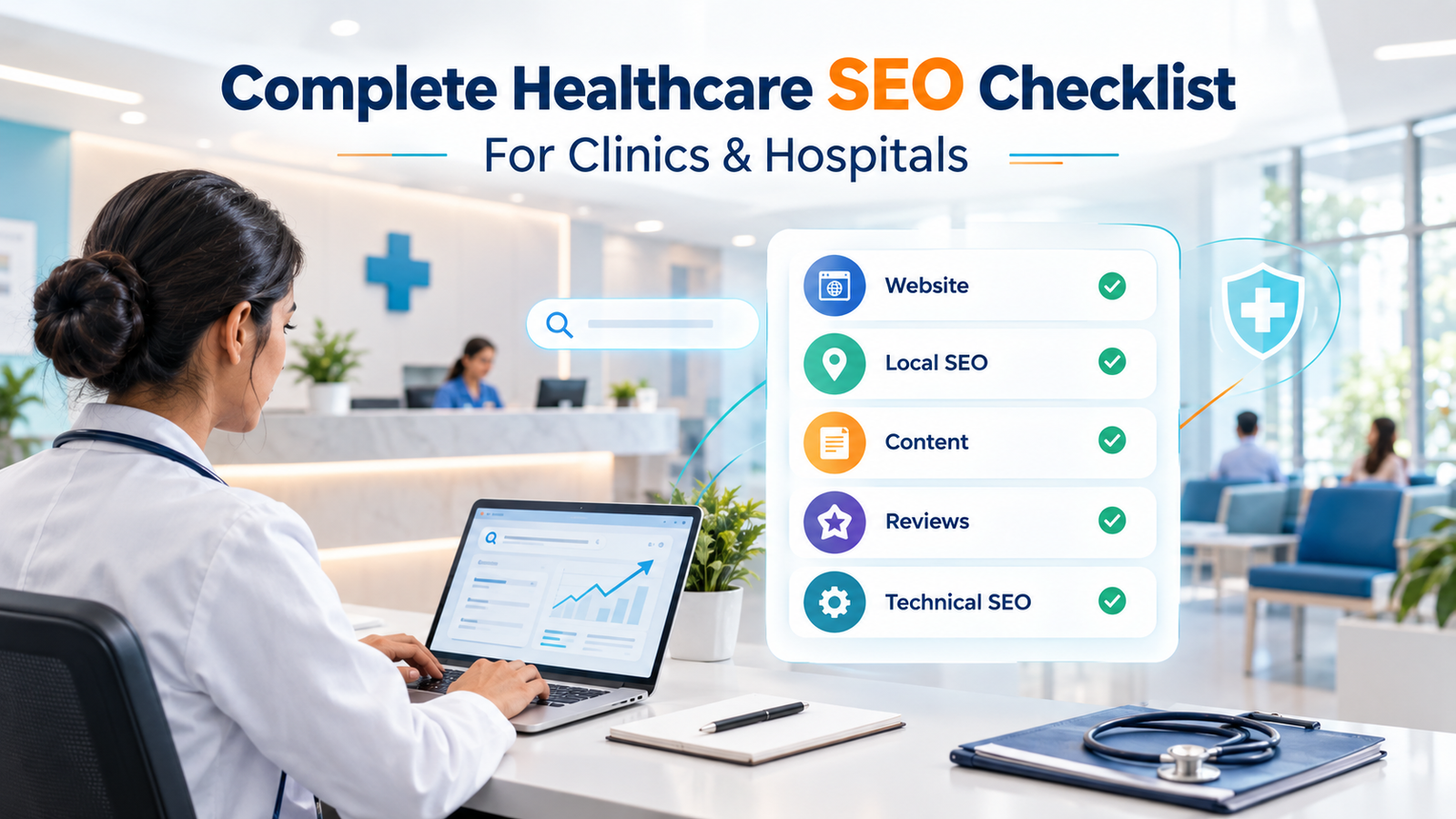
A complete healthcare SEO strategy needs to cover technical performance, search intent, healthcare content, doctor profiles, service pages, local SEO, Google Business Profile, reputation, internal linking, mobile experience, authority, and performance measurement.
Google’s Search guidance emphasizes technical requirements, spam policies, and people-first content as core areas for websites seeking visibility in Search.
This checklist brings those areas together into one practical framework for clinics and hospitals.
What Is Healthcare SEO?
Healthcare SEO is the process of improving a healthcare organization’s website and online presence so that relevant people can discover its information and services through search engines.
It can include:
- Keyword research
- Search-intent mapping
- Technical SEO
- On-page optimization
- Healthcare content
- Local SEO
- Google Business Profile optimization
- Doctor profile optimization
- Service-page optimization
- Internal linking
- Website performance
- Reputation management
- Link building
- AEO
- Analytics and reporting
The objective is not to guarantee a specific Google ranking.
Instead, healthcare SEO should make the website:
Discoverable + Useful + Understandable + Technically Accessible + Easy to Navigate
Complete Healthcare SEO Checklist
1. Healthcare SEO Strategy Checklist
Before making individual SEO changes, establish a clear strategy.
Strategy checklist:
- Define the healthcare organization’s SEO goals
- Identify primary services
- Identify important specialties and departments
- Identify target locations
- Define the target audience
- Analyze major competitors
- Review the existing website
- Identify existing organic traffic sources
- Identify important conversion actions
- Map the patient search journey
- Prioritize high-value pages
- Create a realistic SEO roadmap
A local clinic and a multi-specialty hospital should not necessarily use the same SEO strategy.
For example, a single-location dental clinic may prioritize local search and service pages, while a large hospital may need a much broader structure covering departments, doctors, treatments, facilities, and multiple locations.
2. Keyword Research Checklist
Keyword research helps identify what people actually search for.
However, healthcare SEO should focus on search intent, not simply search volume.
Keyword checklist:
- Research primary healthcare services
- Research specialty-related keywords
- Research doctor-related searches
- Research location-based keywords
- Research “near me” search patterns
- Research appointment-related keywords
- Research informational questions
- Research long-tail keywords
- Identify branded searches
- Identify competitor keyword opportunities
- Group keywords by search intent
- Map keywords to appropriate pages
For example:
Informational:
“What is physiotherapy?”
Service:
“Physiotherapy treatment”
Local:
“Physiotherapy clinic in Jaipur”
Provider:
“Physiotherapist in Jaipur”
Action-oriented:
“Book physiotherapy appointment Jaipur”
These searches may require different pages and different calls to action.
3. Search Intent Checklist
A keyword by itself does not explain what a person wants.
For every important keyword, ask:
- Is the user looking for information?
- Is the user researching a healthcare service?
- Is the user looking for a doctor?
- Is the user looking for a nearby provider?
- Is the user comparing providers?
- Is the user ready to contact or book?
Then assign the right content type.
Possible page types:
- Blog article
- Service page
- Department page
- Doctor profile
- Location page
- FAQ page
- Appointment page
- Contact page
Matching the page with search intent can make the website more useful to both users and search engines.
4. Website Architecture Checklist
A healthcare website should have a logical structure.
Visitors should not have to search through multiple unrelated pages to find an important service or doctor.
Website structure checklist:
- Clear main navigation
- Logical service categories
- Department structure
- Doctor directory where appropriate
- Location structure
- Clear contact page
- Appointment pathway
- Breadcrumb navigation
- Useful footer links
- No unnecessary duplicate pages
- Important pages reachable through internal links
A possible hospital structure could be:
Home → Departments → Cardiology → Cardiology Services → Doctor Profile → Appointment
This creates a connected information journey.
5. Technical SEO Checklist
Technical SEO helps search engines access, crawl, understand, and index a website.
Technical checklist:
- Website uses HTTPS
- Important pages are crawlable
- Important pages are indexable
- XML sitemap is available
- Sitemap is maintained
- Robots.txt is configured correctly
- Canonical URLs are handled properly
- Broken links are identified
- Redirects are checked
- Duplicate URLs are controlled
- 404 pages are managed
- Website architecture is crawl-friendly
- Important pages are not accidentally blocked
- Search Console is configured
- Indexing issues are monitored
Technical SEO problems can prevent otherwise useful content from performing properly.
6. Page Experience Checklist
A healthcare website should be easy to use.
Google’s page-experience guidance encourages site owners to consider factors including Core Web Vitals, secure delivery, mobile display, intrusive elements, and overall usability.
Page-experience checklist:
- Pages load efficiently
- Core Web Vitals are monitored
- Website works properly on mobile
- Content is easy to read
- Buttons are easy to use
- Forms are functional
- Important information is visible
- Pop-ups do not interfere with essential content
- Navigation is simple
- Website uses HTTPS
A patient searching for a phone number or appointment option should not have to fight through a slow or confusing interface.
7. Mobile SEO Checklist
Many healthcare searches happen on smartphones.
A mobile visitor should quickly be able to:
- Find the clinic or hospital phone number
- View the address
- Find directions
- Explore services
- Find doctors
- Read important information
- Submit an enquiry
- Request an appointment
- Navigate between related pages
Check every important page on actual mobile devices rather than assuming desktop performance means the mobile experience is good.
8. On-Page SEO Checklist
Every important healthcare page should have clear on-page signals.
On-page checklist:
- Unique title tag
- Relevant primary keyword
- Clear H1
- Logical H2/H3 structure
- Natural keyword usage
- Useful introduction
- Descriptive URLs
- Optimized meta description
- Relevant internal links
- Descriptive image alt text
- Helpful FAQs where appropriate
- Clear calls to action
- No keyword stuffing
The primary keyword should fit naturally into the page.
Healthcare content should never become awkward simply to repeat a phrase.
9. Healthcare Service Page Checklist
Service pages are especially important because they can attract users with strong service-related intent.
Service-page checklist:
- Clearly explain the service
- Explain what the organization offers
- Include relevant department information
- Link to relevant doctors
- Include location information
- Add appropriate FAQs
- Provide contact options
- Provide appointment information
- Use clear headings
- Answer common user questions
- Avoid unsupported medical claims
- Review information regularly
A service page should provide genuine value rather than functioning as a page created only to target a keyword.
10. Doctor Profile SEO Checklist
Doctor profiles can be valuable search assets for clinics and hospitals.
Doctor profile checklist:
- Correct doctor name
- Specialty
- Relevant qualifications
- Professional experience
- Areas of practice
- Associated department
- Location
- Consultation information
- Appointment option
- Professional photograph where appropriate
- Links to relevant services
- Accurate and updated information
Doctor profiles should contain verified information and should not exaggerate qualifications or experience.
11. Healthcare Content SEO Checklist
Healthcare content should answer real questions.
Content checklist:
- Identify real audience questions
- Match content with search intent
- Use clear language
- Provide useful explanations
- Use descriptive headings
- Break long sections into readable paragraphs
- Add bullet points where useful
- Link to relevant service pages
- Include appropriate FAQs
- Review factual accuracy
- Update outdated information
- Avoid unnecessary keyword repetition
- Avoid fear-based messaging
- Avoid guaranteed medical outcomes
Google’s search guidance encourages helpful, reliable, people-first content rather than content primarily created to manipulate search rankings.
For healthcare organizations, this principle is particularly important.
12. E-E-A-T-Oriented Content Checklist
Healthcare audiences need reliable information.
While SEO should not be reduced to adding credentials to every page, healthcare organizations can strengthen content quality by making relevant expertise and sources clear.
Content quality checklist:
- Content has a clear purpose
- Information is accurate
- Author information is appropriate
- Relevant professional expertise is clear where needed
- Important claims are supported
- Medical information is reviewed where appropriate
- Content is updated when information changes
- Website clearly identifies the organization
- Contact information is accessible
- Content avoids misleading claims
The exact level of expert review will depend on the subject and type of healthcare content.
13. Local SEO Checklist
For clinics and hospitals, local SEO can be extremely important.
Google states that local results are mainly based on relevance, distance, and prominence, and recommends complete and accurate Business Profile information.
Local SEO checklist:
- Claim the relevant Google Business Profile
- Verify the profile
- Use the correct business information
- Keep address accurate
- Keep phone number accurate
- Maintain accurate working hours
- Select appropriate categories
- Add relevant services
- Add useful photos
- Monitor reviews
- Respond appropriately to reviews
- Maintain consistent business information
- Optimize relevant location pages
- Build legitimate local citations
Accurate information helps Google understand what the organization is, where it is located, and what it offers.
14. Google Business Profile Checklist
A healthcare organization’s Google Business Profile should be treated as an active digital asset.
GBP checklist:
- Business name is accurate
- Primary category is appropriate
- Address is correct
- Phone number is correct
- Website URL is correct
- Hours are updated
- Holiday hours are checked
- Services are relevant
- Photos are appropriate
- Reviews are monitored
- Reviews receive professional responses
- Incorrect user-generated information is monitored
Google notes that Business Profile information can come from the business, users, public web sources, and other data sources.
This makes consistency across the website and other online sources important.
15. Healthcare Review and Reputation Checklist
Reviews can influence how potential patients evaluate a provider.
Reputation checklist:
- Monitor Google reviews
- Encourage genuine patient feedback
- Respond professionally
- Avoid sharing confidential patient information
- Track recurring complaints
- Address legitimate service concerns internally
- Monitor brand mentions where relevant
- Check consistency of public information
- Never manufacture fake reviews
Reputation management should support genuine trust rather than attempt to create an artificially perfect online image.
16. Internal Linking Checklist
Internal links help connect related healthcare information.
Internal-linking checklist:
- Link blogs to relevant services
- Link services to relevant doctors
- Link doctors to departments
- Link locations to services
- Link related educational articles
- Use descriptive anchor text
- Avoid excessive links
- Ensure important pages have internal links
- Review orphan pages
A strong internal structure can help create a logical journey:
Educational Content → Service → Doctor → Location → Contact
17. Image SEO Checklist
Healthcare websites often contain large numbers of images.
These can include:
- Doctor photographs
- Facility photographs
- Department images
- Medical illustrations
- Infographics
- Videos and thumbnails
Image checklist:
- Use relevant images
- Use descriptive filenames
- Add meaningful alt text
- Avoid keyword-stuffed alt text
- Compress large images
- Use appropriate image formats
- Check mobile display
- Avoid unnecessary decorative images
- Maintain image quality
- Use captions when they add useful context
Alt text should describe the image appropriately rather than simply repeating the target keyword.
18. Structured Data Checklist
Structured data can help search engines understand certain types of information.
Structured-data checklist:
- Identify relevant schema opportunities
- Use appropriate structured data types
- Ensure markup reflects visible content
- Validate implementation
- Monitor errors
- Avoid adding misleading information
- Review markup after major website changes
Possible areas can include organization information, breadcrumbs, healthcare-related entities, doctors, and other supported content types where appropriate.
Structured data should support accurate understanding rather than be treated as a shortcut to rankings.
19. AEO and AI Search Checklist
Healthcare search is becoming increasingly conversational.
Users may ask complete questions instead of typing short keywords.
AEO checklist:
- Identify common healthcare questions
- Create question-based headings
- Answer questions directly
- Use concise introductory answers
- Provide deeper explanations after direct answers
- Create useful FAQ sections
- Use natural conversational language
- Structure information clearly
- Connect answers to relevant services
- Keep information accurate and updated
AEO should complement SEO, not replace it.
20. Location Page Checklist
Multi-location healthcare organizations often create location pages.
These pages should provide genuine local value.
Location-page checklist:
- Use the actual location
- Mention relevant services available there
- Include correct address
- Include phone number
- Include working hours where relevant
- Link to relevant doctors
- Add directions or location information
- Include unique local information
- Avoid copied city-page templates
- Avoid unnecessary location keyword repetition
A location page should exist because the organization genuinely serves that location—not simply because the keyword has search volume.
21. Backlink and Authority Checklist
External links can contribute to a website’s broader online authority, but quality matters more than simply collecting large numbers of links.
Link-building checklist:
- Earn relevant industry mentions
- Build useful healthcare resources
- Seek legitimate partnerships
- Maintain accurate business listings
- Avoid spammy directories
- Avoid paid link schemes that violate search guidelines
- Monitor suspicious backlinks
- Focus on relevance and quality
The objective should be to build a credible online presence rather than manufacture authority through manipulative tactics.
22. Website Conversion Checklist
SEO should bring relevant visitors to the website, but the website also needs to help them take appropriate next steps.
Conversion checklist:
- Phone number is easy to find
- Appointment option is visible
- Contact form works
- Location is clear
- Doctor information is accessible
- Service pages include relevant next steps
- CTAs are descriptive
- Forms are not unnecessarily long
- Mobile users can call easily
- Confirmation messages work
- Conversion tracking is configured
Not every visitor will be ready to book immediately.
Educational visitors should also have useful next steps, such as exploring a related service or reading another relevant resource.
23. Healthcare Data and Privacy Checklist
Healthcare organizations should take particular care when collecting information through digital channels.
Data checklist:
- Identify what information forms collect
- Collect only information needed for the stated purpose
- Review consent requirements
- Protect submitted information
- Restrict unnecessary access
- Review third-party tools
- Check analytics configurations
- Avoid exposing sensitive information publicly
- Train relevant staff
- Review applicable privacy requirements
SEO should never encourage a healthcare business to collect unnecessary sensitive information simply because additional data might be useful for marketing.
24. Analytics and Search Console Checklist
A healthcare SEO strategy needs measurement.
Analytics checklist:
- Google Search Console is configured
- Analytics is configured appropriately
- Organic traffic is monitored
- Search impressions are tracked
- Click-through rates are reviewed
- Important landing pages are monitored
- Service-page traffic is analyzed
- Doctor-page traffic is reviewed
- Local actions are monitored where available
- Calls are tracked where appropriate
- Form submissions are tracked
- Appointment conversions are monitored
- Lead quality is reviewed
Do not judge SEO only by keyword positions.
Relevant traffic and meaningful actions often provide more useful business information.
25. SEO Audit Checklist
Healthcare SEO should be audited regularly.
Audit checklist:
- Technical SEO audit
- Indexing audit
- Broken-link audit
- Metadata audit
- Content-quality audit
- Keyword cannibalization review
- Internal-linking audit
- Page-speed review
- Mobile usability review
- Local SEO audit
- Google Business Profile review
- Review and reputation audit
- Backlink audit
- Image SEO audit
- Conversion audit
- Analytics review
An audit should result in prioritized actions rather than a long list of issues with no implementation plan.
26. Monthly Healthcare SEO Checklist
SEO is ongoing.
A monthly review can include:
- Check organic performance
- Review Search Console
- Identify ranking changes
- Check important landing pages
- Review new search queries
- Update outdated content
- Check important service pages
- Review doctor information
- Monitor Google Business Profile
- Review new reviews
- Check website errors
- Review conversions
- Identify new content opportunities
- Review competitors
- Prioritize next month’s SEO actions
This makes SEO a continuous improvement process rather than a one-time project.
How World SEO Services Can Support Healthcare SEO
At World SEO Services, healthcare SEO can be approached as a complete search strategy covering both technical foundations and patient-focused visibility.
Depending on the organization’s requirements, this can include:
- Healthcare keyword research
- Search-intent mapping
- Technical SEO
- On-page SEO
- Healthcare content marketing
- Local SEO
- Google Business Profile optimization
- Doctor profile optimization
- Service-page optimization
- Location-page strategy
- Internal linking
- AEO
- Website performance
- Conversion optimization
- Analytics and reporting
The strategy can be customized according to the organization’s specialty, locations, competition, website structure, and business objectives.
For a local clinic, local SEO and service-page optimization may be major priorities.
For a multi-specialty hospital, the focus may extend to departments, doctors, treatments, locations, educational content, and complex website architecture.
The checklist remains broadly useful, but the priority of each item should be based on the actual website and business.
How to Prioritize the Healthcare SEO Checklist
A long checklist can become overwhelming if everything is treated as equally urgent.
A practical priority system is:
Priority 1: Fix Critical Technical Issues
Start with:
- Indexing problems
- Crawl issues
- Broken important pages
- HTTPS problems
- Major mobile issues
- Incorrect canonicalization
Priority 2: Optimize Important Business Pages
Focus on:
- Service pages
- Department pages
- Doctor profiles
- Location pages
- Contact and appointment pages
Priority 3: Strengthen Local SEO
Review:
- Google Business Profile
- Address
- Phone
- Categories
- Services
- Reviews
- Location information
Google recommends keeping Business Profile information complete and accurate, while local visibility is influenced primarily by relevance, distance, and prominence.
Priority 4: Build Useful Content
Create content around:
- Real patient questions
- Search intent
- Healthcare services
- Specialty topics
- Frequently asked questions
Priority 5: Improve Authority and Visibility
Work on:
- Relevant mentions
- Useful resources
- Legitimate backlinks
- Reputation
- Brand visibility
Priority 6: Measure and Improve
Finally, track:
- Organic visibility
- Relevant traffic
- Local performance
- Enquiries
- Calls
- Appointment requests
- Lead quality
This approach helps healthcare organizations spend resources where they can have the most practical impact.
Final Healthcare SEO Checklist
Before considering a healthcare SEO foundation complete, ask:
- Can Google crawl and index the important pages?
- Does every important page have a clear purpose?
- Are service pages genuinely useful?
- Are doctor profiles accurate?
- Are location pages unique and relevant?
- Is the Google Business Profile accurate?
- Are reviews monitored professionally?
- Does the website work well on mobile?
- Is healthcare content useful and responsible?
- Are keywords mapped according to search intent?
- Are internal links connecting relevant pages?
- Are images optimized appropriately?
- Is structured data implemented accurately where appropriate?
- Is the website prepared for conversational search?
- Are important conversions being tracked?
- Are technical and content audits performed regularly?
- Is SEO performance measured beyond rankings?
If the answer to several of these questions is no, there is likely an opportunity to strengthen the healthcare website’s search presence.
Conclusion
A complete healthcare SEO strategy is not one task.
It is a combination of technical optimization, useful content, search-intent research, service-page optimization, doctor profiles, local SEO, Google Business Profile management, reputation, internal linking, mobile experience, authority building, AEO, and ongoing measurement.
For clinics and hospitals, the most important principle is to optimize for people and their search needs first.
A healthcare website should make it easy to discover the right service, understand the available information, find relevant doctors and locations, and take an appropriate next step.
World SEO Services can bring these SEO elements together into a healthcare-focused strategy based on the organization’s services, audience, locations, competition, and digital goals.
SEO should not be treated as a one-time checklist that is completed and forgotten.
Search behaviour changes. Healthcare services change. Websites change. Competition changes.
That is why the strongest healthcare SEO process combines a solid foundation with regular monitoring, useful content updates, technical reviews, and continuous improvement.
FAQs
1. What should be included in a healthcare SEO checklist?
A healthcare SEO checklist should cover keyword research, search intent, technical SEO, on-page optimization, healthcare content, service pages, doctor profiles, local SEO, Google Business Profile, reviews, internal linking, mobile experience, structured data, AEO, backlinks, analytics, and regular SEO audits.
2. Why is local SEO important for clinics and hospitals?
Many healthcare searches are location-specific because patients often need a provider they can physically reach. Local SEO helps healthcare organizations maintain accurate information and become more discoverable for relevant local searches. Google identifies relevance, distance, and prominence as the main factors for local results.
3. How often should a healthcare website be audited for SEO?
There is no universal audit frequency. Important technical issues should be monitored continuously, while a broader SEO review can be performed regularly based on website size, publishing frequency, competition, and the scale of ongoing changes.
4. What are the most important healthcare SEO pages?
Important pages commonly include service pages, department pages, doctor profiles, location pages, contact pages, appointment pages, and useful educational resources. The exact priorities depend on the healthcare organization’s services and search demand.
5. Can healthcare SEO improve patient enquiries?
SEO can help relevant users discover healthcare services and information through search. Whether that visibility leads to enquiries depends on factors such as search intent, website quality, local visibility, trust signals, calls to action, service availability, and the organization’s enquiry or appointment process.