
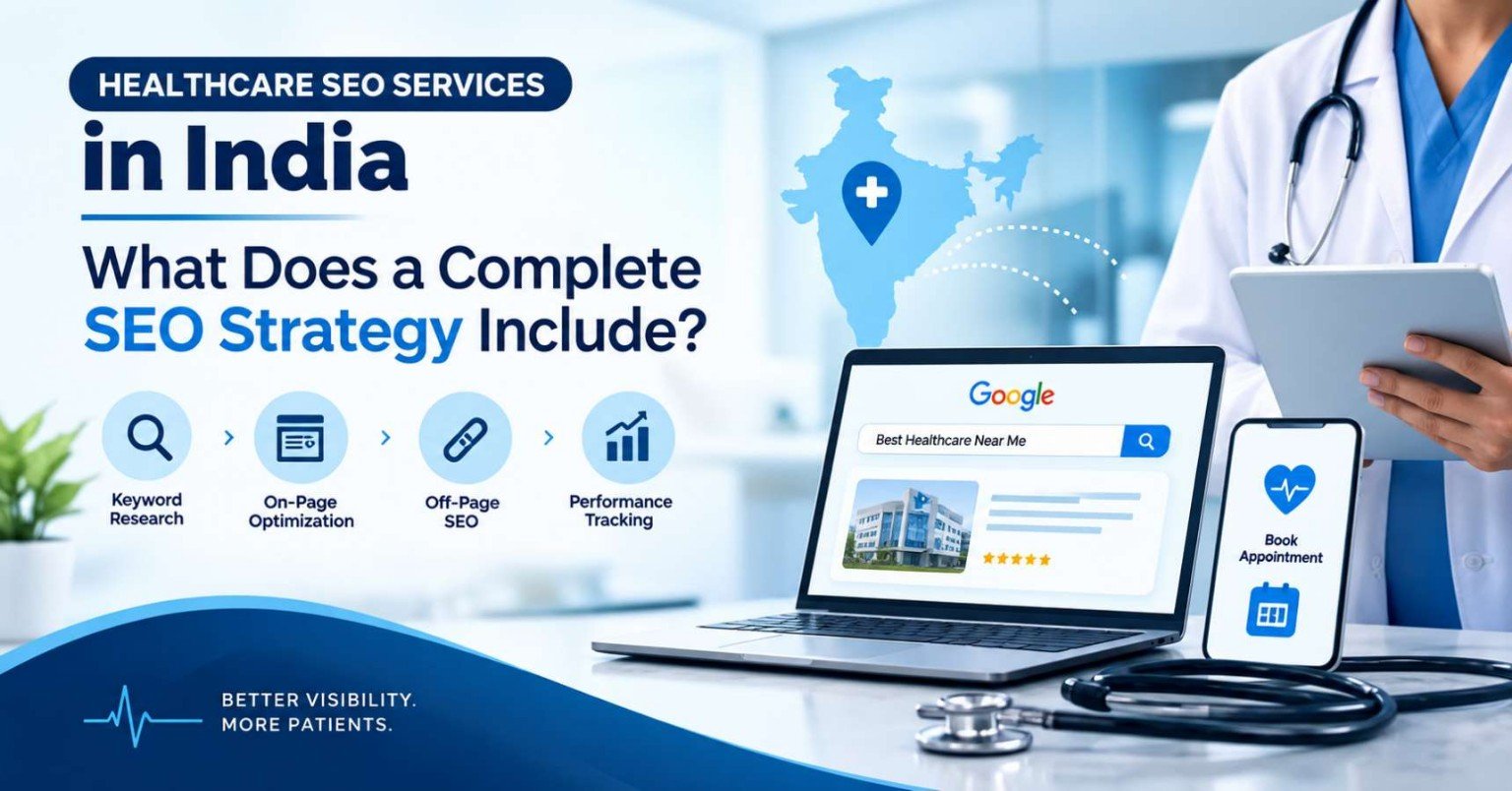
Healthcare businesses in India are competing for attention across Google Search, Google Maps, websites, social platforms, and increasingly conversational search experiences. For clinics, hospitals, diagnostic centres, fertility centres, dental practices, and specialty healthcare providers, simply having a website is no longer enough.
Potential patients may search for a doctor, compare healthcare providers, research a treatment, look for a nearby clinic, read reviews, or check a hospital’s services before making an enquiry.
This is where Healthcare SEO Services in India can become an important part of a healthcare brand’s digital strategy.
A complete healthcare SEO strategy is not limited to adding keywords to webpages. It can involve technical SEO, keyword research, content strategy, local SEO, website optimization, doctor and service pages, reputation-related signals, internal linking, authority building, analytics, and ongoing improvements.
Google recommends following its technical requirements and spam policies while creating useful content that serves people rather than content designed primarily to manipulate search rankings.
For organizations considering healthcare SEO services, the important question is therefore not simply “Do we need SEO?”
It is:
“What should a complete healthcare SEO strategy actually include?”
This guide breaks down the major components to consider when evaluating an SEO strategy or healthcare SEO partner in India.
What Are Healthcare SEO Services?
Healthcare SEO services involve optimizing a healthcare organization’s online presence so that relevant people can discover its services, information, doctors, and locations through search engines.
Depending on the organization’s goals, healthcare SEO may include:
- Healthcare keyword research
- Search-intent analysis
- Technical SEO
- On-page SEO
- Healthcare content strategy
- Service-page optimization
- Doctor profile optimization
- Local SEO
- Google Business Profile optimization
- Internal linking
- Website architecture
- Healthcare reputation support
- Digital authority building
- Analytics and reporting
- Conversion-focused SEO
- AEO and AI-search considerations
The exact mix depends on the organization.
A single-location dental clinic may need a different strategy from a multi-location hospital network.
A fertility centre may require a different content structure from a diagnostic laboratory.
A healthcare SEO strategy should therefore begin with the organization’s actual audience, services, locations, competition, and business objectives.
Why Healthcare SEO Requires a Specialized Approach
Healthcare search is different from many other industries because users often need reliable information before taking action.
A person searching for a restaurant may make a quick decision.
A person researching a medical service may:
- Search for information
- Compare providers
- Research doctors
- Check locations
- Read reviews
- Visit the website
- Contact the clinic
- Decide whether to book
This means healthcare SEO needs to support different stages of the search journey.
Content should be informative, service pages should be clear, doctor information should be accurate, and local information should be easy to find.
Healthcare SEO should also avoid unsupported medical claims, exaggerated guarantees, or misleading promotional language.
1. Healthcare SEO Audit
A complete strategy should begin with an understanding of the current website.
An SEO audit can identify strengths, weaknesses, technical issues, content gaps, and opportunities.
A healthcare SEO audit may review:
- Website structure
- Indexing
- Crawlability
- Page speed
- Mobile usability
- Existing keywords
- Organic traffic
- Service pages
- Doctor pages
- Location pages
- Internal linking
- Metadata
- Duplicate content
- Broken links
- Search Console data
- Google Business Profile
- Competitor visibility
The purpose is not simply to generate a long list of technical errors.
The audit should identify which issues matter most to the healthcare organization’s goals.
2. Healthcare Keyword Research
Keyword research is one of the foundations of SEO.
For healthcare organizations, research should go beyond high-volume keywords.
A useful keyword strategy can include:
Service keywords
- Cardiology services
- IVF treatment
- Dental implants
- Physiotherapy services
Doctor-related keywords
- Cardiologist in Jaipur
- Dermatologist near me
- Gynecologist in Delhi
- Orthopedic doctor in Mumbai
Informational keywords
- What does a cardiologist do?
- When should you see an orthopedic doctor?
- What is IVF treatment?
- How does physiotherapy work?
Local keywords
- Hospital in Jaipur
- Dental clinic near me
- IVF centre in Mumbai
- Diagnostic centre in Delhi
Action-oriented searches
- Book cardiologist appointment
- IVF consultation clinic
- Dental consultation near me
Keyword research should also consider variations, related questions, locations, specialties, and actual search intent.
The objective is to build a useful keyword map rather than force hundreds of keywords onto a small number of pages.
3. Search Intent Mapping
Two keywords can look similar but represent different expectations.
For example:
“What is physiotherapy?”
is primarily informational.
“Physiotherapy clinic in Jaipur”
has local and commercial intent.
“Book physiotherapy appointment Jaipur”
has stronger action-oriented intent.
A complete strategy should map keywords to appropriate pages.
For example:
- Informational queries → Blog or guide
- Service queries → Service page
- Doctor queries → Doctor profile
- Location queries → Local landing page
- Appointment queries → Conversion-focused service or booking page
This reduces the risk of creating multiple pages that compete for the same search intent.
4. Healthcare Website Architecture
The website should have a logical structure that allows both visitors and search engines to understand how information is organized.
A hospital website could have:
Home → Departments → Cardiology → Services
and:
Home → Doctors → Cardiology → Doctor Profile
This structure makes it easier to connect related information.
For large healthcare websites, architecture becomes even more important because hundreds or thousands of URLs may exist.
A complete SEO strategy should review:
- Navigation
- URL structure
- Categories
- Internal linking
- Breadcrumbs
- Orphan pages
- Duplicate pathways
- Important page depth
5. Technical SEO
Technical SEO provides the foundation for search visibility.
A healthcare SEO strategy may include reviewing:
- Crawlability
- Indexability
- Robots.txt
- XML sitemaps
- Canonical tags
- Redirects
- 404 errors
- Server errors
- HTTPS
- JavaScript rendering
- Mobile usability
- Core Web Vitals
- Structured data
- Duplicate URLs
Google’s documentation provides Search Essentials and technical guidance for website owners to help ensure pages can be crawled, indexed, and shown appropriately in Search.
Technical SEO should be treated as an ongoing process, especially when healthcare websites undergo redesigns, CMS changes, migrations, or large content additions.
6. On-Page SEO
Every important page should be optimized around its purpose.
On-page SEO can include:
- Title tags
- Meta descriptions
- H1 headings
- H2/H3 structure
- Relevant terminology
- Content organization
- Internal links
- Image optimization
- Descriptive URLs
- Calls to action
The objective is not keyword stuffing.
Instead, each page should clearly communicate:
What is this page about?
Who is it for?
What information does it provide?
What should the visitor do next?
This is especially important for healthcare service and doctor pages.
7. Healthcare Service Page Optimization
Service pages are often among the most commercially important pages on a healthcare website.
A well-developed service page can explain:
- What the service is
- What the clinic or hospital offers
- Relevant specialists
- Available facilities
- Location
- Frequently asked questions
- Appointment information
- Related services
For example, instead of having one generic “Services” page, a hospital may create dedicated pages for:
- Cardiology
- Orthopedics
- Neurology
- Dermatology
- Gynecology
- Diagnostics
The exact structure should depend on the organization’s real services.
8. Doctor Profile SEO
Doctor pages can attract searches based on:
- Doctor name
- Specialty
- Location
- Qualifications
- Areas of practice
A useful profile can include:
- Name
- Specialty
- Qualifications
- Experience
- Department
- Areas of practice
- Clinic or hospital location
- Consultation information
- Appointment options
Information should be accurate and updated.
A healthcare SEO agency should never create misleading qualifications, exaggerated experience claims, or unsupported “best doctor” statements simply to target search terms.
9. Healthcare Content Strategy
Content marketing and SEO should work together.
A healthcare content strategy can address different search stages.
Awareness content
Answers broad healthcare questions.
Educational content
Explains conditions, procedures, services, and healthcare concepts in accessible language.
Evaluation content
Helps users understand what to consider when choosing a healthcare provider or service.
Service-supporting content
Answers questions that naturally lead users toward relevant services.
The objective should be useful information—not producing large volumes of repetitive articles.
Google’s guidance emphasizes people-first content that provides value to users rather than content created primarily for search-engine manipulation.
10. Healthcare Content Quality and Trust
Healthcare content needs a higher level of responsibility.
A strategy should consider:
- Who created the content?
- Is the information accurate?
- Is it current?
- Are medical claims appropriately supported?
- Are professional credentials represented honestly?
- Is the content written for users rather than search engines?
- Are sources used where appropriate?
Where medical review is genuinely involved, websites can make that process transparent.
The important point is authenticity.
Simply adding a professional’s name to an article does not automatically make the content medically reviewed.
11. Local SEO for Healthcare Businesses
Local SEO is particularly important for clinics and healthcare providers with physical locations.
A local strategy can include:
- Google Business Profile
- Local landing pages
- Location information
- Consistent business details
- Local content
- Reviews
- Relevant local links
- Location-specific service pages
Google says local results are mainly influenced by relevance, distance, and prominence, and recommends keeping Business Profile information complete and accurate.
This means local SEO is not simply about adding a city name repeatedly to webpages.
The website and business profile should clearly communicate what the organization is, what it offers, and where it operates.
12. Google Business Profile Optimization
For healthcare organizations with eligible physical locations, Google Business Profile can be an important part of local visibility.
A profile should contain accurate information such as:
- Business name
- Category
- Address
- Phone number
- Hours
- Website
- Services
- Photos
Google explains that Business Profile information can come from multiple sources, including the business itself, public web information, users, and other data sources.
That makes accuracy across the wider web important as well.
Healthcare businesses should also monitor reviews and respond appropriately rather than attempting to manufacture positive feedback.
13. Healthcare Reputation Support
Search visibility and reputation are increasingly connected.
Before contacting a healthcare provider, people may research:
- Reviews
- Doctor information
- Clinic photographs
- Services
- Location
- Website information
- Public mentions
SEO does not control every reputation signal, but a healthcare brand can make its accurate information easier to discover.
This can involve:
- Accurate doctor profiles
- Updated service information
- Helpful website content
- Consistent business information
- Genuine review management
- Clear organization details
The focus should be on transparency rather than manipulating public perception.
14. Internal Linking Strategy
Internal links connect the website’s information ecosystem.
For example:
A blog about knee pain can link to:
→ Orthopedic Department
→ Orthopedic Doctor
→ Orthopedic Services
→ Appointment Page
This creates a logical path for visitors and helps search engines discover related pages.
For larger healthcare websites, internal linking should be planned rather than added randomly.
15. Healthcare Local Landing Pages
Healthcare organizations operating across multiple areas may need location-specific pages.
For example:
- Hospital in Jaipur
- Hospital in Udaipur
- Hospital in Jodhpur
But location pages should contain meaningful information.
A useful page may include:
- Actual location
- Services available
- Doctors available
- Address
- Contact information
- Operating hours
- Directions
- Relevant local information
Simply changing the city name across identical pages does not create a strong local SEO strategy.
16. Mobile and Page Experience Optimization
Healthcare users frequently search from mobile devices.
A complete SEO strategy should therefore evaluate:
- Mobile layouts
- Navigation
- Readability
- Appointment forms
- Click-to-call functionality
- Page loading
- Core Web Vitals
- Intrusive pop-ups
- HTTPS
Google’s current page-experience guidance emphasizes a broader user experience rather than one isolated metric. It includes Core Web Vitals, secure pages, mobile usability, and ensuring the main content is easy to distinguish.
A technically perfect score is not a substitute for useful content, but a difficult-to-use website can still create unnecessary friction for visitors.
17. Structured Data and Search Appearance
Structured data can help search engines understand specific information on webpages.
Google explains that structured data can help it understand page content and may support eligible search features.
Depending on the website, appropriate structured data opportunities may include:
- Organization information
- Breadcrumbs
- Articles
- Profile-related information
- Other supported content types
Markup should always accurately represent information present on the page.
Valid structured data does not guarantee that Google will display a particular rich result.
18. AEO and AI Search Optimization
Search behaviour is expanding beyond traditional blue links.
People increasingly use conversational queries and AI-powered search experiences to find information.
A healthcare SEO strategy can prepare content by:
- Answering important questions directly
- Using clear headings
- Structuring information logically
- Covering related questions
- Providing accurate context
- Using natural language
- Maintaining clear source and author information where appropriate
Google’s current Search documentation includes guidance covering AI features and other evolving search appearances.
However, AEO should not be treated as a replacement for fundamental SEO.
Strong technical accessibility, useful content, clear information architecture, and genuine value remain important foundations.
19. Healthcare Link Building and Digital Authority
External links can contribute to a website’s broader authority and discoverability.
For healthcare websites, link-building should prioritize relevance and quality.
Potential opportunities may include:
- Healthcare publications
- Professional organizations
- Local organizations
- Industry resources
- Educational institutions
- Relevant news coverage
- Healthcare directories where appropriate
Avoid large-scale low-quality link campaigns.
A healthcare SEO strategy should focus on earning relevant references rather than simply accumulating large numbers of backlinks.
20. Competitor and SERP Analysis
Commercial SEO planning should include research into the search results themselves.
Analyze:
- Which types of pages rank?
- What search intent do they satisfy?
- What topics are covered?
- What local results appear?
- What questions are being asked?
- What content gaps exist?
- How are competitors structuring service pages?
- What types of search features appear?
The purpose is not to copy competitors.
It is to understand the search landscape and identify opportunities to create something more useful and relevant.
21. Conversion-Focused SEO
SEO should connect with the organization’s business goals.
For healthcare websites, relevant conversion actions may include:
- Appointment requests
- Phone calls
- Contact forms
- Consultation enquiries
- Booking actions
- Directions
- Doctor profile views
- Service enquiries
A complete SEO strategy should make these actions easy to understand and use.
For example, a service page may include a clear:
Request an Appointment
button after explaining the service.
A doctor profile may include:
Book a Consultation
The CTA should match the visitor’s intent rather than interrupting every piece of informational content.
22. Analytics and Performance Tracking
A healthcare SEO strategy needs measurement.
Useful metrics can include:
- Organic clicks
- Organic impressions
- Search queries
- Keyword visibility
- Organic landing-page traffic
- Service-page performance
- Doctor-page performance
- Local visibility
- Phone clicks
- Appointment enquiries
- Conversion rate
- Qualified leads
Google Search Console can help site owners monitor search performance and understand indexing.
The most useful reports connect SEO activity with actual business outcomes.
23. SEO Reporting for Healthcare Organizations
A monthly healthcare SEO report should not simply contain a list of ranking positions.
It should explain:
What changed?
Which pages, queries, and technical elements changed?
Why did it change?
What work was completed?
What improved?
Did visibility, clicks, enquiries, or other useful metrics change?
What needs attention?
Which pages or technical areas need additional work?
What happens next?
What are the next priorities?
This makes SEO easier for healthcare decision-makers to evaluate.
24. How to Evaluate Healthcare SEO Services in India
When comparing healthcare SEO agencies, consider more than the monthly price.
Ask potential providers:
Do they understand healthcare search intent?
Healthcare SEO requires more than generic keyword insertion.
Can they handle technical SEO?
Ask whether they perform crawl, indexability, sitemap, canonical, performance, and migration checks.
Do they provide a content strategy?
The agency should explain what content will be created, for whom, and why.
How do they approach local SEO?
For clinics, Google Business Profile and location visibility can be important.
How do they measure results?
Look for reporting that goes beyond keyword positions.
How do they handle healthcare content?
Ask how they approach accuracy, sources, professional information, and medical claims.
How transparent is the process?
You should understand what work is being performed and why.
Is the strategy customized?
A dental clinic, hospital, diagnostic centre, and fertility clinic should not automatically receive the same SEO plan.
25. What a Complete Healthcare SEO Package Can Include
Depending on the organization, a comprehensive package may include:
SEO Strategy
- Business and audience research
- Competitor analysis
- Keyword research
- Search-intent mapping
- SEO roadmap
Technical SEO
- Crawlability
- Indexing
- Sitemap
- Robots.txt
- Canonicals
- Redirects
- Performance
- Mobile SEO
On-Page SEO
- Titles
- Meta descriptions
- Headings
- Content structure
- Internal links
- Image optimization
Content SEO
- Healthcare blogs
- Service content
- Doctor profiles
- FAQs
- Supporting guides
- Content updates
Local SEO
- Google Business Profile
- Location pages
- Local relevance
- Review management support
- Local citations where appropriate
Authority
- Relevant digital PR
- Quality link opportunities
- Healthcare publications
- Relevant industry references
Measurement
- Search Console
- Analytics
- SEO reporting
- Conversion tracking
- Performance analysis
The exact scope should be customized according to the healthcare organization’s size, goals, locations, competition, and website condition.
How World SEO Services Can Support Healthcare SEO in India
World SEO Services can approach healthcare SEO as an integrated process rather than treating keyword rankings as the only objective.
Depending on the organization, the strategy can include:
- Healthcare SEO audits
- Keyword and search-intent research
- Technical SEO
- On-page optimization
- Healthcare content strategy
- Service-page optimization
- Doctor profile optimization
- Local SEO
- Google Business Profile support
- Internal linking
- AEO-focused content
- Authority-building activities
- Conversion-focused SEO
- Analytics and reporting
The approach can be adapted for clinics, hospitals, diagnostic centres, specialty healthcare providers, and multi-location healthcare organizations.
The objective is to build a sustainable search presence around the organization’s real services and audience while keeping the website useful, technically accessible, and trustworthy.
A Practical 90-Day Healthcare SEO Framework
A structured SEO campaign can be organized into phases.
Month 1: Research and Foundation
Focus on:
- Website audit
- Technical SEO
- Keyword research
- Search-intent mapping
- Competitor analysis
- Website architecture
- Google Business Profile review
- Priority-page identification
Month 2: Optimization and Content
Focus on:
- Service-page optimization
- Doctor pages
- Metadata
- Internal linking
- Content creation
- Local landing pages
- Technical improvements
- Conversion elements
Month 3: Authority and Measurement
Focus on:
- Content expansion
- Relevant authority-building opportunities
- Local SEO improvements
- Search Console analysis
- Conversion tracking
- Performance reporting
- Strategy refinement
The exact timeline will vary by website size, competition, technical condition, content requirements, and implementation speed.
Questions to Ask Before Hiring a Healthcare SEO Company
Before signing an SEO contract, ask:
- What exactly is included in the SEO package?
- How will keywords be selected?
- How will healthcare content be handled?
- Who will create and review medical content?
- How will technical issues be identified?
- Will you optimize service and doctor pages?
- How will local SEO be managed?
- How will Google Business Profile be handled?
- What reporting will be provided?
- How will enquiries be measured?
- What happens if the website is redesigned?
- How frequently will the strategy be reviewed?
- What work is handled by the agency and what requires the client’s team?
Clear answers can help healthcare organizations compare SEO proposals based on actual scope rather than just price.
Healthcare SEO Services Checklist
Before choosing or reviewing a healthcare SEO strategy, make sure it covers:
- SEO audit
- Healthcare keyword research
- Search-intent mapping
- Competitor research
- Technical SEO
- On-page SEO
- Service-page optimization
- Doctor profile optimization
- Healthcare content strategy
- Local SEO
- Google Business Profile
- Location pages where relevant
- Internal linking
- Mobile optimization
- Page experience
- Structured data where appropriate
- AEO/AI-search considerations
- Relevant authority building
- Conversion tracking
- Search Console monitoring
- Regular reporting
- Ongoing strategy refinement
Conclusion
A complete healthcare SEO strategy in India is much broader than keyword research or publishing blog articles.
It can bring together technical SEO, website architecture, on-page optimization, healthcare content, service pages, doctor profiles, local SEO, Google Business Profile management, authority building, conversion optimization, analytics, and ongoing performance analysis.
The right combination depends on the healthcare organization’s actual needs.
A local clinic may need to concentrate heavily on local visibility and service pages. A large hospital may require extensive technical SEO, doctor-page optimization, content architecture, and multi-location management. A specialty healthcare provider may need a deeper content strategy around a particular patient search journey.
When evaluating Healthcare SEO Services in India, healthcare organizations should therefore look beyond promises of rankings and ask what work will actually be performed, how the strategy will support their audience, how content quality will be maintained, and how meaningful outcomes will be measured.
Google’s own guidance emphasizes technical accessibility, useful content, and a good overall search experience rather than relying on shortcuts designed to manipulate rankings.
With a structured and transparent approach, World SEO Services can help healthcare organizations build an SEO strategy that connects technical foundations, useful content, local visibility, and measurable digital growth.
FAQs
Healthcare SEO services can include keyword research, technical SEO, on-page optimization, healthcare content, service and doctor-page optimization, local SEO, Google Business Profile support, internal linking, authority building, conversion optimization, analytics, and ongoing reporting.
Healthcare SEO requires greater attention to information accuracy, trust, search intent, professional information, local discovery, and responsible healthcare communication. The strategy also needs to reflect the specific services, specialties, locations, and audience of the healthcare organization.
There is no single standard price. Cost can vary based on website size, number of locations, competition, number of services, technical requirements, content volume, authority-building needs, and the scope of ongoing work. A customized proposal is more useful than a one-size-fits-all price.
SEO does not have a guaranteed timeline. Results can depend on the website’s existing authority, technical condition, competition, content quality, implementation speed, search demand, and many other factors. SEO should generally be evaluated through ongoing changes in visibility, relevant traffic, enquiries, and other business metrics rather than a fixed short-term promise.
Compare agencies based on their understanding of healthcare search, technical SEO capabilities, content strategy, local SEO experience, reporting process, transparency, scope of work, and measurement approach. Ask for a clear roadmap and understand exactly what activities are included before selecting a provider.