
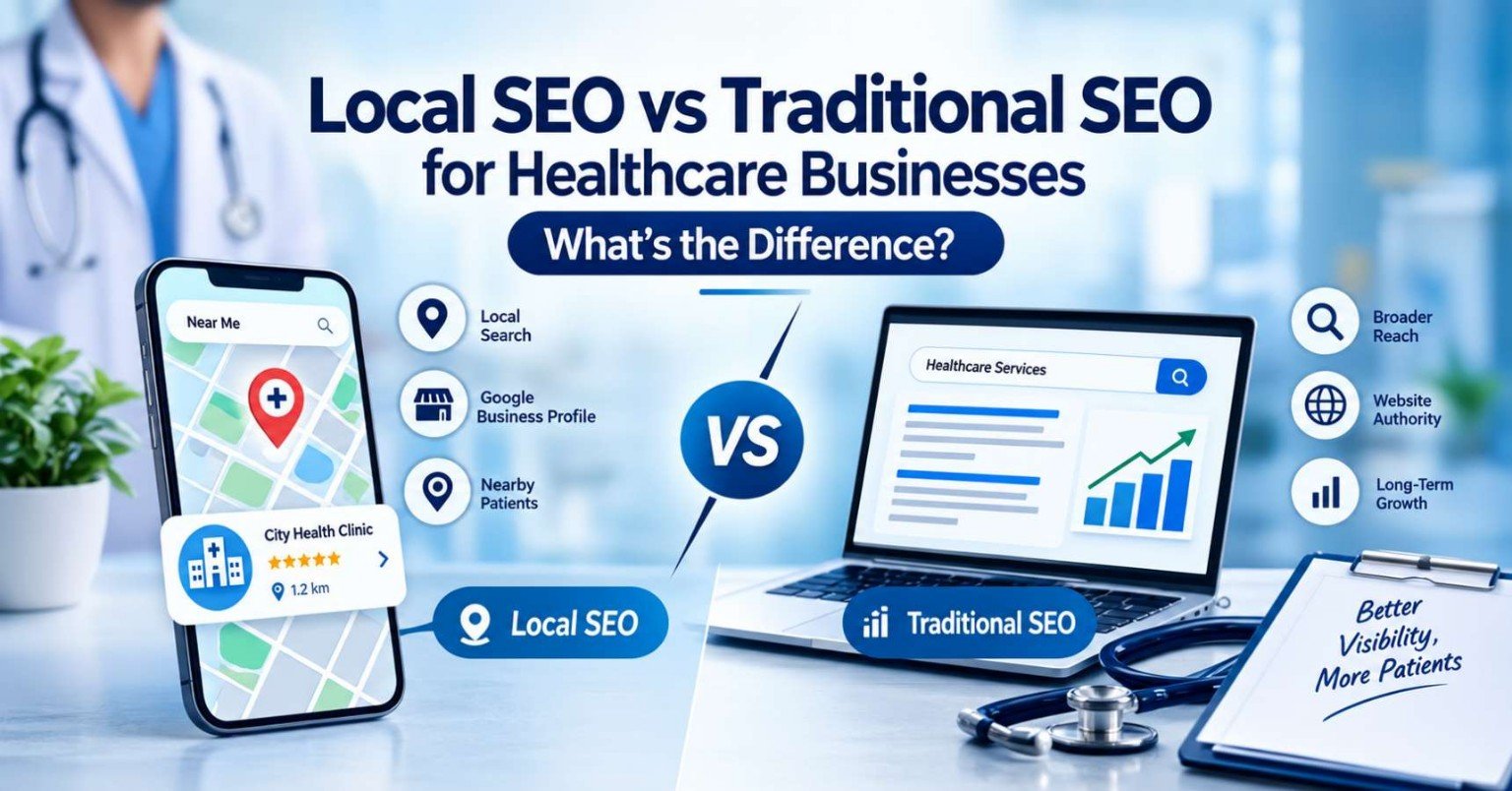
When people search for healthcare services online, they do not all use Google in the same way.
One person may search for:
“Best cardiology services”
while another may search:
“Cardiologist near me”
Someone may look for information about a medical procedure, while another person may already know the service they need and simply want to find a nearby clinic.
These different search behaviours are where the distinction between local SEO and traditional SEO becomes important for healthcare businesses.
Traditional SEO generally focuses on improving a website’s visibility for relevant searches across search engines. Local SEO has a stronger geographic focus and helps businesses become discoverable in location-based searches, including Google Search and Google Maps.
For a clinic, hospital, diagnostic centre, dental practice, or specialty healthcare provider, understanding the difference can help determine where SEO resources should be focused.
Google explains that local results are primarily influenced by relevance, distance, and prominence, while complete and accurate Business Profile information can help Google understand and match a business to relevant local searches.
However, local SEO and traditional SEO are not completely separate strategies.
In many cases, they work together.
This guide explains the differences, similarities, use cases, and practical considerations for healthcare businesses in India.
What Is Traditional SEO?
Traditional SEO, often referred to simply as SEO, focuses on improving a website’s ability to appear in relevant organic search results.
It can involve:
- Keyword research
- Search-intent analysis
- Technical SEO
- On-page optimization
- Content creation
- Internal linking
- Website architecture
- Structured data
- Digital authority
- Performance monitoring
The geographic location of the searcher may not always be the primary focus.
For example, a healthcare organization could create a detailed guide targeting:
“What does a cardiologist do?”
That article could potentially reach people searching for the topic from different cities or regions.
Similarly, a healthcare brand may publish:
- Treatment guides
- Medical FAQs
- Procedure explanations
- Healthcare resources
- Specialist information
- Educational articles
Traditional SEO can therefore help build broader organic visibility around a healthcare website’s expertise and services.
What Is Local SEO?
Local SEO focuses more specifically on searches connected to a location.
Examples include:
- Cardiologist in Jaipur
- Dental clinic in Udaipur
- IVF centre near me
- Hospital in Delhi
- Physiotherapist near me
- Diagnostic centre in Mumbai
The searcher may be looking for a healthcare provider they can actually visit.
Google states that local search results appear across Google Search and Maps, and that local ranking is primarily based on relevance, distance, and prominence.
Local SEO therefore involves more than optimizing the website.
It can also include:
- Google Business Profile
- Accurate business information
- Local landing pages
- Location-specific content
- Reviews
- Local citations
- Local links
- Maps visibility
- Website location signals
Local SEO vs Traditional SEO: The Core Difference
The simplest distinction is:
Traditional SEO focuses primarily on broader organic search visibility.
Local SEO focuses primarily on visibility for geographically relevant searches.
Consider these examples:
Traditional SEO query
“What are the benefits of physiotherapy?”
The searcher is primarily looking for information.
Local SEO query
“Physiotherapy clinic in Jaipur”
The searcher is looking for a provider in a specific location.
Another local query
“Physiotherapist near me”
The searcher’s location becomes an important part of the search context.
Both types of searches can be valuable for a healthcare business, but they require different optimization considerations.
1. Difference in Search Intent
Search intent is one of the biggest differences.
Traditional SEO may target a wider range of informational, commercial, and navigational searches.
For example:
- What is IVF?
- What does an orthopedic doctor treat?
- How does physiotherapy work?
- Types of dental implants
Local SEO focuses more heavily on geographic and provider-related intent:
- IVF clinic in Jaipur
- Orthopedic doctor near me
- Dentist in Udaipur
- Physiotherapy clinic near me
This means the content and landing page should match the searcher’s actual expectation.
A person searching for “what is IVF?” may need an educational article.
Someone searching for “IVF clinic in Jaipur” may need a service or clinic page.
2. Difference in Google’s Search Results
Traditional organic SEO generally focuses on the standard organic search listings.
Local SEO can also involve Google’s local search ecosystem, including:
- Local results
- Google Maps
- Business Profiles
- Location-related search features
Google’s local ranking documentation explains that businesses can appear in local results when their information is relevant to what someone searches for and that distance and prominence also influence local results.
This creates an important distinction.
A healthcare business can have:
Organic website visibility
and separately:
Local business visibility
Both can lead users toward the same website or appointment process.
3. Google Business Profile Is More Important to Local SEO
Traditional SEO primarily works through the website and its organic search presence.
Local SEO adds another important asset:
Google Business Profile.
For an eligible healthcare business with a physical location, the profile can communicate information such as:
- Business name
- Address
- Phone number
- Hours
- Category
- Website
- Photos
- Reviews
- Other available business details
Google says that complete and accurate Business Profile information can help businesses appear for relevant local searches.
Google also explains that local listing information can come from multiple sources, including the business website, third parties, users, and business owners.
This makes consistency and accuracy across the online presence particularly important.
4. Geographic Relevance Is Central to Local SEO
Traditional SEO can target users regardless of where they live.
Local SEO has a stronger geographic component.
For example:
A healthcare article about “How to Choose a Cardiologist” can serve a broad audience.
A page titled:
“Cardiologist in Jaipur”
has a much more specific geographic focus.
Local SEO may therefore involve:
- City
- Neighbourhood
- Service area
- Clinic location
- Nearby areas
- Local landmarks
However, location terms should be used naturally.
Creating dozens of pages with almost identical content and only changing the city name is not a sustainable local SEO strategy.
Google’s spam policies specifically identify doorway abuse, including creating substantially similar regional or city pages primarily to manipulate search visibility.
5. Traditional SEO Can Build Broader Topical Authority
Healthcare websites often need to answer a wide range of questions.
For example, a dermatology clinic may publish content around:
- Skin health
- Acne
- Allergies
- Dermatology procedures
- Skincare questions
- When to consult a dermatologist
These resources can support broader organic visibility.
Traditional SEO can therefore help establish a website’s topical coverage around its specialties.
Local SEO can then connect those specialties with specific geographic locations.
For example:
Educational article
→ Dermatology service
→ Dermatologist profile
→ Jaipur clinic location
This is where both approaches can complement one another.
6. Local SEO Places More Emphasis on Business Information
For local healthcare businesses, accurate business information is essential.
Review:
- Clinic name
- Address
- Phone number
- Opening hours
- Website
- Business category
- Service information
If information differs significantly across online platforms, users may become confused and search engines may have less consistent information to work with.
Google notes that local listing information can be compiled from several sources, including public web content and user contributions.
Keeping important business details accurate therefore supports both user experience and local visibility.
7. Reviews Have a Greater Role in Local Search
Reviews are relevant to local SEO because they appear as part of many business listings.
Google states that reviews and positive ratings can contribute to local ranking prominence.
For healthcare businesses, review management should be handled carefully.
Clinics should:
- Encourage genuine feedback
- Respond professionally
- Avoid fake reviews
- Avoid paying for fabricated feedback
- Avoid manipulating patients into specific wording
The objective should be authentic reputation management rather than artificially creating a positive profile.
8. Traditional SEO Relies More Heavily on Website Content
Content is a major component of traditional SEO.
A healthcare website may create:
- Blogs
- Guides
- Service pages
- Treatment pages
- FAQs
- Doctor profiles
- Research-based resources
The content should satisfy actual search intent.
For example:
“What Is a Root Canal?”
may be answered through an educational article.
“Root Canal Treatment in Jaipur”
may require a location and service-focused landing page.
The two pages can serve different purposes while supporting the same overall SEO strategy.
9. Local SEO Needs Location-Specific Landing Pages
Healthcare businesses serving multiple locations may benefit from dedicated location pages where those locations represent genuine services or facilities.
For example:
- Cardiology Services in Jaipur
- Cardiology Services in Udaipur
- Cardiology Services in Jodhpur
But each page should contain meaningful information.
Useful location-page elements can include:
- Actual clinic location
- Services available there
- Doctors available there
- Contact information
- Opening hours
- Directions
- Local appointment information
- Relevant local FAQs
Avoid creating pages simply to target every nearby city.
10. Traditional SEO Can Reach Users Earlier in the Decision Journey
Healthcare decisions can involve substantial research.
A person may begin with:
“What is knee replacement?”
Then move to:
“When should someone consider knee replacement?”
Then:
“Orthopedic doctor near me.”
Traditional SEO can help capture the earlier informational searches.
Local SEO can become more relevant when the person starts looking for an actual provider.
This creates a potential journey:
Information → Research → Provider Search → Local Discovery → Enquiry
A healthcare SEO strategy can support each stage.
11. Local SEO Is Particularly Relevant for Physical Clinics
Local SEO is especially useful when a healthcare business has a location that patients can visit.
Examples include:
- Dental clinics
- Hospitals
- IVF centres
- Diagnostic centres
- Physiotherapy clinics
- Dermatology clinics
- Eye hospitals
- Orthopedic clinics
For these businesses, local search can connect online discovery with a physical healthcare location.
A person searching “eye hospital near me” is expressing a very different need from someone searching “what are common eye conditions?”
The first query has stronger local intent.
12. Traditional SEO Can Support Healthcare Brands Beyond One Location
Healthcare organizations with national or multi-location services may have broader SEO objectives.
For example, a healthcare brand may want to become visible for:
- Specialty-related searches
- Treatment information
- Healthcare guides
- Doctor expertise
- National service information
Traditional SEO can support this broader content ecosystem.
The website can build visibility around the organization’s specialties while local SEO handles specific physical locations.
13. Keyword Research Is Different
Both strategies use keyword research, but the keyword sets can differ.
Traditional SEO keyword examples
- IVF treatment
- What is IVF?
- IVF process
- Fertility treatment options
- Symptoms of common skin conditions
Local SEO keyword examples
- IVF centre in Jaipur
- IVF clinic near me
- Fertility doctor in Delhi
- Dermatologist in Udaipur
- Dental clinic near me
Local keyword research needs to consider geographic modifiers and search behaviour.
However, not every local search contains the city name.
A query such as “dentist near me” relies on location context rather than an explicit city keyword.
14. Local SEO Depends on Distance
One major distinction is that local search considers geographic distance.
Google explains that distance refers to how far each potential business is from the person searching, using the searcher’s known location when no location is specified.
This means a healthcare business cannot treat local SEO exactly like national organic SEO.
A clinic may have excellent website content but still not appear for every “near me” search because local results vary according to the searcher’s location and other factors.
Distance is not something a business can simply optimize away.
15. Traditional SEO Has a Stronger Website-Centric Structure
Traditional SEO usually concentrates heavily on:
- Website architecture
- Content
- Technical SEO
- Internal links
- Metadata
- Search intent
- Authority
- Search performance
Local SEO adds:
- Business Profile
- Maps visibility
- Reviews
- Local citations
- Location signals
- Geographic relevance
This does not mean local SEO ignores the website.
In fact, Google can use information from a business’s official website as part of the information available for local listings.
16. Both Strategies Need Technical SEO
Technical SEO is not exclusive to either approach.
A healthcare website still needs to be:
- Crawlable
- Indexable
- Mobile-friendly
- Secure
- Logically structured
- Free from major broken links
- Accessible to search engines
A local clinic with a poorly functioning website can still lose potential visitors even if its Business Profile is well maintained.
Technical SEO therefore acts as a shared foundation.
17. Both Strategies Need High-Quality Content
Local SEO does not mean simply adding city names to every page.
Likewise, traditional SEO does not mean publishing endless generic healthcare articles.
Both require useful content.
Google’s Search guidance emphasizes creating helpful, reliable, people-first content, while its spam policies warn against tactics designed primarily to manipulate search rankings.
For healthcare websites, content should also be responsible and accurate.
Avoid:
- Unsupported medical claims
- Guaranteed outcomes
- Fake expertise
- Keyword stuffing
- Duplicate location pages
- Misleading service descriptions
18. How Local and Traditional SEO Work Together
For many healthcare businesses, the strongest approach is not to choose one and ignore the other.
Consider a dental clinic.
Traditional SEO can support:
“What are dental implants?”
↓
Educational article
Local SEO can support:
“Dental implant clinic in Jaipur”
↓
Local/service page
Conversion path:
Service page
↓
Dentist profile
↓
Appointment enquiry
This creates a connected search ecosystem.
The informational content helps people understand the topic.
The local page helps them discover the provider.
The doctor page helps them evaluate the professional.
The appointment page provides the next step.
19. Which Healthcare Businesses May Need Local SEO?
Local SEO can be particularly relevant for healthcare organizations that depend on patients visiting a physical location.
Examples include:
- Local clinics
- Hospitals
- Dental practices
- Diagnostic centres
- Physiotherapy centres
- Eye hospitals
- Fertility centres
- Skin clinics
- Orthopedic clinics
- Mental wellness centres
- Specialty medical practices
For these organizations, geographic discovery can be an important part of the online patient journey.
20. Which Healthcare Businesses May Need Broader Traditional SEO?
Traditional SEO can be particularly useful for organizations seeking broader visibility around information, specialties, or services.
Examples may include:
- National healthcare brands
- Multi-location hospital groups
- Healthcare platforms
- Medical information websites
- Specialty healthcare networks
- Healthcare technology companies
However, these businesses may still benefit from local SEO if they have physical facilities.
The two approaches can coexist.
21. How to Decide What Your Healthcare Business Needs
Start by asking five questions.
1. Do patients visit a physical location?
If yes, local SEO is likely relevant.
2. Do people search for your services by city or “near me”?
If yes, geographic optimization deserves attention.
3. Do you want visibility for educational healthcare topics?
If yes, broader SEO and content strategy can help.
4. Do you operate across multiple cities?
If yes, both location SEO and broader website SEO may be needed.
5. Do you already receive organic traffic but few local enquiries?
Review both website SEO and local search visibility rather than focusing on rankings alone.
22. Common Local SEO Mistakes Healthcare Businesses Should Avoid
Some common mistakes include:
- Incorrect Google Business Profile information
- Wrong business category
- Inconsistent location details
- Duplicate listings
- Fake reviews
- Keyword-stuffed business names
- Identical city pages
- Poor local landing pages
- Ignoring reviews
- Inaccurate opening hours
- Missing location information
- No connection between the website and local profile
Google states that businesses cannot request or pay for a better local ranking and that local results are primarily based on relevance, distance, and prominence.
This is important because no legitimate local SEO strategy can guarantee a specific Google Maps position.
23. Common Traditional SEO Mistakes
Broader healthcare SEO can also fail when businesses:
- Target keywords without understanding intent
- Publish thin content
- Create duplicate articles
- Ignore technical SEO
- Neglect internal linking
- Use excessive keywords
- Publish outdated information
- Create pages with overlapping intent
- Focus only on rankings
- Ignore conversions
Google’s spam policies warn against practices such as scaled low-value content, doorway pages, and other techniques intended to manipulate search visibility.
24. How to Measure Traditional SEO
Traditional SEO performance can be evaluated through metrics such as:
- Organic clicks
- Impressions
- Search queries
- Organic landing-page traffic
- Keyword visibility
- Engagement
- Service-page visits
- Conversions
- Appointment enquiries
The exact metrics should depend on the organization’s objectives.
25. How to Measure Local SEO
Local SEO can be evaluated using signals such as:
- Google Business Profile visibility
- Website clicks
- Phone calls
- Direction requests
- Messages
- Booking actions where available
- Local organic traffic
- Relevant local search queries
- Reviews and review activity
Google Business Profile reporting can provide information about customer interactions with a business profile, depending on the features available to that business.
Local SEO measurement should also consider the actual business outcomes generated from these interactions.
26. How World SEO Services Can Support Both
At World SEO Services, healthcare SEO can be structured to combine broader organic visibility with local search opportunities where relevant.
The strategy may include:
- Healthcare keyword research
- Search-intent mapping
- Technical SEO
- On-page SEO
- Healthcare content strategy
- Service-page optimization
- Doctor profile optimization
- Local SEO
- Google Business Profile optimization
- Location-page strategy
- Internal linking
- Healthcare reputation support
- AEO-focused content
- Search performance analysis
- Conversion tracking
For a single-location clinic, local search may be an important part of the strategy.
For a multi-location healthcare organization, the approach may combine national-level content with individual location optimization.
The strategy should be based on actual services, locations, audience, competition, and business objectives rather than applying the same SEO model to every healthcare organization.
27. A Practical Combined SEO Framework for Healthcare
A healthcare business can organize its strategy into four layers.
Layer 1: Technical Foundation
Make sure the website can be crawled, indexed, and used effectively.
Focus on:
- Technical SEO
- Mobile usability
- Performance
- Site architecture
- Indexing
Layer 2: Organic Content
Build useful pages around:
- Services
- Doctors
- Treatments
- Healthcare questions
- Specialty topics
Layer 3: Local Visibility
For physical healthcare locations, strengthen:
- Google Business Profile
- Location pages
- Reviews
- Local relevance
- Consistent business information
Layer 4: Conversion
Make it easy for users to:
- Call
- Enquire
- Book
- Find a doctor
- Get directions
- Visit the clinic
This creates a more complete path from search visibility to action.
Local SEO vs Traditional SEO: Quick Healthcare Checklist
When reviewing your healthcare SEO strategy, ask:
- Does the website have strong technical foundations?
- Are important services optimized?
- Are doctor profiles useful and accurate?
- Does the content match search intent?
- Is informational content supporting broader SEO?
- Is the Google Business Profile accurate?
- Are location details consistent?
- Are relevant location pages available?
- Are genuine reviews being managed professionally?
- Is the website connected to local search visibility?
- Are mobile users able to contact the clinic easily?
- Are organic conversions being measured?
- Are local interactions being monitored?
- Are duplicate city pages avoided?
- Is content created for users rather than search engines?
Conclusion
Local SEO and traditional SEO serve different search needs, but they are not competing strategies.
Traditional SEO can help healthcare websites build broader organic visibility around services, specialties, doctors, and healthcare information.
Local SEO focuses more heavily on geographic discovery and can help physical healthcare businesses become visible when people search for providers in a particular area or nearby.
For example:
“What is physiotherapy?”
and
“Physiotherapy clinic near me”
may lead to completely different search experiences.
The first may require an educational resource.
The second may require a local business result, service page, or clinic information.
A healthcare organization can benefit from understanding these differences and connecting the two approaches where appropriate.
Google’s local search guidance identifies relevance, distance, and prominence as the main factors behind local results, while accurate Business Profile information helps Google understand a business and match it with relevant searches.
At the same time, broader SEO still provides the website foundation through useful content, technical accessibility, search-intent alignment, internal linking, and strong website structure.
For many healthcare businesses, the practical approach is therefore not Local SEO versus Traditional SEO, but understanding where each fits into the wider digital strategy.
With a structured approach, World SEO Services can help healthcare businesses combine broader organic search optimization with local visibility, creating a search presence that reflects their services, locations, audience, and digital goals
FAQs
Traditional SEO focuses more broadly on improving organic search visibility for relevant topics, services, and queries. Local SEO focuses specifically on geographic searches and local business visibility, including Google Search and Maps. A healthcare business with physical locations may benefit from both.
The importance depends on the clinic’s goals, services, locations, and audience. A clinic that depends heavily on patients visiting a physical location may have significant local search opportunities, while broader SEO can help it reach people researching healthcare topics and services.
Yes. Google Business Profile is an important part of local SEO for eligible businesses. It allows businesses to manage information that can appear across Google Search and Maps, including details such as address, hours, phone number, website, photos, and reviews.
Yes. They can complement each other. For example, a clinic can use broader SEO to publish an educational article about a treatment, while local SEO can help users find the clinic’s relevant service page and location when they are ready to find a provider.
No. Google does not guarantee a specific local ranking position. Google states that local results are primarily influenced by relevance, distance, and prominence. Search results can also vary based on the searcher’s location and query.