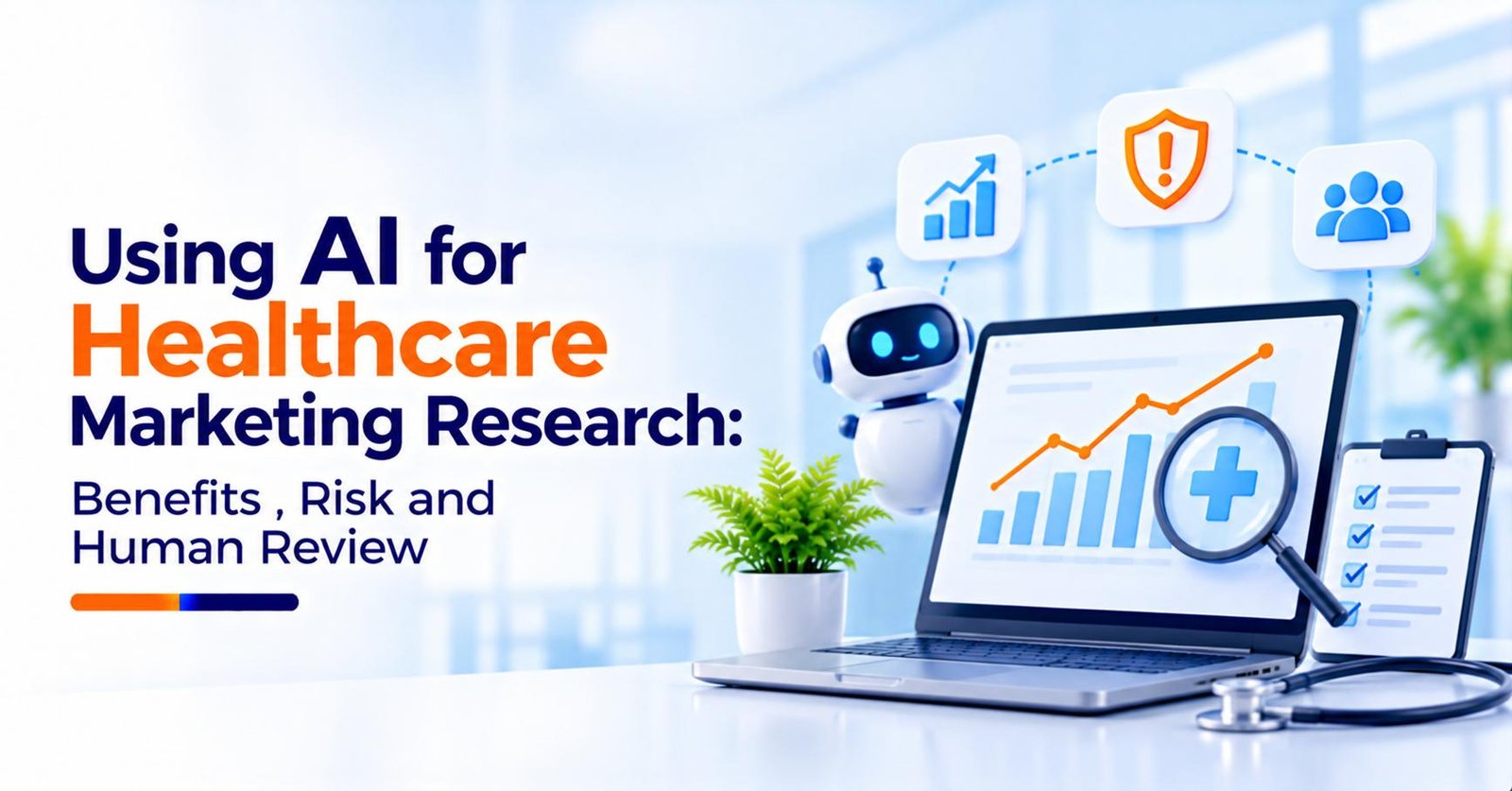
Healthcare marketing research involves understanding patient information needs, studying audience behaviour, identifying relevant search topics, analysing competitors, and finding better ways to communicate healthcare services. Traditionally, these activities require considerable time because marketing teams need to collect information from multiple sources, organise data, and identify useful patterns.
Artificial Intelligence (AI) is changing how businesses approach research. Healthcare marketing teams can now use AI-powered tools to organise information, analyse large amounts of data, discover content ideas, and support strategic planning.
However, healthcare is a sensitive industry where accuracy, privacy, and responsible communication matter. AI-generated information should never be treated as automatically correct, especially when research involves medical topics, patient-related information, or healthcare claims.
This is where a balanced approach becomes important. AI can improve research efficiency, but human expertise is necessary to evaluate findings, verify information, and make appropriate marketing decisions.
At World SEO Services, healthcare-focused digital marketing combines research, content strategy, SEO, and technology to support better online communication. Through practical Healthcare AI Solutions, healthcare organisations can explore how AI supports marketing research while keeping accuracy, privacy, and human review at the centre of the process.
In this article, we will explore the benefits of AI in healthcare marketing research, its limitations, potential risks, and the importance of human involvement.
1. What Is AI-Powered Healthcare Marketing Research?
AI-powered healthcare marketing research uses artificial intelligence tools to collect, organise, analyse, and interpret information that supports marketing decisions.
Instead of manually reviewing every research source, marketing professionals can use AI to assist with specific tasks.
For example, AI tools may help teams:
- Identify common healthcare search topics.
- Organise frequently asked questions.
- Analyse publicly available competitor content.
- Discover possible content gaps.
- Categorise audience feedback.
- Summarise marketing reports.
- Generate initial content ideas.
- Identify patterns in campaign performance data.
Consider a hospital planning to improve its cardiology marketing strategy. The marketing team may use AI to organise common heart-health questions, review existing website content, and identify topics that could be explained more clearly.
The tool can help organise the research, but healthcare professionals and experienced marketers must still determine whether the findings are accurate, relevant, and suitable for publication.
2. Benefits of Using AI for Healthcare Marketing Research
AI can support several stages of the research process. Its biggest advantage is helping teams work with information more efficiently.
A. Faster Topic Research
Healthcare marketing teams need to create content around different medical specialities, services, treatments, and patient information needs.
Manually brainstorming topics for every department can become time-consuming.
AI tools can help generate initial topic ideas based on:
- Medical speciality.
- Healthcare service.
- General audience questions.
- Seasonal health awareness themes.
- Common website content gaps.
- Search intent.
For example, a hospital’s orthopaedics department may need content related to joint health, sports injuries, posture, and bone health.
AI can suggest possible topics within these categories. The marketing team can then select relevant ideas based on the hospital’s services and the expertise of its doctors.
B. Better Understanding of Search Intent
Search intent refers to the reason behind a user’s search query.
Understanding intent helps marketers create content that matches what people are actually looking for.
AI can assist with organising keywords and queries into broad categories.
- Informational intent: A person wants to understand a health topic.Example: What causes frequent headaches?
- Commercial investigation: A person is comparing available healthcare services or providers.Example: What should I consider when choosing a diagnostic centre?
- Transactional intent: A person is ready to take an action.Example: Book an appointment with a cardiologist.
AI can help categorise large keyword lists and suggest relevant content formats. However, marketers should verify these classifications using actual search results, keyword research tools, and website performance data.
C. Identifying Content Gaps
A content gap exists when a website does not adequately cover information that its intended audience may need.
AI can help compare existing website content with a list of relevant topics or questions.
For example, a hospital website may have a general cardiology page but limited information about its diagnostic services, doctor profiles, or frequently asked questions.
AI-assisted research can help identify these missing areas.
The marketing team can then decide which pages need improvement and which topics deserve separate content.
D. Organising Competitor Research
Competitor research helps healthcare organisations understand how other providers communicate their services online.
AI can assist in reviewing publicly available information, such as:
- Website service pages.
- Blog categories.
- Department descriptions.
- Public social media content.
- Content formats.
- Frequently discussed topics.
It can organise these observations into useful summaries.
However, AI-generated competitor analysis should not be treated as a complete or verified picture of another organisation’s marketing strategy. Teams should check the original sources and avoid copying competitor content.
E. Supporting Campaign and Performance Analysis
Healthcare marketing campaigns generate different types of data, including impressions, clicks, website visits, form submissions, and enquiries.
AI can help organise campaign reports and highlight possible patterns.
For example, a marketing team may notice that one service page receives considerable website traffic but generates fewer appointment enquiries.
AI may help summarise the available data and suggest areas for further investigation, such as page content, form usability, or audience relevance.
The final interpretation should consider tracking quality, campaign settings, website behaviour, and other relevant factors.
3. How AI Can Support Different Healthcare Marketing Research Activities
AI is not limited to blog topic research. It can assist with several activities across a healthcare marketing strategy.
Keyword and Search Query Research
AI can help expand seed keywords into related questions, topic groups, and possible long-tail search terms.
For example, a seed keyword such as “orthopaedic doctor” may lead to related research topics involving joint pain, sports injuries, bone health, and consultation-related questions.
Dedicated SEO tools should still be used to verify search volume, keyword difficulty, competition, and actual search performance.
Audience Question Research
AI can help organise publicly available questions from search results, website FAQs, and approved feedback sources.
This can help marketing teams understand which topics may require clearer explanations.
For example, a hospital may discover that visitors frequently need information about consultation timings, department availability, or appointment procedures.
Social Media Research
AI can help identify broad content themes and organise ideas for different healthcare audiences.
It may also assist in categorising public comments and identifying recurring general questions.
However, social media comments should not be treated as verified medical evidence or representative patient research.
Website Content Analysis
AI can review website text and help identify:
- Repeated information.
- Unclear service descriptions.
- Missing explanations.
- Inconsistent terminology.
- Opportunities to improve content structure.
This can support a broader healthcare website audit when combined with technical checks and human review.
4. Popular AI Tools That Can Support Healthcare Marketing Research
Different AI tools offer different capabilities. Marketing teams should select tools based on their actual research requirements, data policies, and available features.
ChatGPT
<text><Entity value=”ChatGPT” category=”software” disambig=”AI assistant by OpenAI”/> can assist with brainstorming, organising research notes, grouping keywords, summarising non-sensitive information, and preparing initial content outlines.
It can also help marketing teams develop research questions and organise findings into structured formats.
Google Gemini
<text><Entity value=”Google Gemini” category=”software” disambig=”Google AI assistant”/> can support research, content ideation, summarisation, and analysis depending on the available features and connected services.
Marketing professionals should verify important facts using reliable original sources.
Perplexity
<text><Entity value=”Perplexity” category=”software” disambig=”AI-powered answer and research engine”/> can assist with exploratory research by presenting information alongside sources that users can review.
The presence of a citation does not automatically make a claim accurate. Always open and assess the original source.
SEMrush
<text><Entity value=”Semrush” category=”software” disambig=”SEO and digital marketing research platform”/> provides SEO and competitive research capabilities. Its data and research features can help marketers examine keywords, website visibility, and content opportunities.
AI-related features may also support parts of the content workflow, depending on the selected product and plan.
Google Analytics 4
<text><Entity value=”Google Analytics 4″ category=”software” disambig=”Google website and app analytics platform”/> helps marketers understand website and app activity.
Its reporting and analysis capabilities can support research into traffic sources, user engagement, and conversion activity. It should not be confused with a tool that independently verifies patient needs or medical information.
These tools can complement one another, but no single platform should be treated as a replacement for proper research and professional judgement.
5. Risks of Using AI in Healthcare Marketing Research
Although AI can save time, using it without proper checks can create serious problems.
Healthcare marketing involves medical information, professional reputation, and sometimes sensitive data. Incorrect findings can affect the quality of published content and marketing decisions.
A. Inaccurate or Fabricated Information
AI tools may generate incorrect facts, outdated information, or unsupported statements.
For example, an AI-generated article may describe a medical treatment incorrectly or present an unverified statistic as established evidence.
How to manage this risk:
- Verify medical information through reliable sources.
- Use current clinical guidance where relevant.
- Ask qualified healthcare professionals to review medical content.
- Check statistics and references before publication.
- Remove unsupported claims.
B. Data Privacy and Confidentiality Risks
Healthcare organisations may work with sensitive information, including patient records, appointment details, medical histories, and enquiry data.
Entering identifiable patient information into an unapproved AI tool can create privacy and confidentiality risks.
How to manage this risk:
- Never upload identifiable patient information into public AI tools without an appropriate legal basis and approved safeguards.
- Use approved systems for sensitive information.
- Apply data minimisation.
- Remove identifying details when preparing suitable research examples.
- Review vendor data handling, retention, and security policies.
- Follow applicable privacy and healthcare regulations.
Even removing a patient’s name may not be sufficient to anonymise information if other details can identify the person.
C. Bias in AI-Generated Insights
AI outputs can reflect limitations or biases in their training data and the information provided to them.
For example, an AI-generated audience profile may overemphasise one age group or assume that everyone searches for healthcare services in the same way.
How to manage this risk:
- Compare AI suggestions with actual audience and website data.
- Consider different age groups and accessibility needs.
- Avoid making broad assumptions about patient behaviour.
- Review research across different medical specialities.
- Involve people with relevant healthcare and marketing knowledge.
D. Overdependence on AI Suggestions
If a marketing team relies entirely on AI-generated research, its content strategy may become repetitive or disconnected from the hospital’s actual services.
AI may suggest popular topics that are not relevant to a particular hospital or its available medical facilities.
How to manage this risk:
Use AI as a research assistant, not as the final decision-maker. Prioritise topics based on service availability, audience needs, clinical relevance, and marketing objectives.
E. Misleading Healthcare Marketing Claims
AI-generated content may include exaggerated benefits, unsupported success rates, or statements that imply guaranteed medical outcomes.
Such claims can create ethical, professional, and regulatory concerns.
How to manage this risk:
Review all healthcare marketing claims before publication. Ensure that service descriptions, doctor information, treatment explanations, and outcome-related statements are accurate and appropriately supported.
6. Why Human Review Is Essential in Healthcare Marketing Research
AI can process information quickly, but it does not replace clinical expertise, marketing experience, or professional accountability.
Human review is necessary because healthcare decisions and communication require context.
Medical Accuracy Review
A qualified medical professional should review health-related claims, explanations, treatment descriptions, and educational content where appropriate.
This helps ensure that information is consistent with reliable medical knowledge and the hospital’s actual services.
Research Source Verification
Marketing professionals should open original sources rather than relying only on AI summaries.
Check:
- Who published the information.
- When it was published or updated.
- Whether the source is authoritative.
- Whether the information is supported by evidence.
- Whether the findings are relevant to the intended audience.
Strategic Decision-Making
AI may suggest dozens of content opportunities, but a marketing team must decide which ones are worth pursuing.
For example, a hospital may receive many suggestions about a speciality that it does not currently offer. These topics should not automatically become part of its content plan.
Human judgement helps connect research findings with actual business priorities.
Tone and Audience Review
Healthcare content should be informative, respectful, and easy to understand.
Human editors can identify language that sounds insensitive, confusing, overly technical, or unnecessarily promotional.
7. A Practical Workflow for Using AI in Healthcare Marketing Research
Healthcare organisations can introduce AI into their research process through a structured workflow.
Step 1: Define the Research Objective
Start with a clear question.
For example:
- Which healthcare topics should our website cover?
- What information do visitors need before requesting an appointment?
- Which speciality pages need improvement?
- What search queries are relevant to our services?
A specific objective helps prevent unnecessary AI-generated information.
Step 2: Collect Reliable Research Inputs
Use suitable sources such as:
- Google Search Console data.
- Google Analytics 4 reports.
- Keyword research platforms.
- Existing website content.
- Publicly available competitor information.
- Approved and anonymised audience feedback.
- Relevant healthcare publications and official guidance.
Do not use confidential patient data in unapproved tools.
Step 3: Use AI to Organise Information
Provide non-sensitive research inputs and ask the AI tool to organise them into categories.
For example, keyword lists can be grouped by medical speciality, search intent, or content format.
The output should be treated as an initial working document rather than verified research.
Step 4: Verify the Findings
Check suggested keywords, medical claims, statistics, competitor observations, and research sources.
Remove unsupported or irrelevant findings.
Step 5: Review With Relevant Experts
Involve healthcare professionals when medical accuracy needs to be assessed. Marketing specialists should also evaluate whether the findings match the organisation’s audience and objectives.
Step 6: Turn Research Into a Marketing Plan
Convert verified findings into practical activities, such as:
- New website pages.
- Updated service descriptions.
- Educational blog topics.
- Social media content.
- SEO improvements.
- Campaign ideas.
Step 7: Measure and Improve
Monitor the results using relevant indicators such as organic search visibility, website engagement, relevant enquiries, and content performance.
Use these findings to improve future research and marketing decisions.
8. Best Practices for Responsible AI Use in Healthcare Marketing
A responsible AI strategy should include clear guidelines for employees, agencies, and other people involved in marketing activities.
Consider the following practices:
- Choose appropriate tools: Use AI platforms that meet the organisation’s security, privacy, and operational requirements.
- Protect sensitive information: Do not share identifiable patient details or confidential business information with unapproved tools.
- Verify important facts: Check medical claims, statistics, and references before using them.
- Maintain human accountability: Assign responsibility for reviewing and approving AI-assisted research.
- Avoid misleading claims: Ensure that marketing content does not promise guaranteed outcomes or exaggerate services.
- Document the process: Maintain clear internal guidelines for AI use and content approval.
- Review outputs regularly: AI tools and their capabilities change, so workflows should be evaluated periodically.
These practices help organisations use AI more carefully without losing the efficiency benefits it can provide.
9. How Healthcare AI Solutions Support a Better Marketing Strategy
AI is becoming a useful part of digital marketing, but its value depends on how it is implemented.
Healthcare organisations need more than access to AI tools. They need a clear strategy that connects technology with research, content development, SEO, audience understanding, and responsible communication.
Professional Healthcare AI Solutions can support this process by helping organisations identify suitable AI applications, improve research workflows, and use available information more effectively.
At World SEO Services, healthcare-focused digital marketing brings together SEO, content marketing, website development, PPC advertising, social media marketing, and AI-related capabilities.
For hospitals, clinics, and other healthcare organisations, a practical approach should focus on:
- Identifying research tasks where AI can save time.
- Selecting suitable tools for specific requirements.
- Improving the organisation of marketing information.
- Maintaining reliable research and review processes.
- Protecting sensitive data.
- Evaluating the impact of AI-assisted workflows.
The objective is not to replace marketing professionals or healthcare experts. It is to help them work with better-organised information and make more informed decisions.
Conclusion
AI can make healthcare marketing research more organised and efficient by supporting keyword research, content planning, competitor analysis, audience question categorisation, and campaign reporting.
However, these benefits come with responsibilities. Inaccurate information, data privacy risks, biased outputs, and unsupported healthcare claims can create problems when AI-generated findings are used without verification.
The most effective approach combines AI assistance with human expertise. Marketing professionals should verify research findings, while qualified healthcare professionals should review medical information wherever necessary.
With a responsible strategy, Healthcare AI Solutions can support better research workflows and more informed marketing decisions.
World SEO Services helps healthcare organisations explore digital marketing and AI-supported strategies while keeping useful information, accuracy, and responsible communication at the centre of their online presence.
Frequently Asked Questions
1. How is AI used in healthcare marketing research?
AI can support healthcare marketing research by organising keywords, identifying content opportunities, analysing publicly available competitor information, categorising audience questions, summarising reports, and generating initial content ideas. Its outputs should be verified before being used for marketing decisions.
2. What are the main benefits of AI in healthcare marketing?
The main benefits include faster research, improved organisation of information, support for keyword grouping, content gap identification, and assistance with campaign analysis. AI can reduce repetitive work, allowing marketing teams to focus more on strategy and decision-making.
3. What are the risks of using AI for healthcare marketing?
Common risks include inaccurate information, outdated claims, data privacy issues, biased outputs, and misleading medical content. These risks can be reduced through approved tools, reliable sources, data protection practices, and appropriate human review.
4. Why is human review important when using AI for healthcare marketing?
Human review helps verify medical accuracy, assess research sources, identify misleading claims, and ensure that content matches the organisation’s actual services. Qualified healthcare professionals should review medical information where appropriate, while marketing specialists should evaluate its relevance and communication quality.
5. How can Healthcare AI Solutions help hospitals and clinics?
Healthcare AI Solutions can help hospitals and clinics explore AI-assisted research, organise marketing information, identify content opportunities, and improve selected marketing workflows. The best results come from combining suitable technology with reliable data, privacy safeguards, and professional human oversight.