Choosing the right digital marketing partner is an important decision for any hospital, clinic, diagnostic centre, IVF centre, or healthcare organisation. Patients increasingly use search engines, online reviews, websites, and social media to research healthcare providers before contacting them. A strong digital presence can help healthcare businesses reach relevant audiences, communicate their services clearly, and make it easier for potential patients to find essential information.
However, not every digital marketing agency understands the unique requirements of the healthcare industry. Healthcare marketing involves more than increasing website traffic or running advertisements. It requires accurate medical content, responsible communication, patient-focused website experiences, local search visibility, and a clear understanding of how people look for healthcare services.
This is why selecting a Healthcare Digital Marketing Company in India requires careful evaluation. The right partner should understand your business goals, identify opportunities for improvement, and develop a strategy that aligns with your services, audience, budget, and long-term plans.
At World SEO Services, healthcare digital marketing involves bringing together essential activities such as search engine optimisation, content marketing, website development, social media management, paid advertising, reputation management, and lead generation. Understanding what to look for in an agency can help healthcare organisations make more informed decisions.
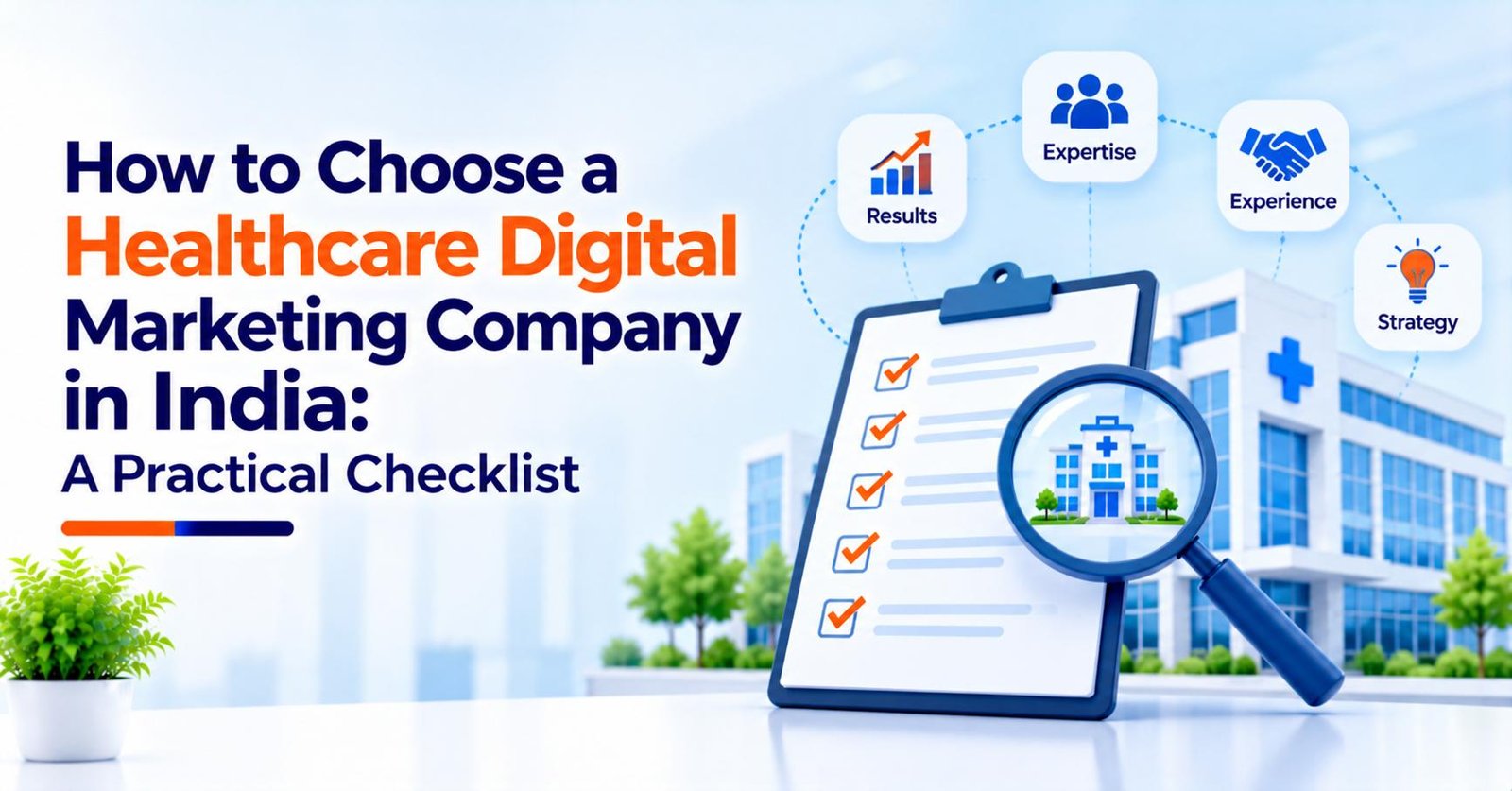
This practical checklist explains the key factors to evaluate before choosing a healthcare digital marketing company in India.
1. Check Whether the Company Understands Healthcare Marketing
The first step is to determine whether the agency understands the healthcare sector and its specific marketing requirements.
Healthcare audiences often search for information about symptoms, medical specialities, doctors, treatments, diagnostic facilities, and hospital locations. They may need clear answers before deciding to contact a provider. Marketing communication must therefore prioritise accuracy, trust, and clarity.
A company that focuses only on generic marketing techniques may overlook these important considerations.
What to look for
- Experience working with hospitals, clinics, doctors, or other healthcare organisations.
- Understanding of healthcare-related search behaviour.
- Ability to create clear and responsible medical content.
- Knowledge of local search optimisation for healthcare facilities.
- Familiarity with healthcare website requirements.
- Awareness of applicable advertising and professional communication guidelines.
Ask the agency how it approaches healthcare marketing differently from marketing for retail, hospitality, or other industries.
A suitable partner should be able to explain its approach clearly instead of relying only on general statements about increasing traffic or improving rankings.
2. Evaluate Its Healthcare SEO Capabilities
Search engine optimisation can help potential patients discover a healthcare organisation when they search for relevant services. However, effective healthcare SEO requires a structured approach that considers technical performance, content quality, website organisation, and local visibility.
When evaluating a Healthcare Digital Marketing Company in India, ask how it plans to improve your website’s search presence.
Review these SEO areas
Technical SEO: The company should be able to identify issues involving crawling, indexing, page speed, mobile usability, broken links, and duplicate content.
Keyword research: The strategy should consider relevant service-based, speciality-based, and location-based searches rather than targeting high-volume keywords without a clear business purpose.
Content optimisation: Important pages should answer genuine questions, describe services accurately, and use clear headings and relevant terminology.
Internal linking: Related department pages, doctor profiles, diagnostic services, and location pages should connect logically.
Local SEO: For healthcare organisations serving specific cities or neighbourhoods, local search visibility may be particularly important.
Performance reporting: The agency should explain how it measures search impressions, clicks, relevant organic traffic, and meaningful enquiries.
Ask whether the agency conducts a website audit before recommending changes. A professional approach should begin with understanding your current website and business objectives rather than promising immediate ranking improvements.
3. Examine the Company’s Healthcare Portfolio and Case Studies
An agency’s previous work can provide useful information about its experience, working methods, and ability to manage projects.
However, a portfolio should be evaluated carefully. A collection of attractive designs or impressive traffic figures does not automatically demonstrate that the company understands healthcare marketing.
Questions worth asking
- Has the agency worked with organisations similar to yours?
- What marketing challenges did those clients face?
- Which strategies were implemented?
- How was progress measured?
- Were the results related to organic visibility, qualified enquiries, website engagement, or another objective?
- Can the company explain what contributed to the reported results?
Look for clear explanations of the work performed and the metrics used to evaluate it.
For example, a hospital may receive more website visits after an SEO campaign, but the more useful question is whether the campaign helped relevant audiences discover its departments and contact the appropriate team.
If an agency shares case studies, ask whether the information is verifiable and whether the results relate to the type of project you are considering.
Do not rely on unverified claims, screenshots without context, or guaranteed outcomes.
4. Understand the Services Included in Its Package
Healthcare marketing often involves several connected activities. An agency should explain which services it provides, how they work together, and which responsibilities remain with your internal team.
A company offering multiple services may be useful if your organisation needs a coordinated strategy. However, a long service list is not enough; each service should have a clear purpose.
Important healthcare marketing services
- Healthcare SEO: Improving the website’s technical health, content relevance, and organic search visibility.
- Healthcare content marketing: Developing useful, accurate content for service pages, educational articles, and other relevant formats.
- Healthcare social media marketing: Communicating with relevant audiences through suitable social platforms.
- Healthcare PPC advertising: Managing paid campaigns with appropriate targeting, landing pages, budgets, and performance tracking.
- Healthcare website development: Building or improving a website that is accessible, mobile-friendly, and easy to navigate.
- Healthcare reputation management: Monitoring feedback and helping organisations respond professionally to reviews.
- Healthcare local SEO: Improving the accuracy and visibility of local business information.
- Healthcare lead generation: Helping relevant visitors find clear ways to request information or appointments.
- Healthcare AI solutions: Using appropriate AI-assisted workflows to support activities such as content organisation, analysis, or reporting.
World SEO Services offers healthcare-focused digital marketing capabilities across areas such as SEO, content marketing, social media marketing, PPC advertising, website development, reputation management, local SEO, lead generation, and AI solutions.
When reviewing an agency’s services, prioritise the activities that support your immediate needs. A small clinic may need local SEO and website improvements first, while a multi-speciality hospital may require a broader strategy covering several departments and locations.
5. Assess the Quality of Its Content Strategy
Healthcare content influences how people understand your organisation, its services, and the information available to them.
A strong content strategy should be based on actual audience needs rather than simply publishing a large number of articles.
What a useful healthcare content strategy includes
Service-focused pages: Clear descriptions of the services and specialities offered by the organisation.
Educational content: Articles that answer relevant questions in understandable language.
Doctor and department information: Accurate details about professionals, departments, and available facilities.
Location-specific content: Useful information for patients searching for services in a particular city or area.
Content review procedures: A process for checking medical accuracy and updating information when required.
Consistent terminology: Clear, accurate naming of specialities, procedures, and services.
Ask the agency how medical content is researched, written, reviewed, and updated. Find out whether your healthcare professionals will need to approve content before publication.
This is particularly important for subjects involving diagnosis, treatment options, medication, or medical outcomes.
AI tools may assist with drafting and organising content, but they should not replace qualified medical review or factual verification.
6. Check Whether It Can Improve Your Website Experience
Your website is often one of the first places where prospective patients learn about your organisation. Even a well-planned marketing campaign may struggle to generate useful enquiries if visitors cannot find the information they need.
A healthcare digital marketing agency should understand the relationship between website usability and marketing performance.
Evaluate the following website elements
- Clear navigation for departments, doctors, and services.
- Mobile-friendly page layouts.
- Readable text and accessible design.
- Accurate contact information.
- Easy-to-find appointment enquiry options.
- Relevant calls to action.
- Appropriate loading speed.
- Secure handling of information submitted through forms.
- Clear privacy information and suitable consent processes.
Consider a visitor who clicks an advertisement for a hospital’s orthopaedics department. If the landing page provides only a general hospital introduction, the visitor may struggle to find the relevant service details.
A better experience connects the advertisement to a page that explains the service, identifies relevant facilities or professionals, and provides an appropriate next step.
Ask the agency whether it can review your website before recommending additional advertising expenditure.
7. Review Its Local SEO and Google Business Profile Approach
Local visibility is important for healthcare providers that serve patients within a particular city or geographical area.
People may search for a speciality alongside a location, compare nearby facilities, or look for practical information such as an address, telephone number, or opening hours.
A capable agency should understand how local search optimisation supports these needs.
Your local SEO checklist
- Ensure the organisation’s name, address, and contact details are accurate.
- Maintain an appropriate Google Business Profile for eligible locations.
- Select relevant business categories.
- Keep available services and opening hours up to date.
- Use genuine, location-relevant information on the website.
- Create useful location pages where appropriate.
- Monitor reviews and respond professionally.
- Avoid misleading listings or unnecessary duplicate profiles.
For hospitals with multiple branches, the agency should explain how it will manage each location’s information and prevent confusion between facilities.
It should also follow applicable platform rules and avoid tactics such as fake reviews, misleading locations, or unsupported claims about local rankings.
8. Understand How Paid Advertising Will Be Managed
Paid advertising can help healthcare organisations reach relevant audiences, but results depend on targeting, messaging, landing page quality, campaign management, and the organisation’s ability to handle enquiries.
Before hiring an agency for PPC, ask how it plans to manage the full campaign rather than focusing only on clicks.
Questions to ask
- How will the target audience be defined?
- Which services or locations will the campaigns focus on?
- How will the advertising budget be allocated?
- What landing pages will visitors reach?
- How will enquiry tracking be configured?
- How will irrelevant or low-quality enquiries be assessed?
- How frequently will campaigns be reviewed?
- Which advertising platform policies apply to the proposed campaigns?
Healthcare advertising can be subject to specific platform restrictions and privacy requirements. The agency should understand the rules relevant to the services being promoted and the geographical markets being targeted.
It should also distinguish between a click, a submitted form, a qualified enquiry, and a completed appointment. These are different stages of the patient acquisition process.
9. Ask About Reporting, Communication, and Accountability
A digital marketing partnership should include clear communication and a transparent process for evaluating progress.
Before signing an agreement, understand how the company will report its work and respond to questions.
A practical reporting checklist
- Which performance indicators will be monitored?
- How often will reports be shared?
- Who will be your main point of contact?
- How will planned activities and completed work be documented?
- How will campaign changes be explained?
- How will the team address underperforming activities?
- What access will you have to analytics and advertising accounts?
A useful report should explain what happened, why it may have happened, and what the agency recommends next.
For example, if website traffic increases but relevant enquiries remain unchanged, the agency should investigate possible causes such as search intent, service-page clarity, landing page usability, and enquiry tracking.
Avoid choosing a company solely because it promises a particular ranking position or a fixed number of leads without explaining the assumptions behind those targets.
10. Evaluate Pricing, Contracts, and Ownership
Pricing should be assessed alongside the scope and quality of the services being offered.
Two agencies may quote different prices because they include different deliverables, levels of support, campaign budgets, or reporting arrangements.
Request a written proposal that clearly explains the work involved.
Confirm these details before signing
Scope of work: Which services, pages, campaigns, or deliverables are included?
Pricing: What are the agency fees, advertising costs, and any additional charges?
Timelines: When will the work begin, and when should initial deliverables be expected?
Contract terms: What is the minimum commitment, renewal process, and cancellation policy?
Account ownership: Who owns the website, domain, analytics accounts, advertising accounts, and creative assets?
Access and security: How will account permissions and confidential business information be managed?
Exit process: What happens to campaign data, reports, and access when the partnership ends?
Your organisation should retangements that prevent you from accessing your own website, advertising accounts, or performance data.
The proposal should also distinguish between agency fees and the media budget paid to advertising platforms.
11. Look for Rin appropriate ownership and administrative control of its digital assets. Avoid arraesponsible AI Adoption and Data Protection
AI is becoming part of many digital marketing workflows, but healthcare organisations should assess its use carefully.
An agency may use AI-assisted tools to analyse content, organise information, identify patterns, or support reporting. The value depends on the suitability of the tools, the quality of the input, and the review process.
Ask the company:
- Which marketing tasks use AI-assisted tools?
- Who verifies AI-generated information?
- How is confidential information protected?
- Are patient details entered into external AI systems?
- What safeguards prevent inaccurate content from being published?
- How are access permissions and data retention managed?
Patient information requires particular care. Marketing teams should not share identifiable patient information with unapproved tools or use sensitive data in ways that violate applicable privacy requirements.
The agency should also be transparent about its workflow rather than presenting AI usage as a substitute for expertise.
A responsible approach combines useful technology with human oversight, appropriate security, and clear accountability.
12. Watch for Warning Signs Before Making a Decision
During your evaluation, pay attention to how the agency explains its methods and commitments.
Potential warning signs include:
- Guaranteed first-page rankings within a fixed period.
- Promises of a guaranteed number of patients without sufficient context.
- Vague proposals with no defined deliverables.
- Unclear reporting or restricted access to campaign data.
- Poor understanding of healthcare-specific requirements.
- Unverified case studies or exaggerated performance claims.
- Keyword stuffing and low-quality bulk content.
- Fake reviews or misleading local SEO tactics.
- No process for medical content review.
- No clear policy for handling confidential information.
A reliable agency should explain what it can control, which results depend on external factors, and how progress will be measured.
Final Checklist Before Choosing a Healthcare Digital Marketing Company in India
Before making your final decision, confirm that the agency meets your essential requirements:
- Understands healthcare marketing and your organisation’s goals.
- Has relevant, verifiable experience.
- Can explain its SEO and content strategy.
- Understands healthcare website usability and technical SEO.
- Offers services that match your actual needs.
- Has a clear approach to local SEO, where relevant.
- Follows responsible healthcare content practices.
- Provides transparent reporting and communication.
- Explains pricing, deliverables, and contract terms.
- Protects access to your digital assets and business information.
- Uses AI-assisted workflows responsibly, where applicable.
- Avoids unrealistic promises and misleading tactics.
You do not necessarily need an agency that offers every possible service. You need a partner that understands your priorities, explains its strategy, and can demonstrate how its work supports your business objectives.
Conclusion
Choosing a Healthcare Digital Marketing Company in India requires more than comparing prices or reviewing a list of services. Healthcare organisations should evaluate industry understanding, SEO capabilities, content quality, website performance, local search expertise, paid advertising management, reporting practices, and data protection.
The best fit will depend on your organisation’s size, services, target audience, budget, and current digital marketing challenges. A smaller clinic may prioritise local visibility and website improvements, while a hospital network may need coordinated marketing across multiple departments and locations.
World SEO Services provides healthcare-focused digital marketing services designed to help healthcare organisations strengthen their online presence through areas such as SEO, content marketing, social media, PPC, website development, reputation management, local SEO, lead generation, and AI solutions.
Use this checklist to compare agencies, ask informed questions, and choose a partner based on relevant capabilities, transparent working practices, and a strategy aligned with your long-term goals.
Frequently Asked Questions
1. How do I choose the right healthcare digital marketing company in India?
Start by assessing the company’s healthcare experience, SEO capabilities, content quality, website expertise, reporting process, pricing, and understanding of healthcare-specific requirements. Request a clear proposal and verify any case studies or performance claims before making a decision.
2. What services should a healthcare digital marketing company provide?
Depending on your needs, services may include healthcare SEO, content marketing, website development, social media marketing, PPC advertising, local SEO, reputation management, and lead generation. Choose services based on your business goals rather than selecting the largest package automatically.
3. How much does healthcare digital marketing cost in India?
The cost depends on the agency’s scope of work, the size of the website, the number of locations, the services required, and the advertising budget. Request a customised proposal that separates agency fees from advertising expenditure and clearly lists deliverables.
4. How long does healthcare digital marketing take to show results?
Timelines vary by channel and starting conditions. Paid advertising can generate initial traffic soon after campaigns launch, while SEO and content development generally require sustained work and monitoring. Results also depend on competition, website quality, budget, and the relevance of the strategy. No agency can reliably guarantee a specific ranking or outcome within a fixed period.
5. Why should healthcare organisations consider a specialised digital marketing agency?
A specialised agency may have a better understanding of healthcare audiences, medical content requirements, local search behaviour, and the practical needs of hospitals and clinics. This knowledge can help the organisation develop a more relevant strategy, provided the agency demonstrates its capabilities and follows responsible marketing practices.