
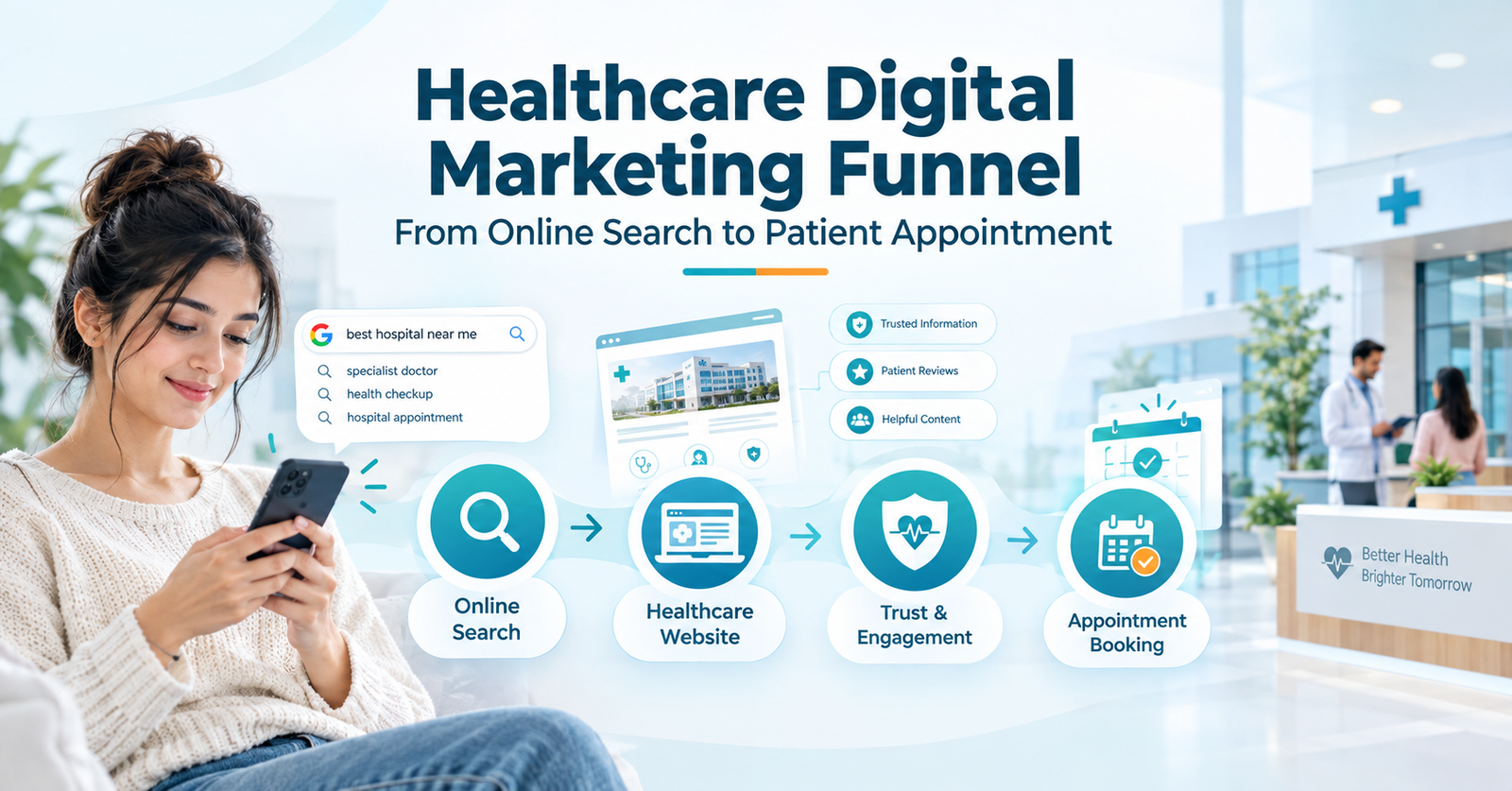
A patient rarely decides to contact a hospital or clinic the moment they see it online. In most cases, the journey starts much earlier.
Someone may begin by searching for information about a health concern, looking for a specialist, checking a nearby clinic, reading reviews, exploring treatment-related information, or comparing healthcare providers. Only after gathering enough information may they decide to call, submit an enquiry, or request an appointment.
This journey is what makes a healthcare digital marketing funnel different from a simple advertising campaign.
A healthcare digital marketing funnel maps the different stages a person may move through before becoming a patient or taking another meaningful action. It connects search visibility, healthcare content, website experience, local SEO, reputation, paid advertising, and conversion opportunities into one connected journey.
For healthcare organizations, understanding this funnel can make digital marketing more focused. Instead of asking only, “How do we get more traffic?”, the better question becomes, “What does a person need at each stage before they are ready to contact us?”
What Is a Healthcare Digital Marketing Funnel?
A healthcare digital marketing funnel is a structured view of the online journey a potential patient may take—from discovering a healthcare provider through search or another digital channel to researching its services and eventually contacting the organization.
A simplified healthcare funnel can include these stages:
Online Discovery → Information Search → Provider Evaluation → Trust Building → Enquiry → Appointment
Not every person will follow these steps in exactly the same order.
Some people may already know which provider they want and go directly to an appointment page. Others may spend days or weeks researching before making contact.
The purpose of the funnel is therefore not to force every visitor through identical steps. It is to understand the different needs people have at different points in their decision-making process.
Why Healthcare Businesses Need to Understand the Funnel
Healthcare marketing can become difficult to measure when every digital activity is treated separately.
For example, SEO may bring organic visitors to a website. Social media may introduce people to a healthcare brand. A Google Business Profile may help someone find the clinic’s location. A review may influence trust. A service page may answer the visitor’s questions. A clear contact form may finally lead to an enquiry.
These activities are connected.
At World SEO Services, this type of connected thinking can help healthcare organizations look beyond individual marketing channels and understand how different digital touchpoints contribute to the broader patient journey.
A successful funnel is not necessarily about pushing visitors toward an appointment as quickly as possible. It is about providing the right information and experience at the right stage.
Stage 1: Online Search and Discovery
The healthcare journey often begins with a search.
A person may search for a general topic, a healthcare service, a doctor, or a local provider.
Examples include:
- “symptoms of vitamin deficiency”
- “what is laparoscopic surgery”
- “cardiologist in Jaipur”
- “dental clinic near me”
- “fertility specialist in Udaipur”
- “diagnostic centre near me”
At this stage, the person may not know which healthcare provider they want.
The primary goal is discovery.
How SEO Supports the Discovery Stage
Healthcare SEO can help an organization become visible for searches that are relevant to its services and audience.
A strong SEO strategy may include:
- Keyword and search-intent research
- Technical SEO
- Service-page optimization
- Educational content
- Internal linking
- Local SEO
- Location-based pages
- Relevant topic coverage
The important point is that not every search should lead to a promotional service page.
Someone looking for general information may be better served by an educational article. Someone searching for a specific clinic may need a service or location page.
Matching content to intent makes the funnel more useful.
Stage 2: Information and Education
After discovering a topic or healthcare provider, many people begin researching.
They may want to understand:
- What the service involves
- Who typically provides the service
- What questions they should ask
- What facilities are available
- Where the provider is located
- What other relevant information is available
This is where healthcare content becomes particularly important.
Content Should Answer Real Patient Questions
A healthcare content strategy should be based on the questions people actually ask.
Useful formats can include:
- Healthcare guides
- Service explainers
- FAQs
- Doctor or specialist information
- Procedure-related educational content
- Condition awareness articles
- Location guides
- Short educational videos
The purpose is not simply to increase the number of pages on a website.
Good content should help a visitor understand the subject more clearly while avoiding unsupported medical claims or promises.
For example, an article explaining what patients should know before discussing a particular procedure can be more useful than an article filled with repeated keywords and promotional language.
AEO Can Support the Information Stage
Search is increasingly becoming conversational.
People may ask detailed questions instead of entering short keyword phrases. This creates an opportunity for healthcare websites to structure content around direct questions and clear answers.
Answer Engine Optimization, or AEO, can support this by using:
- Question-based headings
- Direct answers
- Clear explanations
- Related questions
- Logical content structure
- Natural language
- Concise definitions
This can make information easier for both users and modern search systems to understand.
Stage 3: Provider Evaluation
Once a person understands what they are looking for, they may start evaluating healthcare providers.
This is an important transition in the funnel.
The visitor may compare several providers based on factors such as:
- Relevant services
- Specialist information
- Location
- Website quality
- Available facilities
- General reputation
- Reviews
- Contact options
- Information provided online
At this point, the healthcare organization’s website becomes especially important.
Your Website Becomes Part of the Decision
A healthcare website should make important information easy to find.
A potential patient should not have to click through multiple unrelated pages just to understand what a clinic offers.
Important website elements may include:
- Clear service pages
- Doctor and specialist profiles
- Location information
- Contact details
- Appointment options
- Frequently asked questions
- Educational resources
- Relevant trust information
The website should also work properly on mobile devices because many healthcare searches happen from smartphones.
At World SEO Services, website optimization can be considered alongside SEO so that a page is not only visible in search but also useful once a visitor arrives.
Stage 4: Local Search and Location Validation
For many healthcare services, location is a major part of the decision.
A patient may search for a provider in a specific city, neighbourhood, or nearby area.
This makes local SEO an important funnel component.
Google Business Profile and Local Visibility
A Google Business Profile can help potential patients find essential information such as:
- Business location
- Phone number
- Website
- Working hours
- Directions
- Reviews
- Photos
- Services
Accurate information matters.
If a patient finds incorrect opening hours, an outdated phone number, or an incorrect location, the organization can lose trust even if its website performs well in organic search.
Healthcare businesses should therefore make sure local information is consistent across relevant digital platforms.
Location Pages Can Support Local Intent
Healthcare organizations serving multiple locations may also benefit from dedicated location pages.
However, these pages should not be simple copies of one another with different city names.
A useful location page should provide meaningful information about that specific facility, including relevant services, location details, contact information, and other useful context.
Stage 5: Trust Building
Before contacting a healthcare provider, many people look for signals that help them feel comfortable with their choice.
Trust can come from multiple sources.
These may include:
- Professional website presentation
- Clear doctor information
- Accurate service details
- Genuine reviews
- Consistent business information
- Helpful healthcare content
- Transparent communication
- Easy-to-find contact information
This stage is particularly important because healthcare decisions can involve sensitive personal concerns.
Online Reviews Matter, But Authenticity Matters More
Reviews may help potential patients understand other people’s experiences with areas such as communication, appointment processes, staff interaction, and overall service experience.
Healthcare reputation management can include:
- Monitoring reviews
- Responding professionally
- Encouraging genuine feedback
- Addressing legitimate concerns
- Protecting patient confidentiality
The goal should not be to manufacture a perfect-looking reputation.
A more sustainable approach is to maintain an authentic and professional digital presence.
Stage 6: The Enquiry or Conversion Stage
Once a visitor has enough information and feels comfortable with the provider, they may be ready to take action.
The action could be:
- Calling the clinic
- Filling out an enquiry form
- Requesting an appointment
- Sending a message
- Asking for additional information
- Getting directions to the facility
This is the stage where website conversion becomes important.
Make the Next Step Clear
A healthcare website should make it obvious what the visitor can do next.
For example, service pages can include relevant calls to action such as:
Request an Appointment
Contact the Clinic
Speak With the Team
Get More Information
The exact wording should depend on the organization’s services and communication process.
A complicated form with too many unnecessary fields can create friction. On the other hand, a simple and clear enquiry process can make it easier for interested visitors to take the next step.
Stage 7: From Enquiry to Appointment
Generating an enquiry does not automatically mean an appointment will happen.
The final part of the digital funnel depends partly on what happens after the lead is received.
For example, a healthcare organization may need an internal process for:
- Responding to enquiries
- Handling calls
- Confirming appointment details
- Providing relevant information
- Following up appropriately
- Recording lead sources
This is why healthcare digital marketing should not be measured only by clicks or website traffic.
The organization should also understand what happens after the conversion point.
Where Different Digital Marketing Channels Fit Into the Funnel
A healthcare digital marketing funnel works best when different channels have clear roles.
SEO
SEO can support discovery by helping relevant pages appear for healthcare-related searches.
Healthcare Content Marketing
Content can support people who are researching healthcare topics, services, and providers.
Local SEO
Local SEO can help people discover nearby healthcare organizations.
Social Media
Social platforms can support awareness, education, brand familiarity, and communication.
PPC Advertising
Paid search can help reach users with relevant high-intent searches, depending on applicable platform policies and campaign goals.
Reputation Management
Reviews and responses can support trust during provider evaluation.
Website Optimization
The website connects many stages by providing information and conversion paths.
AEO
AEO can help structure healthcare information around questions that people ask in conversational and answer-based search.
The important point is that these channels should not work in isolation.
Common Healthcare Funnel Problems
Healthcare businesses may attract visitors but still struggle to generate meaningful enquiries.
Some common reasons include:
Traffic Without Relevant Intent
A website may receive visitors who are not actually looking for the services offered.
Weak Service Pages
Visitors may arrive on a page but leave because the service information is unclear.
Poor Mobile Experience
A difficult mobile interface can create friction for users searching from smartphones.
Missing Local Information
Incomplete or outdated location details can make it difficult for people to visit or contact the provider.
Too Much Promotional Content
If every page focuses on selling rather than answering questions, visitors may not find the information they need.
Complicated Enquiry Forms
Long or confusing forms can discourage people from completing an enquiry.
No Conversion Tracking
Without tracking, it becomes difficult to understand which channels and pages are contributing to enquiries.
How to Improve a Healthcare Digital Marketing Funnel
Improving a healthcare funnel does not always mean increasing the marketing budget.
Often, the first step is identifying where people are dropping out.
A healthcare organization can review:
- Search visibility – Are relevant people finding the website?
- Landing pages – Are visitors reaching the right pages?
- Content quality – Are their questions being answered?
- Website experience – Is information easy to find?
- Local visibility – Are location details accurate?
- Trust signals – Is the organization presented professionally?
- Calls to action – Is the next step clear?
- Lead handling – Are enquiries being followed up properly?
- Conversion data – Which channels generate meaningful actions?
- Ongoing performance – What needs to be improved?
This creates a more practical approach to digital marketing because it focuses on the complete journey rather than one isolated metric.
How World SEO Services Can Support a Healthcare Marketing Funnel
A healthcare digital marketing funnel requires coordination between multiple areas of online marketing.
World SEO Services can approach healthcare digital marketing by connecting SEO, content marketing, website optimization, local SEO, social media, PPC, reputation management, lead generation, and AEO within a broader strategy.
The exact funnel will differ between a hospital, clinic, diagnostic centre, specialist practice, or other healthcare organization.
For example, a local clinic may need to focus heavily on Google Business Profile, local SEO, service pages, reviews, and appointment conversions. A larger hospital may require a broader content strategy covering multiple departments, specialties, locations, and patient information needs.
The strategy should therefore be built around the organization’s audience, services, location, search demand, and business objectives rather than using one standard funnel for every healthcare brand.
Measuring a Healthcare Digital Marketing Funnel
A funnel becomes useful when its performance can be measured.
Relevant metrics may include:
- Organic search traffic
- Keyword visibility
- Local search visibility
- Website engagement
- Service-page visits
- Landing-page performance
- Calls
- Form submissions
- Appointment requests
- Lead quality
- Conversion rate
- Cost per lead for paid campaigns
The most useful metrics depend on the organization’s goals.
For example, a healthcare website may receive thousands of visitors but generate very few relevant enquiries. In that situation, increasing traffic alone may not solve the problem.
Looking at the complete funnel can reveal whether the issue is related to search intent, content, website experience, trust, conversion, or lead handling.
Conclusion
A healthcare digital marketing funnel is more than a path from Google search to an appointment. It represents the different questions, expectations, and decisions a potential patient may have before contacting a healthcare provider.
The journey can begin with a general search and continue through education, provider evaluation, local discovery, reputation checking, website research, enquiry, and appointment scheduling.
Each stage needs a different type of digital support.
SEO can improve discovery. Healthcare content can answer questions. Local SEO can support nearby searches. A professional website can provide important information. Reviews can contribute to reputation. Clear calls to action can make enquiries easier. AEO can help organize information for increasingly conversational search experiences.
The strongest healthcare funnel is not necessarily the one with the most marketing channels. It is the one that connects those channels around a clear patient journey.
For healthcare organizations working with World SEO Services, a connected approach can help align search visibility, useful content, website experience, local presence, reputation, and conversion opportunities into one structured digital marketing strategy.
FAQs
1. What is a healthcare digital marketing funnel?
A healthcare digital marketing funnel is a framework that maps the online journey of a potential patient from discovering a healthcare provider or service to researching, evaluating, contacting, and potentially booking an appointment.
2. What are the main stages of a healthcare marketing funnel?
The main stages can include online discovery, information search, provider evaluation, trust building, enquiry, and appointment. The exact journey can vary depending on the healthcare service and the individual.
3. How does SEO help a healthcare marketing funnel?
SEO can help healthcare organizations become visible when people search for relevant services, providers, locations, or healthcare information. Different pages and content types can target different search intents across the funnel.
4. Why is a healthcare website important for conversions?
A healthcare website can bring together important information about services, specialists, locations, reviews, contact details, and appointment options. A clear and easy-to-use website can reduce friction when visitors are ready to take the next step.
5. How can healthcare businesses improve their digital marketing funnel?
Healthcare businesses can improve their funnel by understanding search intent, creating useful content, strengthening SEO and local visibility, improving website experience, building trust, simplifying enquiry processes, tracking conversions, and regularly analyzing where potential patients leave the journey.