
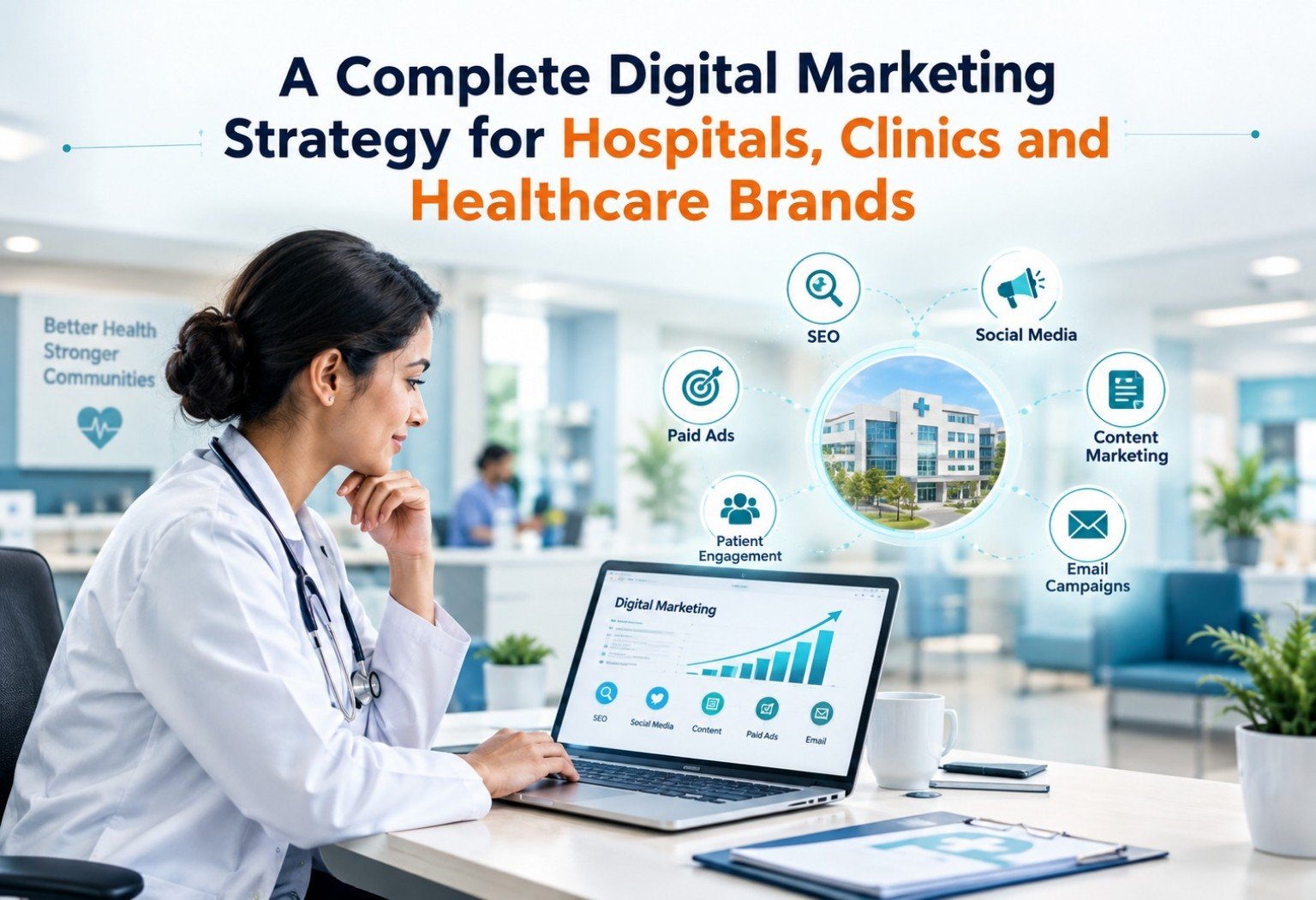
Healthcare has become increasingly digital, and the way patients discover hospitals, clinics, specialists, and diagnostic services has changed significantly. People now use search engines, websites, Google Business Profiles, social media, online reviews, and other digital channels to research healthcare options before making an enquiry or appointment.
For healthcare organizations, simply having a website or social media account is no longer enough. A strong online presence requires a planned strategy where different marketing channels support one another.
This is where a structured healthcare digital marketing strategy becomes important.
At World SEO Services, the approach to healthcare marketing is not limited to getting a website to rank or running individual advertising campaigns. The focus is on connecting search visibility, useful content, local presence, website experience, reputation, lead generation, and measurable performance into one broader digital strategy.
A complete healthcare digital marketing strategy can help hospitals, clinics, diagnostic centres, and healthcare brands improve online visibility, communicate useful information, build trust, and create relevant opportunities for enquiries and appointments.
What Is a Healthcare Digital Marketing Strategy?
A healthcare digital marketing strategy is a structured plan for using online channels to reach relevant audiences, provide useful healthcare information, strengthen online visibility, and support appropriate patient enquiries or appointments.
A complete strategy can include:
- Healthcare SEO
- Local SEO
- Healthcare website optimization
- Content marketing
- Social media marketing
- Google Ads and PPC advertising
- Online reputation management
- Lead generation
- Analytics and conversion tracking
- Answer Engine Optimization (AEO)
- AI-focused search strategies
The important point is that these activities should not operate independently.
For example, SEO may bring a visitor to a service page. Useful content can answer their questions. A well-structured website can make information easier to find. Local SEO can help them understand where the provider is located, while reviews may contribute to trust.
The different parts of the strategy should work together to create a smoother digital journey.
Why Hospitals and Clinics Need a Structured Digital Strategy
Healthcare organizations often serve multiple audiences and provide a wide range of services.
A hospital may have departments such as:
- Cardiology
- Orthopedics
- Gynecology
- Pediatrics
- Neurology
- Oncology
- Diagnostics
- Emergency care
A specialized clinic may focus on a much narrower service or patient group.
Because the audiences, services, locations, and search behaviour can vary, a generic marketing strategy may not be suitable for every healthcare organization.
A structured strategy helps answer important questions:
- Who is the organization trying to reach?
- Which services need more visibility?
- What are potential patients searching for?
- Which locations matter?
- Which channels generate relevant enquiries?
- What information is missing from the website?
- Which marketing activities should be measured?
These answers provide the foundation for a more focused digital marketing plan.
Step 1: Understand the Healthcare Audience
The first step is understanding the people the healthcare organization wants to reach.
A multi-specialty hospital may have several different audiences, while a local clinic may primarily serve people within a particular geographic area.
Audience research can consider:
- Healthcare services people search for
- Location
- Search behaviour
- Common questions
- Patient expectations
- Decision-making factors
- Relevant digital channels
Keyword research is useful, but it should not be the only source of information.
Search queries can show what people are looking for, while website analytics, enquiry data, frequently asked questions, and feedback from the healthcare team can provide additional context.
A healthcare marketing strategy should be built around real information needs, not simply a list of keywords.
Step 2: Build a Strong Healthcare Website
The website should act as the central point of the digital strategy.
It should help visitors quickly understand:
- Who the healthcare organization is
- Which services are available
- Which specialists or departments are involved
- Where the organization is located
- How to contact the provider
- How appointment-related enquiries can be made
Important website elements can include:
- Clear service pages
- Department or specialty information
- Doctor profiles where appropriate
- Location information
- Contact details
- Appointment information
- Educational resources
- FAQs
- Mobile-friendly navigation
- Fast-loading pages
The website should also have a logical structure.
For example, a hospital’s main department page can connect to individual services, doctor profiles, and relevant educational content.
This creates a clearer experience for visitors and helps search engines understand how different pages relate to one another.
At World SEO Services, website development and SEO can be considered together because website structure directly affects both user experience and organic visibility.
Step 3: Create a Healthcare SEO Strategy
SEO is one of the core components of long-term healthcare digital marketing.
Healthcare SEO involves improving a website so that relevant pages can appear when people search for services, specialists, locations, and healthcare information.
A comprehensive strategy can include several areas.
Keyword Research
Identify relevant searches related to healthcare services, specialties, locations, questions, and patient needs.
On-Page SEO
Optimize titles, headings, URLs, content, internal links, images, and other relevant page elements.
Technical SEO
Review factors such as:
- Website speed
- Crawlability
- Indexing
- Mobile usability
- Broken links
- Redirects
- Structured data
- Technical website health
Content SEO
Develop useful content that answers genuine questions and supports important service pages.
Internal Linking
Connect related pages so that users and search engines can understand the relationship between services, doctors, departments, and educational resources.
The purpose should not be to repeat the same keyword throughout a page.
Modern SEO works better when content is relevant, well organized, useful, and aligned with what people are actually trying to find.
Step 4: Strengthen Local SEO
For clinics, hospitals, diagnostic centres, and other location-based healthcare organizations, local search can be particularly important.
People may search for:
- Hospital near me
- Cardiologist in Jaipur
- Dental clinic near me
- Diagnostic centre in my area
- Fertility clinic near me
A strong local SEO strategy can help healthcare organizations become more visible for these types of searches.
Important areas include:
- Google Business Profile
- Accurate address
- Correct phone number
- Working hours
- Website information
- Relevant categories
- Service information
- Photos
- Genuine reviews
Information should remain consistent across relevant online platforms.
Local SEO is not simply about adding a city name to a page. It is about helping people find accurate information about a real healthcare provider in a specific location.
Step 5: Develop a Healthcare Content Strategy
Healthcare content should answer the questions patients actually have.
A strong content strategy can include:
- Service pages
- Educational blogs
- FAQs
- Condition-related information
- Doctor-focused content
- Preventive healthcare topics
- Short educational videos
- Social media content
- Helpful guides
The language should be understandable to ordinary readers.
Medical terminology may be necessary in some cases, but complex terms should be explained rather than used simply to make content appear more technical.
Healthcare content also requires appropriate quality control.
It should avoid unsupported promises, exaggerated claims, misleading statements, or language that could cause unnecessary fear.
At World SEO Services, content can be planned around search intent and patient questions so that blogs and service pages have a clear purpose rather than being created only to increase the number of pages on a website.
Step 6: Create Content for Different Search Intent
Not every person visiting a healthcare website is at the same stage of decision-making.
One person may simply want information, while another may already be comparing providers.
Informational Intent
The user wants to understand a topic.
Example:
“What are the common signs of a particular condition?”
Commercial Investigation
The user is researching available options.
Example:
“What should I consider when choosing a specialist?”
Local Intent
The user is looking for a provider in a particular area.
Example:
“Cardiologist near me.”
Action-Oriented Intent
The user is closer to taking action.
Example:
“Book an appointment with a cardiologist.”
Understanding these differences allows healthcare brands to create appropriate pages and content for different stages of the patient journey.
Step 7: Use Social Media Strategically
Social media should support the broader healthcare strategy rather than operate as a completely separate activity.
Depending on the audience and objectives, healthcare organizations may use platforms such as Instagram, Facebook, YouTube, or LinkedIn.
Content can include:
- Health awareness posts
- Educational videos
- FAQs
- Doctor introductions
- Department information
- General wellness information
- Healthcare event updates
- Facility information
Social media should not be used to diagnose individual users or encourage people to publicly share sensitive health information.
A consistent and informative presence can help healthcare organizations remain visible while communicating their expertise in a more accessible format.
Step 8: Use Paid Advertising for Targeted Reach
PPC advertising can help healthcare organizations reach relevant audiences through paid search and other advertising platforms, subject to applicable advertising rules and platform policies.
Campaign objectives may include:
- Increasing awareness of a service
- Generating relevant enquiries
- Supporting appointment requests
- Promoting a particular healthcare service
- Reaching audiences within a defined location
The advertisement should lead to a relevant landing page.
For example, an advertisement for a specific service should ideally direct visitors to information about that service instead of sending every user to the homepage.
Campaign performance should also be measured using meaningful outcomes rather than clicks alone.
Step 9: Manage Online Healthcare Reputation
A healthcare organization’s reputation exists both offline and online.
Before contacting a provider, people may read Google reviews or other public feedback.
Reputation management can involve:
- Monitoring reviews
- Encouraging genuine feedback
- Responding professionally
- Identifying recurring concerns
- Keeping online information accurate
- Monitoring brand mentions
Healthcare organizations should never manufacture positive reviews or disclose private patient information while responding publicly.
When negative feedback appears, responses should remain professional and respectful. Sensitive matters can be moved to an appropriate private communication channel.
The objective is to build an authentic reputation over time.
Step 10: Build a Healthcare Lead Generation Journey
Website traffic alone does not automatically create meaningful business results.
A healthcare digital strategy should consider what happens after someone reaches the website.
A simple journey may look like:
Search → Website Visit → Service Information → Trust Building → Enquiry → Appointment
There can be barriers at every stage.
For example:
- The website may be difficult to navigate.
- Contact information may be hidden.
- A service page may not answer basic questions.
- A form may be unnecessarily complicated.
- The page may load slowly.
- The next step may not be clear.
Improving these areas can make it easier for visitors to move from information discovery to an appropriate enquiry.
Step 11: Track the Right Marketing Metrics
Healthcare organizations need to understand whether their digital activities are producing meaningful results.
Useful metrics can include:
- Organic search visibility
- Relevant website traffic
- Search performance
- Local search visibility
- Website engagement
- Enquiries
- Appointment-related conversions
- Lead quality
- PPC conversion rate
- Cost per lead
- Social media engagement
- Returning visitors
The right metrics depend on the organization’s objectives.
For example, a large hospital may focus partly on visibility and service discovery, while a specialized clinic may place greater emphasis on relevant enquiries and appointment conversions.
Step 12: Use Data to Improve the Strategy
Digital marketing is not a one-time activity.
Search behaviour changes. New competitors appear. Healthcare services evolve. Website performance changes. Advertising costs can fluctuate.
Regular analysis can help identify opportunities for improvement.
Marketing teams can ask:
- Which pages attract relevant visitors?
- Which searches generate visibility?
- Which content receives engagement?
- Which channels generate enquiries?
- Where are visitors leaving?
- Which campaigns generate qualified leads?
- Which services need stronger visibility?
These insights can guide future SEO, content, website, and advertising decisions.
The Role of AI and AEO in Healthcare Marketing
AI-powered search is changing how people discover information.
Instead of entering a short keyword, users can ask complete questions such as:
“What should I consider before choosing a specialist in my city?”
This creates a need for healthcare content that directly addresses real questions.
Answer Engine Optimization, or AEO, focuses on making content clear and easy for answer-based search systems to understand.
Healthcare websites can support this by:
- Answering important questions directly
- Using descriptive headings
- Including relevant FAQs
- Explaining medical terminology
- Covering related questions naturally
- Providing useful context
- Avoiding unnecessary repetition
AI can also support research and marketing workflows, but healthcare content still needs appropriate human review and quality control.
How World SEO Services Can Support a Complete Healthcare Strategy
A complete healthcare strategy requires coordination between multiple digital activities.
World SEO Services can support healthcare organizations across:
- Healthcare SEO
- Local SEO
- Healthcare content marketing
- Website development
- Google Ads and PPC
- Social media marketing
- Healthcare lead generation
- Online reputation management
- AEO and AI-focused search strategies
The important part is how these services work together.
For example, SEO can bring relevant users to a service page. Content can answer their questions. Local SEO can help them discover the nearest facility. Reputation management can support trust, while conversion-focused website elements can make the next step easier.
This connected approach helps prevent digital marketing from becoming a collection of unrelated activities.
Common Healthcare Digital Marketing Mistakes
Even organizations investing in digital marketing can struggle when their activities lack a clear structure.
Common mistakes include:
- Publishing content only to target keywords
- Repeating the same content across multiple pages
- Ignoring local search
- Sending all paid traffic to the homepage
- Keeping outdated website information
- Treating social media only as a promotional channel
- Ignoring online reviews
- Measuring traffic without looking at lead quality
- Using unnecessarily complicated healthcare language
- Publishing medical content without appropriate quality review
Avoiding these problems can make the overall strategy more useful and sustainable.
How to Build a Practical Healthcare Marketing Plan
A healthcare organization can approach its strategy in stages.
Start With the Foundation
Review the website, technical SEO, service pages, doctor information, Google Business Profile, tracking, and contact processes.
Build Visibility
Develop SEO content, local search visibility, social media, and relevant paid campaigns.
Improve Trust
Strengthen educational content, provider information, reviews, reputation management, and transparent communication.
Improve Conversions
Review landing pages, contact forms, appointment journeys, calls, and other relevant conversion points.
Measure and Refine
Use performance data to identify what is working and where further improvement is required.
This allows the strategy to develop based on actual performance rather than assumptions.
Conclusion
A complete digital marketing strategy for hospitals, clinics, and healthcare brands is much more than a combination of SEO, social media, or advertising campaigns.
It brings together healthcare SEO, local search, website development, content marketing, social media, PPC, reputation management, lead generation, analytics, and AI-focused search practices into a connected digital ecosystem.
The strongest strategies begin with understanding the audience and the questions patients are asking. From there, healthcare organizations can create useful content, improve search visibility, strengthen their websites, maintain accurate local information, build trust, and measure meaningful results.
For healthcare organizations looking for a structured approach, World SEO Services can bring these digital marketing activities together with a focus on visibility, useful information, patient experience, and measurable outcomes.
Ultimately, healthcare digital marketing should serve two purposes at the same time: helping people find the right information and helping healthcare organizations build a stronger, more sustainable digital presence.
FAQs
1. What should a healthcare digital marketing strategy include?
A complete strategy can include healthcare SEO, local SEO, website optimization, content marketing, social media, PPC advertising, online reputation management, lead generation, analytics, and AEO-focused content.
2. Why is SEO important for hospitals and clinics?
SEO can help hospitals and clinics become more visible when people search online for healthcare services, specialists, locations, and educational information. It can also help organize website content around relevant search intent.
3. How can healthcare businesses generate leads through digital marketing?
Healthcare organizations can combine SEO, local search, useful content, paid advertising, social media, and conversion-focused websites to attract relevant visitors and provide clear options for enquiries or appointment requests.
4. How does local SEO help healthcare providers?
Local SEO can improve visibility for location-based searches. Accurate business information, a well-maintained Google Business Profile, relevant local content, and genuine reviews can all contribute to a stronger local presence.
5. What is the role of AI and AEO in healthcare marketing?
AI and AEO are becoming increasingly relevant as people ask detailed questions through AI-powered search experiences. Healthcare websites can prepare by creating clear, trustworthy, well-structured content that directly answers common questions and provides useful context.