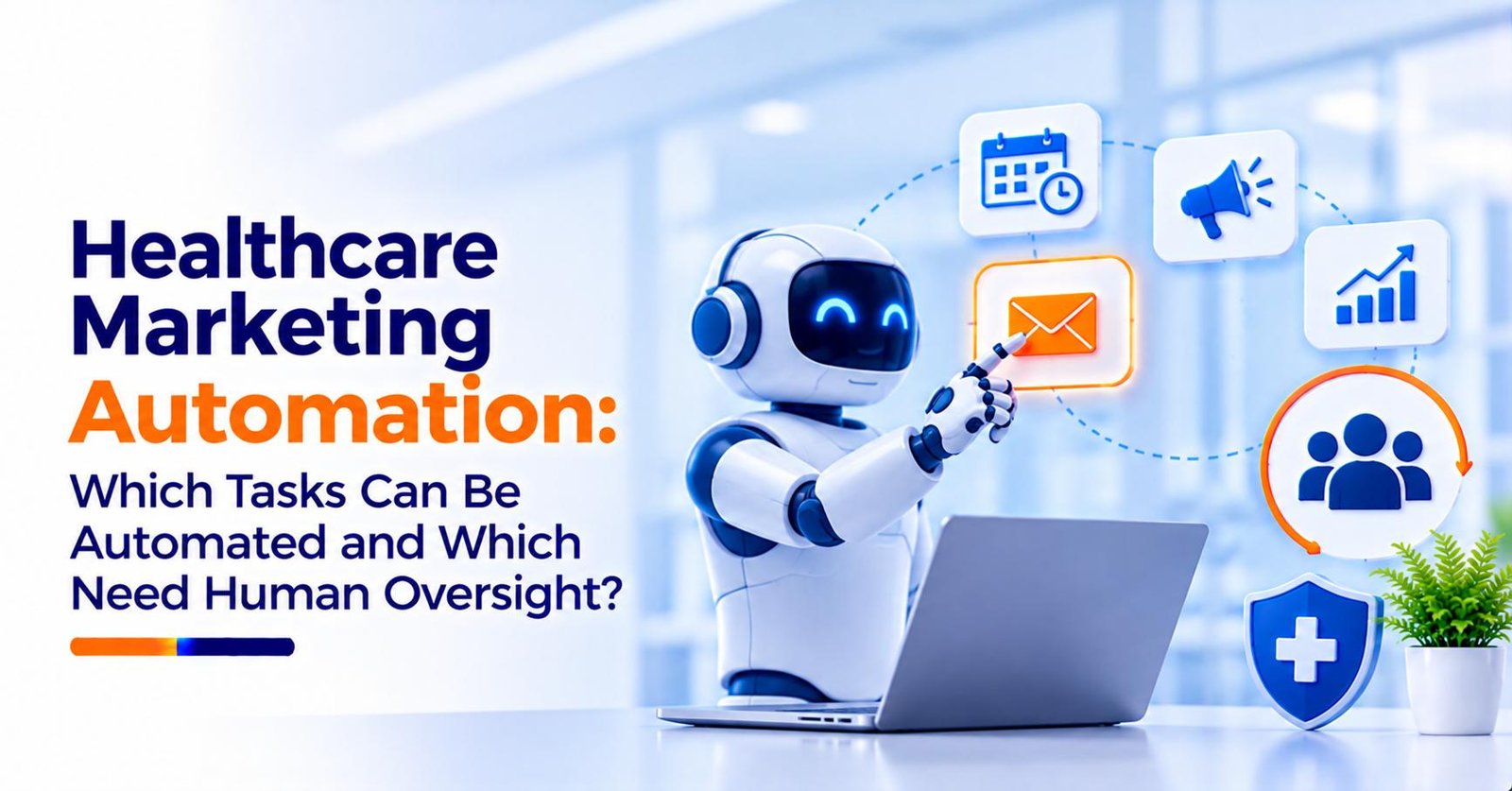
Healthcare marketing involves several activities that require regular attention, from managing patient enquiries and publishing educational content to running advertising campaigns and monitoring website performance. As hospitals, clinics, and healthcare brands expand their digital presence, handling every marketing task manually can become time-consuming.
This is where marketing automation can make a difference.
Automation helps healthcare organisations manage repetitive marketing activities through software, predefined workflows, and data-driven processes. It can support email communication, appointment reminders, lead management, campaign reporting, social media scheduling, and more.
However, healthcare marketing is different from marketing in many other industries. It involves sensitive information, medical topics, patient expectations, and decisions that can affect people’s trust. Not every task should be handled by an automated system.
For example, an automated email can send an appointment reminder, but a healthcare professional should handle a patient’s medical question. Similarly, AI tools can help prepare an initial content draft, but qualified human reviewers must check medical accuracy before publication.
At World SEO Services, healthcare digital marketing involves multiple activities, including SEO, content marketing, PPC advertising, social media marketing, lead generation, and AI solutions. A thoughtful automation strategy can help healthcare organisations manage these activities more efficiently while maintaining the human attention that healthcare communication requires.
In this article, we will explore Healthcare Marketing Automation, the tasks hospitals and clinics can automate, the activities that need human oversight, and how to implement automation responsibly.
1. What Is Healthcare Marketing Automation?
Healthcare marketing automation is the use of software, digital platforms, and predefined workflows to manage repetitive marketing activities with limited manual involvement.
Instead of completing every activity individually, healthcare marketing teams can create workflows that perform specific actions when certain conditions are met.
For example:
- A website visitor submits an enquiry form.
- The system records the enquiry in a CRM.
- The relevant team receives a notification.
- The visitor receives an acknowledgement message.
- The enquiry is assigned for follow-up.
These steps can happen automatically once the workflow is configured correctly.
Healthcare marketing automation can support activities such as:
- Email marketing and follow-up communication.
- Appointment reminders.
- Lead collection and management.
- Social media scheduling.
- Marketing campaign reporting.
- Website analytics.
- Review request workflows.
- Content planning and administrative tasks.
The purpose is not to remove people from healthcare marketing. It is to reduce repetitive work so that marketing teams can spend more time on strategy, communication quality, and decision-making.
2. Why Is Automation Becoming Important in Healthcare Marketing?
Hospitals and clinics often manage multiple departments, locations, services, and communication channels. As marketing activities increase, manual processes can become difficult to manage consistently.
Here are some reasons why automation can be useful.
A. Saves Time on Repetitive Activities
Marketing teams regularly perform tasks such as scheduling posts, organising leads, sending routine emails, and preparing reports.
These activities can consume a significant amount of time when handled manually.
Automation can manage suitable repetitive steps, allowing teams to focus on campaign planning, content quality, and performance improvement.
B. Improves Enquiry Management
Healthcare organisations may receive enquiries through websites, phone calls, advertisements, and social media.
Without a structured process, some enquiries may be delayed or overlooked.
Automated notifications and CRM workflows can help direct enquiries to the appropriate team for follow-up.
C. Supports Consistent Communication
Hospitals often need to send routine updates, appointment confirmations, reminders, and general service information.
Automation can help deliver these messages at the right stage of a communication process.
However, organisations should ensure that messages are accurate, relevant, appropriately authorised, and sent through suitable communication channels.
D. Makes Marketing Reporting Easier
Healthcare marketing involves several platforms, each generating different performance data.
Automated reporting can bring selected metrics into a central dashboard, making monthly performance reviews easier.
E. Supports Marketing at Scale
A healthcare organisation with multiple departments or branches may need to manage different campaigns simultaneously.
Automation can help standardise repetitive processes while allowing teams to customise communication for relevant audiences and services.
3. Healthcare Marketing Tasks That Can Be Automated
Not every marketing activity needs to be completed manually. Several routine tasks can be managed through automation when suitable tools and safeguards are in place.
A. Email Marketing and Routine Follow-Ups
Email marketing is one of the most common areas where automation can help.
Healthcare organisations can create predefined email workflows for people who have voluntarily subscribed to receive relevant communication.
Examples include:
- Sending a welcome email after newsletter registration.
- Sharing general hospital information.
- Sending educational newsletters.
- Providing event registration confirmations.
- Sharing approved service updates.
- Sending follow-up communication based on consent and communication preferences.
For example, a clinic may create an automated welcome email for people who subscribe to its health awareness newsletter.
The message can introduce the clinic, explain the type of information subscribers may receive, and provide an option to manage their preferences.
Human oversight required: Marketing teams should review email content, audience selection, consent records, and frequency. Messages involving medical advice or individual treatment decisions should not be generated and sent without appropriate professional review.
B. Appointment Reminders and Confirmations
Appointment communication often involves repetitive administrative steps.
An appointment management system can send:
- Booking confirmations.
- Appointment reminders.
- Rescheduling notifications.
- Cancellation confirmations.
- General preparation instructions approved by the clinic.
For example, after a patient books an appointment, the system can send a confirmation message containing the date, time, location, and contact details.
Human oversight required: Staff should manage appointment exceptions, patient concerns, special instructions, and requests that need personal assistance. Automated reminders must also be configured to avoid exposing sensitive information through shared devices or notification previews.
C. Lead Capture and CRM Management
Healthcare organisations may receive enquiries from website forms, landing pages, advertisements, and other digital channels.
CRM automation can help organise these enquiries.
Possible automated activities include:
- Recording form submissions.
- Assigning enquiries to the appropriate department.
- Sending internal notifications.
- Updating enquiry status.
- Identifying duplicate records.
- Creating follow-up tasks.
- Tracking enquiry sources.
For example, an enquiry submitted through a cardiology service page can be routed to the relevant authorised team.
Human oversight required: Staff must review enquiries, understand the person’s actual requirement, and respond appropriately. Automated lead scoring should not be treated as a medical assessment or a substitute for professional judgement.
D. Social Media Scheduling
Hospitals and clinics often publish content about health awareness, doctors, services, events, and general healthcare information.
Social media management tools can schedule approved content in advance.
Automatable activities include:
- Scheduling posts.
- Planning content calendars.
- Publishing approved creatives.
- Sending internal publishing reminders.
- Preparing basic performance reports.
For example, a hospital can schedule approved awareness posts for an upcoming health campaign.
Human oversight required: Every post should be checked before publication. Comments, complaints, medical questions, misinformation, and sensitive discussions require careful human attention.
E. Marketing Performance Reporting
Marketing teams often collect data from multiple platforms every month.
Reporting tools can automate the collection and presentation of selected metrics.
These may include:
- Website traffic.
- Organic search clicks.
- Search impressions.
- Advertising expenditure.
- Campaign conversions.
- Social media reach.
- Website form submissions.
For example, a reporting dashboard can display monthly SEO and paid advertising performance in one place.
Human oversight required: Teams should verify data accuracy, understand changes, identify unusual results, and explain what the numbers mean. Automated reports cannot independently determine why a campaign performed differently.
F. Review Request Workflows
Online reviews influence how people evaluate healthcare organisations.
Automation can help manage routine review-related activities.
For example:
- Sending an approved review invitation after an eligible interaction.
- Notifying staff when a new review is received.
- Organising reviews by platform.
- Creating reminders for responses.
Human oversight required: Responses should be reviewed by authorised staff, particularly when a review contains complaints or personal health information. Hospitals should never use incentives, pressure, or selective requests designed to manipulate review ratings.
G. Basic Website and Campaign Notifications
Automation can also support routine website and campaign monitoring.
Examples include:
- Notifications when a website form stops working.
- Alerts for broken landing page links.
- Campaign budget notifications.
- Website uptime alerts.
- Reminders to review outdated content.
- Notifications about unusual changes in website traffic.
These workflows can help marketing teams identify issues sooner.
Human oversight required: Technical teams and marketing managers should investigate alerts and decide what corrective action is necessary.
4. Healthcare Marketing Tasks That Need Human Oversight
Automation can make marketing operations faster, but certain activities require human judgement, expertise, and accountability.
These tasks should not be handed over entirely to automated systems.
A. Medical Content Creation and Approval
AI tools can help generate blog outlines, suggest headings, organise research notes, and prepare initial drafts.
However, healthcare content must be accurate, responsible, and understandable.
Human reviewers should verify:
- Medical terminology.
- Treatment descriptions.
- Health-related claims.
- References and supporting information.
- Potentially misleading statements.
- Suitability for the intended audience.
Qualified healthcare professionals should review clinical information where appropriate.
For example, an AI tool may help prepare a draft about diabetes awareness, but a qualified reviewer should verify the medical information before it is published.
B. Patient Complaints and Sensitive Communication
Automated systems can acknowledge that a message has been received, but they should not independently handle every patient complaint.
Some messages may involve:
- Dissatisfaction with services.
- Delays or appointment problems.
- Billing concerns.
- Privacy complaints.
- Negative treatment experiences.
- Requests involving personal circumstances.
These situations require an empathetic and context-aware response from authorised staff.
An automated acknowledgement can be useful, but it should not replace genuine communication.
C. Medical Questions and Treatment Guidance
Healthcare organisations may receive questions about symptoms, medicines, diagnosis, and treatment through websites and social media.
Marketing automation should not provide personalised medical advice or make clinical decisions.
Instead, systems can direct such enquiries to the appropriate healthcare team or provide approved contact information.
Human healthcare professionals must handle medical questions according to their qualifications and the organisation’s procedures.
D. Marketing Strategy and Campaign Decisions
Automation can collect campaign data, identify patterns, and generate reports.
However, decisions about marketing strategy require an understanding of the organisation’s objectives, services, audience, budget, and operational capacity.
Human marketing managers should decide:
- Which services need greater visibility.
- Which audience segments are relevant.
- Whether campaign messaging needs improvement.
- How marketing budgets should be allocated.
- Which channels deserve further attention.
- Whether a campaign should be changed or paused.
Automation can support these decisions, but it should not make important strategic choices without human review.
E. Brand Voice and Patient-Focused Communication
Healthcare communication should be clear, respectful, and reassuring without making unrealistic promises.
Automated content may sound repetitive, generic, or unsuitable for a particular audience.
Human editors should check whether messages:
- Match the organisation’s brand voice.
- Use understandable language.
- Avoid exaggerated claims.
- Respect patient concerns.
- Provide clear and accurate information.
F. Crisis Communication and Reputation Management
Healthcare organisations may need to respond to unexpected situations, serious complaints, misinformation, or public concerns.
These situations require careful coordination.
Automated systems can alert the relevant team, but public responses should be prepared and approved by authorised people.
A generic automated reply may create confusion when a situation requires a sensitive and specific response.
5. Automation vs Human Oversight: A Practical Comparison
The following comparison shows how healthcare organisations can divide responsibilities.
| Marketing Activity | What Can Be Automated | What Needs Human Oversight |
|---|---|---|
| Email marketing | Scheduling and routine delivery | Content, consent and audience review |
| Appointment communication | Confirmations and reminders | Exceptions and patient concerns |
| Lead management | Recording and routing enquiries | Enquiry assessment and follow-up |
| Social media | Scheduling approved posts | Comments, complaints and medical questions |
| Content marketing | Outlines and initial drafts | Medical accuracy and final approval |
| Reporting | Data collection and dashboards | Interpretation and decisions |
| Review management | Notifications and reminders | Sensitive and personalised responses |
| Campaign management | Alerts and routine reporting | Strategy, targeting and budget decisions |
The most effective approach is to automate predictable processes while keeping important communication and decisions under appropriate human control.
6. How AI Tools Can Support Healthcare Marketing Automation
Artificial intelligence has expanded the possibilities of marketing automation.
AI-powered tools can help marketing teams organise information, generate ideas, analyse performance, and manage repetitive activities.
Here are some practical applications.
A. AI-Assisted Content Planning
AI tools can help identify content ideas based on common audience questions, search topics, and healthcare service categories.
They can also suggest:
- Blog outlines.
- Social media topics.
- Frequently asked questions.
- Content calendar ideas.
- Draft captions.
Human editors and relevant healthcare professionals should review the final content before publication.
B. Automated Data Analysis
AI-powered analytics tools may help identify patterns in marketing reports.
For example, they can highlight changes in organic traffic, campaign engagement, or landing page performance.
Marketing teams can use these observations as starting points for further investigation.
C. Chatbots for Basic Information
Healthcare websites may use chatbots to answer predefined questions about:
- Clinic timings.
- Location and directions.
- Available departments.
- General appointment procedures.
- Contact information.
However, chatbots should clearly communicate their limitations.
They should not diagnose symptoms, recommend treatment, or present automated responses as professional medical advice.
Sensitive enquiries should be transferred to an appropriate human team.
D. Automated Content Repurposing
AI tools can help convert approved content into different formats.
For example, a reviewed healthcare blog may be adapted into:
- Short social media captions.
- Newsletter summaries.
- Educational post outlines.
- Short video scripts.
The adapted versions still need human review to maintain accuracy and avoid changing the original meaning.
7. Important Risks to Consider Before Automating Healthcare Marketing
Automation can create operational benefits, but poorly configured systems can introduce privacy, communication, and accuracy problems.
Healthcare organisations should consider the following risks.
A. Patient Data Privacy
Healthcare enquiries may contain personal and sensitive information.
Before introducing automation, organisations should evaluate what information is collected, where it is stored, who can access it, and how it is processed.
Use appropriate access controls, data minimisation, secure systems, and applicable privacy safeguards.
Avoid transferring identifiable patient information into general-purpose AI tools unless the organisation has approved the tool and established appropriate privacy and security arrangements.
B. Incorrect Automated Communication
A system may send outdated information, incorrect appointment details, or messages to the wrong audience if its data or settings are inaccurate.
Regular testing and workflow reviews can help reduce these risks.
C. Over-Automation
Automating every interaction can make healthcare communication feel impersonal.
People may need reassurance, clarification, or assistance that a predefined message cannot provide.
Organisations should maintain clear options for speaking with a real person.
D. Unreviewed AI-Generated Content
AI-generated healthcare content may contain incorrect information, unsupported claims, or outdated details.
Every piece of medical content should go through an appropriate review process before publication.
E. Lack of Clear Accountability
Every automated workflow should have an assigned owner.
The organisation should know who is responsible for reviewing its performance, updating its information, managing errors, and responding when something goes wrong.
8. How to Implement Healthcare Marketing Automation Step by Step
Healthcare organisations do not need to automate every process at once. A gradual approach is usually easier to manage.
Step 1: Review Existing Marketing Processes
Identify repetitive activities that consume time.
For example:
- Manual enquiry entry.
- Appointment reminder calls.
- Monthly report preparation.
- Social media scheduling.
- Routine email communication.
Understand which tasks are suitable for automation and which require personal attention.
Step 2: Set Clear Objectives
Decide what the organisation wants to improve.
Possible objectives include:
- Reducing manual administrative work.
- Improving enquiry assignment.
- Maintaining consistent communication.
- Organising campaign data.
- Improving reporting efficiency.
Choose objectives that can be measured.
Step 3: Select Suitable Tools
Choose platforms based on the organisation’s requirements.
These may include:
- CRM systems for enquiry management.
- Email marketing platforms for approved communication.
- Social media management tools for scheduling.
- Analytics platforms for reporting.
- Appointment management systems for reminders.
- AI tools for assisted content planning.
Before selecting a platform, evaluate its security, access controls, integration options, data handling practices, and suitability for healthcare use.
Step 4: Create Simple Workflows
Start with predictable, low-risk activities.
For example, a website enquiry workflow could:
- Record the submitted enquiry.
- Notify the relevant team.
- Assign the enquiry to an authorised staff member.
- Send an approved acknowledgement.
- Create a follow-up task.
Test the workflow before using it at scale.
Step 5: Define Human Approval Points
Decide which activities need approval before they are completed.
For example:
- Medical content requires appropriate review.
- Sensitive patient communication requires authorised staff.
- Public responses to serious complaints require approval.
- Major advertising changes require marketing oversight.
Clearly defined approval stages help prevent automated systems from taking actions beyond their intended purpose.
Step 6: Monitor and Improve Workflows
Automation needs regular maintenance.
Review whether messages are being delivered correctly, enquiries are reaching the right teams, and reports are displaying accurate information.
Update workflows when services, policies, contact details, or communication requirements change.
Step 7: Measure the Results
Evaluate whether automation is achieving its intended purpose.
Useful indicators may include:
- Time spent on repetitive tasks.
- Enquiry assignment time.
- Email delivery and engagement.
- Appointment reminder delivery.
- Reporting preparation time.
- Workflow errors.
- Staff feedback.
The goal should be better efficiency without reducing communication quality or patient trust.
9. How World SEO Services Can Support Healthcare Marketing Automation
Healthcare marketing automation works best when it is connected to a clear digital marketing strategy.
Hospitals and clinics need more than automated messages. They also need relevant website content, strong search visibility, organised lead management, and consistent communication across digital channels.
World SEO Services offers digital marketing solutions that can support healthcare organisations across several areas.
A. SEO and Content Marketing
SEO and content marketing help healthcare organisations improve their online visibility and provide useful information to their audiences.
AI-assisted research and content workflows can support planning, but content quality and medical accuracy remain important.
B. PPC Advertising
Paid advertising campaigns can use structured tracking and reporting processes to monitor expenditure, clicks, and conversions.
Human review is essential for campaign targeting, messaging, budget decisions, and healthcare advertising compliance.
C. Social Media Marketing
Social media workflows can support content planning, scheduling, and performance reporting.
Human oversight helps maintain brand consistency and ensures that sensitive comments and questions receive appropriate attention.
D. Lead Generation and Management
A structured lead generation process can help healthcare organisations track enquiries from different channels and improve coordination between marketing and follow-up teams.
E. AI Solutions
AI-powered tools can support research, reporting, content planning, and selected administrative workflows.
The right approach combines useful automation with human judgement, data protection, and clear accountability.
Conclusion
Healthcare Marketing Automation can help hospitals, clinics, and healthcare brands manage repetitive marketing activities more efficiently. Tasks such as email scheduling, appointment reminders, enquiry routing, social media publishing, and performance reporting can often be automated through suitable tools and workflows.
However, automation should not replace human judgement where accuracy, empathy, privacy, or professional expertise is required.
Medical content approval, patient complaints, treatment-related questions, marketing strategy, and crisis communication all need appropriate human involvement.
The best approach is to identify repetitive tasks, automate suitable processes, establish clear approval points, and regularly monitor results.
At World SEO Service, the focus is on helping healthcare organisations strengthen their digital marketing activities through SEO, content marketing, PPC advertising, social media marketing, lead generation, and AI solutions. Combining these activities with responsible automation can support more organised marketing operations while keeping communication accurate, useful, and people-focused.
Frequently Asked Questions
1. What is healthcare marketing automation?
Healthcare marketing automation uses software, predefined workflows, and digital tools to manage repetitive marketing activities. Common examples include email scheduling, appointment reminders, enquiry management, social media publishing, and campaign reporting.
2. Which healthcare marketing tasks can be automated?
Healthcare organisations can automate routine email communication, appointment reminders, lead recording, enquiry notifications, social media scheduling, review alerts, and marketing reports. These processes should be configured and monitored appropriately.
3. Which healthcare marketing activities should not be fully automated?
Medical content approval, personalised medical communication, patient complaints, crisis responses, and important marketing strategy decisions require human oversight. These activities involve accuracy, context, professional judgement, or empathy.
4. Can AI tools be used for healthcare marketing?
Yes. AI tools can support content planning, research, reporting, social media drafts, and basic information workflows. However, AI-generated healthcare information should be reviewed before publication, and sensitive patient information should only be processed through appropriately approved systems.
5. How can hospitals start using marketing automation?
Hospitals can begin by identifying repetitive tasks, setting clear objectives, selecting suitable tools, and creating simple workflows for activities such as enquiry notifications or appointment reminders. They should establish human approval points, protect patient information, and monitor workflow performance regularly.