
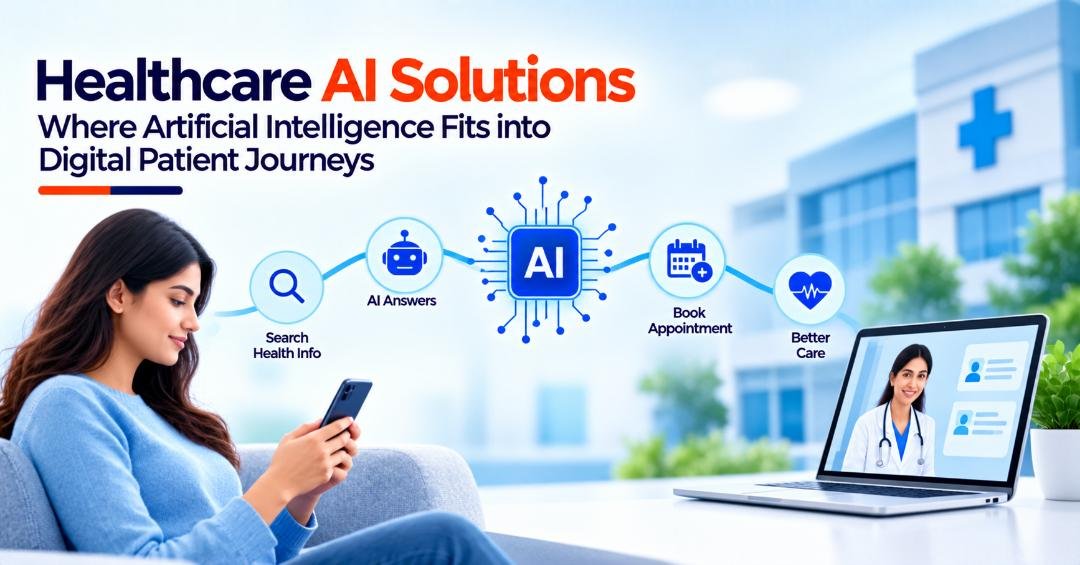
The digital patient journey is becoming more connected than ever.
A patient may discover a healthcare provider through a Google search, explore its website, read educational content, check reviews, compare services, interact with a chatbot, look at a location on Google Maps, and finally submit an enquiry or request an appointment.
Artificial intelligence is becoming part of several of these digital touchpoints.
For hospitals, clinics, diagnostic centres, specialty practices, and other healthcare organizations, AI can help make digital experiences more efficient, relevant, and responsive. It can support activities such as search analysis, content recommendations, website assistance, lead management, communication, personalization, and marketing performance analysis.
However, healthcare AI solutions should not be viewed as a way to automate every part of the patient journey.
Healthcare involves sensitive information and decisions that require professional judgment. AI should therefore be used where it can add genuine value while keeping privacy, accuracy, transparency, and human oversight at the centre.
Understanding where AI fits into the digital patient journey can help healthcare brands use the technology more responsibly and effectively.
What Is a Digital Patient Journey?
A digital patient journey refers to the different online interactions a person may have with a healthcare organization before, during, and after contacting it.
Unlike a simple customer journey, healthcare journeys can involve uncertainty, research, trust-building, and sensitive questions.
A typical digital journey may look like:
Online Search → Information Discovery → Provider Research → Website Visit → Trust Check → Enquiry → Appointment
The exact journey varies depending on the healthcare service.
For example, someone looking for a diagnostic centre may make a decision relatively quickly, while someone researching a specialist treatment may spend much more time reading and comparing information.
AI can potentially support different stages of this journey without replacing the healthcare professionals involved in actual medical care.
Where Do Healthcare AI Solutions Fit?
AI can be useful at several digital touchpoints.
These may include:
- Search and discovery
- Content recommendations
- Website navigation
- Frequently asked questions
- Conversational assistance
- Lead management
- Personalization
- Follow-up communication
- Marketing analytics
- Reputation monitoring
- Patient journey analysis
The key is to match the technology with the right purpose.
An AI tool designed to answer basic website questions has a very different role from an AI system used in clinical decision-making.
This article focuses specifically on the digital marketing and patient-experience side of healthcare AI solutions.
1. AI Can Support Healthcare Search and Discovery
The patient journey often starts with a search.
People may search for:
- Hospitals near me
- Specialist doctors in a city
- Diagnostic services
- Healthcare treatments
- Clinics for a particular service
- General health information
AI can help healthcare marketing teams understand large volumes of search data and identify patterns in what people are looking for.
For example, a clinic may discover that users are searching not only for its main service but also for questions about preparation, consultation, cost-related considerations, location, and follow-up.
These insights can influence SEO and content planning.
The goal is not to target every search query individually. Instead, AI-assisted analysis can help identify broader topics and patient needs.
2. AI Can Help Patients Find Relevant Information
Once someone reaches a healthcare website, they may not know exactly where to look.
A large hospital website can contain hundreds or thousands of pages.
Patients may need to find:
- A particular department
- A specialist
- A healthcare service
- A location
- Appointment information
- General FAQs
- Contact details
AI-powered website search or recommendation systems can help users reach relevant information more quickly.
For example, a visitor searching for “orthopedic services” could be guided toward the appropriate department or service page instead of manually browsing through multiple menus.
This can make the website experience easier, especially for visitors using mobile devices.
3. AI Can Support Conversational Website Assistance
AI-powered chat systems are another potential touchpoint.
A website assistant can help answer routine, non-clinical questions such as:
- Where is the clinic located?
- What are the working hours?
- Which departments are available?
- How can I contact the hospital?
- How can I request an appointment?
- Where can I find information about a specific service?
This can reduce friction during the early stages of the patient journey.
However, there should be clear boundaries.
An AI chatbot should not present itself as a doctor or provide personalized diagnosis and treatment decisions unless it is a properly designed and regulated clinical system intended for that purpose.
For general digital marketing and patient-support use, the safest approach is to keep AI assistance focused on information, navigation, and administrative support.
4. AI Can Help Personalize Website Experiences
Different visitors may have different objectives.
Someone visiting a hospital website to find a specialist has a different need from someone researching a diagnostic service.
AI can help analyze broad user behaviour and recommend relevant information.
For example, a website could potentially recommend:
- Related service pages
- Relevant FAQs
- Educational resources
- Department information
- Location details
This can help users discover information that may be relevant to their search.
Healthcare personalization must be handled carefully, however.
Organizations should not use sensitive personal information irresponsibly or create experiences that feel invasive. Data collection and personalization should follow applicable privacy requirements and internal governance policies.
5. AI Can Improve Content Recommendations
Healthcare websites often contain large amounts of educational information.
A visitor reading one article may benefit from another related resource.
For example:
Heart health article → Cardiology service page → Specialist information → Appointment information
AI-assisted recommendation systems can help identify relationships between content.
This can create a more connected digital experience.
It can also help healthcare organizations understand which topics are most relevant to different audiences.
However, recommendations should be based on genuine relevance rather than simply encouraging users to visit more pages.
6. AI Can Support the Healthcare Content Strategy
Content is an important part of the digital patient journey.
Patients often begin with informational searches before looking for a specific provider.
AI can help marketing teams analyze:
- Search queries
- Common questions
- Existing content
- Content gaps
- Related topics
- Search intent
- Audience interests
This can help organizations build content around genuine patient needs.
For example, a hospital may discover that people are asking several related questions about a particular specialty.
Instead of publishing unrelated articles, the marketing team can create a structured content cluster that answers those questions and connects users to the relevant service page.
This supports both patient education and search visibility.
7. AI Can Help Healthcare Brands Prepare for AI Search
The patient journey is changing as AI-powered search becomes more common.
People may ask complete questions rather than using short keywords.
For example:
“What should I consider before choosing a specialist in my city?”
AI search can interpret the context behind the question and provide a more conversational response.
Healthcare brands can prepare by creating content that:
- Answers questions directly
- Uses clear headings
- Explains healthcare terminology
- Provides useful context
- Includes relevant FAQs
- Uses natural language
- Maintains accurate information
This is where AEO, or Answer Engine Optimization, becomes increasingly relevant.
The goal is not to manipulate AI-generated answers. It is to make the healthcare organization’s information clear, useful, and easy for modern search systems to understand.
8. AI Can Help Organize Patient Enquiries
Healthcare organizations receive enquiries through multiple channels.
These may include:
- Website forms
- Phone calls
- Social media
- Online advertisements
- Messaging platforms
- Appointment systems
AI-assisted systems can help categorize and organize these enquiries.
For example, enquiries may be grouped according to:
- Requested service
- Location
- Source
- Follow-up status
- General enquiry type
This can help marketing and administrative teams understand where enquiries are coming from and how efficiently they are being handled.
Importantly, the system should not make unsupported assumptions about a person’s medical condition.
AI can help organize information provided by users, but sensitive healthcare decisions should remain with qualified professionals.
9. AI Can Support Appointment-Related Communication
Appointment processes can sometimes involve repetitive communication.
Patients may need information about:
- Appointment procedures
- Available departments
- Location
- Timing
- Contact channels
- Basic preparation information where officially provided
AI-supported systems can help users find this information.
For example, an online assistant could guide a visitor to the appropriate appointment page or explain how to contact the relevant department.
This can reduce unnecessary friction.
At the same time, appointment-related AI systems should clearly communicate when a human representative is required.
10. AI Can Help With Follow-Up and Engagement
The digital patient journey does not necessarily end after the first enquiry.
Healthcare organizations may need to maintain communication with users through appropriate channels.
AI can help marketing teams understand engagement patterns and organize communication workflows.
For example, a healthcare brand may analyze whether people who visit a particular service page later return to the website, request information, or interact with another content resource.
This type of analysis can help teams improve the overall digital journey.
Any patient communication involving personal or sensitive information should be managed carefully and in accordance with applicable privacy requirements.
11. AI Can Help Analyze Digital Patient Behaviour
One of the strongest uses of AI is analyzing large amounts of data.
Healthcare marketing teams can receive information from:
- Website analytics
- Search performance
- PPC campaigns
- Social media
- Local search
- Content engagement
- Enquiry sources
AI-assisted analysis can help identify patterns.
For example, a healthcare organization may discover that users frequently visit a service page but leave before reaching the enquiry section.
That could indicate:
- The page does not answer important questions
- The contact option is difficult to find
- The page loads slowly
- The next step is unclear
- The content does not match search intent
AI can help identify the pattern, while human teams determine what needs to change.
12. AI Can Support Healthcare Reputation Management
Online reviews are an important part of provider discovery.
Patients may check reviews before deciding whether to contact a clinic or hospital.
AI-assisted reputation tools can help organizations analyze large volumes of feedback and identify recurring themes.
For example, reviews may repeatedly mention:
- Appointment delays
- Communication
- Staff interaction
- Facility experience
- Website or booking issues
This information can help healthcare organizations understand how people perceive their digital and service experience.
However, AI should never be used to create fake reviews or manipulate patient feedback.
Authentic reputation management should focus on understanding genuine experiences and responding professionally.
13. AI Can Support Healthcare PPC and Advertising
Paid search is another part of the digital patient journey.
A healthcare organization may run campaigns for specific services, locations, or awareness goals.
AI-assisted tools can help analyze:
- Search terms
- Campaign performance
- Click-through rates
- Conversion patterns
- Geographic performance
- Landing page behaviour
- Cost-related metrics
This can help marketing teams understand which campaigns attract relevant audiences.
However, healthcare advertising must still follow applicable platform policies and regulations.
AI should support campaign analysis rather than automatically making sensitive advertising decisions.
14. AI Can Improve the Connection Between Marketing Channels
One of the biggest advantages of AI-assisted analysis is the ability to identify relationships across channels.
A patient might:
See a social media post → Search Google → Visit the website → Read an article → Check reviews → Submit an enquiry
Looking at each interaction separately may make the journey difficult to understand.
AI-assisted analytics can help marketers identify patterns across multiple touchpoints.
This can help healthcare brands understand which channels contribute to discovery and which help move people toward an enquiry.
The goal is to create a connected digital experience rather than isolated marketing campaigns.
How World SEO Services Can Approach Healthcare AI Solutions
AI becomes more valuable when it is connected to a clear digital strategy.
At World SEO Service healthcare AI solutions can be considered as part of a wider digital ecosystem rather than as a standalone technology.
Depending on the healthcare organization’s objectives, AI can support areas such as:
- Healthcare SEO
- AI-search optimization
- AEO
- Healthcare content planning
- Website optimization
- Patient-focused communication
- Local SEO
- Lead generation
- Reputation management
- Marketing analytics
The right combination depends on the organization’s services, audience, locations, competition, existing website, and digital maturity.
For example, a local clinic may primarily need better search discovery, website assistance, and lead organization. A large hospital may require a more comprehensive approach across multiple departments and locations.
The technology should always be selected according to the problem being solved.
How to Introduce AI Into a Healthcare Digital Journey
Healthcare organizations do not need to implement every AI solution at once.
A practical approach can start with smaller, clearly defined applications.
1. Identify the Problem
First determine where patients are experiencing friction.
Is it difficult to find information? Are enquiries poorly organized? Is content planning taking too much time?
2. Choose the Appropriate AI Application
Select technology that addresses the specific problem instead of adopting AI simply because it is trending.
3. Start With Low-Risk Use Cases
Content analysis, search research, website navigation, reporting, and administrative support can be useful starting points.
4. Establish Human Review
Create clear processes for checking AI-generated or AI-assisted information.
5. Protect Sensitive Information
Patient data should not be entered into AI systems without appropriate authorization, privacy safeguards, and security controls.
6. Measure the Impact
Monitor whether the technology improves usability, efficiency, engagement, or relevant enquiries.
7. Refine the System
Use real performance data to improve the digital experience over time.
Important Risks Healthcare Brands Should Consider
AI can provide significant benefits, but healthcare organizations need to understand its limitations.
Common risks include:
- Incorrect information
- Hallucinated or unsupported claims
- Privacy concerns
- Poorly defined chatbot boundaries
- Inappropriate personalization
- Over-automation
- Lack of human oversight
- Inconsistent information
- Unclear responsibility for AI-generated communication
The World Health Organization has emphasized the importance of ethics, governance, privacy, safety, transparency, and accountability when AI is used in healthcare. (who.int)
For this reason, healthcare AI solutions should be implemented with appropriate policies and human oversight.
AI Should Support the Patient Journey, Not Replace It
Technology should make the digital journey easier, not more complicated.
If a patient cannot understand whether they are interacting with a person or an automated system, the experience may become frustrating.
Healthcare organizations should therefore communicate clearly when AI is being used.
They should also provide an easy way to reach a human team when the situation requires it.
The best digital experience is not necessarily the most automated one.
It is the one that gives people the right information at the right stage while making it easy to access human support when needed.
The Future of AI-Powered Digital Patient Journeys
AI will likely become more deeply integrated into healthcare digital experiences.
Patients may use AI-powered search to discover providers, conversational interfaces to find information, personalized website experiences to explore services, and digital tools to manage administrative interactions.
At the same time, healthcare organizations will continue to use AI to understand search behaviour, analyze marketing data, organize content, and improve digital communication.
This does not mean that technology will replace the human side of healthcare.
Healthcare remains fundamentally based on trust, expertise, empathy, and professional care.
AI can improve the digital layer surrounding that experience.
Conclusion
Healthcare AI solutions can support many stages of the digital patient journey, from the first online search to website discovery, content engagement, enquiry management, appointment-related communication, and marketing analysis.
The most valuable applications are often those that remove friction and help patients find relevant information more easily.
AI can help healthcare organizations understand search behaviour, organize content, improve website navigation, support routine communication, analyze enquiries, monitor reputation, and prepare for AI-powered search.
However, successful implementation requires more than technology.
Privacy, accuracy, transparency, human oversight, and patient trust must remain central to the strategy.
For healthcare organizations working with World SEO Services, AI can become part of a broader digital marketing ecosystem that combines healthcare SEO, content, website development, AEO, local search, lead generation, reputation management, and performance analysis.
The objective should not be to automate the patient journey from beginning to end.
The objective should be to make every digital interaction clearer, more useful, more accessible, and more patient-focused while ensuring that human expertise remains available where it matters most.
FAQs
1. What are healthcare AI solutions?
Healthcare AI solutions are technologies that use artificial intelligence to support different healthcare-related processes. In digital marketing and patient experience, they can include AI-powered website assistance, search analysis, content planning, personalization, lead organization, analytics, and AI-search optimization.
2. How can AI improve the digital patient journey?
AI can help patients find relevant information, navigate healthcare websites, receive answers to routine questions, discover appropriate services, and access appointment-related information. It can also help healthcare organizations understand where users experience difficulties during their online journey.
3. Can AI replace human communication in healthcare?
AI can support routine digital communication, but it should not replace qualified healthcare professionals where diagnosis, treatment decisions, personalized medical advice, or sensitive situations are involved. Human support should remain accessible when needed.
4. How can AI help healthcare websites?
AI can support website search, content recommendations, conversational assistance, personalization, FAQ management, and analysis of user behaviour. These applications can help make large healthcare websites easier for visitors to navigate.
5. What should healthcare organizations consider before implementing AI?
Healthcare organizations should consider the purpose of the AI system, data privacy, security, accuracy, human oversight, transparency, user experience, applicable regulations, and how the system will handle situations that require human intervention.