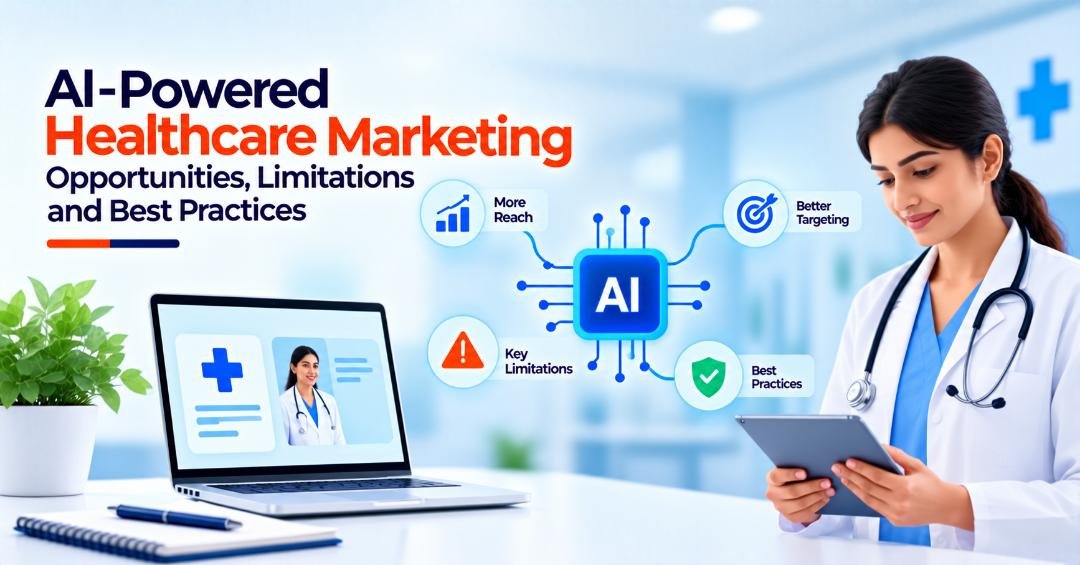
Artificial intelligence is changing the way businesses understand audiences, create content, analyze data, and communicate online. Healthcare marketing is also becoming part of this transformation.
Hospitals, clinics, diagnostic centres, specialty practices, and healthcare brands can now use AI-powered tools to analyze search behaviour, identify content opportunities, improve website experiences, understand marketing performance, and support routine communication.
However, healthcare marketing is different from marketing many other industries. People searching for healthcare services may be dealing with sensitive concerns and important decisions. The information they find online can influence how they view a provider and whether they decide to make an enquiry.
This makes responsible use of artificial intelligence particularly important.
AI can create new opportunities for healthcare marketing, but it also has limitations. Incorrect information, privacy concerns, lack of human oversight, over-automation, and inappropriate personalization can create serious problems if AI is implemented without proper controls.
A successful approach therefore requires more than simply adding AI tools to an existing marketing process. Healthcare organizations need to understand where AI can genuinely add value, where human expertise is necessary, and how technology can be used responsibly.
What Is AI-Powered Healthcare Marketing?
AI-powered healthcare marketing refers to the use of artificial intelligence technologies to support different marketing and digital communication activities within the healthcare sector.
Depending on the organization and its objectives, AI can assist with:
- Search and keyword analysis
- Content planning
- Website search and navigation
- Patient-focused communication
- Marketing analytics
- Lead organization
- Personalization
- Reputation monitoring
- Paid advertising analysis
- AI search optimization
- Content recommendations
AI does not necessarily replace the people responsible for these activities.
Instead, it can help marketing teams process information faster, identify patterns, automate repetitive tasks, and make more informed decisions.
For healthcare organizations, the most effective use of AI is usually connected to a clear business or patient-experience problem.
Why AI Is Becoming Important in Healthcare Marketing
The amount of digital information available to healthcare organizations has increased significantly.
A healthcare brand may manage:
- Website content
- Search data
- Google Business Profile information
- Social media activity
- Online reviews
- PPC campaigns
- Patient enquiries
- Educational resources
- Multiple service pages
- Different locations
Reviewing all of this information manually can take significant time.
AI can help identify patterns across large datasets and highlight areas that deserve attention.
For example, an AI-assisted analysis may reveal that visitors frequently search for a particular healthcare service but leave the website without making an enquiry. This insight can encourage the marketing team to review the relevant page, content, navigation, or enquiry process.
The value comes not simply from using AI, but from turning data into better decisions.
Opportunities Created by AI for Healthcare Marketing
AI can create opportunities across different stages of the digital patient journey.
1. Better Understanding of Search Behaviour
Search behaviour can provide valuable insight into what people want to know.
Healthcare users may search for:
- Symptoms and conditions
- Specialists
- Healthcare services
- Clinics and hospitals
- Locations
- Treatment-related information
- Appointment details
- General healthcare questions
AI can analyze large volumes of search data and identify related themes, questions, and patterns.
This can help marketing teams build content around actual audience needs rather than relying only on assumptions.
The result can be a more relevant healthcare SEO and content strategy.
2. More Efficient Content Planning
Healthcare websites often need content for different specialties and services.
AI can help marketing teams organize content ideas around topics, questions, search intent, and existing website resources.
For example, instead of producing random blog topics, a healthcare marketing team could identify a broader topic and create supporting content around:
- Basic information
- Common questions
- Service explanations
- Preparation information
- Frequently asked questions
- Related specialist services
This can help create a more organized content ecosystem.
However, AI-generated ideas should still be reviewed by people who understand the healthcare subject and the organization’s services.
3. Faster Content Research and Drafting
AI can help with early-stage content work such as:
- Topic research
- Content outlines
- Question identification
- Content organization
- Headline ideas
- FAQ discovery
- Draft structuring
This can improve productivity for marketing teams.
But healthcare content should not be published simply because an AI system generated it.
Medical information requires careful verification. AI can produce information that sounds convincing but is inaccurate, outdated, incomplete, or unsuitable for a particular audience.
Human review remains essential.
4. Improved Website Experiences
Large hospital and healthcare websites can be difficult to navigate.
AI-powered search and website assistants can help visitors find information more efficiently.
For example, a user may ask:
“Where can I find information about orthopedic services?”
An AI-supported website interface may direct them to the appropriate service or department page.
AI can also support content recommendations, internal search, and navigation.
This can reduce the number of steps users need to take to find basic information.
5. AI-Assisted Patient Communication
Routine communication is another area where AI can provide support.
Healthcare websites may receive repetitive questions about:
- Working hours
- Location
- Departments
- Services
- Contact details
- Appointment procedures
- Basic administrative information
An AI-powered assistant can help provide answers to these routine questions.
However, healthcare organizations should establish clear boundaries.
An automated system should not create confusion about whether a user is communicating with a healthcare professional. Where medical judgment or personalized advice is required, the user should be directed to an appropriate human professional.
6. Better Marketing Analytics
Healthcare marketing generates data across multiple channels.
AI can help identify patterns in:
- Organic traffic
- Search visibility
- PPC performance
- Website engagement
- Conversion behaviour
- Social media activity
- Lead sources
- Content performance
For example, a healthcare organization may discover that one service page attracts significant traffic but generates very few enquiries.
This could indicate a problem with search intent, page content, trust signals, navigation, or the conversion process.
AI can highlight the pattern, but the marketing team must investigate the reason.
7. Improved Lead Organization
Healthcare brands may receive enquiries from several sources.
AI-assisted systems can help organize these enquiries based on information such as:
- Source
- Service requested
- Location
- Enquiry type
- Follow-up status
This can help marketing teams understand which channels are generating relevant interest.
However, sensitive healthcare information should be handled with appropriate privacy and security safeguards.
8. Support for AI Search and AEO
The way people search for healthcare information is changing.
Instead of entering short phrases, users can ask detailed questions through AI-powered search systems.
For example:
“What should I consider when choosing a specialist for a particular healthcare need?”
This creates an opportunity for healthcare brands to produce content that answers complete questions clearly.
AI search optimization and AEO can involve:
- Direct answers
- Clear headings
- Structured content
- Relevant FAQs
- Natural language
- Useful explanations
- Strong topical coverage
- Accurate information
The goal should be to make information genuinely useful rather than writing content solely to influence an AI-generated answer.
Limitations of AI-Powered Healthcare Marketing
Despite its opportunities, AI has important limitations.
Understanding these limitations is necessary before introducing AI into a healthcare marketing strategy.
1. AI Can Produce Incorrect Information
One of the biggest concerns is accuracy.
AI systems can generate responses that sound authoritative while containing factual errors.
In healthcare marketing, this can be particularly problematic because incorrect information may affect how readers understand a health topic or healthcare service.
Every healthcare-related piece of AI-assisted content should therefore go through appropriate fact-checking and review.
2. AI Does Not Replace Healthcare Expertise
AI can process information, identify patterns, and assist with communication.
It does not replace the professional expertise of doctors, specialists, healthcare administrators, or subject-matter experts.
Marketing teams should avoid presenting AI-generated information as a substitute for qualified medical guidance.
3. Privacy Is a Major Concern
Healthcare data can be highly sensitive.
Organizations must be careful about what information is entered into AI systems and how that information is stored, processed, or shared.
Before implementing an AI tool, healthcare organizations should understand:
- What data the tool collects
- Where the data is processed
- How information is stored
- Who can access it
- Whether the provider uses the data for other purposes
- What security controls are available
Privacy and security should be considered before deployment, not after a problem occurs.
4. AI Can Create Generic Content
Another limitation is that AI can produce repetitive or generic content when prompts and source information are weak.
Healthcare websites already face a large amount of similar content online.
Simply publishing AI-generated articles that repeat commonly available information may not provide meaningful value.
Healthcare brands should focus on original insights, accurate information, real audience questions, and useful explanations.
5. Over-Automation Can Reduce Trust
Healthcare is built around human trust.
If every interaction feels automated, patients may become frustrated.
A chatbot that repeatedly gives generic answers without understanding the user’s situation can create a poor experience.
AI should therefore support human communication rather than create unnecessary barriers between patients and healthcare teams.
Best Practices for AI-Powered Healthcare Marketing
A responsible AI strategy should combine technology with human expertise.
1. Start With a Clear Objective
Do not implement AI simply because it is a current trend.
First identify the problem.
For example:
- Is content research taking too much time?
- Are users struggling to find website information?
- Is marketing data difficult to analyze?
- Are enquiries poorly organized?
- Is the organization preparing for AI-powered search?
A clear objective makes it easier to choose the right technology.
2. Keep Human Review in the Process
AI-generated content, recommendations, and analysis should be reviewed by appropriate people.
The level of review should depend on the sensitivity and purpose of the information.
Healthcare-related content requires particular attention to factual accuracy and responsible communication.
3. Protect Sensitive Information
Healthcare organizations should create clear rules around AI use.
Employees should understand what information can and cannot be entered into external AI tools.
Privacy policies, access controls, security procedures, and applicable legal requirements should be considered before implementation.
4. Use AI to Assist, Not Mislead
AI should make communication easier and more useful.
It should not be used to create fake patient experiences, fabricate reviews, exaggerate healthcare outcomes, or present unsupported claims as facts.
Authenticity is particularly important in healthcare marketing.
5. Maintain Clear AI Boundaries
If a website uses an AI assistant, users should understand what it can and cannot do.
For example, the system may help with general website information but direct users to a qualified healthcare professional for medical concerns.
Clear boundaries improve both safety and user expectations.
6. Combine AI With Strong Healthcare SEO
AI should not replace fundamental SEO practices.
Healthcare brands still need:
- Useful service pages
- Clear website architecture
- Technical SEO
- Local SEO
- Relevant internal linking
- High-quality content
- Accurate business information
- Strong user experience
AI can support these activities, but it cannot compensate for a poorly structured or unreliable website.
7. Create Content for People First
AI search has increased interest in AEO, but the fundamental principle remains the same: create useful information for people.
Content should answer genuine questions, explain complex topics clearly, and provide appropriate context.
Keyword repetition should not be the main objective.
8. Monitor Performance Regularly
AI systems should be evaluated after implementation.
Organizations can review:
- User engagement
- Website behaviour
- Enquiry quality
- Content performance
- Search visibility
- Response accuracy
- User satisfaction
- Operational efficiency
If an AI application is not producing useful results, it should be adjusted or replaced.
How World SEO Services Can Help Healthcare Brands Use AI Strategically
AI is most effective when it is integrated into a broader digital marketing strategy.
At World SEO Services, healthcare AI solutions can be considered alongside healthcare SEO, content marketing, website development, AEO, local SEO, lead generation, reputation management, and digital analytics.
The objective is not to add AI to every part of marketing.
Instead, the focus can be on identifying areas where AI can create measurable value while keeping healthcare communication accurate, useful, and patient-focused.
For example, AI may assist with content planning and search analysis, while experienced marketing professionals review the strategy and healthcare subject experts verify sensitive information.
Similarly, AI-powered website assistance can help visitors find routine information while human teams remain available for questions that require professional judgment.
This combination of technology and human oversight can create a more balanced healthcare digital marketing approach.
AI and the Future of Healthcare Marketing
AI-powered marketing is likely to become increasingly common as search behaviour, digital communication, and data analysis continue to evolve.
Healthcare brands may use AI to understand audiences more effectively, improve website experiences, organize marketing data, identify content opportunities, and adapt to AI-powered search.
But technological advancement does not remove the need for trust.
In fact, as AI-generated information becomes more common, reliable and clearly presented healthcare information may become even more important.
Healthcare organizations that use AI responsibly can focus on combining efficiency with credibility.
The strongest approach is unlikely to be the one that automates the most tasks.
It will be the one that uses technology where it is genuinely useful while preserving human judgment, accuracy, privacy, and empathy.
A Practical Framework for Healthcare AI Adoption
Healthcare organizations can use a simple framework when evaluating a new AI application.
Identify
Find a specific marketing or patient-experience problem.
Evaluate
Determine whether AI is actually suitable for solving it.
Protect
Review privacy, security, data handling, and compliance requirements.
Implement
Start with a controlled use case rather than changing the entire digital system at once.
Review
Have appropriate people check outputs and performance.
Measure
Track whether the solution creates meaningful improvements.
Improve
Use results and feedback to refine the system.
This approach reduces unnecessary risk while allowing healthcare organizations to benefit from AI where it makes sense.
Conclusion
AI-powered healthcare marketing offers significant opportunities for hospitals, clinics, diagnostic centres, and healthcare brands. It can support search analysis, content planning, website navigation, patient-focused communication, lead organization, marketing analytics, reputation monitoring, and preparation for AI-powered search.
At the same time, AI has clear limitations. It can produce incorrect information, create generic content, raise privacy concerns, and reduce trust when it is overused or poorly implemented.
Healthcare organizations therefore need a balanced approach.
AI should support marketing teams rather than replace human expertise. Sensitive information should be protected, healthcare content should be reviewed carefully, and automated systems should have clear boundaries.
For organizations exploring Healthcare AI Solutions, the most valuable strategy is not simply adopting more technology. It is identifying where AI can improve the digital patient experience while maintaining the standards that healthcare requires.
With the right combination of AI, human expertise, healthcare SEO, quality content, website optimization, AEO, and responsible digital communication, healthcare brands can build a stronger and more useful online presence for the future.
FAQs
1. What is AI-powered healthcare marketing?
AI-powered healthcare marketing uses artificial intelligence to support activities such as search analysis, content planning, website assistance, marketing analytics, lead organization, personalization, reputation monitoring, and AI-search optimization. It is generally used to support marketing teams rather than replace human decision-making.
2. What are the main benefits of AI in healthcare marketing?
AI can help healthcare organizations analyze large amounts of data, identify search and content opportunities, automate repetitive tasks, improve website navigation, organize enquiries, understand marketing performance, and create more relevant digital experiences.
3. What are the limitations of AI in healthcare marketing?
AI can produce inaccurate information, generic content, or inappropriate recommendations. Privacy, security, over-automation, lack of human judgment, and unclear chatbot boundaries are also important concerns. Healthcare organizations should therefore use AI with appropriate human oversight.
4. How can healthcare businesses use AI responsibly?
Healthcare businesses can use AI responsibly by defining clear objectives, protecting sensitive information, verifying healthcare-related content, maintaining human review, being transparent about automated systems, and monitoring performance after implementation.
5. Will AI replace traditional healthcare digital marketing?
AI is more likely to change and support healthcare digital marketing than completely replace it. SEO, content quality, local visibility, websites, reputation, user experience, and human expertise will remain important. AI can make some of these activities more efficient when implemented responsibly.