
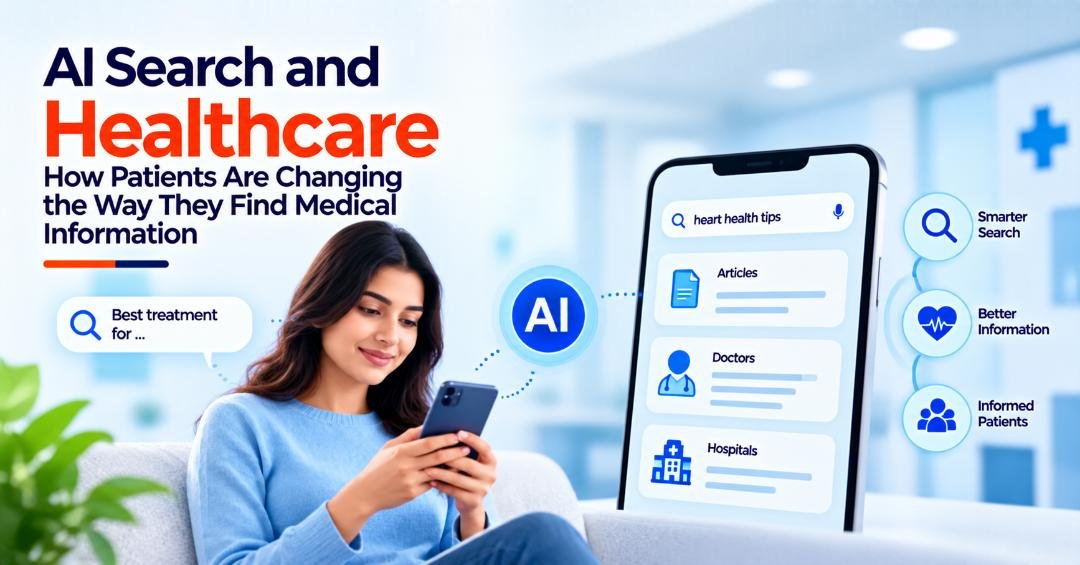
The way people search for healthcare information is changing.
For years, patients primarily used search engines by typing short phrases such as “dentist near me,” “best hospital in Jaipur,” or “symptoms of diabetes.” Today, search is becoming more conversational. People can ask longer and more specific questions through AI-powered search tools and expect an answer that brings together information from different sources.
This change is creating a new digital environment for hospitals, clinics, diagnostic centres, specialists, and healthcare brands.
Patients are not only searching for healthcare providers. They are also asking questions, comparing options, trying to understand medical terms, looking for nearby services, and researching what they should consider before contacting a healthcare professional.
For healthcare organizations, this means that simply targeting a list of keywords may no longer be enough. Websites and content need to provide clear, useful, trustworthy, and well-structured information that can serve both patients and modern search experiences.
What Is AI Search in Healthcare?
AI search refers to search experiences that use artificial intelligence to understand questions, interpret context, summarize information, and provide more conversational answers.
Traditional search often presents a list of webpages that users can open and compare.
AI-powered search can work differently. A person may ask a complete question and receive a synthesized response that draws on information from multiple sources.
For healthcare, this could include questions such as:
- What should I consider when choosing a specialist?
- How can I find a reliable clinic near me?
- What questions should I ask during my first consultation?
- What is the difference between two healthcare services?
- When should I speak with a qualified healthcare professional?
This does not mean traditional search is disappearing. Search engines, websites, local listings, and other digital channels remain important.
Instead, healthcare discovery is becoming more diverse.
Why Patient Search Behaviour Is Changing
Several factors are influencing the way people look for healthcare information.
People have become accustomed to conversational technology. They expect digital platforms to understand natural language rather than requiring them to use a particular keyword format.
At the same time, patients are becoming more research-oriented.
Before contacting a healthcare provider, they may want to understand:
- What a service involves
- Which type of specialist they may need
- What questions they should ask
- Where a provider is located
- What other patients say
- What services are available
- How to request an appointment
This creates a longer digital research journey.
Instead of one search followed immediately by an appointment, the journey may involve multiple questions across search engines, websites, reviews, social media, maps, and AI-powered tools.
Traditional Search vs AI-Powered Search
Traditional search and AI search should not be viewed as completely separate systems.
A patient might begin with a traditional search such as:
“cardiologist in Jaipur”
After finding several providers, they might ask an AI-powered search tool:
“What factors should I consider when choosing a cardiologist in Jaipur?”
They may then return to a search engine to check:
“cardiology clinic near me”
Finally, they may visit a healthcare website to check the doctor’s profile, services, location, and appointment information.
This means healthcare brands need to think about the complete search journey rather than optimizing only for one type of search.
Patients Are Asking More Complete Questions
One of the most noticeable changes is the move from short keyword searches toward longer questions.
For example, instead of:
“fertility clinic Jaipur”
a patient might ask:
“What should I consider when choosing a fertility clinic in Jaipur?”
Instead of:
“knee specialist near me”
they might ask:
“What type of specialist should I consult for ongoing knee problems?”
These questions reveal more context.
They also provide an opportunity for healthcare brands to create content that directly addresses the concerns behind the search.
This is why question-focused content is becoming increasingly valuable.
The Patient Journey Is Becoming More Conversational
Healthcare search is rarely limited to one question.
A patient may follow a sequence such as:
Question → Understanding → Follow-up Question → Provider Research → Comparison → Trust Check → Enquiry
For example, someone may first search for general information about a healthcare concern.
After reading basic information, they may ask what type of specialist handles that concern.
Then they may search for specialists in their city.
After finding providers, they may compare websites, reviews, services, qualifications, location, and appointment options.
Each stage requires different information.
A healthcare brand that understands this journey can create content that supports patients from the early research stage through provider discovery.
Why Healthcare Content Needs to Be More Useful
AI search makes the quality and structure of online information increasingly important.
If a healthcare website contains only short promotional pages, it may provide limited value to someone researching a topic.
A stronger content strategy can include:
- Detailed service pages
- Educational articles
- FAQs
- Specialist information
- Location information
- General healthcare guides
- Treatment-related educational resources
- Preventive healthcare content
- Appointment information
The purpose is not to create content for every possible search phrase.
It is to build a useful information resource around the healthcare organization’s areas of expertise.
Clear Answers Can Support AI Search Visibility
AI-powered search systems need to understand what a webpage is about.
Clear structure can help.
Healthcare content should use descriptive headings and provide direct answers to important questions.
For example:
What Should Patients Consider When Choosing a Specialist?
A useful answer might explain factors such as the specialist’s area of practice, relevant qualifications, location, available services, consultation process, and the importance of discussing individual medical concerns with a qualified professional.
The answer should then provide supporting context rather than repeating the same keyword several times.
This type of structure can be useful for readers and can also make the information easier for modern search systems to interpret.
AEO Is Becoming More Relevant for Healthcare
Answer Engine Optimization, commonly called AEO, focuses on creating content that clearly answers questions used in answer-based search experiences.
For healthcare websites, AEO can involve:
- Direct answers
- Question-based headings
- Relevant FAQs
- Clear definitions
- Logical content structure
- Natural language
- Supporting context
- Useful internal links
- Accurate information
AEO should not be treated as a replacement for traditional SEO.
Instead, healthcare brands can combine traditional SEO with answer-focused content.
SEO can help users discover a webpage, while clear answers can help them understand the information once they arrive.
AI Search Does Not Remove the Importance of Healthcare SEO
There is sometimes a misconception that AI search means traditional SEO is no longer important.
That is not the case.
Healthcare brands still need technically sound websites, relevant content, strong page structures, local visibility, useful service pages, and appropriate internal linking.
Search engines and AI systems both need reliable information to understand a healthcare organization.
Healthcare SEO therefore remains an important foundation.
The difference is that SEO strategy now needs to consider more forms of search behaviour.
Instead of asking only:
“What keyword should this page rank for?”
marketers should also ask:
“What question is the patient trying to answer?”
That shift can lead to more useful content.
Local Healthcare Search Is Still Extremely Important
AI search does not eliminate local search.
Patients often need healthcare services in a specific city or nearby area.
A person may ask:
“Which clinics provide this service near me?”
This means local information remains important.
Healthcare brands should maintain accurate information across relevant digital platforms, including:
- Business name
- Address
- Phone number
- Working hours
- Website
- Services
- Location details
- Genuine reviews
A well-maintained Google Business Profile can also support local discovery.
The information should be consistent and accurate because patients may rely on it when deciding whether to visit a healthcare facility.
Healthcare Websites Need Strong Information Architecture
AI search makes the structure of a website even more important.
A healthcare website should make relationships between different types of information clear.
For example:
Hospital → Department → Specialty → Service → Educational Content → FAQ
This structure helps users navigate the website and provides search engines with additional context.
A hospital offering cardiology services could have a dedicated cardiology page supported by educational content about relevant topics and FAQs related to the service.
This is more useful than publishing disconnected articles without a clear relationship to the organization’s services.
Trust Becomes Even More Important in AI Search
Healthcare information requires a high level of trust.
People may make important decisions based on what they find online, which means healthcare brands need to be careful about the accuracy and presentation of information.
A trustworthy healthcare website should clearly communicate:
- Who provides the service
- What services are available
- Where the organization operates
- Relevant professional information
- How patients can contact the provider
- General information about services
- Appropriate sources or references where useful
Content should avoid exaggerated promises or guaranteed outcomes.
It should also make the distinction between general educational information and personalized medical advice clear.
Patient Reviews Still Matter
AI search does not replace the importance of online reputation.
Patients may still check reviews after discovering a healthcare provider through search.
Reviews can influence perceptions about:
- Communication
- Appointment experience
- Staff interaction
- Facility experience
- Accessibility
- General service quality
Healthcare organizations should encourage genuine feedback and respond professionally.
They should also protect patient privacy when responding publicly.
A strong digital presence combines useful content with a credible real-world reputation.
AI Search Can Change How Healthcare Brands Think About Content
Traditional content strategies often begin with a keyword list.
AI search encourages a broader approach.
Instead of creating content only around:
“best dental clinic in Jaipur”
a healthcare brand may also create useful resources around questions patients ask before choosing a dental provider.
For example:
- What should I consider when choosing a dental clinic?
- What questions should I ask before a dental procedure?
- What services should I check when comparing dental clinics?
- How can I find a dental specialist near me?
These topics may support people at different stages of their decision-making process.
The result is a more complete content ecosystem.
AI Can Help Healthcare Marketers Understand Search Patterns
AI is not only changing how patients search. It can also help marketing teams understand search behaviour.
Healthcare marketers can use AI-assisted analysis to organize large sets of:
- Search queries
- Website questions
- FAQ data
- Search trends
- Content performance
- Social media questions
- Customer enquiries
This can help identify recurring themes.
For example, if many people ask similar questions about a healthcare service, the organization may decide to create a dedicated FAQ, guide, service page, or educational video.
The technology can help identify the pattern, while human expertise determines the appropriate response.
What Healthcare Brands Should Do About AI Search
Healthcare organizations do not need to completely rebuild their digital presence just because AI search is growing.
Instead, they can strengthen the fundamentals.
1. Create Useful Service Pages
Each major healthcare service should have a clear and informative page.
2. Answer Common Patient Questions
Use FAQs and educational content to address genuine questions.
3. Improve Website Structure
Connect related services, specialties, locations, and educational content logically.
4. Strengthen Local Information
Keep location and contact information accurate across relevant platforms.
5. Focus on Trust
Provide clear information about services, professionals, facilities, and the organization.
6. Use Natural Language
Write for people rather than forcing keywords into every paragraph.
7. Update Important Information
Healthcare services, locations, timings, and other business information should remain current.
8. Monitor Search Behaviour
Regularly review the questions and topics people are searching for.
9. Use AEO Alongside SEO
Create content that is useful for both traditional search and conversational answer-based queries.
10. Keep Human Review
AI can assist with research and organization, but healthcare content should receive appropriate human oversight.
How World SEO Services Can Help Healthcare Brands Adapt to AI Search
AI search requires a broader digital marketing approach.
At World SEO Services, healthcare digital marketing can be planned around the way patients discover, research, and evaluate healthcare providers across search engines, local platforms, websites, and emerging AI-powered search experiences.
The strategy can combine:
- Healthcare SEO
- AEO and AI-search optimization
- Healthcare content marketing
- Local SEO
- Healthcare website development
- Search-intent research
- Online reputation management
- Social media marketing
- Healthcare lead generation
- Performance analysis
The focus should not be on trying to manipulate AI-generated answers.
Instead, healthcare brands should build a strong information foundation that makes their expertise, services, and relevant information easier to understand.
For a healthcare organization, this may mean improving existing service pages, creating patient-focused educational content, strengthening FAQs, organizing internal links, improving local information, and ensuring that important business details remain consistent.
Common Mistakes Healthcare Brands Should Avoid
As AI search becomes more popular, some businesses may try to create large amounts of automated content.
This can create problems.
Healthcare brands should avoid:
- Publishing unchecked AI-generated medical information
- Creating hundreds of similar pages
- Repeating keywords unnaturally
- Writing only for AI systems
- Making unsupported healthcare claims
- Using outdated service information
- Ignoring local search
- Treating FAQs as keyword lists
- Copying information from other websites
- Replacing expert review with automation
More content does not automatically mean better visibility.
Useful content is more valuable than content created simply to increase page count.
The Future of Healthcare Search
Healthcare search will likely continue becoming more conversational.
Patients may use traditional search engines, AI assistants, voice interfaces, maps, social platforms, healthcare websites, and other digital tools during the same research journey.
This means healthcare brands need to think beyond one search engine or one ranking position.
The stronger goal is to become a reliable source of useful information across the patient’s digital journey.
That requires:
Helpful content + strong SEO + clear answers + accurate information + local visibility + trust
AI can change the way people discover information, but the fundamentals of good healthcare communication remain the same.
People still want answers they can understand.
They still want reliable providers.
They still want accurate information.
And they still want confidence before taking the next step.
Conclusion
AI search is changing how patients find and understand medical information. Instead of relying only on short keyword searches, people can now ask detailed, conversational questions and expect answers that provide context.
For healthcare brands, this creates a need for a more complete digital strategy.
Hospitals, clinics, diagnostic centres, and specialists should focus on creating useful service pages, answering genuine patient questions, strengthening local visibility, maintaining accurate information, building trustworthy content, and preparing their websites for both traditional and AI-powered search.
SEO remains important, but healthcare content should now also consider AEO and the growing role of conversational search.
For healthcare organizations working with World SEO Services, this changing search environment can be addressed through an integrated approach combining healthcare SEO, content strategy, website optimization, local search, AEO, reputation management, and patient-focused communication.
The goal is not simply to appear in search.
The goal is to make sure that when patients search for healthcare information, they find clear, useful, trustworthy, and relevant information that helps them understand their options and take the appropriate next step.
FAQs
1. How is AI changing the way patients search for healthcare information?
AI is making search more conversational. Instead of using only short keywords, patients can ask detailed questions and receive answers that summarize information from multiple sources. This encourages healthcare brands to create content that answers complete questions clearly.
2. What is AEO in healthcare marketing?
Answer Engine Optimization, or AEO, is the practice of structuring useful content so that it can clearly answer questions used in answer-based and AI-powered search experiences. Healthcare AEO can include direct answers, FAQs, clear headings, natural language, and well-organized information.
3. Is traditional healthcare SEO still important with AI search?
Yes. Healthcare SEO remains important because AI search does not replace websites, search engines, local listings, technical SEO, or relevant content. A strong SEO foundation can support visibility while AEO helps healthcare content address conversational searches.
4. How can healthcare websites improve their visibility in AI search?
Healthcare websites can focus on accurate and useful content, clear answers to common questions, descriptive headings, strong service pages, relevant FAQs, logical internal linking, local information, and trustworthy communication. Content should be created primarily to help users rather than to manipulate AI results.
5. Should healthcare brands use AI to write all their content?
No. AI can assist with research, topic planning, content organization, and drafting, but healthcare content requires appropriate human review. Important medical information should be checked for accuracy, context, privacy, and responsible communication before publication.