
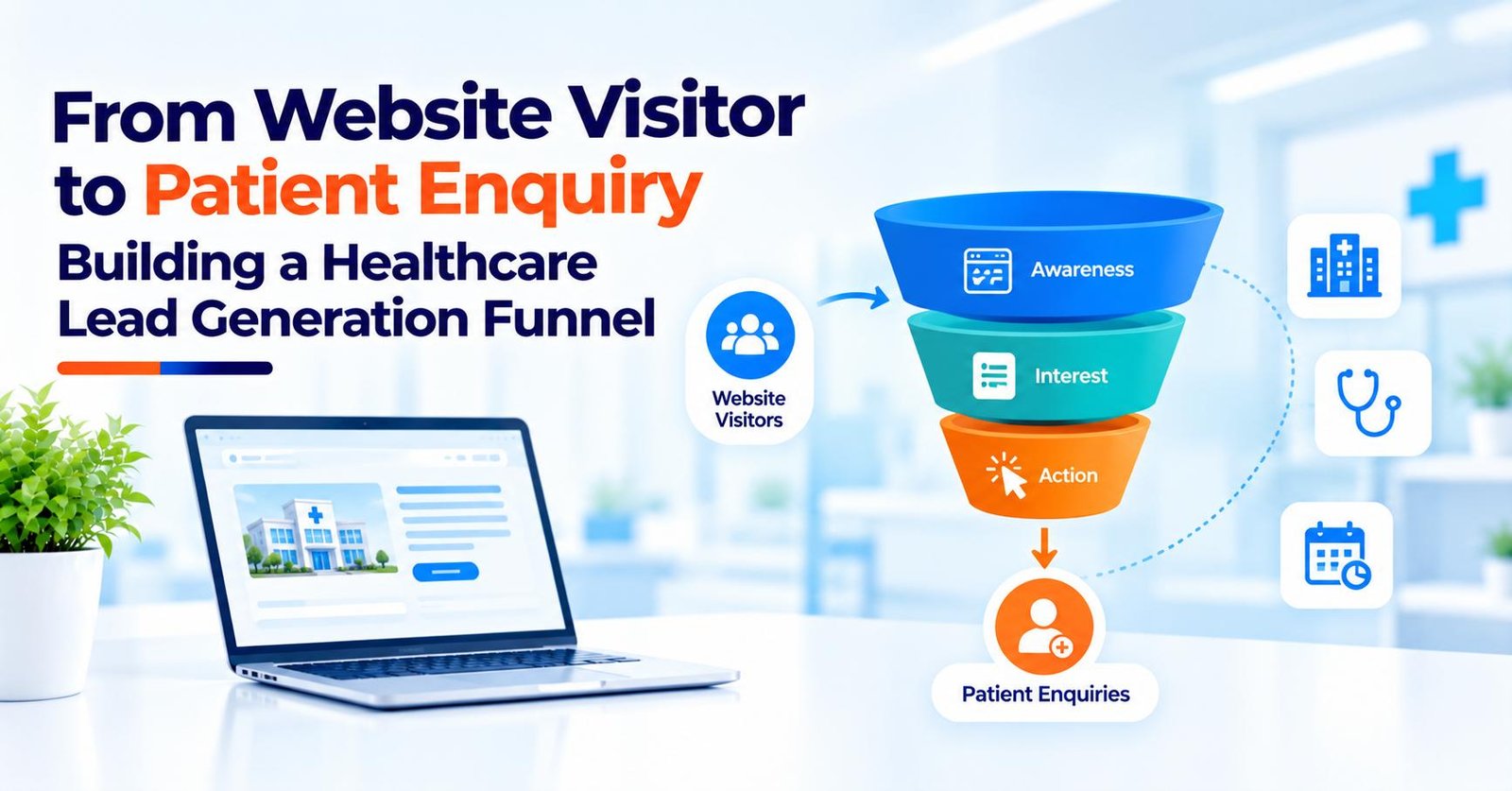
A healthcare website may receive visitors through Google searches, social media, paid advertising, and educational blog articles. However, website traffic alone does not indicate whether a digital marketing strategy is achieving its objectives. The real challenge is helping interested visitors find relevant information and take an appropriate next step, such as requesting appointment details or contacting a clinic.
This is where a healthcare lead generation funnel becomes valuable. It provides a structured way to understand how people discover a healthcare business, explore its services, evaluate the available information, and make an enquiry.
For hospitals, clinics, fertility centres, diagnostic laboratories, and other healthcare organisations, a well-planned funnel can help identify gaps between website visits and meaningful enquiries.
The goal is not to pressure every visitor into booking an appointment. Instead, healthcare businesses should provide accurate information, make contact options accessible, and help people decide whether a particular service meets their needs.
What Is a Healthcare Lead Generation Funnel?
A healthcare lead generation funnel is a framework that describes the steps a person may take from first discovering a healthcare provider online to making an enquiry.
The journey is not always linear. Someone may discover a clinic through Google, return through a direct website visit, and contact the practice several days later. Another person may see a local listing and call immediately.
Despite these differences, the funnel helps marketers understand the main stages of the journey and improve the experience at each point.
A typical healthcare lead generation funnel includes five stages:
- Awareness: A person discovers the healthcare business.
- Consideration: The person explores services and relevant information.
- Evaluation: The person reviews practical details before deciding whether to make contact.
- Enquiry: The person submits a form, calls the clinic, or uses another appropriate contact channel.
- Follow-up: The organisation responds and provides the requested information or explains the next administrative step.
Each stage requires a different approach. Educational content may help during awareness, while clear service pages and contact details may be more important when someone is ready to enquire.
Stage 1: Attract Relevant Visitors Through Digital Channels
The first stage is helping people discover the healthcare organisation through channels that match their needs and search behaviour.
A website can attract visitors from organic search, local listings, paid advertising, social media, and referral links. However, not every visitor will be relevant to the services offered.
A clinic should therefore focus on reaching the right audience rather than simply increasing traffic.
Search Engine Optimisation
Healthcare SEO helps relevant service pages and educational content appear in organic search results.
For example, a person searching for a dermatology clinic in Jaipur may be looking for a nearby provider, while someone searching for information about a skin condition may still be researching.
An effective SEO strategy should address these different intentions through accurate service pages and helpful educational content.
Useful activities include:
- Researching relevant service and location keywords.
- Optimising page titles, headings, and website content.
- Creating useful pages for genuine clinic locations.
- Improving website accessibility and technical performance.
- Publishing medically appropriate educational content.
SEO can support long-term visibility, although rankings and traffic are influenced by competition and other factors outside a business’s control.
Google Business Profile and Local Search
For healthcare organisations serving a specific area, local search can help nearby people find the correct clinic or hospital.
An accurate Google Business Profile should provide the correct business name, address, contact details, opening hours, and website link.
These details help people identify the location and understand how to contact the organisation.
Paid Search Advertising
Where permitted, paid search campaigns can connect people with relevant healthcare service pages.
Campaigns should use accurate messaging, appropriate landing pages, and compliant targeting. Healthcare advertising is subject to additional platform restrictions, particularly when campaigns involve sensitive health information or regulated services.
Before launching a campaign, healthcare organisations should review the applicable advertising policies, service-specific restrictions, and local requirements.
Social Media and Content Marketing
Social media posts, educational videos, and blog articles can introduce people to a healthcare organisation and direct them to relevant information.
Content should be useful and accurate rather than relying on exaggerated medical claims or fear-based messaging.
Key objective: Attract relevant visitors and help them understand what the healthcare business offers.
Stage 2: Help Visitors Understand the Available Services
After reaching a website, visitors need to determine whether the organisation provides the service they are looking for.
If the information is unclear, people may leave without exploring further. A well-structured website makes this stage easier by presenting services, specialities, locations, and practical details clearly.
Create Clear Healthcare Service Pages
Each important service should have a dedicated page where appropriate.
For example, a hospital may have separate pages for its cardiology department, diagnostic facilities, and outpatient services.
A useful service page should explain:
- What the service involves.
- Which services are available at the relevant location.
- Relevant information about the department or practitioner.
- How visitors can obtain further information.
- Appropriate contact or appointment options.
The content should reflect the actual services provided. Avoid promising specific treatment outcomes or presenting general information as a personalised medical recommendation.
Organise Website Navigation
Visitors should be able to find important information without navigating through multiple unrelated pages.
Useful navigation elements include:
- A clearly labelled services menu.
- Links to doctor or department information.
- Location and contact pages.
- Frequently asked questions.
- Appointment or enquiry information.
Internal links should connect related pages logically. Someone reading about a hospital department should be able to find its location and relevant contact details without having to restart their search.
Provide Helpful Educational Content
Some visitors need more information before contacting a healthcare provider. Educational articles can answer general questions and explain what people may expect from a service.
For example, a diagnostic centre could publish an appropriately reviewed guide explaining how to prepare for a particular test.
The content should be accurate, understandable, and relevant to the organisation’s services.
Key objective: Help visitors understand the service and find the information they need to decide what to do next.
Stage 3: Build Confidence During the Evaluation Stage
Before making an enquiry, visitors may compare providers, check practical details, or look for information about a healthcare organisation’s qualifications and facilities.
A website should support this evaluation process through transparent and accurate information.
Present Professional Information Clearly
Healthcare organisations should provide appropriate details about their doctors, departments, and available services.
Depending on the organisation, this may include relevant qualifications, professional roles, facility information, and the scope of services offered.
Claims should be factual and verifiable. Avoid unsupported statements such as “guaranteed results,” “best doctor in India,” or claims of universal treatment success.
Make Location and Contact Information Accessible
Visitors should be able to identify the correct branch and understand how to reach it.
For multi-location organisations, each location page should display its own accurate address, contact details, and available services.
Incorrect or conflicting information can create unnecessary uncertainty and may lead visitors to contact the wrong department.
Design for Mobile Users
A website may look clear on a desktop but become difficult to use on a mobile device.
Healthcare businesses should check whether:
- Text is readable without unnecessary zooming.
- Important buttons are easy to tap.
- Phone numbers are accessible.
- Pages load efficiently.
- Navigation works on smaller screens.
- Forms can be completed without difficulty.
A mobile-friendly website makes it easier for visitors to find relevant information when they need it.
Use Reviews and Testimonials Responsibly
Public feedback may form part of a visitor’s evaluation, but healthcare organisations must manage it carefully.
Reviews should be genuine, and public responses should not reveal confidential patient information. The use of patient testimonials in promotional material may also be subject to additional professional and advertising requirements.
Key objective: Provide trustworthy information and remove avoidable barriers to making an enquiry.
Stage 4: Convert Interested Visitors Into Enquiries
A conversion occurs when a visitor completes a defined action, such as submitting an enquiry form or calling the clinic.
The most suitable action depends on the service and the visitor’s needs. Some people may want to request appointment information, while others may need clarification about operating hours or available services.
Make Contact Options Easy to Find
Healthcare websites can provide appropriate contact options such as:
- A telephone number.
- A general enquiry form.
- An appointment request form.
- An official email address.
- A relevant department contact page.
These options should be clearly labelled and connected to the correct team or location.
Keep Forms Short and Relevant
Long forms can discourage people from completing an enquiry.
For an initial request, the organisation may need only a name, preferred contact method, and a brief indication of the information requested.
Additional information should be collected only when necessary for a legitimate purpose and through an appropriate, secure process.
Avoid asking visitors to provide detailed medical histories, diagnoses, or sensitive health information through ordinary marketing forms when that information is not needed to respond to the request.
Use Clear Calls to Action
A call to action should explain what the visitor can do next.
Examples include:
- Request Appointment Information
- Contact the Clinic
- View Available Services
- Find Clinic Directions
- Enquire About Consultation Timings
The wording should match the action that follows. If a button opens a general contact form, it should not imply that an appointment has already been confirmed.
Healthcare organisations should also ensure that promotional messaging and calls to action comply with applicable professional and advertising requirements.
Test the Enquiry Process
A form that does not submit correctly can prevent a visitor from making contact.
Periodically test forms, phone links, email links, and appointment workflows. Confirm that submissions reach the correct team and that visitors receive a clear confirmation where appropriate.
Key objective: Make it straightforward for interested visitors to contact the organisation through a suitable channel.
Stage 5: Manage and Respond to Enquiries Effectively
A successful lead generation funnel does not end when someone submits a form or calls a clinic. The organisation must have a reliable process for responding to the request.
Slow responses, unclear ownership, or incorrect routing can undermine the experience even when digital marketing has attracted a relevant visitor.
Establish an Enquiry Management Process
A practical process may include:
- Receive the enquiry: Capture it through an approved channel.
- Record necessary information: Store only the contact and request details required to respond appropriately.
- Route the request: Direct the enquiry to the appropriate team or branch.
- Respond promptly: Follow an internally defined and reasonable response timeframe.
- Record the outcome: Track whether the request was answered, redirected, or resolved.
- Follow up appropriately: Contact the person again only when suitable and consistent with their preferences and applicable requirements.
For example, if someone requests consultation timings for a clinic, the relevant team can provide accurate information and explain how to request an appointment.
Marketing teams should not make clinical decisions or provide personalised medical advice unless the communication is handled by an appropriately qualified professional within their role.
Use CRM Tools Where Appropriate
A customer relationship management (CRM) system can help healthcare organisations organise incoming enquiries from different channels.
Depending on the system and the organisation’s requirements, it may support:
- Enquiry source tracking.
- Assignment to the correct team.
- Response status monitoring.
- Identification of unresolved requests.
- Administrative follow-up.
- Aggregate performance reporting.
Because healthcare enquiries can contain sensitive information, access permissions, security controls, and retention policies should be established before personal data is stored in a CRM.
Collecting more data than necessary can create privacy risks without improving the enquiry process.
Key objective: Ensure that relevant enquiries receive an appropriate and timely response.
How to Measure the Healthcare Lead Generation Funnel
A funnel becomes more useful when healthcare businesses can identify how visitors progress through each stage and where they leave the process.
Different metrics provide insight into different stages.
| Funnel stage | Useful measurements |
| Awareness | Organic visits, relevant search impressions, local profile interactions |
| Consideration | Service-page visits, relevant content engagement, navigation to contact pages |
| Evaluation | Visits to doctor, department, or location pages; use of contact information |
| Enquiry | Form submissions, calls, and other defined enquiry actions |
| Follow-up | Response time, enquiry status, and appropriate appointment progression |
These are examples of measurements rather than guaranteed indicators of success. Available data will vary by channel and analytics setup.
1. Website Conversion Rate
The conversion rate measures the proportion of eligible website visits that result in a defined action.
For example, if a website receives 1,000 visits and 30 visitors submit a relevant enquiry form, the form conversion rate for that measurement period is 3%, assuming both figures use the same defined visitor or session basis.
The calculation should use a consistent denominator and a clearly defined conversion event.
2. Cost Per Enquiry
For paid campaigns, cost per enquiry can help evaluate advertising efficiency.
It is calculated by dividing the relevant campaign cost by the number of enquiries attributed to that campaign.
However, a low cost per enquiry does not necessarily mean a campaign is performing well if the enquiries are unrelated to the services offered.
3. Qualified Enquiry Rate
This metric measures the proportion of enquiries that are relevant to the organisation’s actual services and can appropriately be handled.
Define qualification criteria carefully. The aim is to assess service relevance and administrative suitability, not to make unsupported assumptions about a person’s medical condition or treatment needs.
4. Enquiry-to-Appointment Rate
Where suitable data is available, organisations may measure the proportion of relevant enquiries that proceed to an appointment.
Interpret this metric carefully because appointment decisions depend on many factors, including service availability, the person’s preferences, and the nature of the enquiry.
Use privacy-conscious reporting and avoid collecting unnecessary patient information solely for marketing attribution.
Common Healthcare Lead Generation Funnel Mistakes
Healthcare organisations can lose potential enquiries when the stages of the funnel are not connected properly.
Common mistakes include:
- Attracting irrelevant traffic: Targeting keywords or audiences that do not match the services offered.
- Using generic landing pages: Sending visitors to pages that do not answer the questions behind their search.
- Hiding contact information: Making phone numbers or enquiry forms difficult to find.
- Overcomplicating forms: Requesting unnecessary details before responding to a general enquiry.
- Making misleading claims: Using unsupported promises about treatment outcomes or professional superiority.
- Neglecting mobile usability: Providing a difficult experience on phones and tablets.
- Failing to respond consistently: Leaving enquiries unanswered or directing them to the wrong department.
- Tracking clicks instead of outcomes: Measuring traffic without understanding whether visitors make relevant enquiries.
- Ignoring privacy requirements: Collecting or sharing sensitive information without appropriate safeguards.
Reviewing the funnel from beginning to end helps identify these issues and prioritise practical improvements.
How World SEO Services Can Support Healthcare Lead Generation
Building an effective healthcare lead generation funnel requires more than driving traffic to a website. Search visibility, landing page quality, contact options, enquiry management, and performance measurement should work together.
As a healthcare-focused digital marketing agency, World SEO Services can support healthcare organisations with a structured digital marketing approach that considers each stage of the visitor journey.
Potential areas of support include:
- Healthcare SEO and local search optimisation.
- Google Business Profile optimisation.
- Healthcare website and landing page improvements.
- Content planning for relevant patient information needs.
- Paid campaign planning where permitted.
- Website conversion tracking.
- Enquiry funnel analysis.
- Digital marketing performance reporting.
The appropriate strategy depends on the organisation’s services, locations, website, operational capacity, and marketing objectives. Results should be evaluated over time rather than based on a single traffic or enquiry figure.
The goal is to help healthcare businesses make relevant information easier to discover, improve the online enquiry experience, and build a more measurable digital marketing process.
Conclusion
Moving from a website visitor to a patient enquiry involves several connected stages. People first need to discover a healthcare provider, understand its services, evaluate the available information, and find a suitable way to make contact.
SEO, local search, content marketing, permitted paid advertising, and social media can help attract relevant visitors. Clear service pages, accessible contact options, and simple enquiry forms can support the next step, while a reliable response process helps ensure that requests are handled appropriately.
Healthcare organisations should measure the entire funnel rather than focusing on traffic alone. By reviewing each stage, they can identify barriers, improve the user experience, and make better-informed marketing decisions.
With a structured and patient-focused approach, World SEO Services can help healthcare businesses strengthen their digital lead generation process while keeping accurate information, privacy, and responsible communication at the centre of their strategy.
FAQs
1. What is a healthcare lead generation funnel?
A healthcare lead generation funnel is a framework that describes how people discover a healthcare organisation, explore its services, evaluate available information, make an enquiry, and receive an appropriate response.
2. How can a healthcare website convert visitors into enquiries?
A healthcare website can support enquiries through clear service pages, accurate location details, mobile-friendly navigation, accessible contact information, and simple enquiry forms. The information should be accurate, and the next step should be clearly explained.
3. Which digital channels can support healthcare lead generation?
SEO, local SEO, Google Business Profile, permitted paid search advertising, content marketing, and social media can all contribute. The most suitable combination depends on the healthcare business, its audience, location, and applicable advertising requirements.
4. How can healthcare businesses measure funnel performance?
They can monitor relevant website traffic, service-page engagement, enquiry submissions, calls, cost per enquiry, qualified enquiry rate, and appropriate follow-up outcomes. Metrics should be defined consistently and interpreted with privacy safeguards.
5. Why is patient privacy important in a healthcare lead generation funnel?
Enquiries may contain sensitive personal or health information. Healthcare organisations should collect only necessary data, use suitable security controls, limit access to authorised personnel, and follow applicable privacy and advertising requirements throughout the enquiry process.