
For clinics, attracting website visitors and social media followers is only one part of digital growth. The real challenge is reaching people who are actively looking for relevant healthcare services, helping them understand their options, and making it easy for them to enquire about an appointment.
This is where qualified lead generation becomes important. Instead of focusing only on clicks, impressions, or the total number of enquiries, clinics need a strategy that attracts relevant audiences, answers their questions, and encourages meaningful next steps.
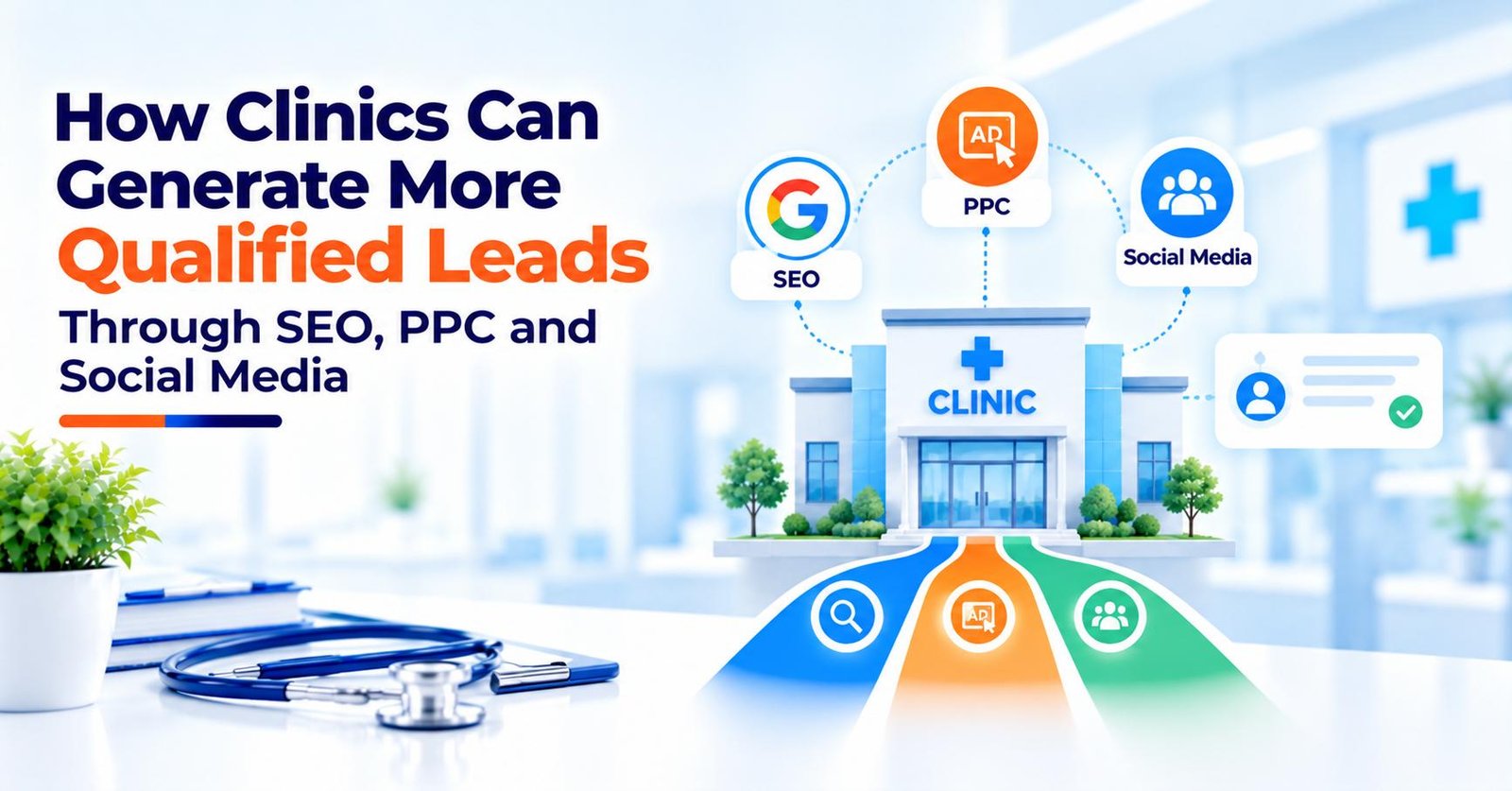
Search engine optimization (SEO), pay-per-click advertising (PPC), and social media marketing each play a different role in this process. SEO helps clinics become discoverable through organic searches, PPC can connect them with people searching for specific services, and social media supports awareness, education, and trust.
When these channels work together, clinics can create a more consistent and measurable approach to digital patient acquisition.
What Is Qualified Lead Generation for Clinics?
A lead is someone who expresses interest in a clinic’s services through an action such as submitting an enquiry form, calling the reception desk, or requesting appointment information.
However, not every enquiry is equally valuable. Someone looking for a service the clinic does not offer, asking about an unrelated location, or submitting an incomplete form may not be a suitable lead.
A qualified lead is an enquiry that broadly matches the clinic’s services, location, availability, and appointment process. Qualification should be based on relevant service requirements rather than assumptions about a person’s health, finances, or likelihood of needing treatment.
For example, a clinic offering dermatology services may receive enquiries from people looking for skin consultations. If the clinic provides the requested service and the person is seeking an appointment within its service area, the enquiry may be considered relevant.
Clinics should define lead quality before investing heavily in marketing. Useful criteria include:
- Whether the enquiry relates to a service the clinic provides.
- Whether the person is looking for care at a location the clinic serves.
- Whether the enquiry contains enough information to arrange appropriate follow-up.
- Whether the person has requested contact or appointment information.
- Whether the enquiry progresses to a scheduled appointment.
This definition helps clinics evaluate marketing based on meaningful outcomes instead of lead volume alone.
1. Use SEO to Attract Patients With Relevant Search Intent
SEO helps a clinic appear in organic search results when people look for healthcare services, doctors, or clinics in their area. It can support long-term visibility by making useful information easier to discover.
The objective is not simply to rank for as many keywords as possible. It is to attract people whose searches are relevant to the clinic’s actual services.
Target Service-Specific Keywords
Broad terms such as “clinic” may attract visitors with different needs and intentions. More specific searches can provide clearer context.
A clinic can research keyword themes such as:
- Dermatologist in Jaipur
- Dental clinic near Vaishali Nagar
- Physiotherapy services for rehabilitation
- Diagnostic centre in Udaipur
- Consultation hours for a particular medical specialty
These are illustrative examples. The best keywords depend on the clinic’s location, services, competition, and the language patients use when searching.
Organize keywords by search intent. Someone searching for general information may need an educational article, while someone looking for a clinic in a specific area may be closer to contacting a provider.
Avoid creating multiple nearly identical pages just to target small keyword variations. Each service or location page should offer distinct, useful information.
Build Helpful Service Pages
A well-structured service page can answer the questions a prospective patient needs to consider before making an enquiry.
Include:
- A clear explanation of the service offered
- Relevant information about the clinic and its medical team
- The clinic’s location and contact details
- Consultation hours or appointment procedures, where applicable
- Answers to common questions
- A clear next step, such as contacting the clinic or requesting an appointment
Healthcare content should be accurate, easy to understand, and appropriately reviewed. Avoid unsupported treatment claims, guaranteed outcomes, or language that pressures readers into seeking care.
Creating helpful, reliable, people-first content is more valuable than producing pages primarily to manipulate search rankings.
Strengthen Local SEO
For clinics that serve a defined geographic area, local search visibility can be especially valuable.
Maintain accurate business information across the website and relevant business listings. A clinic’s Google Business Profile should reflect its correct name, address, phone number, operating hours, category, and services where supported.
Other useful local SEO activities include:
- Keeping location and contact details consistent
- Adding clear directions and accessibility information
- Encouraging genuine patient feedback without offering incentives for positive reviews
- Responding professionally to reviews while protecting patient confidentiality
- Monitoring local search queries and profile interactions
Local visibility does not guarantee appointments, but it can make it easier for relevant people to find and contact the clinic.
Measure SEO Beyond Rankings
Track organic traffic to service pages, calls, appointment requests, and the proportion of enquiries that match the clinic’s services. Monitor which pages contribute to meaningful actions instead of judging success solely by keyword positions.
SEO generally requires ongoing work and time to build visibility. It is best viewed as a long-term acquisition channel rather than an immediate source of guaranteed leads.
2. Use PPC Advertising to Reach High-Intent Searchers
Pay-per-click advertising allows clinics to display ads for selected search themes and pay when users interact with the ads according to the campaign’s bidding model. Search campaigns can be useful when a clinic wants to promote a particular service, location, or appointment offering.
Unlike organic SEO, paid search can begin generating visibility shortly after a campaign is approved and launched. However, performance depends on competition, budget, relevance, website experience, and compliance with advertising policies.
Structure Campaigns Around Services
Avoid sending every paid-search visitor to one generic homepage. Instead, group campaigns around distinct services or relevant locations.
For example, a multispecialty clinic might separate dental services, physiotherapy, and general consultations into different campaigns or ad groups where appropriate.
This makes it easier to align:
- The search query
- The advertisement
- The landing page
- The requested next step
- The subsequent lead-quality report
Use relevant keywords and clear ad copy. Explain what the clinic offers, where it operates, and how people can learn more or request an appointment.
Create Landing Pages That Support Enquiries
A landing page should deliver what the advertisement promises. If an ad promotes a specific service, the page should explain that service rather than forcing visitors to search through unrelated information.
Useful elements include a clear headline, relevant service details, clinic location, contact options, mobile-friendly design, and a straightforward appointment enquiry process.
Keep forms proportionate to their purpose. Asking for unnecessary personal or medical information at the initial marketing stage can discourage visitors and create avoidable privacy risks.
Monitor Costs and Lead Quality Together
A campaign that generates many low-quality enquiries may be less useful than one producing fewer but more relevant enquiries.
Clinics can track:
- Advertising spend
- Click-through rate
- Landing-page conversion rate
- Cost per enquiry
- Percentage of relevant enquiries
- Cost per qualified lead
- Enquiry-to-appointment rate
For example, if a campaign generates 40 enquiries but only 10 match the clinic’s services and location, the clinic should assess the cost of those 10 qualified leads, not just the cost per enquiry.
Also review search terms, geographic targeting, landing-page relevance, and call or form quality. Make changes based on aggregated performance data and appropriate privacy safeguards.
Follow Healthcare Advertising Policies Carefully
Healthcare advertising is subject to platform-specific rules and applicable laws. Some platforms restrict personalized advertising techniques when campaigns relate to sensitive health topics.
Clinics should review current advertising policies before launching or changing campaigns. Requirements can depend on the service, country, ad format, audience settings, and landing-page content.
Do not assume that every medical service can be advertised in the same way, and avoid using sensitive health information to build or target audiences.
3. Use Social Media to Build Awareness and Encourage Enquiries
Social media helps clinics stay visible between the moments when people search for a service and when they decide to contact a provider. It is particularly useful for sharing educational information, introducing the clinic’s team, explaining services, and answering general questions.
However, follower counts and likes do not automatically translate into qualified leads. A social media strategy should connect relevant content with a clear and appropriate next step.
Publish Content That Answers Real Questions
Plan content around the questions people commonly ask before choosing a clinic. Depending on the specialty, useful topics may include:
- Educational posts: General information about services, preventive care, and common health questions.
- Service explainers: What a consultation involves and what patients can generally expect.
- Doctor introductions: Verified qualifications, areas of practice, and professional experience.
- Clinic information: Location, facilities, accessibility, consultation hours, and appointment procedures.
- Frequently asked questions: General answers about booking, preparation, and available services.
- Myth-versus-fact posts: Evidence-based explanations that correct common misconceptions without creating fear.
All medical information should be reviewed by an appropriately qualified professional. Content should avoid exaggerated claims, guaranteed results, and advice that could be mistaken for an individual diagnosis.
Make the Next Step Clear
A useful social media post should help interested people understand what to do next. Depending on the content, this might mean visiting a relevant service page, calling the clinic, checking consultation hours, or using an appointment enquiry form.
Keep calls to action simple and consistent. For example, a post introducing a physiotherapy service could direct visitors to the clinic’s physiotherapy page for more information.
Ensure that contact details are accurate and that messages are monitored. If the clinic invites enquiries through direct messages, establish a process for moving appointment discussions to an appropriate private channel rather than requesting sensitive medical details in public comments.
Use Paid Social Campaigns Thoughtfully
Paid social campaigns can increase the reach of educational content and clinic announcements. Their suitability depends on the service, target audience, platform rules, and campaign objective.
Before promoting healthcare content, review the platform’s current policies on medical claims, sensitive information, and audience targeting. Avoid targeting people based on inferred diagnoses or other sensitive health information.
Social media works best as a supporting channel: it helps people discover and understand a clinic, while relevant service pages and clear contact options provide a route to enquiry.
4. Connect SEO, PPC and Social Media Instead of Treating Them Separately
Each channel has a different role, but their combined value becomes clearer when they support the same service priorities.
Consider a clinic launching a new diagnostic service. SEO can help its website explain the service and appear for relevant organic searches. PPC can provide additional visibility for eligible, high-intent searches. Social media can introduce the service through educational posts and clinic updates.
A coordinated approach can include the following steps:
- Choose the priority service. Identify the service the clinic wants to make more discoverable, based on its actual capabilities and appointment capacity.
- Research audience questions. Understand what people search for, what information they need, and what may prevent them from making an enquiry.
- Create a relevant landing page. Provide accurate service information, location details, and clear contact options.
- Build organic visibility. Improve the service page, internal links, local business information, and supporting educational content.
- Launch suitable paid campaigns. Use relevant keywords, compliant targeting, and advertisements that match the landing page.
- Support awareness through social media. Share useful information and direct interested visitors to appropriate resources.
- Review enquiry quality. Assess which channels generate relevant enquiries and whether those enquiries progress to appointments.
This approach also helps clinics identify gaps. If a campaign attracts clicks but produces few enquiries, the problem may involve landing-page relevance, unclear contact information, or a mismatch between the advertisement and the service.
If enquiries arrive but rarely become appointments, the clinic may need to examine response times, appointment availability, or its follow-up process.
Marketing data can help identify these possibilities, but it should be interpreted alongside operational context rather than used to make unsupported assumptions about patients.
5. Improve the Website Experience to Convert Relevant Visitors
SEO, PPC, and social media can bring people to a clinic’s website, but the website must make the next step straightforward.
A confusing or outdated website can undermine otherwise effective marketing. Visitors may leave if they cannot find the clinic’s location, understand a service, or determine how to request an appointment.
Clinics should review the following elements:
- Mobile usability: Pages, contact details, buttons, and forms should work well on mobile devices.
- Page speed: Important information should load promptly without unnecessary distractions.
- Clear navigation: Visitors should be able to find relevant services without searching through unrelated pages.
- Visible contact options: Phone numbers, directions, and enquiry options should be easy to locate.
- Relevant information: Each service page should answer practical questions without making unsupported promises.
- Accessible design: Text should be readable, navigation understandable, and important actions usable by people with different needs.
- Simple enquiry forms: Request only information necessary for the stated purpose and explain how submitted information will be handled.
Trust is equally important. Accurate doctor profiles, transparent clinic details, appropriate professional credentials, and clear privacy information can help visitors make informed decisions.
6. Build a Reliable Process for Handling Enquiries
Lead generation does not end when someone submits a form or calls the clinic. A consistent enquiry-management process helps the clinic respond appropriately and understand whether its marketing is attracting relevant interest.
Establish Clear Responsibilities
Decide who monitors incoming calls, website forms, and social media enquiries. Set reasonable internal response targets according to staffing and operating hours, and provide a process for enquiries received outside those hours.
Reception teams should have accurate information about services, appointment availability, consultation procedures, and referral requirements where relevant. They should also know when a question needs to be passed to a qualified healthcare professional.
Protect Patient Information
Healthcare enquiries may involve sensitive personal information. Collect only what is needed, explain the purpose of collection, restrict access to authorized staff, and use suitable systems for storing and handling information.
Do not place identifiable patient information in ordinary marketing spreadsheets, public comments, or advertising reports. Follow applicable privacy requirements and platform policies when configuring analytics, call tracking, CRM systems, and conversion measurement.
Connect Marketing With Appointment Outcomes
Where appropriate and lawful, clinics can record high-level outcomes such as whether an enquiry was relevant, whether contact was made, and whether an appointment was scheduled.
Use aggregated reporting wherever possible. Avoid uploading sensitive medical or patient information to advertising platforms unless the specific use is permitted and all applicable legal requirements have been met.
This feedback helps marketing teams understand which campaigns contribute to meaningful enquiries while keeping patient confidentiality central to the process.
7. Measure the Metrics That Matter
A clinic should choose metrics that reflect its actual goals rather than tracking every available dashboard figure.
Important measures include:
- Qualified lead rate: The percentage of enquiries that meet the clinic’s defined relevance criteria.
- Cost per qualified lead: Marketing expenditure divided by the number of qualified leads.
- Landing-page conversion rate: The percentage of eligible visitors who complete a defined enquiry action.
- Enquiry-to-appointment rate: The proportion of relevant enquiries that result in scheduled appointments.
- Organic service-page performance: Search visibility, relevant traffic, and enquiry actions associated with key service pages.
- Paid campaign efficiency: Advertising costs compared with relevant enquiries and appropriate business outcomes.
- Social media referral performance: Website visits and meaningful enquiry actions associated with social campaigns.
Interpret these metrics in context. A specialty with fewer available appointments may need a different acquisition strategy from a clinic seeking to increase awareness of a new service. Seasonality, location, competition, and appointment availability can also influence results.
Review performance regularly and make changes based on evidence. No channel or campaign can guarantee a particular number of leads or appointments.
Common Mistakes Clinics Should Avoid
Even a well-funded campaign can underperform when the underlying strategy is unclear. Clinics should avoid:
- Focusing on total leads without evaluating relevance.
- Using broad keywords that do not match the services offered.
- Sending every advertisement to the homepage.
- Publishing repetitive or medically unverified content.
- Treating social media engagement as proof of appointment growth.
- Making unsupported claims about treatment outcomes.
- Ignoring calls, forms, or messages after generating enquiries.
- Using sensitive patient information for inappropriate ad targeting.
- Measuring success without considering appointment availability and operational capacity.
A more effective approach combines clear service positioning, accurate information, suitable targeting, a user-friendly website, responsible follow-up, and consistent measurement.
How World SEO Services Can Support Healthcare Lead Generation
Clinics need a digital marketing strategy that connects online visibility with relevant enquiries. World SEO Services supports healthcare businesses through services such as healthcare SEO, local SEO, PPC advertising, social media marketing, website optimization, and content strategy.
An integrated approach can help a clinic strengthen its service pages, improve local discoverability, align paid campaigns with relevant landing pages, and make its online communication more useful to prospective patients.
The right priorities depend on the clinic’s specialty, locations, services, competition, budget, and internal capacity. Rather than relying on a one-size-fits-all campaign, clinics should build a strategy around measurable objectives, responsible healthcare communication, and patient privacy.
Conclusion
Generating qualified leads requires more than increasing website traffic or running advertisements. Clinics need to reach relevant audiences, provide accurate information, build trust, and make it easy for people to enquire about services.
SEO supports long-term organic and local visibility, PPC can capture relevant search demand, and social media helps clinics share educational content and maintain awareness. When these channels connect with a helpful website and a reliable enquiry-management process, clinics can make better-informed marketing decisions.
For healthcare businesses looking to strengthen their online acquisition strategy, World SEO Services can help bring these activities together through a structured approach to healthcare digital marketing. The goal is not simply to generate more enquiries, but to attract relevant interest and create a clearer path from online discovery to appointment requests.
FAQs
1. What is the best way for clinics to generate qualified leads?
There is no single best channel for every clinic. SEO can build long-term visibility, PPC can reach relevant searchers through eligible campaigns, and social media can support awareness and education. The most suitable mix depends on the clinic’s specialty, location, budget, and appointment capacity.
2. Is SEO or PPC better for healthcare lead generation?
SEO is generally suited to building sustainable organic visibility over time, while PPC can provide additional visibility through paid campaigns when they are eligible and properly configured. Many clinics use both, measuring qualified enquiries and appointment outcomes to understand their relative contribution.
3. How can social media help clinics attract more enquiries?
Social media can introduce clinic services, share medically reviewed educational content, explain appointment procedures, and direct interested people to relevant website pages. Its value should be assessed through meaningful website visits and enquiries rather than likes or follower counts alone.
4. How can a clinic measure lead quality?
A clinic can define a qualified lead using relevant criteria such as service fit, location, and the person’s request for appointment information. It can then track the proportion of enquiries meeting those criteria, cost per qualified lead, and the rate at which relevant enquiries progress to appointments.
5. Why should clinics work with a healthcare digital marketing agency?
Healthcare marketing requires an understanding of patient search behaviour, medical content accuracy, local visibility, advertising restrictions, and privacy considerations. A specialized agency can help coordinate these areas and measure performance against the clinic’s goals, although results depend on many factors and cannot be guaranteed.