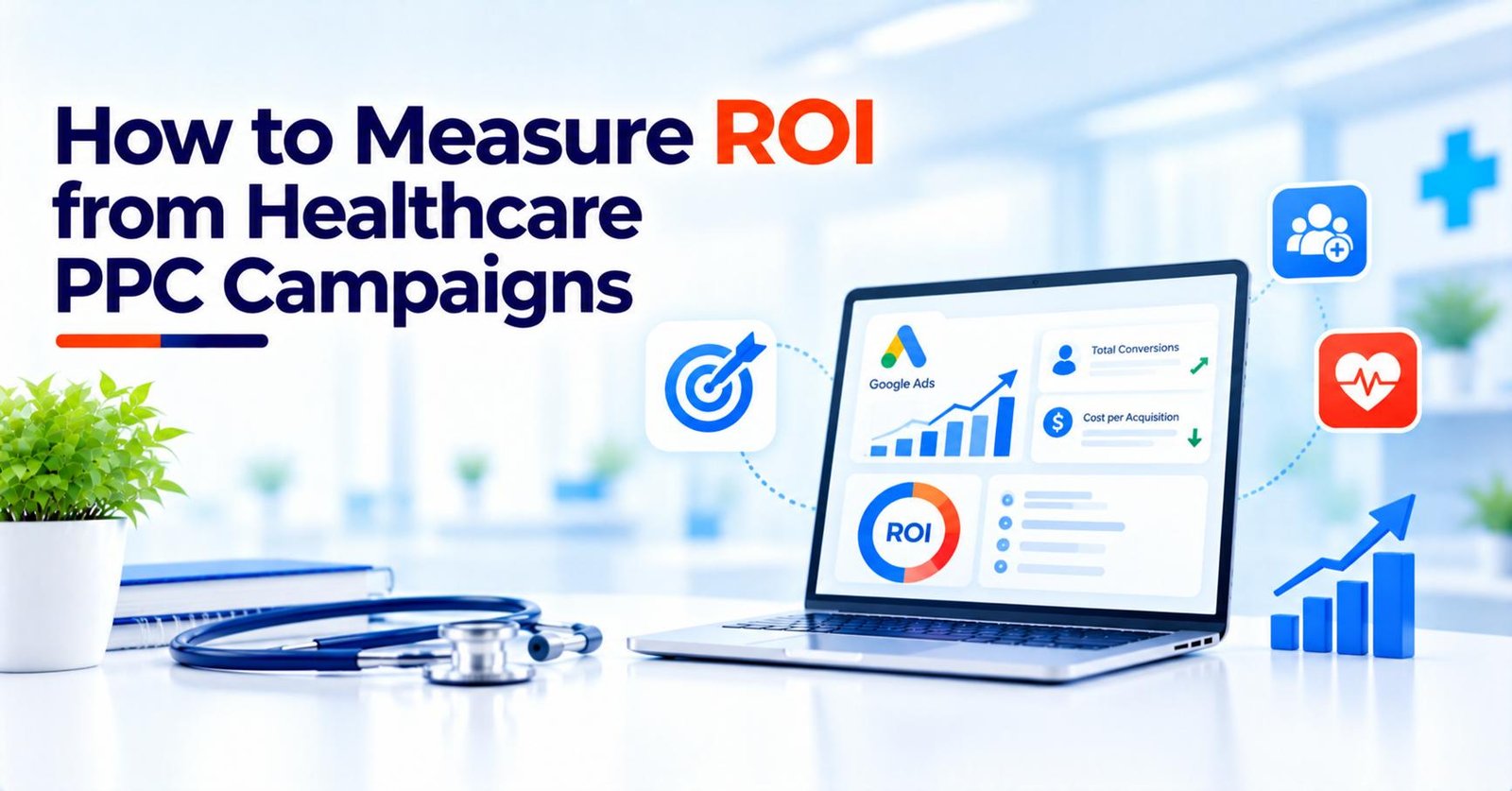
Healthcare businesses invest in paid advertising to increase service enquiries, connect with potential patients, and support appointment bookings. However, running Google Ads or other pay-per-click (PPC) campaigns is only one part of a successful advertising strategy. The real challenge is understanding whether the money invested is generating meaningful business results.
Measuring return on investment (ROI) helps hospitals, clinics, diagnostic centres, and other healthcare providers evaluate the financial impact of their advertising campaigns. Instead of focusing only on impressions and clicks, healthcare marketers can use conversion data, lead quality, appointment bookings, and revenue information to understand campaign performance.
A structured measurement approach also helps identify which campaigns deserve more budget and which need improvement. In this guide, we explain how to measure ROI from healthcare PPC campaigns, the metrics to track, and the practical steps healthcare businesses can take to make more informed advertising decisions.
What Is ROI in Healthcare PPC Advertising?
Return on investment, or ROI, measures the financial return generated by an advertising investment compared with its total cost.
For healthcare businesses, this means evaluating how much revenue or profit can reasonably be attributed to PPC campaigns against the money spent on advertising and related campaign expenses.
According to Google Ads’ ROI guidance, advertisers should measure conversions and compare the value generated with the costs involved to understand the actual impact of advertising.
For example, a clinic might receive hundreds of clicks from a Google Ads campaign. However, if those visitors do not submit enquiries, call the clinic, or book appointments, the campaign may not be delivering the intended business outcome.
Similarly, a campaign generating fewer leads may perform better financially if those leads are more likely to become paying patients.
This is why healthcare PPC performance should be assessed through business outcomes rather than traffic numbers alone.
How to Calculate ROI From Healthcare PPC Campaigns
The basic ROI formula is:
ROI = (Revenue Attributed to PPC − Total Investment) ÷ Total Investment × 100
For this calculation, total investment should include relevant advertising expenses, such as media spend and campaign management fees. Depending on the purpose of the analysis, businesses may also include landing page development, creative production, call tracking, and other campaign-related costs.
Example of Healthcare PPC ROI
Consider a diagnostic centre that invests ₹50,000 in a PPC campaign and generates ₹1,50,000 in revenue attributed to the campaign.
For a simplified calculation, assume the ₹50,000 represents the entire campaign investment and the ₹1,50,000 represents revenue before subtracting that investment.
- Revenue attributed to PPC: ₹1,50,000
- Total campaign investment: ₹50,000
- Net return after campaign investment: ₹1,00,000
ROI = (₹1,50,000 − ₹50,000) ÷ ₹50,000 × 100
ROI = 200%
This means the campaign generated ₹2 in return above the campaign investment for every ₹1 invested, based on the stated figures.
However, this is not necessarily the clinic’s final business profit. Staff costs, diagnostic consumables, clinical operating expenses, discounts, and other costs may reduce the actual profit.
For a more accurate financial assessment, healthcare businesses should distinguish between revenue-based ROI and profit-based ROI.
Why Clicks and Impressions Are Not Enough
Clicks and impressions help marketers understand how advertisements are being delivered, but they do not establish whether a campaign is financially successful.
A healthcare PPC campaign can receive strong engagement without generating valuable patient enquiries. For example, an advertisement may attract people looking for general medical information when the campaign is intended to generate appointments for a specific service.
To evaluate performance accurately, businesses should examine the complete journey from advertising interaction to enquiry, appointment, and eventual revenue.
Important questions include:
- How many website visitors submitted an enquiry?
- How many calls came from paid advertisements?
- How many enquiries were relevant to the advertised service?
- How many leads booked appointments?
- How many appointments resulted in completed consultations or procedures?
- What revenue or contribution did those completed services generate?
Answering these questions helps healthcare marketers understand whether advertising is attracting the right audience and supporting business objectives.
Key Metrics to Track for Healthcare PPC ROI
1. Cost Per Lead (CPL)
Cost per lead measures the average advertising cost required to generate one lead.
CPL = Total Advertising Spend ÷ Number of Leads Generated
For example, if a clinic spends ₹30,000 on advertising and receives 60 enquiries, its cost per lead is ₹500.
CPL helps compare campaigns, ad groups, keywords, and landing pages. However, the lowest CPL is not always the best result. A campaign generating inexpensive but irrelevant enquiries may deliver less value than a campaign with a higher CPL and stronger appointment conversion rates.
2. Conversion Rate
Conversion rate measures the percentage of visitors who complete a defined action after interacting with a campaign.
Conversion Rate = Number of Conversions ÷ Total Relevant Visits or Clicks × 100
Depending on the campaign objective, a conversion might include submitting an enquiry form, calling the clinic, or booking an appointment.
Healthcare businesses should define conversions carefully. A page view or button click may indicate interest, but it should not automatically be treated as an actual patient enquiry.
3. Cost Per Appointment
Cost per appointment measures the advertising cost associated with generating a booked appointment.
Cost Per Appointment = Total Advertising Spend ÷ Appointments Attributed to PPC
This metric goes a step beyond cost per lead. It helps identify whether the enquiries generated by a campaign are progressing towards the clinic’s main business objective.
Where possible, distinguish between appointments booked, appointments attended, and appointments cancelled or missed.
4. Cost Per Acquired Patient
Cost per acquired patient estimates the advertising cost associated with acquiring a new patient through PPC.
Cost Per Acquired Patient = Total Advertising Spend ÷ New Patients Attributed to PPC
The calculation depends on reliable patient acquisition data and clear attribution rules. Healthcare businesses should avoid counting the same patient multiple times or treating every enquiry as a new patient.
This metric can be particularly useful when comparing services with different appointment values, conversion rates, and patient acquisition costs.
5. Revenue Attributed to PPC
Revenue attribution connects advertising activity with revenue generated from relevant appointments or services.
For example, a clinic may track whether an enquiry originated from a paid search campaign and whether that enquiry eventually resulted in a completed appointment.
Revenue should be attributed carefully. Not every patient who books after seeing an advertisement would necessarily have been lost without that advertisement, and some patients interact with several marketing channels before booking.
Consistent attribution rules help make campaign comparisons more meaningful.
6. Lead-to-Appointment and Appointment-to-Patient Rates
These metrics reveal how leads progress through the healthcare business’s conversion process.
- Lead-to-appointment rate: The percentage of leads that book an appointment.
- Appointment attendance rate: The percentage of booked appointments that are attended.
- Appointment-to-patient rate: The percentage of relevant appointments that result in the defined patient acquisition outcome.
Together, these measures help identify where potential patients drop out of the journey. If a campaign generates many enquiries but few bookings, the issue may involve lead relevance, follow-up speed, service availability, or the booking experience rather than advertising alone.
How to Set Up Accurate Conversion Tracking
Reliable ROI measurement starts with accurate tracking. Without it, healthcare businesses may underestimate valuable actions or overestimate campaign performance.
Step 1: Define Valuable Conversion Actions
Identify the actions that matter to the business. Depending on the service, these may include:
- Completed appointment enquiry forms
- Calls that meet defined quality criteria
- Confirmed online appointment bookings
- Qualified leads
- Completed appointments or acquired patients
Keep early engagement actions separate from meaningful business outcomes. For example, clicking a phone number is not the same as completing a call.
Step 2: Configure Google Ads Conversion Tracking
Use Google Ads conversion tracking and, where appropriate, Google Analytics to measure relevant website and advertising interactions.
Check that tracking is configured correctly, duplicate conversions are not being counted, and each conversion action reflects the campaign’s actual objective.
Google provides guidance on conversion tracking and ROI measurement.
Step 3: Track Calls and Enquiries Consistently
Healthcare businesses often receive enquiries through multiple channels, including website forms, telephone calls, and appointment systems.
Use suitable call tracking and lead management processes to connect these enquiries with their original marketing sources where possible. Staff should record lead status consistently so that campaign reporting reflects genuine outcomes.
Step 4: Connect Advertising Data With Lead Outcomes
A conversion recorded in Google Ads may represent an initial enquiry rather than a completed patient acquisition.
Connecting advertising data with a suitable customer relationship management (CRM) system or internal lead register can help healthcare businesses understand which leads became qualified prospects, booked appointments, or completed the desired conversion.
Google Ads also supports qualified-lead and converted-lead measurement using offline conversion data. See Google’s guide to qualified and converted leads.
Any data integration should follow applicable privacy requirements and use appropriate safeguards for sensitive healthcare information.
How to Evaluate Lead Quality and Financial Value
Lead volume alone can create a misleading picture of campaign success. A healthcare business should assess whether enquiries match the services it provides and whether they progress through the appointment process.
For example, consider two campaigns:
- Campaign A generates 100 enquiries, but only 10 result in appointments.
- Campaign B generates 50 enquiries, and 20 result in appointments.
Campaign A generates more leads, but Campaign B produces twice as many appointments in this example. The next step is to compare campaign costs, appointment attendance, completed services, and attributable revenue.
Healthcare businesses can use lead qualification criteria that are relevant to their services, such as whether the enquiry concerns an offered service or whether the person successfully books an appointment. These criteria should not substitute for clinical assessment or be used to make unsupported assumptions about a patient’s health.
Where reliable data is available, assigning values to qualified leads or completed conversions can provide a more useful view of performance than treating every enquiry equally.
Common Mistakes When Measuring Healthcare PPC ROI
Several measurement mistakes can lead to poor budget decisions.
Counting Every Enquiry as a Successful Conversion
Spam submissions, duplicate forms, irrelevant calls, and incomplete enquiries can inflate reported results. Review lead quality before concluding that a campaign is successful.
Ignoring the Full Cost of Advertising
Calculating ROI using ad spend alone may be appropriate for a limited media-efficiency analysis, but it does not represent the full cost of a campaign if management fees and other expenses are excluded.
Be consistent about which costs are included in each calculation.
Overlooking Delayed Conversions
Some healthcare decisions take time. A patient may enquire today, book an appointment later, and complete a service after that. Measuring too early can make a campaign appear less effective than it ultimately becomes.
Use suitable reporting periods and allow for conversion delays.
Relying on Incomplete Attribution
Patients may discover a healthcare provider through organic search, return through a paid advertisement, and then call directly. No attribution method captures every journey perfectly.
Use consistent attribution rules and compare platform reports with internal lead and appointment records rather than assuming every reported conversion represents incremental business.
Ignoring Healthcare Advertising Requirements
Healthcare campaigns must follow applicable advertising policies, professional standards, and privacy requirements. Google’s healthcare and medicines policies restrict some content and allow certain categories only under specific conditions, including location-based requirements and certification.
Review the official Google Ads Healthcare and Medicines policy before launching or modifying campaigns.
How to Improve Healthcare PPC ROI Over Time
Once tracking is reliable, use the findings to improve campaign efficiency.
- Review search terms: Identify irrelevant queries and refine keyword targeting or negative keywords where appropriate.
- Improve landing pages: Make service information, contact options, and appointment steps clear and easy to use.
- Compare campaigns by outcomes: Evaluate cost per qualified lead, appointment, or acquired patient—not only cost per click.
- Review lead follow-up: Check whether enquiries are handled promptly and consistently.
- Allocate budgets based on evidence: Consider increasing investment in campaigns that demonstrate stronger business value, provided sufficient data is available.
- Test changes systematically: Compare landing pages, ad messaging, and campaign settings over meaningful periods rather than making decisions from short-term fluctuations.
- Review reports regularly: Monitor performance weekly or monthly, depending on campaign volume, and investigate unusual changes in cost or conversion quality.
Changes should be based on reliable data and the healthcare provider’s actual objectives. A campaign with limited conversion data may need further measurement before a confident ROI decision can be made.
How World SEO Services Can Support Healthcare PPC Measurement
Measuring healthcare PPC ROI requires more than reviewing advertising dashboards. Healthcare businesses need a clear connection between campaign spending, enquiry quality, appointment outcomes, and business performance.
World SEO Services, a Healthcare Digital Marketing Agency, can support healthcare brands with a structured digital marketing approach that considers campaign objectives, conversion tracking, landing page performance, and ongoing reporting.
A well-organised measurement process can help hospitals, clinics, and other healthcare providers identify performance gaps, understand which advertising activities contribute to meaningful enquiries, and make better-informed decisions about future budgets.
The goal is not simply to generate more clicks or leads. It is to build a measurable advertising strategy that aligns with the healthcare business’s service objectives while maintaining responsible communication and appropriate data practices.
Conclusion
Measuring ROI from healthcare PPC campaigns helps businesses understand whether their advertising investment is generating meaningful financial value. By tracking cost per lead, appointment conversion rates, patient acquisition costs, and attributable revenue, healthcare marketers can evaluate campaign performance beyond clicks and impressions.
Accurate conversion tracking, consistent lead records, realistic attribution, and regular optimisation are essential for making reliable decisions. When these elements work together, healthcare businesses can identify stronger-performing campaigns, address weaknesses, and use their advertising budgets more effectively.
With a structured measurement strategy, World SEO Services can help healthcare businesses approach PPC performance with greater clarity, accountability, and a focus on measurable outcomes.
FAQs
1. What is a good ROI for healthcare PPC campaigns?
There is no single ROI benchmark that applies to every healthcare business. A suitable target depends on the service being advertised, campaign costs, patient conversion rates, revenue, operating expenses, and business objectives. Each provider should establish targets using its own financial data.
2. How do you calculate cost per lead for healthcare Google Ads?
Divide the advertising spend by the number of leads generated during the same reporting period. For example, ₹20,000 spent on a campaign that generates 40 leads results in a cost per lead of ₹500. Lead quality should also be reviewed.
3. Can Google Ads track healthcare appointment bookings?
Yes. Google Ads conversion tracking can measure supported website actions, including completed booking actions when tracking is configured correctly. Businesses may need additional systems to connect bookings with attended appointments and completed services.
4. Why is lead quality important when measuring healthcare PPC ROI?
Lead quality indicates whether enquiries are relevant to the advertised services and whether they progress towards appointments or other business outcomes. A lower volume of qualified leads may be more valuable than a larger volume of irrelevant enquiries.
5. How often should healthcare businesses review PPC ROI?
Many businesses review campaign performance weekly and assess broader ROI monthly. The appropriate schedule depends on campaign volume, conversion delays, and the availability of reliable financial data. Decisions should account for enough time for enquiries to progress through the booking process.