
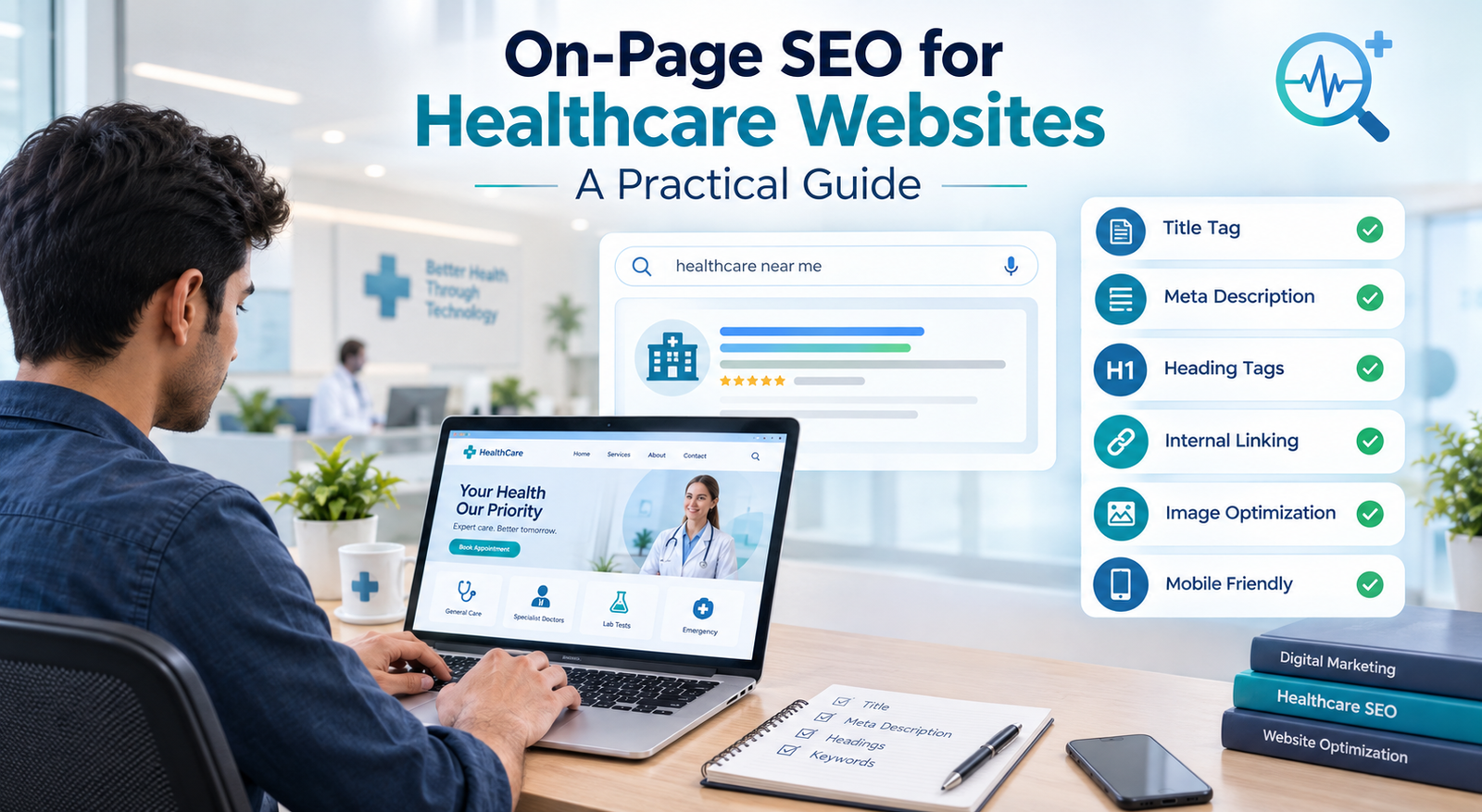
A healthcare website can have experienced doctors, advanced facilities, and a wide range of medical services, but none of that helps much if the right audience cannot find or understand the website through search.
This is where on-page SEO for healthcare websites becomes important.
On-page SEO is the process of optimizing the content and elements on individual web pages so that search engines can better understand them and visitors can easily find the information they need. For healthcare organizations, this goes beyond adding keywords to a page. It involves creating clear service pages, useful medical content, well-structured doctor profiles, descriptive titles, logical headings, internal links, optimized images, strong user experience, and trustworthy information.
Healthcare websites also require greater attention to accuracy and credibility because visitors may use the information when making important healthcare decisions.
Google’s Search guidance recommends focusing on technical requirements, spam policies, and helpful, reliable, people-first content rather than creating pages primarily for search-engine manipulation.
This practical guide explains how clinics, hospitals, diagnostic centres, and other healthcare organizations can approach on-page SEO effectively.
What Is On-Page SEO for Healthcare Websites?
On-page SEO refers to optimizing elements that exist directly on a webpage.
These can include:
- Page titles
- Meta descriptions
- Headings
- Main content
- Keywords and related terms
- URLs
- Internal links
- Images and alt text
- Content structure
- Author information
- Calls to action
- Structured data
- Mobile usability
- Page experience
For healthcare websites, these elements should work together.
For example, a page targeting a service such as “cardiology consultation” should make it immediately clear what the service is, who provides it, where it is available, what visitors can expect, and how they can take the next appropriate step.
The goal is not to repeat “cardiology consultation” dozens of times.
The goal is to make the page genuinely useful while making its subject clear to search engines.
Why On-Page SEO Matters for Healthcare Websites
Healthcare search behaviour is diverse.
Someone may search for:
- A symptom or general health question
- A medical specialty
- A treatment or procedure
- A doctor
- A clinic
- A hospital
- A nearby healthcare provider
- Appointment information
- Reviews or provider information
Each search can represent a different intent.
A blog article may be appropriate for an informational query, while a service page may be more appropriate for someone looking for a specific healthcare service.
Good on-page SEO helps align the page with that intent.
It can also make the website easier to navigate, easier to understand, and more useful on mobile devices.
Google’s current page-experience guidance emphasizes an overall good experience, including mobile usability, secure pages, Core Web Vitals, and ensuring the main content is easy to distinguish from other elements.
1. Start With Search Intent
Before optimizing a healthcare page, determine what the searcher actually wants.
Consider a keyword such as:
“dermatologist in Jaipur”
The person may be looking for a doctor or clinic.
Now consider:
“What causes dry skin?”
This is primarily informational.
Or:
“laser hair removal clinic Jaipur”
This has a stronger service and local intent.
These searches should not necessarily lead to the same type of page.
Search-intent checklist
Before creating or optimizing a page, ask:
- What question is the user asking?
- What information do they expect?
- Are they looking for a service?
- Are they looking for a doctor?
- Are they looking for a location?
- Are they ready to contact the provider?
- What type of page best satisfies the query?
This prevents a common SEO mistake: forcing one page to target unrelated search intentions.
2. Optimize Healthcare Page Titles
The title element helps communicate what a page is about.
A healthcare page title should be:
- Specific
- Descriptive
- Relevant to the page
- Natural
- Useful to searchers
- Unique across the website
For example:
Weak:
“Healthcare Services | Hospital”
More descriptive:
“Cardiology Services in Jaipur | [Hospital Name]”
The title should represent the actual content of the page.
Avoid creating titles simply by adding multiple keyword variations.
Google’s Search documentation provides guidance around how title links and search appearance work, while also noting that Google may sometimes adjust how a title appears in search results.
3. Write Useful Meta Descriptions
A meta description can help communicate what visitors can expect from a page.
It should summarize the page naturally rather than becoming a list of keywords.
For example:
Instead of:
“Cardiology Jaipur, best cardiology services Jaipur, cardiologist Jaipur, heart treatment Jaipur.”
Use something closer to:
“Explore cardiology services, specialist information, consultation options, and appointment details at our Jaipur hospital.”
The description should accurately reflect the page.
Do not make promises that the page or healthcare provider cannot substantiate.
4. Use One Clear H1
Every important page should have a clear primary heading that immediately tells visitors what they are viewing.
Examples:
- Cardiology Services in Jaipur
- Dr. [Name] – Cardiologist
- IVF Services in Jaipur
- Orthopedic Care at [Hospital Name]
- Diagnostic Services in Jaipur
The H1 should describe the page rather than functioning as a keyword container.
The rest of the page can then use H2 and H3 headings to organize information.
5. Build a Logical Heading Structure
Headings help both visitors and search engines understand the organization of a page.
A healthcare service page could use:
Cardiology Services in Jaipur
What Does Cardiology Care Include?
Our Cardiology Services
When Should You Consult a Cardiologist?
Meet Our Cardiology Specialists
Why Choose Our Cardiology Department?
Frequently Asked Questions
The exact structure should depend on the service and search intent.
Avoid creating headings simply because they contain additional keyword variations.
6. Place Keywords Naturally
Keywords still matter, but modern on-page SEO should not depend on repeating the same phrase unnaturally.
Instead, understand the topic and cover its relevant concepts.
For a page about a cardiology department, naturally relevant terms might include:
- Cardiologist
- Cardiology consultation
- Heart health
- Cardiac care
- Cardiology department
- Diagnostic services
- Cardiac specialists
- Appointment
- Hospital location
The goal is topical clarity, not keyword density.
Google’s spam policies specifically warn against practices intended to manipulate search visibility, including creating content that contains search keywords but provides little value.
7. Create Strong Healthcare Service Pages
Service pages are among the most important on-page assets for many healthcare websites.
A strong service page should answer practical questions.
For example:
- What is the service?
- What does the department provide?
- Who provides the service?
- Where is it available?
- What should a visitor know before contacting the provider?
- How can they request an appointment?
- What related services are available?
Depending on the subject, the page may also include:
- Common questions
- Treatment or service overview
- Relevant facilities
- Doctor profiles
- Location information
- Appointment information
The page should be informative without making unsupported medical promises.
8. Optimize Doctor Profile Pages
Doctor profile pages can serve both users and search engines.
A useful profile can include:
- Doctor’s name
- Specialty
- Qualifications
- Professional experience
- Areas of practice
- Department
- Clinic or hospital location
- Consultation information
- Appointment options
- Professional biography
Keep information accurate and updated.
Avoid exaggerated claims such as guaranteed outcomes or unsupported statements about being the “best” doctor.
Where appropriate, clear author and professional information can also help visitors understand who is responsible for healthcare information.
9. Write Healthcare Content for People First
A healthcare article should answer the user’s question clearly.
Do not begin with several paragraphs of generic SEO filler before answering the actual question.
For example, if the heading is:
What Is an IVF Consultation?
The first paragraph should directly explain what an IVF consultation generally involves before moving into supporting details.
A useful structure is:
Direct answer → Explanation → Relevant details → Related questions → Appropriate next step
This structure also makes content easier to scan.
Google’s guidance emphasizes helpful, reliable, people-first content, rather than content created primarily to manipulate search rankings.
10. Use Trust and Expertise Signals Carefully
Healthcare content requires particular attention to accuracy.
On-page elements that can support transparency include:
- Clear organization information
- Author information where relevant
- Professional credentials where appropriate
- Medical review information when applicable
- Publication or update dates where useful
- References to credible sources
- Clear contact information
- Transparent service information
These elements should be genuine.
Adding a doctor’s name to content without actual involvement simply to create an appearance of expertise is not a substitute for responsible content development.
11. Optimize URLs
Healthcare URLs should be short, descriptive, and easy to understand.
For example:
Better:
/cardiology-services/
or
/doctors/cardiologist-jaipur/
Avoid unnecessarily complicated URLs containing multiple parameters or repeated keyword variations.
The URL should communicate the page’s purpose.
12. Improve Internal Linking
Internal links connect related healthcare information across the website.
For example:
A blog about heart health could link to:
- Cardiology department
- Cardiologist profiles
- Cardiac diagnostic services
- Appointment page
A doctor profile could link to:
- Their department
- Relevant services
- Location page
- Appointment page
This creates a logical information path.
Internal linking checklist
- Link relevant blogs to service pages
- Link service pages to related doctors
- Link doctors to departments
- Link locations to services
- Use descriptive anchor text
- Avoid excessive linking
- Check for orphan pages
- Review important links regularly
Internal links should help users navigate, not simply exist for SEO purposes.
13. Optimize Images on Healthcare Pages
Images can improve understanding and trust, but they also need optimization.
Healthcare websites commonly use:
- Doctor photographs
- Hospital photographs
- Department images
- Facility images
- Medical illustrations
- Infographics
Image SEO checklist
- Use relevant images
- Use descriptive file names
- Add appropriate alt text
- Compress large files
- Use suitable image formats
- Check mobile display
- Avoid unnecessary image duplication
For example, instead of:
IMG1234.jpg
use a descriptive filename such as:
cardiology-department-jaipur.jpg
Alt text should describe the image where alternative text is useful. It should not simply repeat the target keyword.
14. Optimize Content for Featured Search and AI Experiences
Search is becoming increasingly conversational.
People may ask questions such as:
- What does a cardiologist do?
- When should I consult an orthopedic specialist?
- What services does a fertility clinic provide?
- How do I book an appointment with a dermatologist?
Healthcare pages can become more useful for these searches by providing direct, clearly structured answers.
AEO-friendly on-page practices
- Use question-based headings where appropriate
- Answer the question early
- Follow the short answer with useful context
- Use clear sections
- Add relevant FAQs
- Use natural language
- Include related concepts
- Keep information accurate
- Avoid writing solely for AI-generated summaries
Google has also documented how AI features are represented in Search Console reporting, making search visibility increasingly broader than traditional blue-link rankings alone.
The foundation remains useful, original, well-structured content.
15. Use Structured Data Where Appropriate
Structured data can help search engines understand certain types of information on a page.
Google explains that structured data can help it understand page content and support eligible search features.
For healthcare websites, relevant structured data opportunities may depend on the type of page and the information actually present.
Possible examples include:
- Organization information
- Breadcrumbs
- Article information
- Profile-related information where applicable
The important rule is that markup should accurately represent the visible content.
Do not add structured data simply because a schema type exists.
16. Add Breadcrumb Navigation
Breadcrumbs help users understand where they are within a website.
For example:
Home → Departments → Cardiology → Cardiology Services
This is particularly useful for large hospital websites with many departments and services.
Google notes that breadcrumb trails can help users understand and navigate a site’s hierarchy.
17. Make Healthcare Pages Mobile-Friendly
A healthcare website should work smoothly on smartphones.
Check whether users can easily:
- Read the content
- Tap buttons
- Call the hospital
- Find the address
- View doctor information
- Submit forms
- Request appointments
- Navigate between pages
A page that looks good on desktop but becomes difficult to use on mobile is not properly optimized.
18. Improve Page Experience
On-page SEO is not limited to text.
The overall page experience matters.
Review:
- Loading performance
- Core Web Vitals
- Mobile usability
- HTTPS
- Layout stability
- Navigation
- Readability
- Intrusive pop-ups
- Visibility of the main content
Google specifically advises site owners to consider page experience as a broader picture rather than focusing on one individual metric.
A perfect technical score alone does not guarantee high rankings, so improvements should be made primarily to create a better experience for users.
19. Add Clear Healthcare CTAs
A healthcare page should make the next step clear.
Depending on the page, appropriate calls to action may include:
- Book an Appointment
- Call the Clinic
- Contact the Hospital
- Find a Doctor
- View Department
- Get Directions
- Request a Consultation
The CTA should match the user’s intent.
An educational article may not need a large “Book Now” button immediately after every paragraph.
A service page, however, may appropriately provide appointment options after explaining the service.
20. Avoid Common On-Page SEO Mistakes
Healthcare websites often encounter the same optimization problems.
Common mistakes include:
- Keyword stuffing
- Duplicate service pages
- Thin content
- Generic AI-generated articles
- Unclear page titles
- Multiple pages targeting the same intent
- Poor internal linking
- Missing alt text
- Slow pages
- Difficult mobile navigation
- Outdated doctor information
- Unverified medical claims
- City pages with almost identical content
- Excessive promotional language
Google’s spam guidance specifically identifies scaled content created mainly to manipulate search rankings as a problem, particularly when pages are unoriginal or provide little value.
For healthcare websites, publishing fewer useful pages can be more sensible than producing large numbers of repetitive pages.
21. Create Location Pages Carefully
Clinics and hospitals serving multiple locations may create location-specific pages.
However, each page should provide genuine value.
A useful location page can include:
- Actual location
- Services available there
- Doctors available there
- Address
- Phone number
- Working hours
- Directions
- Relevant local information
Avoid creating dozens of pages where only the city name changes.
That creates a poor user experience and may provide little unique value.
22. Optimize Healthcare Blog Articles
Healthcare blogs can attract users earlier in their search journey.
For every article:
- Define the primary topic
- Understand search intent
- Create a clear title
- Use one strong H1
- Organize sections with H2/H3 headings
- Answer the main question early
- Use relevant supporting terms
- Add internal links
- Include credible references where appropriate
- Add useful FAQs
- Review outdated information
- Include a relevant next step
The article should solve a real information need rather than exist simply to capture a keyword.
23. Optimize Existing Pages Before Creating More
SEO is not always about publishing new content.
Sometimes an existing page has more potential than a new article.
Review pages that already receive:
- Search impressions
- Organic clicks
- Relevant queries
- Backlinks
- Brand searches
- User engagement
Then consider whether the page needs:
- Better title
- Better headings
- Clearer content
- Improved internal links
- Updated information
- Better CTA
- Stronger search-intent alignment
- Better mobile experience
Updating useful existing content can be an important part of an ongoing SEO strategy.
24. Use Search Console for On-Page Improvements
Google Search Console can help identify how pages perform in Google Search.
Look for:
- Queries generating impressions
- Pages receiving clicks
- Pages with high impressions but low click-through
- New queries
- Indexing problems
- Search appearance information
- Changes in organic performance
For example, if a service page receives impressions for several closely related searches but has weak click-through, review its title and search snippet.
If a page receives impressions for queries not properly addressed in the content, consider whether the page should be expanded or whether a separate page would better satisfy that intent.
25. A Practical On-Page SEO Workflow for Healthcare Websites
Instead of optimizing pages randomly, use a repeatable process.
Step 1: Audit the existing page
Review:
- Title
- URL
- H1
- Headings
- Content
- Images
- Internal links
- CTA
- Mobile experience
Step 2: Identify search intent
Determine what the target audience actually wants from the page.
Step 3: Map the primary topic
Choose one main topic rather than forcing multiple unrelated keywords onto the same URL.
Step 4: Improve the structure
Create clear sections that answer the user’s important questions.
Step 5: Optimize the content
Use relevant terminology naturally and remove unnecessary filler.
Step 6: Add useful internal links
Connect the page with relevant services, doctors, departments, blogs, and locations.
Step 7: Improve page experience
Check mobile usability, speed, readability, and navigation.
Step 8: Add appropriate trust elements
Make relevant expertise, authorship, organization information, and supporting sources clear.
Step 9: Add appropriate structured data
Only when it accurately represents the page.
Step 10: Measure the result
Monitor organic visibility, clicks, relevant traffic, and conversions.
How World SEO Services Approaches On-Page SEO for Healthcare
At World SEO Services, on-page SEO for healthcare websites can be approached as more than keyword placement.
The focus can include:
- Healthcare keyword mapping
- Search-intent analysis
- Service-page optimization
- Doctor profile optimization
- Healthcare content optimization
- Title and meta optimization
- Heading structure
- Internal linking
- Image SEO
- Local landing pages
- AEO-focused content structure
- Technical coordination
- Conversion-focused page improvements
- Ongoing SEO audits
The right approach depends on the website.
A small clinic may need stronger service and location pages, while a large hospital may require optimization across hundreds of department, doctor, treatment, and informational pages.
The objective is to build a website where search engines can understand the content and users can quickly find useful, trustworthy information.
On-Page SEO Checklist for Healthcare Websites
Before publishing or updating an important healthcare page, check:
- Does the page have one clear purpose?
- Does it match the search intent?
- Is the title descriptive and unique?
- Is the meta description relevant?
- Is the H1 clear?
- Are H2 and H3 headings logically organized?
- Is the primary keyword used naturally?
- Does the content answer real questions?
- Are medical claims accurate and responsible?
- Is relevant expertise or authorship clear?
- Is the URL descriptive?
- Are internal links useful?
- Are images optimized?
- Is alt text descriptive where appropriate?
- Is the page mobile-friendly?
- Is the main content easy to find?
- Is the CTA appropriate for the user’s intent?
- Is structured data used only where appropriate?
- Are breadcrumbs useful for the site’s structure?
- Has the page been reviewed for outdated information?
Conclusion
On-page SEO for healthcare websites is ultimately about making every important page clear, useful, trustworthy, and easy to navigate.
A well-optimized healthcare page should not feel like an SEO page.
It should feel like a useful resource created for the person searching for that information.
That means understanding search intent, creating accurate content, optimizing titles and headings, improving internal linking, making doctor and service information accessible, optimizing images, supporting mobile usability, and providing a clear next step.
SEO should support the healthcare website’s real purpose rather than distract from it.
With a structured approach, World SEO Services can help healthcare organizations bring these on-page elements together into a broader SEO strategy designed around their services, audience, locations, and digital objectives.
The most effective approach is not to optimize a page once and forget it. Search behaviour, services, website content, and business priorities change over time. Regular reviews and meaningful updates help keep important healthcare pages useful for both users and search engines.
FAQs
1. What is on-page SEO for a healthcare website?
On-page SEO involves optimizing elements directly on healthcare webpages, including titles, headings, content, URLs, internal links, images, structured data, and user experience. The objective is to make pages easier for users and search engines to understand.
2. How should keywords be used on healthcare websites?
Keywords should be used naturally in relevant page elements such as titles, headings, URLs, and content when appropriate. Healthcare websites should focus on satisfying search intent and covering the topic comprehensively rather than repeatedly using the same keyword.
3. Are doctor profile pages important for healthcare SEO?
Yes. Doctor profile pages can help users understand a healthcare professional’s specialty, qualifications, experience, department, location, and consultation information. Accurate and regularly updated profiles can also become useful search landing pages.
4. How can healthcare websites optimize content for AI search?
Healthcare websites can create clear, well-structured, people-first content that directly answers common questions, uses descriptive headings, provides useful context, and maintains factual accuracy. AEO should complement strong traditional SEO rather than replace it.
5. How often should healthcare webpages be updated for SEO?
There is no fixed update schedule for every page. Important healthcare pages should be reviewed whenever services, doctors, locations, medical information, or other important details change. Performance data can also identify pages that may benefit from further improvement.