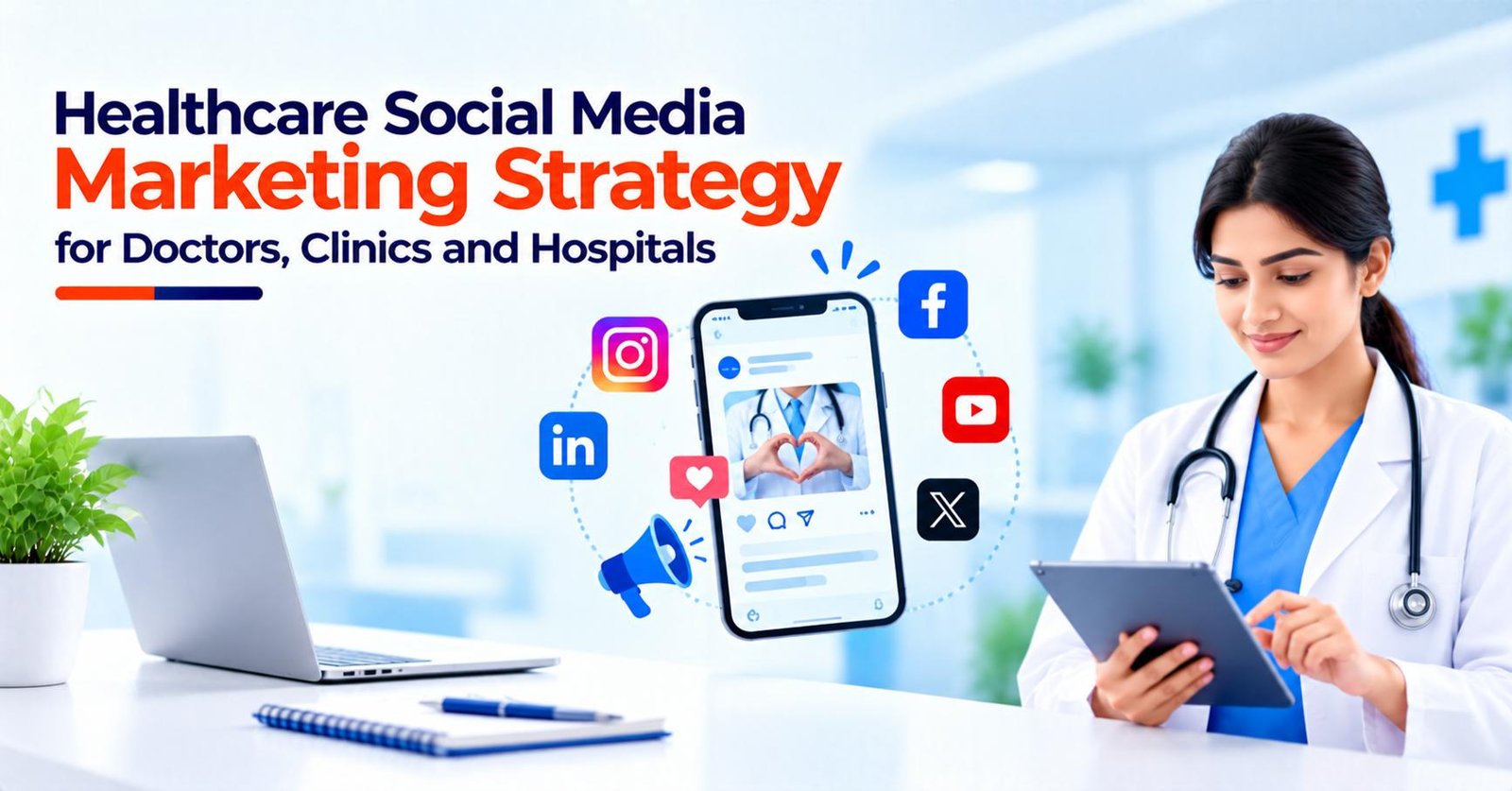
Social media has become an important communication channel for healthcare organizations. People use platforms such as Instagram, Facebook, YouTube, and LinkedIn to discover healthcare information, learn about medical services, understand hospital facilities, and stay informed about health-related topics.
For doctors, clinics, and hospitals, social media offers an opportunity to communicate with their audience beyond the traditional website experience. It can help healthcare organizations share educational information, explain their services, answer general questions, and maintain a consistent digital presence.
However, healthcare social media marketing requires a thoughtful approach. Medical information must be accurate, patient privacy must be protected, and communication should remain professional and responsible.
A successful healthcare social media marketing strategy is therefore not just about posting regularly or gaining followers. It is about sharing useful information, choosing relevant platforms, maintaining trust, and creating a consistent experience across digital channels.
What Is Healthcare Social Media Marketing?
Healthcare social media marketing involves using social media platforms to communicate information about healthcare services, share educational content, build awareness, and maintain engagement with relevant audiences.
It can support different types of healthcare organizations, including:
- Hospitals and multispecialty centres
- Individual doctors and specialists
- Clinics and medical practices
- Diagnostic centres
- Dental clinics
- Fertility and wellness centres
- Healthcare technology companies
The content strategy should reflect the organization’s services, audience, professional responsibilities, and communication objectives.
For example, a hospital may share factual information about its departments and facilities, while a healthcare organization may publish educational resources related to its areas of expertise.
The objective is to provide relevant information rather than treat healthcare communication like ordinary product advertising.
Why Social Media Matters for Healthcare Businesses
Social media can help healthcare brands reach people where they already spend time online.
When managed responsibly, it offers several practical benefits.
1. Improving Healthcare Awareness
Social media allows healthcare organizations to distribute educational information through short videos, graphics, carousels, and longer-form content.
A well-explained post can help people understand a healthcare topic without requiring them to read a lengthy article.
2. Communicating Service Information
Healthcare organizations can use their social profiles to provide factual information about departments, specialties, facilities, working hours, and available services, subject to applicable professional and advertising rules.
Clear information helps people understand what an organization offers.
3. Building a Consistent Digital Presence
A well-maintained social profile makes it easier for audiences to find current information about a healthcare organization.
Consistent branding, accurate contact details, and relevant educational content can support a professional online presence.
4. Supporting Website Discovery
Social media posts can direct interested users to relevant educational resources or service information on the organization’s website.
For example, a healthcare organization may share a short educational video and link to a more detailed article explaining the topic.
Social media engagement does not automatically translate into website traffic or appointments, so performance should be evaluated using relevant metrics.
Choose the Right Social Media Platforms
Healthcare businesses do not need to maintain every social media platform.
The right choice depends on the audience, content format, available resources, and communication goals.
Instagram supports visual communication through Reels, carousels, Stories, and graphics.
Healthcare organizations can use these formats for general health education, service information, awareness topics, and frequently asked questions.
Facebook can support community-oriented communication, factual announcements, educational posts, and updates about healthcare facilities.
It may be particularly useful for organizations whose audiences actively use the platform for local information.
YouTube
YouTube is suitable for longer educational videos, interviews, general healthcare explainers, and discussions led by qualified professionals.
It can also provide a searchable library of video resources.
LinkedIn is often more relevant for hospital leadership, healthcare organizations, medical technology companies, recruitment, professional updates, and business-to-business communication.
How to Select Platforms
Before choosing a platform, consider:
- Where the intended audience is active
- Which formats suit the information
- Whether the organization can publish consistently
- Whether the content can be managed responsibly
- What the organization wants to achieve
A focused presence on relevant platforms is often more practical than posting identical content everywhere.
Build a Healthcare Social Media Content Strategy
A content strategy provides direction and prevents social media activity from becoming a series of unrelated posts.
The first step is to identify the organization’s communication priorities.
These might include public education, sharing factual service information, improving awareness of healthcare resources, or helping people find relevant information on the website.
Once the objectives are clear, content can be organized into suitable categories.
Educational Content
Educational posts can address general healthcare questions and explain relevant topics in simple language.
Examples include general preventive health information, explanations of medical terminology, and awareness resources related to the organization’s specialty.
Medical information should be appropriately reviewed before publication.
Service Information
Healthcare organizations can share factual information about their services, facilities, departments, and general processes.
The content should describe what is available without making unsupported claims about quality or outcomes.
Doctor and Specialist Information
Professional profiles can help audiences understand a healthcare professional’s relevant qualifications, specialty, and role.
All professional information should be accurate and presented in accordance with applicable rules.
Public Health Awareness
Seasonal awareness campaigns and general preventive health topics can help healthcare organizations share useful information with their audiences.
Content should be based on reliable information and should not create unnecessary fear.
Frequently Asked Questions
Social media posts can answer general questions about healthcare services, appointments, locations, and administrative processes.
For individual medical concerns, users should be directed toward appropriate professional channels rather than receiving personalized diagnosis or treatment advice through public comments.
Create a Practical Healthcare Content Calendar
A content calendar helps healthcare teams plan posts, coordinate approvals, and maintain consistency.
Instead of deciding what to publish at the last minute, the team can prepare a schedule around relevant topics and organizational priorities.
A practical workflow includes:
- Identify the main communication objectives.
- Research relevant audience questions.
- Select suitable topics and formats.
- Prepare captions, graphics, or videos.
- Review medical accuracy and compliance.
- Schedule approved content.
- Monitor responses and performance.
- Update the calendar based on results.
The publishing frequency should match the team’s capacity.
There is no universal number of posts that guarantees success. A smaller number of well-planned, useful posts can be more valuable than frequent, repetitive content.
Use Short-Form Video Responsibly
Short-form video can help explain healthcare topics in an accessible format.
Depending on the organization and applicable rules, video ideas may include:
- General health education
- Explanations of healthcare terminology
- Factual information about facilities
- Answers to common administrative questions
- General preventive health awareness
- Educational discussions with qualified professionals
Videos should have a clear purpose and use understandable language.
Healthcare organizations should avoid exaggerated hooks, fear-based messaging, misleading visual comparisons, or claims that guarantee results.
Patient footage, clinical images, and identifiable health information require particular care. Consent alone may not resolve every professional or regulatory restriction on promotional use.
Healthcare Social Media SEO and Discoverability
Social media content can also support a broader digital marketing strategy.
Although social media activity does not guarantee higher search rankings, discoverable profiles and useful content can help people find information about a healthcare organization.
Helpful practices include:
- Using clear profile descriptions
- Maintaining accurate contact details
- Naming services accurately
- Writing descriptive captions
- Adding relevant location information where appropriate
- Organizing video titles and descriptions clearly
- Linking to relevant website resources
- Maintaining consistent business information
Keywords should appear naturally.
Repeatedly inserting phrases such as “best hospital” or “top doctor” does not create trustworthy content and may conflict with applicable healthcare advertising requirements.
Protect Patient Privacy and Confidentiality
Patient privacy should be central to every healthcare social media strategy.
A healthcare organization should establish clear rules about what staff members can publish and how patient-related information is handled.
Important considerations include:
- Do not disclose identifiable patient information without a lawful basis and appropriate authorization.
- Do not share medical records, reports, or clinical images casually.
- Avoid discussing individual patient cases in public comments.
- Do not reveal sensitive information when responding to complaints.
- Restrict access to social media accounts.
- Establish approval procedures for sensitive content.
Healthcare organizations should also consider whether photographs, backgrounds, dates, or other contextual details could identify a patient.
If someone asks for medical advice through a comment or direct message, the response should avoid attempting to diagnose them without the appropriate clinical context.
Follow Ethical Healthcare Communication Practices
Healthcare marketing needs to be more careful than conventional promotional marketing because misleading information can affect important decisions.
For organizations operating in India, current National Medical Commission guidance on ethical advertising and public communication is particularly important. Guidance introduced in October 2026 addresses communications by registered medical practitioners and medical institutions, including digital and social media content. Healthcare organizations should review the applicable requirements before publishing promotional material.
A responsible content process should avoid:
- Unsupported treatment claims
- Guaranteed medical outcomes
- Misleading professional credentials
- Fabricated testimonials or clinical results
- Manipulated reviews or rankings
- Unverified health information
- Content that exploits patient vulnerability
Rules can differ according to the professional, institution, content type, and jurisdiction. Organizations should obtain appropriate compliance advice when needed.
How to Handle Comments and Messages
Social media interaction should be managed professionally.
Healthcare organizations can establish response guidelines for common questions, service enquiries, complaints, and sensitive medical concerns.
For example, general questions about clinic timings may receive a straightforward factual response.
A message describing symptoms, however, should not receive an unsupported diagnosis. The person can be guided toward an appropriate professional consultation or official contact channel.
Teams should also avoid asking users to post personal medical details publicly.
A clear response policy helps maintain consistency while protecting privacy and professional boundaries.
Paid Social Media Marketing for Healthcare
Paid social media campaigns can provide reach and targeting options, but healthcare organizations must ensure that their campaigns comply with the rules applicable to their services and audience.
Before launching a campaign, review:
- Whether the proposed advertising is permitted
- Whether the claims are factual and supportable
- Whether the creative is professionally appropriate
- Whether targeting could misuse sensitive health information
- Whether the landing page provides accurate information
- Whether the campaign complies with platform policies
- Whether relevant professional and legal requirements have been met
Paid campaigns should not rely on fear, fabricated urgency, or guaranteed outcomes.
In regulated healthcare settings, a campaign that performs well on engagement metrics may still be inappropriate if it violates professional standards.
Measure Healthcare Social Media Performance
Healthcare social media should be evaluated against clear objectives rather than follower growth alone.
Useful metrics may include:
- Reach and impressions
- Video views and completion rates
- Saves and shares
- Relevant profile visits
- Website link clicks
- Engagement quality
- Follower growth among relevant audiences
- Response time
- Website enquiries attributable to social media
The right metrics depend on the goal.
An educational campaign may focus on relevant reach and content engagement, while a website-awareness campaign may track link clicks and subsequent website activity.
Healthcare organizations should avoid collecting or using sensitive personal health information for analytics or targeting without appropriate authorization and safeguards.
Common Healthcare Social Media Marketing Mistakes
Some common mistakes can weaken both communication quality and trust.
Posting without a strategy: Random posts often lack a clear purpose or connection to audience needs.
Overpromoting services: Repeated promotional messages can make the profile less useful and may create compliance concerns.
Using unverified information: Medical content should be checked before publication.
Ignoring privacy: Patient information should never be treated as ordinary marketing material.
Copying trends without review: A popular social media format may not be suitable for healthcare communication.
Focusing only on followers: Large follower numbers do not necessarily indicate relevant engagement or meaningful website activity.
Publishing inconsistently: An unrealistic calendar can lead to rushed content and missed reviews.
A structured workflow can help healthcare teams avoid these problems.
How World SEO Services Can Support Healthcare Social Media Marketing
At World SEO Services healthcare social media marketing can be integrated with the wider digital marketing strategy rather than managed as a separate activity.
Depending on the organization’s objectives and applicable rules, a coordinated approach can include:
- Healthcare social media strategy
- Content planning and calendars
- Educational content development
- Social media creative and video planning
- Healthcare SEO
- Website content optimization
- Local SEO
- AEO and AI-search-focused content
- Performance reporting
For example, an educational social media post can support a related website article, while the article can link readers to relevant service information.
This creates a more connected digital experience.
The strategy should be tailored to the organization’s specialty, audience, resources, and compliance requirements. Content approval and medical accuracy should remain essential parts of the process.
Conclusion
A healthcare social media marketing strategy should focus on useful communication, professional credibility, audience needs, and responsible digital engagement.
Doctors, clinics, and hospitals can use social platforms to share educational information, explain services, maintain accurate profiles, and help people discover relevant healthcare resources. However, effective healthcare communication requires more than attractive graphics and regular posting.
Medical accuracy, patient privacy, ethical communication, and appropriate review processes should guide every stage of content planning and publication.
For organizations investing in Healthcare Social Media Marketing Services, combining social media with healthcare SEO, website content, local search, and performance measurement can create a more consistent online presence.
At World SEO Services, this integrated approach can help healthcare brands plan meaningful content while keeping their communication aligned with their objectives and professional responsibilities.
Ultimately, successful healthcare social media marketing is not about making the loudest promotional claims. It is about communicating useful information clearly, maintaining trust, and helping audiences find accurate information about healthcare services.
FAQs
1. What is a healthcare social media marketing strategy?
It is a structured plan for using social media to share healthcare information, communicate factual service details, reach relevant audiences, and maintain a consistent digital presence while following applicable professional and privacy requirements.
2. Which social media platforms are useful for doctors and hospitals?
Instagram, Facebook, YouTube, and LinkedIn can serve different purposes. The most suitable platforms depend on the target audience, content format, communication goals, available resources, and applicable healthcare regulations.
3. What should healthcare businesses post on social media?
They can share educational resources, general health awareness content, factual service information, professional profiles, facility information, and answers to common administrative questions. Medical content should be accurate, appropriately reviewed, and compliant with relevant rules.
4. How can healthcare organizations protect patient privacy on social media?
They should establish content approval policies, restrict account access, protect confidential information, avoid disclosing individual medical details, and review the use of patient images or clinical information under applicable privacy and professional requirements.
5. How can healthcare social media marketing be measured?
Organizations can track relevant reach, video engagement, saves, shares, profile visits, website clicks, response times, and attributable enquiries. Metrics should match the campaign objective, and sensitive health information should be handled appropriately.