
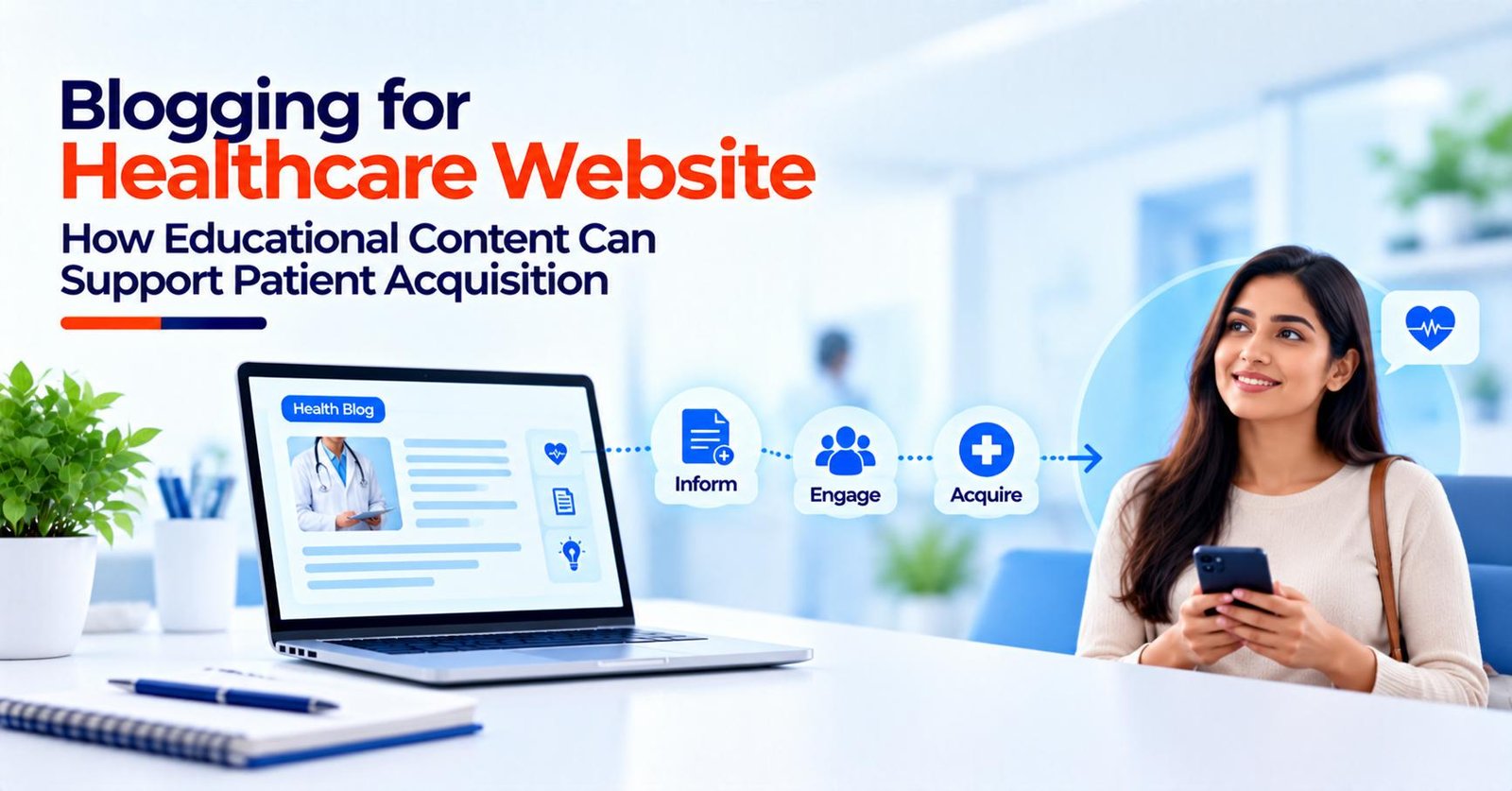
When people need healthcare services, their journey often starts with a question.
They may search for symptoms, treatment options, a medical procedure, a specialist, or a healthcare provider in their city. In many cases, they do not immediately know which doctor or healthcare organization they want to contact. They first look for information that helps them understand their situation and available options.
This is why blogging can play an important role in healthcare digital marketing.
A well-planned healthcare blog is not simply a place to publish articles regularly. Educational content can help healthcare websites answer patient questions, improve search visibility, build trust, support service pages, and guide relevant visitors toward the next stage of their journey.
However, healthcare blogging requires more care than publishing general SEO articles. Medical information needs to be accurate, understandable, responsible, and aligned with the needs of the intended audience.
For healthcare organizations, Healthcare Content Marketing Services can help turn a blog into a useful part of a broader patient acquisition strategy.
What Is Healthcare Blogging?
Healthcare blogging involves creating educational and informative content around healthcare topics that are relevant to a provider’s audience and services.
A healthcare blog may cover topics such as:
- Common health questions
- Conditions and symptoms
- Treatment-related information
- Preventive healthcare
- Diagnostic procedures
- Frequently asked patient questions
- Specialist-related topics
- Healthcare service explanations
- Recovery and preparation information
- General wellness education
The purpose should not be to diagnose readers or replace professional medical consultation.
Instead, the blog should help people understand a topic and identify when they may need appropriate professional guidance.
A strong healthcare blog connects useful education with the services and expertise of the organization without turning every article into an advertisement.
Why Patients Search for Healthcare Information Before Choosing a Provider
A patient may not begin their online journey by searching for a clinic.
For example, someone may first search:
“What are the common signs of a particular condition?”
After learning about the topic, they may search:
“When should I consult a specialist?”
Later, the search may become:
“Specialist for this condition in my city.”
Finally, they may look for:
“Best clinic near me” or “How to book an appointment.”
This shows how educational content can become part of the wider patient journey.
A healthcare blog can help a provider reach people earlier in that journey, before they have selected a specific healthcare organization.
How Educational Content Supports Patient Acquisition
Patient acquisition is not only about generating immediate enquiries.
It involves attracting relevant people, helping them understand their needs, building confidence, and making it easier for them to take an appropriate next step.
Educational content can support several stages of this process.
1. It Attracts Relevant Searchers
People frequently use search engines to find answers to healthcare questions.
A well-optimized article can appear when someone searches for a topic related to the healthcare organization’s area of service.
For example, a fertility clinic may publish educational content around general fertility questions, while a dental clinic may create resources explaining common dental procedures.
The key is relevance.
The content should relate naturally to the organization’s expertise rather than targeting unrelated topics simply to increase website traffic.
2. It Introduces the Healthcare Brand
A person reading an educational article may not know the healthcare organization beforehand.
The article can become their first interaction with the brand.
If the content is useful, clear, and professionally presented, the reader may explore other parts of the website.
They may visit:
- Service pages
- Doctor profiles
- Department pages
- Location information
- FAQs
- Contact pages
This creates an opportunity for the healthcare brand to become part of the patient’s consideration process.
3. It Builds Familiarity Before the Enquiry
Patients may feel more comfortable contacting a healthcare provider after finding useful information from its website.
A single article does not automatically create trust, but a consistent collection of high-quality resources can gradually make the website more useful and familiar.
For example, a patient researching a healthcare topic may read one article and later return to the same website for another question.
Repeated useful interactions can support brand familiarity.
Healthcare Blogging Should Follow Search Intent
One of the biggest mistakes in healthcare blogging is writing articles around keywords without understanding why people are searching for them.
Search intent helps explain what the user actually wants.
Informational Intent
The person wants to learn something.
Examples:
- What is a particular medical condition?
- What are common symptoms?
- How does a diagnostic procedure work?
Educational blog content is particularly useful for this type of search.
Commercial Investigation
The person is comparing options.
Examples:
- What should I consider when choosing a specialist?
- What questions should I ask before selecting a clinic?
This type of content can help readers evaluate their options without making unsupported promotional claims.
Local Intent
The person is looking for a healthcare provider in a specific location.
Examples:
- Dentist near me
- Clinic in Jaipur
- Specialist in Udaipur
Local service pages and location-focused content may be more suitable than a general blog article for these searches.
Action Intent
The person is ready to take a next step.
Examples:
- Book an appointment
- Contact a clinic
- Schedule a consultation
These searches are generally better supported by service and conversion pages.
Understanding these differences helps healthcare brands create the right type of content for each stage.
What Types of Healthcare Blog Topics Work Well?
There is no single topic format that works for every healthcare organization.
The best topics depend on the provider’s specialty, services, audience, location, and common patient questions.
Useful topic categories can include:
Educational Guides
These explain healthcare concepts in simple language.
Condition-Focused Articles
These provide general information about specific conditions, symptoms, risk factors, or treatment considerations.
Procedure and Service Explainers
These help people understand what a particular healthcare service or procedure generally involves.
Preparation Guides
These can explain general preparation considerations for relevant appointments or diagnostic services.
Frequently Asked Questions
Questions received by doctors, support teams, or reception staff can provide useful ideas for blog content.
Comparison and Decision Guides
These can help readers understand factors they may want to consider when evaluating healthcare options.
The focus should remain educational and responsible rather than turning every topic into a sales message.
How to Choose Topics Patients Are Actually Searching For
A healthcare content strategy should begin with audience research.
Useful sources of topic ideas can include:
- Keyword research
- Search suggestions
- Google search results
- Website search data
- Frequently asked questions
- Patient enquiries
- Service-related questions
- Existing website analytics
- Competitor content gaps
- Questions commonly discussed by healthcare professionals
Keyword volume can be useful, but it should not be the only consideration.
A topic with moderate search demand may be more valuable than a high-volume topic if it attracts a highly relevant audience.
The question should be:
Will this content help the people the healthcare organization actually wants to reach?
Creating Content Around Patient Questions
Question-based content can be particularly useful for healthcare websites.
Instead of writing an article simply because a keyword has search volume, content teams can identify real questions patients ask.
For example:
What should I know before visiting a specialist?
How does a diagnostic test generally work?
When should someone consider speaking with a healthcare professional?
These questions can become the foundation for useful articles.
Clear answers also make content easier for readers to scan and understand.
How Internal Linking Can Support Patient Acquisition
A healthcare blog should not exist separately from the rest of the website.
Relevant internal links can connect educational articles with important service pages.
For example, an educational article about a healthcare condition may naturally link to a relevant specialty or service page.
This can help readers move from:
Question → Education → Service Information → Provider Information → Enquiry
Internal linking can also help search engines understand the relationship between different pages on the website.
However, links should be added naturally.
A blog should not contain excessive internal links simply for SEO purposes.
Why Service Pages and Blogs Should Work Together
A healthcare blog and a service page serve different purposes.
A service page usually explains what the healthcare organization offers.
A blog provides broader educational information around questions and topics related to those services.
For example, a hospital may have a dedicated cardiology service page and publish educational articles about heart health, common cardiac conditions, diagnostic procedures, and questions patients may have before consulting a specialist.
The blog can introduce users to the subject while the service page provides information about the actual healthcare offering.
This creates a more connected website experience.
Healthcare Content Should Be Easy to Understand
Medical topics can become complicated quickly.
A healthcare article should therefore avoid unnecessary technical language when a simpler explanation is possible.
Instead of trying to sound highly scientific, the content should aim to be clear.
Useful practices include:
- Short paragraphs
- Descriptive headings
- Simple explanations
- Relevant examples
- Bullet points where useful
- Clear definitions
- Direct answers to questions
If a medical term is necessary, it can be explained in plain language.
The objective is to help readers understand the subject rather than make the content appear complicated.
Accuracy Matters More Than Publishing Frequency
Publishing a new blog every day is not necessarily better than publishing fewer, higher-quality articles.
Healthcare organizations should prioritize accuracy and usefulness.
Before publishing an article, the content team should consider:
- Is the information accurate?
- Is the topic relevant to the healthcare organization’s expertise?
- Are medical claims appropriately supported?
- Does the content avoid misleading promises?
- Is the language responsible?
- Does the article need professional review?
- Is the information current?
A smaller collection of genuinely useful resources can provide more long-term value than a large collection of thin or repetitive articles.
E-E-A-T and Healthcare Blogging
Healthcare content should demonstrate appropriate Experience, Expertise, Authoritativeness, and Trustworthiness.
This can be supported by:
- Clear author information where appropriate
- Professional reviewer information when relevant
- Accurate medical information
- Transparent organization details
- Updated content
- Useful references where appropriate
- Genuine service information
- Responsible communication
The goal is not to add credentials simply for SEO.
The information should help readers understand why the content and the organization are credible.
The Role of AI in Healthcare Blogging
AI tools can help content teams with brainstorming, topic organization, research assistance, outlines, and content workflows.
However, healthcare information should not be published without appropriate human oversight simply because it was generated quickly.
AI-generated content may contain:
- Incorrect information
- Missing context
- Outdated details
- Overconfident statements
- Repetitive explanations
Healthcare content requires careful review.
AI can support the workflow, but expertise, accuracy, and editorial responsibility should remain central.
Healthcare Blogging and AI Search
Search is also changing as people increasingly ask detailed questions through AI-powered search tools.
Instead of searching for only a few words, a user may ask:
“What should I consider before choosing a specialist for this healthcare concern?”
Healthcare blogs can prepare for this changing search behaviour by creating content that directly answers questions and provides useful context.
Helpful practices include:
- Clear headings
- Direct answers
- Well-structured sections
- Relevant FAQs
- Natural language
- Complete explanations
- Logical internal linking
- Accurate information
This approach supports both human readers and modern search experiences.
How Blogging Can Support Local Patient Acquisition
For location-based healthcare organizations, content can also support local visibility.
A healthcare brand may create useful content around topics relevant to its local audience while maintaining genuine value.
For example, an organization serving a particular city can publish practical information related to accessing healthcare services in that area.
However, local content should not simply repeat the city name throughout an article.
Search engines and readers can recognize repetitive, low-value location content.
The stronger approach is to create genuinely useful local information and connect it naturally with relevant services.
Measuring the Value of Healthcare Blogging
Healthcare organizations should measure more than page views.
Useful metrics can include:
- Organic impressions
- Relevant organic traffic
- Search visibility
- Engagement
- Time spent on useful pages
- Internal link clicks
- Service page visits
- Contact enquiries
- Appointment-related conversions
- Returning visitors
- Lead quality
Not every blog article will generate an immediate enquiry.
Some articles may primarily introduce the brand to new audiences, while others may support people who are closer to making a decision.
This is why blogging should be evaluated as part of the broader patient journey.
Common Healthcare Blogging Mistakes
Healthcare organizations should avoid several common mistakes.
Writing Only for Keywords
Keyword placement should support the topic, not control the entire article.
Publishing Thin Content
Short articles that provide little useful information are unlikely to create meaningful value.
Making Unsupported Medical Claims
Healthcare content should not promise results or present uncertain information as fact.
Copying Competitor Topics Without Adding Value
Similar topics are acceptable, but the content should provide its own useful perspective and information.
Overpromoting Services
An educational article should not read like a sales brochure.
Ignoring Internal Linking
Useful connections between educational and service pages can improve navigation.
Forgetting Content Updates
Important healthcare information should be reviewed when it becomes outdated.
How World SEO Services Can Support Healthcare Content Marketing
At World SEO Services healthcare content can be planned as part of a broader digital marketing strategy rather than treating blogging as an isolated SEO task.
Through Healthcare Content Marketing Services, a healthcare brand can develop content around:
- Patient questions
- Search intent
- Healthcare services
- Relevant specialties
- Local search opportunities
- Educational topics
- E-E-A-T principles
- AI and AEO search behaviour
The objective is to create content that attracts relevant audiences while supporting a healthcare organization’s wider digital presence.
A connected strategy can bring together content, healthcare SEO, website development, local SEO, social media, reputation management, and lead generation.
The exact approach should depend on the healthcare organization’s specialty, audience, location, competition, and goals.
A Practical Healthcare Blogging Process
A structured workflow can make healthcare blogging more effective.
1. Research the Audience
Identify common questions, concerns, and search behaviour.
2. Select Relevant Topics
Choose topics that match the organization’s expertise and audience needs.
3. Understand Search Intent
Determine whether the search is informational, comparison-based, local, or action-oriented.
4. Research the Subject
Use reliable information and appropriate professional knowledge.
5. Create a Clear Structure
Organize the article around the questions readers are most likely to have.
6. Write for People First
Use clear, simple, natural language.
7. Add Relevant Internal Links
Connect the article to useful service and informational pages.
8. Review for Accuracy
Healthcare content should receive the appropriate level of quality and professional review.
9. Optimize for Search
Use relevant keywords naturally along with proper headings, metadata, internal links, and technical SEO practices.
10. Measure and Improve
Review performance and update useful content as search behaviour and information change.
Conclusion
Blogging can become a valuable part of healthcare digital marketing when it is built around real patient questions rather than simply a publishing schedule.
Educational content can help healthcare organizations attract relevant searchers, introduce their brand, build familiarity, support service pages, strengthen search visibility, and guide potential patients toward appropriate next steps.
However, successful healthcare blogging requires more than keywords and regular publishing. Content should be accurate, useful, understandable, responsible, and aligned with the organization’s genuine expertise.
For healthcare brands investing in Healthcare Content Marketing Services, a patient-focused blogging strategy can work alongside SEO, local search, website optimization, reputation management, and AI-focused search practices.
At World SEO Services, the focus can be on creating a connected healthcare content strategy where educational articles support both patient needs and long-term digital visibility.
The strongest healthcare blog is not simply the one that receives the most traffic. It is the one that attracts the right audience, answers meaningful questions, builds confidence, and helps people find the information and healthcare services they need.
FAQs
1. How can blogging help healthcare websites attract patients?
Healthcare blogging can help attract people who are searching for answers related to healthcare conditions, services, procedures, and providers. Useful content can introduce the healthcare brand, build familiarity, support service pages, and guide relevant visitors toward an appropriate enquiry or appointment-related action.
2. What should healthcare websites blog about?
Healthcare websites can publish educational content around common patient questions, healthcare services, conditions, procedures, preventive care, frequently asked questions, specialist topics, and other subjects relevant to their audience and professional expertise.
3. How often should a healthcare website publish blogs?
There is no universal publishing frequency. Quality, accuracy, relevance, and consistency are more important than publishing a large number of articles. A healthcare website should focus on creating useful content that genuinely answers audience questions.
4. Can healthcare blogs improve SEO?
Yes. High-quality healthcare blogs can support SEO by covering relevant topics, answering search queries, strengthening topical relevance, creating opportunities for internal linking, and attracting relevant organic traffic. However, blogging alone does not guarantee rankings.
5. How can healthcare blogs support AI search and AEO?
Healthcare blogs can support AI search by providing clear answers to real questions, using descriptive headings, organizing information logically, covering related questions, and maintaining accurate and trustworthy information. This makes the content easier for both readers and modern search systems to understand.