
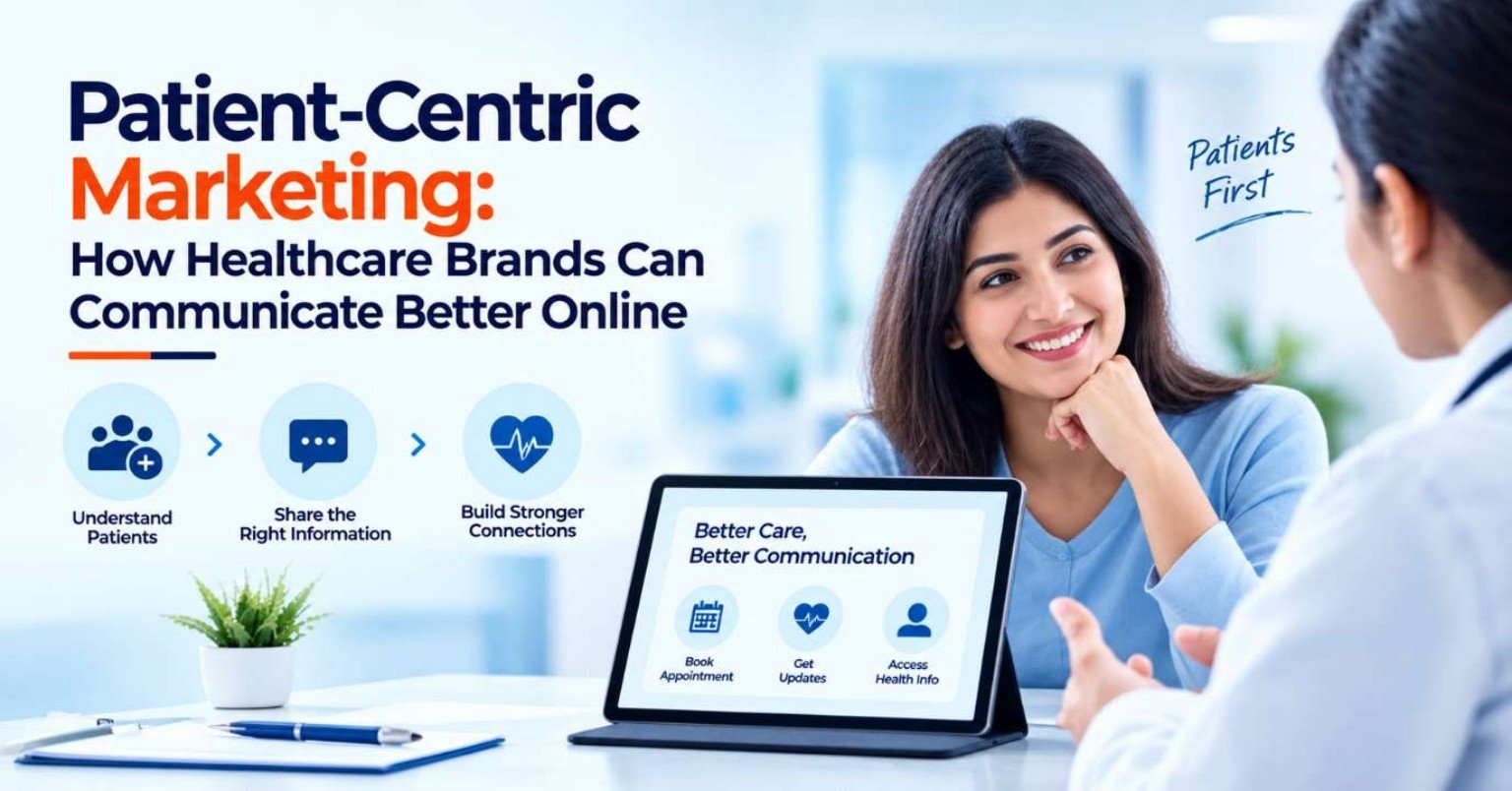
Healthcare marketing is no longer only about telling people that a hospital, clinic, doctor, or healthcare brand exists.
People now discover healthcare providers through search engines, Google Maps, social media, websites, videos, reviews, online directories, and other digital channels. Before contacting a provider, they may spend time researching symptoms, services, specialists, locations, procedures, reviews, and appointment options.
This changes what effective healthcare communication should look like.
A patient-centric approach starts with a simple question:
What does the person on the other side of the screen actually need to understand, decide, or do?
Instead of focusing only on promotional messages, healthcare brands can design digital communication around real patient questions, concerns, preferences, and stages of the healthcare journey.
This approach is closely connected to health literacy. The World Health Organization describes health literacy as the ability to access, understand, evaluate, and use health information and services, and emphasizes the role healthcare organizations play in making trustworthy information understandable and actionable.
For healthcare businesses in India, patient-centric digital marketing can therefore help create a more useful online experience while supporting visibility, engagement, and meaningful enquiries.
What Is Patient-Centric Healthcare Marketing?
Patient-centric marketing means designing communication around the needs and expectations of the people a healthcare organization serves.
It does not mean telling patients what they want to hear.
It means making healthcare information:
- Clear
- Relevant
- Accessible
- Useful
- Respectful
- Accurate
- Easy to navigate
- Appropriate to the audience
For example, instead of publishing a generic post saying:
“We offer advanced healthcare solutions.”
a patient-centric message could explain:
“Our cardiology department provides consultations and diagnostic services. Find information about available specialists, clinic timings, and how to book an appointment.”
The second message gives people something they can actually use.
WHO’s communication framework highlights six useful principles: communication should be accessible, relevant, actionable, timely, credible, and understandable.
These principles can provide a useful foundation for healthcare digital marketing.
Why Patient-Centric Communication Matters
Healthcare decisions can involve uncertainty, stress, unfamiliar terminology, and important personal considerations.
A person may visit a healthcare website while:
- Researching a newly noticed health concern
- Looking for a specialist
- Comparing healthcare providers
- Searching for a nearby clinic
- Learning about a procedure
- Checking appointment information
- Looking for general health education
The information they need can change depending on the situation.
A person searching for “what does an orthopedic doctor do?” needs educational information.
Someone searching for “orthopedic doctor in Jaipur” may be looking for a provider.
Someone searching for “book orthopedic appointment Jaipur” may already be ready to take action.
A patient-centric strategy recognizes these differences rather than presenting the same promotional message to everyone.
1. Understand Who You Are Communicating With
Patient-centric marketing begins with audience understanding.
A healthcare organization may serve different groups, such as:
- Young adults
- Parents
- Older adults
- Caregivers
- Patients researching specialist care
- People comparing healthcare providers
- People looking for routine services
- People searching for urgent information
Their questions and preferred communication formats may differ.
WHO recommends understanding audience characteristics, communication preferences, channels, and trusted messengers when developing relevant health communication.
Healthcare marketers can therefore research:
- Common search queries
- Frequently asked questions
- Website behaviour
- Social media engagement
- Enquiry patterns
- Patient feedback
- Common objections
- Frequently misunderstood services
This information can shape better content.
2. Write for Patients, Not Healthcare Jargon
Healthcare websites can become difficult to understand when every page is written primarily for medical professionals.
Technical terminology has its place, but general patient communication should be easy to follow.
For example:
Technical:
“Patients presenting with persistent musculoskeletal symptoms may undergo a comprehensive orthopedic evaluation.”
Patient-friendly:
“If you have ongoing bone, joint, or muscle problems, an orthopedic specialist can evaluate your symptoms and discuss appropriate next steps.”
The second version communicates the idea more directly.
WHO recommends plain language and familiar words when communicating with non-expert audiences.
This does not mean removing medically important details.
It means explaining them in a way the intended audience can understand.
3. Answer the Question First
Patient-centric content should get to the point.
If a user searches:
“What is a root canal?”
the first section should answer that question.
If someone searches:
“How do I book an appointment?”
the appointment process should be easy to find.
If someone searches:
“Where is the clinic located?”
the location should not be hidden several clicks away.
A useful rule is:
Give people the information they came for before asking them to take another action.
This approach improves both communication and user experience.
4. Build Content Around Real Patient Questions
Healthcare brands can use real questions as the foundation of their content strategy.
For example, a dental practice may create content around:
- What is a root canal?
- How long does a dental consultation take?
- What are dental implants?
- How should I prepare for a dental appointment?
- What services does the clinic provide?
An IVF centre might address:
- What is IVF?
- What happens during an IVF consultation?
- What fertility services are available?
- What questions should I ask a fertility specialist?
These questions can become:
- Blog articles
- FAQ sections
- Service-page sections
- Short videos
- Social media posts
- Infographics
This creates a more useful content ecosystem.
5. Make Healthcare Websites Easy to Navigate
A patient-centric website should not make visitors work unnecessarily hard to find basic information.
Important sections should be easy to access, including:
- Services
- Doctors
- Specialties
- Locations
- Contact details
- Appointment information
- FAQs
- About the organization
- Patient resources
Navigation should reflect how patients think.
For example, users may search for:
“I need a cardiologist.”
They should be able to move from:
Cardiology → Doctors → Specialist Profile → Appointment
without unnecessary confusion.
6. Design Content for Different Stages of the Patient Journey
Not everyone visiting a healthcare website is ready to book an appointment.
A simplified digital journey might look like:
Awareness
“What is physiotherapy?”
↓
Research
“Benefits of physiotherapy”
↓
Provider search
“Physiotherapist in Udaipur”
↓
Evaluation
“Physiotherapy clinic reviews”
↓
Action
“Book physiotherapy appointment”
Each stage requires different communication.
Educational content may be useful at the awareness stage.
Service and doctor pages become more relevant during provider research.
Contact and appointment pages matter when the user is ready to act.
A patient-centric healthcare marketing strategy connects these stages instead of treating every visitor as an immediate lead.
7. Make Service Pages More Helpful
A service page should do more than mention a keyword repeatedly.
It should explain what the healthcare organization actually provides.
Depending on the service, useful information may include:
- What the service is
- Who provides it
- What the service includes
- Where it is available
- How appointments work
- Relevant preparation information
- Common questions
- Contact information
For example, a page targeting “Dental Services in Jaipur” can provide actual information about available dental services, clinic location, doctors, appointment process, and frequently asked questions.
This is more useful than simply repeating the phrase “dental services in Jaipur” throughout the page.
8. Use Local Information Clearly
For many healthcare organizations, location matters.
People may search:
- Dentist near me
- Hospital in Jaipur
- IVF centre in Delhi
- Dermatologist in Udaipur
- Diagnostic centre near me
A patient-centric local strategy should provide accurate information about:
- Clinic address
- Service availability
- Opening hours
- Phone number
- Directions
- Appointment options
- Locations served
The goal is not simply to rank for a city keyword.
It is to help someone understand whether the healthcare provider is actually accessible to them.
9. Create Better Doctor Profiles
Doctor profiles can be an important part of a healthcare website.
Patients may want to know:
- Who is the doctor?
- What is their specialty?
- What qualifications do they have?
- What services do they provide?
- Where do they practice?
- How can I book an appointment?
A useful doctor profile can answer these questions clearly.
Avoid turning profiles into exaggerated promotional pages.
Instead of relying heavily on statements such as “the best doctor,” provide specific, verifiable professional information.
This gives users something meaningful to evaluate.
10. Use Social Media as a Communication Channel
Patient-centric healthcare marketing should not treat social media only as an advertising platform.
Social media can be used for:
- Health education
- Awareness campaigns
- Doctor introductions
- Service explanations
- FAQs
- General wellness information
- Clinic updates
- Event announcements
- Short educational videos
WHO has noted that digital channels can help make reliable health information more accessible and understandable.
The key is to select formats and platforms based on the audience.
A long educational article may work well on a website.
A short video may work better for a simple question.
An infographic may help explain a process visually.
11. Use Multiple Content Formats
Different people understand information differently.
Healthcare brands can use:
Written Content
Useful for detailed explanations, guides, FAQs, and service information.
Short Videos
Useful for simple explanations, doctor introductions, and frequently asked questions.
Infographics
Useful for processes, checklists, and high-level educational information.
Images
Useful for introducing facilities, doctors, departments, and services.
FAQs
Useful for direct questions that patients commonly ask.
WHO’s communication guidance recommends using visuals and familiar language to make information easier to understand.
A patient-centric strategy therefore considers both the message and the format.
12. Consider Language and Cultural Context
India has a diverse audience.
A healthcare organization may serve people with different:
- Languages
- Educational backgrounds
- Cultural contexts
- Digital habits
- Geographic locations
Healthcare communication should consider whether the audience understands the language and terminology being used.
For some audiences, bilingual or multilingual content may improve accessibility.
The objective is not to translate every page automatically.
It is to identify where language differences create a genuine communication barrier.
13. Make Mobile Communication a Priority
Many people discover healthcare services through smartphones.
A patient visiting a website on mobile should be able to:
- Read the content comfortably
- Tap the phone number
- Find the location
- Open directions
- View doctor information
- Submit an enquiry
- Book an appointment
If important information requires excessive scrolling, tiny buttons, or difficult navigation, the digital experience becomes less patient-friendly.
Mobile usability should therefore be part of the communication strategy, not treated only as a technical SEO issue.
14. Make Calls to Action Clear
Patient-centric marketing does not mean avoiding calls to action.
It means making them relevant and clear.
Depending on the page, the CTA could be:
- Book an appointment
- Contact the clinic
- Find a doctor
- View services
- Get directions
- Call the hospital
- Request more information
The CTA should match the user’s intent.
An educational article does not necessarily need several aggressive appointment prompts.
A service page may reasonably provide a clear appointment option.
15. Avoid Aggressive Healthcare Marketing
Healthcare communication should not create unnecessary fear or pressure.
Avoid messages that:
- Exaggerate risks
- Guarantee medical outcomes
- Create false urgency
- Use sensational language
- Shame users
- Make unsupported claims
- Present one option as universally suitable
Patient-centric marketing respects the fact that healthcare decisions can be personal and complex.
Useful information should help people understand their options and know when professional advice may be appropriate.
16. Be Transparent About What You Offer
A healthcare brand should clearly communicate what it actually provides.
For example:
Instead of:
“Complete healthcare solutions for everyone.”
Explain:
“Our centre provides dermatology consultations, diagnostic services, and selected skin-care procedures at our Jaipur location.”
Specific information is easier to understand and verify.
Transparency can cover:
- Services
- Locations
- Doctors
- Facilities
- Appointment process
- Contact information
- Operating hours
Clear communication reduces unnecessary uncertainty.
17. Use Patient Reviews Responsibly
Reviews can influence healthcare provider research, particularly in local search.
But patient-centric marketing should never turn reviews into manufactured promotional material.
Healthcare brands should focus on:
- Genuine feedback
- Professional responses
- Appropriate privacy
- Honest communication
A healthcare organization should also be careful when responding publicly to reviews.
Never disclose sensitive patient information simply to defend the organization against a negative comment.
The objective is respectful communication, not winning an online argument.
18. Protect Patient Privacy in Digital Marketing
Patient-centric marketing must include privacy.
Potentially sensitive information can appear in:
- Testimonials
- Patient stories
- Photographs
- Videos
- Contact forms
- Appointment requests
- Social media content
- Remarketing systems
Before using patient-related content for marketing, healthcare organizations should consider appropriate consent, privacy requirements, and internal policies.
A story that performs well on social media is not automatically appropriate to publish.
Patient dignity and privacy should remain more important than engagement metrics.
19. Make Digital Forms Simple
A complicated enquiry form can create unnecessary friction.
If a patient only wants to request an appointment, asking for excessive information may discourage completion.
Review:
- Number of fields
- Required information
- Mobile usability
- Error messages
- Confirmation messages
- Privacy information
Only ask for information that is appropriate and necessary for the purpose of the form.
A simpler experience can make digital communication more accessible.
20. Communicate What Happens Next
Patients often want to know what will happen after they submit an enquiry.
For example:
“After submitting the form, our team will contact you regarding appointment availability.”
This simple explanation can reduce uncertainty.
Similarly, appointment pages can explain:
- What information is required
- How confirmation works
- Where to go
- What communication to expect
The clearer the process, the less guesswork the user has to do.
21. Use Email and Messaging Carefully
Email, WhatsApp, SMS, and other messaging channels can support patient communication where appropriate.
Potential uses include:
- Appointment confirmations
- General reminders
- Service information
- Follow-up communication
- Educational resources
However, healthcare organizations should establish appropriate privacy and communication practices for each channel.
Marketing messages should not become intrusive.
The communication should also respect user preferences and applicable requirements.
22. Make SEO Patient-Centric
SEO should not be separated from patient experience.
Instead of asking only:
“What keyword should we rank for?”
ask:
“What information does someone searching this keyword need?”
For example:
Keyword: Cardiologist in Jaipur
Possible patient needs:
- Doctor information
- Specialty
- Clinic location
- Consultation details
- Appointment process
- Contact information
The SEO page should address those needs naturally.
This creates a stronger relationship between search visibility and useful communication.
23. Build Content Around Search Intent
Different keywords indicate different needs.
Informational
“What does a cardiologist do?”
Create educational content.
Commercial Investigation
“Best cardiology clinic in Jaipur”
Provide clear information about services, doctors, location, facilities, and relevant evaluation factors without making unsupported ranking claims.
Local
“Cardiologist near me”
Make location and contact information easy to find.
Action-focused
“Book cardiologist appointment Jaipur”
Provide a straightforward appointment pathway.
This approach helps prevent generic content from being used for every type of search.
24. Make Content Easy to Scan
People often scan online content before deciding whether to read it.
Healthcare pages can improve readability through:
- Short paragraphs
- Descriptive headings
- Bullet points
- FAQs
- Highlighted key information
- Simple language
- Clear navigation
A user should be able to understand the basic purpose of a page within a few seconds.
WHO recommends organizing information so important points appear early and breaking complex information into understandable sections.
25. Use FAQs to Address Real Concerns
FAQs can be valuable when they answer genuine questions.
For example, a hospital page might answer:
- What services are available?
- How can I book an appointment?
- Which specialists are available?
- Where is the hospital located?
- What are the visiting hours?
A healthcare service page can answer questions specific to that service.
FAQs should not simply be created to insert additional keywords.
They should help users find information without navigating through multiple pages.
26. Use AEO-Friendly Healthcare Content
Search is increasingly becoming question-oriented.
People may ask complete questions rather than entering short keyword phrases.
Healthcare brands can make their content easier to understand by providing direct answers under clear headings.
For example:
What does a dermatologist do?
A dermatologist is a medical specialist who focuses on conditions affecting the skin, hair, and nails.
Then the page can provide more detailed information.
This structure benefits both users and modern search experiences because the information is clearly organized around questions and answers.
27. Use AI Without Losing the Human Perspective
AI tools can support healthcare marketing with:
- Topic research
- Content outlines
- Search-query analysis
- Drafting assistance
- Content organization
- Performance analysis
But patient-centric communication still needs human review.
AI-generated content may:
- Use unnecessarily complicated language
- Present outdated information
- Miss cultural context
- Make unsupported claims
- Sound repetitive
- Misunderstand the patient’s actual concern
Healthcare organizations should review important content for accuracy, clarity, relevance, and appropriate medical context.
The goal should be better communication, not simply faster content production.
28. Listen to Patients and Use Their Feedback
Patient-centric marketing should not be based entirely on assumptions.
Use feedback to understand:
- What information is difficult to find
- Which questions appear repeatedly
- Why users abandon forms
- Which services need better explanations
- Which pages receive engagement
- What people ask customer-support teams
- What information patients misunderstand
Website analytics and marketing data can identify patterns.
Direct feedback can explain why those patterns exist.
Both are useful.
29. Measure Communication Quality, Not Just Traffic
Traffic is useful, but it does not tell the entire story.
Healthcare brands can also monitor:
- Appointment enquiries
- Calls
- Form completion
- Service-page engagement
- Search queries
- Returning visitors
- Content engagement
- Local actions
- Video engagement
- FAQ interactions
For example, if a page receives thousands of visits but almost nobody reaches the appointment section, the problem may not be traffic.
The page may simply fail to answer the user’s needs clearly.
Patient-centric marketing therefore looks beyond impressions and clicks.
30. Create a Consistent Experience Across Channels
Patients may interact with a healthcare brand through several platforms before contacting it.
They might discover the organization through:
Google Search → Website → Google Maps → Instagram → Reviews → Appointment Page
If every platform provides different information, confusion can occur.
Keep important details consistent across:
- Website
- Google Business Profile
- Social media
- Healthcare directories
- Advertising landing pages
- Doctor profiles
Consistency makes the digital journey easier to follow.
31. How World SEO Services Can Support Patient-Centric Marketing
At World SEO Services, healthcare marketing can be structured around both search visibility and the people using that search.
A patient-centric digital strategy may include:
- Healthcare SEO
- Search-intent research
- Healthcare content marketing
- Local SEO
- Google Business Profile optimization
- Healthcare website optimization
- Social media marketing
- Healthcare PPC campaigns
- Reputation management
- AEO-focused content
- Conversion optimization
- Analytics and performance reporting
For a Healthcare Marketing Company India strategy, the focus can also be adapted to different cities, specialties, patient groups, services, and search behaviours.
The objective is not simply to generate more digital impressions.
It is to help healthcare organizations communicate their services and information in ways that are relevant, understandable, accessible, and useful to the people they serve.
A Practical Patient-Centric Communication Framework
Healthcare brands can use this simple framework when planning digital content:
1. Listen
Identify what patients are searching for, asking, and struggling to understand.
2. Understand
Group those questions by audience, service, location, and search intent.
3. Explain
Create clear content using simple and appropriate language.
4. Guide
Show users what they can do next, whether that means reading more, finding a doctor, contacting the organization, or booking an appointment.
5. Respect
Protect privacy, avoid fear-based communication, and treat patient concerns with sensitivity.
6. Improve
Use feedback, analytics, and search data to identify communication gaps and improve the digital experience.
Patient-Centric Healthcare Marketing Checklist
Before publishing healthcare content, ask:
- Is this information useful to the intended audience?
- Does the content answer a real question?
- Is the language easy to understand?
- Are medical terms explained where necessary?
- Is the information accurate and appropriately reviewed?
- Is the page easy to navigate?
- Is the content readable on mobile?
- Is the next step clear?
- Are doctor and service details current?
- Is local information accurate?
- Are reviews and testimonials genuine?
- Is patient privacy protected?
- Are marketing claims realistic?
- Does the content match search intent?
- Is the same information consistent across digital channels?
- Is patient feedback being used to improve communication?
Conclusion
Patient-centric marketing is ultimately about changing the starting point of healthcare communication.
Instead of asking:
“What do we want to promote?”
healthcare brands can begin with:
“What does the patient need to understand?”
That change can influence everything from SEO and website content to social media, paid advertising, doctor profiles, local search, appointment forms, and reputation management.
Effective healthcare communication should be clear, relevant, timely, credible, accessible, and understandable. These principles align closely with WHO’s current communication framework and its focus on improving access to trustworthy health information.
For healthcare businesses in India, this approach can also make digital marketing more useful across the entire patient journey.
A person who finds a healthcare brand through Google should be able to understand the service.
A person who visits the website should be able to find the relevant information.
A person comparing providers should be able to evaluate genuine details.
And someone ready to contact the organization should be able to take the next step without unnecessary confusion.
World SEO Services can support healthcare brands in building this kind of digital presence through SEO, content marketing, local search, social media, paid campaigns, reputation management, AEO, and conversion-focused strategies.
The strongest healthcare communication is not necessarily the loudest.
It is the communication that helps the right person find the right information, understand it clearly, and know what to do next.
FAQs
1. What is patient-centric marketing in healthcare?
Patient-centric marketing is an approach where healthcare communication is designed around the needs, questions, preferences, and digital behaviour of the people being served. It focuses on making information useful, understandable, accessible, respectful, and relevant instead of relying only on promotional messaging.
2. How can healthcare brands communicate better online?
Healthcare brands can improve online communication by using simple language, answering real patient questions, creating easy-to-navigate websites, maintaining accurate doctor and service information, using appropriate content formats, providing clear calls to action, and keeping information consistent across digital channels.
3. Why is simple language important in healthcare marketing?
Healthcare information can contain technical terminology that many users may not understand. Using plain language can make information easier to access and understand. WHO specifically recommends clear, familiar language for communicating with non-expert audiences.
4. How does SEO support patient-centric healthcare marketing?
SEO can help connect people with healthcare information that matches their search intent. By researching real questions and creating useful pages around services, doctors, locations, and educational topics, healthcare brands can make relevant information easier to discover through search.
5. How can a healthcare marketing company support patient-centric communication?
A healthcare marketing company can support areas such as healthcare SEO, content strategy, local SEO, website optimization, social media, paid advertising, reputation management, AEO, and conversion optimization. The strategy should be adapted to the organization’s services, audience, locations, and communication goals.