
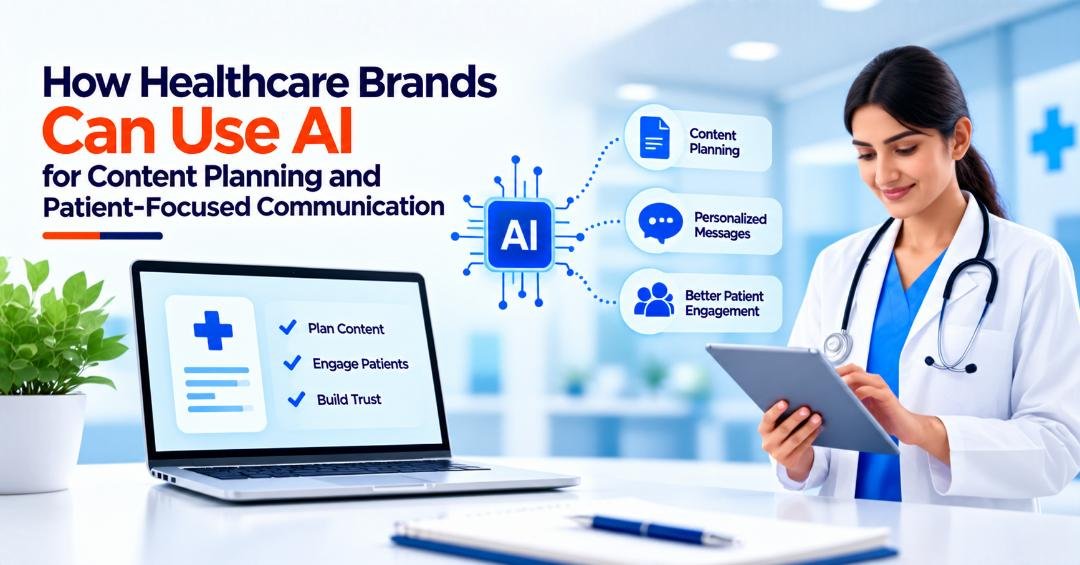
Healthcare communication is changing rapidly. Patients no longer depend only on doctors, hospitals, or word-of-mouth recommendations to find information. They search online, read healthcare articles, compare providers, check reviews, watch educational videos, and increasingly use AI-powered search tools to ask detailed questions.
For healthcare brands, this creates both an opportunity and a responsibility.
Hospitals, clinics, diagnostic centres, specialty practices, and other healthcare organizations need to publish useful information consistently while making sure that their communication remains accurate, understandable, trustworthy, and relevant to patients.
This is where artificial intelligence can support healthcare marketing.
AI can help healthcare teams understand content opportunities, organize topics, identify common questions, create content frameworks, analyze audience behaviour, and adapt approved information into different formats. At the same time, AI should not replace human judgment in areas where accuracy, empathy, privacy, and healthcare expertise matter.
A thoughtful approach can help healthcare brands use AI as a support system for better content planning and more patient-focused communication.
What Is AI-Powered Content Planning in Healthcare?
AI-powered content planning means using artificial intelligence tools to analyze information and support decisions about what healthcare content should be created, how it should be structured, and which audience needs it should address.
For a healthcare brand, this may include analyzing:
- Patient search queries
- Frequently asked questions
- Website search behaviour
- Existing website content
- Search trends
- Content gaps
- Social media questions
- Common service-related queries
- Different stages of the patient journey
The purpose is not to allow AI to decide what patients need medically.
Instead, AI can help marketing teams organize information and identify communication opportunities more efficiently.
For example, if a clinic offers orthopedic services, AI-assisted research may help group audience questions around joint pain, specialist consultations, diagnostic procedures, treatment-related information, recovery questions, and preventive care.
The healthcare marketing team can then use these insights to build a more organized content plan.
Why Content Planning Matters for Healthcare Brands
Healthcare content can easily become repetitive if there is no clear strategy.
A clinic may publish several articles around the same service while missing important questions patients are actually asking. A hospital may have detailed service pages but very little educational content to support users who are still researching their options.
A structured content plan helps avoid this problem.
It can connect:
Patient Question → Content Topic → Useful Answer → Relevant Service → Appropriate Next Step
This approach is more useful than creating content simply because a keyword has search volume.
Healthcare audiences often need information at different stages.
Someone may first want to understand a health topic. Later, they may search for a specialist. After comparing providers, they may look for location, reviews, consultation details, or appointment information.
Content planning should reflect this journey.
1. Use AI to Discover Common Patient Questions
One of the most practical uses of AI is organizing large amounts of questions and search queries.
Healthcare brands receive questions through many sources, including:
- Website forms
- Customer support
- Phone enquiries
- Social media comments
- Search engines
- Reviews
- Frequently asked questions
- Existing website searches
AI can help categorize these questions into themes.
For example, a dental clinic might discover recurring questions about:
- Dental check-ups
- Root canal treatment
- Dental implants
- Braces
- Tooth sensitivity
- Recovery
- Treatment preparation
- Appointment procedures
Instead of treating every question as an individual content idea, the marketing team can group them into broader topic clusters.
This makes content planning more organized and helps the website build stronger topical coverage.
2. Build Content Around Patient Search Intent
Not every patient searches for information for the same reason.
Understanding search intent is essential for healthcare content.
Informational Intent
The user wants to understand something.
Examples:
- What is a dental implant?
- What are common causes of back pain?
- What does a health screening involve?
Provider Intent
The user is looking for a healthcare provider.
Examples:
- Dermatologist near me
- Children’s hospital in Jaipur
- Dental clinic in Udaipur
Comparison Intent
The user is evaluating different options.
Examples:
- What should I consider when choosing a fertility clinic?
- What should I ask a specialist before treatment?
Action Intent
The user is ready to take the next step.
Examples:
- Book a consultation
- Contact a clinic
- Schedule a diagnostic test
AI can help marketers organize search queries according to these different intentions.
The final content strategy should then provide appropriate information for each stage instead of sending every visitor toward the same promotional page.
3. Use AI to Create Topic Clusters
Healthcare websites often contain many related subjects.
For example, a cardiology department may cover:
- Heart health
- Cardiac consultations
- Diagnostic services
- Preventive care
- Risk factors
- Common heart-related conditions
- Lifestyle information
AI can help organize these subjects into topic clusters.
A central service page can act as the main topic, while supporting educational articles answer related questions.
This structure can improve the overall organization of a healthcare website and help users move naturally from general information to relevant services.
It can also support SEO by creating logical relationships between related pages.
However, topic clustering should never become an excuse to create dozens of thin or repetitive pages. Each piece of content should have a clear purpose and provide useful information.
4. Use AI to Identify Content Gaps
A healthcare website may already have hundreds of pages but still fail to answer important questions.
AI-assisted content analysis can help compare existing content with relevant search topics and identify potential gaps.
For example, a clinic may have a page explaining a particular treatment but no content answering:
- Who may need to discuss this treatment with a specialist?
- What questions should patients ask during a consultation?
- What should patients generally know before an appointment?
- What are common misconceptions about the treatment?
These gaps can become opportunities for useful educational content.
The objective should be to improve the information experience rather than simply increase the number of pages on the website.
5. Use AI to Build Better Content Briefs
Creating a good healthcare article requires planning before writing begins.
AI can assist marketing teams in preparing content briefs that include:
- Main topic
- Search intent
- Related questions
- Suggested headings
- Supporting topics
- Audience level
- Internal linking opportunities
- FAQ ideas
- Content format
For example, a content brief for a hospital article could identify the questions a first-time visitor is likely to have and arrange them in a logical order.
This can make the writing process more efficient.
However, a content brief should not be treated as the final authority on medical information. Healthcare-specific claims and explanations need appropriate human review.
6. Make Healthcare Communication Easier to Understand
Healthcare information can sometimes be difficult for people without a medical background.
Complex terminology may be necessary in certain contexts, but patients should be able to understand what the information means.
AI can help marketing teams identify complicated sentences, excessive jargon, unclear explanations, and unnecessarily technical language.
For example, instead of using a highly technical explanation without context, content can introduce the medical term and then explain it in simple language.
The goal is not to make healthcare content less accurate.
The goal is to make accurate information easier to understand.
This is particularly valuable for websites where patients may be reading information while they are worried, confused, or unfamiliar with a medical topic.
7. Use AI to Repurpose Approved Healthcare Content
Healthcare organizations often have valuable information that is published in only one format.
For example, a detailed website article could potentially be adapted into:
- A short educational social media post
- An FAQ
- A video outline
- A newsletter topic
- A carousel
- A patient education summary
AI can assist with this repurposing process.
However, the original approved information should remain the source of truth.
The AI-generated version should be checked to make sure that it has not changed the meaning, introduced unsupported claims, or removed important context.
This allows healthcare brands to communicate consistently across different digital channels without recreating every piece of content from the beginning.
8. Personalize Communication Without Becoming Intrusive
Personalization can make digital communication more relevant.
For example, a healthcare website may organize content according to different service categories so visitors can quickly find information related to their interests.
AI can assist in understanding broad behavioural patterns and recommending relevant content.
However, healthcare personalization needs additional caution.
A healthcare organization should not create an experience that makes visitors feel that their sensitive health information is being tracked or analyzed unnecessarily.
There should be a clear distinction between useful personalization and intrusive personalization.
Patient trust should always be more important than increasing engagement metrics.
9. AI Can Help Organize Patient Communication
Healthcare organizations receive many routine questions.
Visitors may want to know:
- Where is the clinic located?
- What are the working hours?
- Which department provides a particular service?
- How can an appointment be requested?
- What documents may be required?
- How can the organization be contacted?
AI-powered communication systems can help guide users toward this basic information.
This can make websites easier to navigate and reduce repetitive administrative questions.
However, communication systems should have clear boundaries.
Questions involving diagnosis, treatment recommendations, emergencies, or personalized medical advice should be directed to appropriate healthcare professionals.
AI should support patient communication, not pretend to be a doctor.
10. Use AI to Improve FAQ Strategy
Frequently asked questions are valuable for both users and search visibility.
AI can help identify recurring questions across website content, search queries, social media, and customer interactions.
Healthcare brands can then create FAQ sections that answer genuine questions.
Good healthcare FAQs should:
- Answer the question directly
- Use simple language
- Avoid unnecessary repetition
- Provide relevant context
- Avoid unsupported medical claims
- Make it clear when professional advice is required
Well-structured FAQs can also support Answer Engine Optimization because modern search systems increasingly process questions expressed in natural language.
The goal should still be to answer real questions rather than create FAQs solely for search engines.
11. Prepare Healthcare Content for AI Search
The way people search is changing.
Instead of entering a short phrase such as:
“orthopedic doctor Jaipur”
a user might ask:
“What should I consider when choosing an orthopedic specialist in Jaipur?”
AI-powered search experiences can provide answers by processing information from multiple sources.
This makes structured and useful healthcare content increasingly important.
Healthcare brands can prepare by:
- Answering important questions clearly
- Using descriptive headings
- Providing concise explanations
- Covering related questions naturally
- Organizing content logically
- Including relevant FAQs
- Maintaining consistent service information
- Demonstrating expertise and trust
- Avoiding keyword repetition
This approach supports both traditional search and emerging answer-based search experiences.
12. Use AI to Understand Content Performance
Creating content is only one part of the process.
Healthcare brands should also understand how their content performs.
AI-assisted analytics can help identify patterns across:
- Organic traffic
- Search visibility
- Page engagement
- Content interactions
- Enquiries
- Conversion paths
- Returning visitors
- Search queries
For example, a healthcare organization may discover that certain educational articles attract large numbers of visitors but rarely lead people toward relevant service pages.
That does not necessarily mean the articles are unsuccessful. It may indicate that the internal linking or next-step information could be improved.
Data should be used to understand the user journey rather than simply chase traffic numbers.
13. AI Can Help Create a More Consistent Brand Voice
Healthcare organizations often publish content across multiple platforms.
The website, social media channels, email communication, blogs, and advertisements may all be managed by different people.
AI can help teams compare approved content against brand guidelines and identify inconsistencies in:
- Tone
- Terminology
- Formatting
- Messaging
- Service descriptions
This can help create a more consistent digital identity.
However, healthcare brands should avoid making every piece of communication sound automated.
Patient communication should still feel clear, respectful, and human.
How World SEO Services Can Support AI-Based Healthcare Content Strategy
Using AI effectively requires more than access to an AI writing tool.
The real value comes from combining technology with search strategy, healthcare content expertise, audience understanding, and human review.
At World SEO Services, AI-focused healthcare marketing can be integrated with broader digital strategies such as healthcare SEO, content marketing, website optimization, local SEO, AEO, social media, and lead generation.
For a healthcare organization, the process can involve:
- Understanding the target patient audience
- Researching search behaviour and questions
- Identifying content opportunities
- Creating topic clusters
- Developing useful content
- Reviewing healthcare information carefully
- Optimizing content for search and AI discovery
- Measuring performance
- Refining the strategy based on real data
The objective is not to publish more content simply because AI makes content creation faster.
The objective is to publish better and more useful content.
What Healthcare Brands Should Avoid When Using AI
AI can save time, but careless use can create significant problems.
Healthcare brands should avoid:
- Publishing AI-generated medical information without review
- Creating repetitive articles at scale
- Using AI only to insert keywords
- Making unsupported treatment claims
- Creating fake patient experiences
- Sharing confidential patient information with inappropriate tools
- Automating sensitive communication without safeguards
- Replacing healthcare expertise with AI-generated answers
- Prioritizing search rankings over patient usefulness
Google’s guidance emphasizes creating helpful, reliable, people-first content rather than content produced mainly to manipulate search rankings. (developers.google.com)
For healthcare brands, this principle is particularly important because inaccurate information can affect real people.
A Practical Framework for AI-Assisted Healthcare Content Planning
Healthcare organizations can start with a simple process.
Step 1: Collect Real Questions
Gather questions from search queries, enquiries, website data, social media, and healthcare teams.
Step 2: Group Similar Questions
Use AI to organize questions into themes and topic clusters.
Step 3: Identify Search Intent
Determine whether the user wants information, a provider, a comparison, or an action.
Step 4: Plan the Right Content
Decide whether each question needs a blog, service page, FAQ, video, social post, or another format.
Step 5: Create the Content
Use AI where appropriate for research organization, outlines, and content adaptation while maintaining human control.
Step 6: Review for Accuracy
Healthcare information should be carefully checked before publication.
Step 7: Optimize for Search
Apply appropriate SEO, internal linking, structured content, and AEO principles.
Step 8: Measure and Improve
Review performance and update the content strategy based on actual audience behaviour.
Why Human Expertise Still Matters
AI can identify patterns quickly, but it does not automatically understand every healthcare situation.
A healthcare brand needs people who can evaluate whether information is:
- Accurate
- Relevant
- Responsible
- Appropriate for the audience
- Consistent with the organization’s services
- Sensitive to patient concerns
Human expertise also brings something AI cannot reliably reproduce: empathy.
A patient reading about a health concern may not simply be looking for information. They may be anxious, uncertain, or trying to understand what to do next.
Healthcare communication should recognize this context.
Technology can make communication more efficient, but human judgment makes it more responsible.
The Future of Patient-Focused Healthcare Communication
AI is likely to become a regular part of healthcare marketing workflows.
Content teams may use AI to understand search behaviour. SEO teams may use it to analyze large datasets. Website teams may use it to improve navigation. Marketing teams may use it to identify content opportunities and understand performance.
But the healthcare brands that benefit most will not necessarily be those that automate the most.
They will be those that use AI thoughtfully.
The future of healthcare content is likely to combine:
AI efficiency + human expertise + accurate information + patient understanding
This combination can help healthcare organizations communicate more clearly while adapting to the changing way people search for information online.
Conclusion
AI can provide healthcare brands with valuable support in content planning and patient-focused communication. It can help identify common questions, organize search intent, discover content gaps, build topic clusters, prepare content briefs, improve readability, repurpose approved information, analyze performance, and support AI-search optimization.
But healthcare content requires a higher level of responsibility than simply generating text quickly.
Accuracy, privacy, trust, empathy, and human oversight should remain central to every AI-supported marketing process.
For healthcare organizations working with World SEO Services, AI can be used as part of a broader digital marketing strategy that combines healthcare SEO, content marketing, website optimization, AEO, local visibility, and patient-focused communication.
The goal should not be to let AI speak for the healthcare brand.
The goal should be to use AI intelligently so the brand can listen better, plan better, explain better, and communicate more effectively with the people it serves.
FAQs
1. How can AI help healthcare brands with content planning?
AI can help healthcare brands analyze search queries, identify common questions, organize topics into clusters, discover content gaps, prepare content briefs, and suggest suitable content formats. Human review should remain part of the process, especially for healthcare information.
2. Can AI improve patient communication for hospitals and clinics?
Yes. AI can support communication by helping users find basic information about services, locations, timings, appointment processes, and frequently asked questions. It should not replace healthcare professionals for diagnosis, treatment decisions, or personalized medical advice.
3. Is AI-generated healthcare content good for SEO?
AI can assist with content research, planning, and drafting, but simply publishing large amounts of AI-generated content does not guarantee better rankings. Healthcare content should be useful, accurate, original, well-structured, and created primarily to help users.
4. How can AI support AEO for healthcare websites?
AI can help identify the questions people ask and organize content around direct answers. Healthcare websites can support AEO through clear headings, concise explanations, relevant FAQs, natural language, strong topic coverage, and trustworthy information.
5. Should healthcare organizations use AI without human review?
No. Human oversight is especially important for healthcare content and communication. AI can produce inaccurate or misleading information, so important healthcare claims, service information, and patient-facing communication should be reviewed before publication.