
When people search for healthcare information online, they are not simply looking for content. They are looking for information they can understand and trust.
A person researching a medical condition, treatment, diagnostic service, hospital, clinic, or specialist may use several online sources before deciding what to do next. They may read educational articles, visit healthcare websites, check provider information, look at reviews, compare services, and search for answers to specific questions.
This makes trust an essential part of healthcare content.
For medical brands, creating content that is visible in search results is only one part of the challenge. The information should also demonstrate appropriate expertise, provide useful context, communicate responsibly, and help readers understand where professional medical guidance may be required.
This is where E-E-A-T becomes particularly relevant.
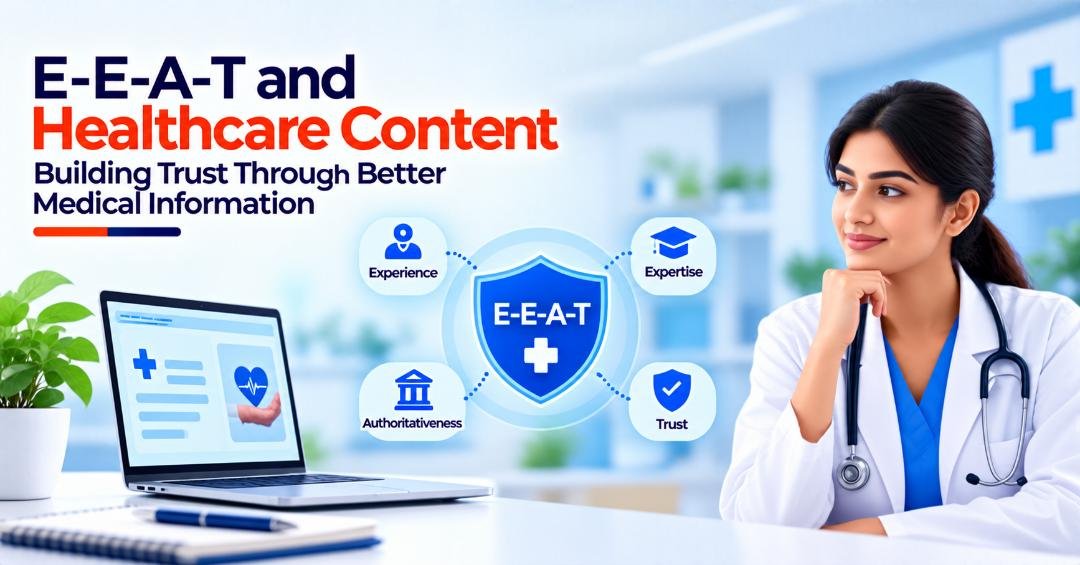
E-E-A-T stands for Experience, Expertise, Authoritativeness, and Trustworthiness. These concepts provide a useful framework for thinking about the quality and credibility of online content.
For healthcare organizations, E-E-A-T is not simply an SEO checklist. It is closely connected to the quality of the information a brand provides to people who may be making important healthcare decisions.
What Is E-E-A-T?
E-E-A-T represents four qualities that can help demonstrate the value and credibility of content.
Experience
Experience relates to first-hand knowledge or practical understanding where it is relevant.
For healthcare content, this could include appropriate real-world experience from healthcare professionals or organizations discussing services they genuinely provide.
Expertise
Expertise relates to having appropriate knowledge about the subject being discussed.
Medical topics can require specialized knowledge, so content should be created or reviewed with the appropriate level of expertise.
Authoritativeness
Authoritativeness refers to the reputation and credibility of the content creator, organization, or website in a particular subject area.
A healthcare organization that clearly communicates its services, professional information, and areas of expertise can provide stronger context for its audience.
Trustworthiness
Trust is arguably the foundation of the entire framework.
Healthcare content should be accurate, transparent, responsible, and clear about what it can and cannot tell a reader.
These four concepts work together rather than functioning as completely separate factors.
Why E-E-A-T Matters So Much in Healthcare
Healthcare content can influence how people understand health conditions, services, treatments, and providers.
A reader may use online information to decide whether to speak with a healthcare professional, investigate a service, or contact a clinic.
This creates a greater responsibility for healthcare websites.
Content that looks professional but contains inaccurate or unsupported information can damage trust.
Similarly, an article filled with medical terminology may appear authoritative but still fail if ordinary readers cannot understand it.
Strong healthcare content should therefore balance knowledge with clarity and responsibility.
Experience in Healthcare Content
Experience can make content more useful when it provides genuine insight.
For example, a healthcare organization can explain its services based on the areas it actually operates in. A qualified professional can provide appropriate insights within their area of expertise.
Experience should never be manufactured.
Healthcare brands should avoid creating artificial stories, fake patient experiences, or invented testimonials simply to make content appear more credible.
If real experiences are shared, privacy and consent should be handled appropriately.
Experience should strengthen authenticity rather than become another marketing technique.
How Healthcare Brands Can Demonstrate Experience
Healthcare organizations can communicate relevant experience through:
- Detailed service information
- Professional profiles
- Department information
- Appropriate educational resources
- Genuine organizational information
- Real-world process explanations
- Relevant case information where ethically and legally appropriate
The objective is to help readers understand that the organization has genuine knowledge of the services and topics it discusses.
Expertise Is Essential for Medical Information
Healthcare topics often require specialized knowledge.
An article discussing a complex medical condition should not be treated like a general lifestyle article.
Medical content may involve:
- Symptoms
- Diagnostic procedures
- Treatment options
- Risks
- Clinical terminology
- Preventive information
- Recovery considerations
Because of this, healthcare content should be developed with appropriate expertise.
Depending on the subject, this may involve review by doctors, medical professionals, subject-matter experts, or other qualified professionals.
The level of review should match the sensitivity and complexity of the topic.
How to Demonstrate Expertise on a Healthcare Website
Healthcare brands can make expertise easier for readers to understand by providing relevant information about:
- Healthcare professionals
- Qualifications
- Specialties
- Departments
- Areas of practice
- Professional experience
- Services
- Healthcare facilities
This information should be accurate and presented transparently.
Author or reviewer information can also provide useful context for educational articles where appropriate.
For example, a medical article may identify its author and indicate whether the content has been reviewed by a qualified healthcare professional.
The exact approach will depend on the organization’s content and editorial process.
Authoritativeness Comes From Consistency and Credibility
A healthcare website does not become authoritative simply because it publishes a large number of articles.
Authority develops through relevant knowledge, useful information, consistent quality, professional credibility, and a strong overall reputation.
For example, a healthcare organization specializing in a particular area can build a deeper content resource around that specialty.
Instead of publishing unrelated topics simply to attract traffic, the website can develop meaningful resources connected to its actual expertise and services.
This creates a more logical and useful content ecosystem.
How Healthcare Brands Can Build Authority
Healthcare organizations can strengthen their digital authority through:
- High-quality educational content
- Accurate service information
- Expert-reviewed resources
- Clear professional information
- Relevant industry contributions
- Genuine reputation signals
- Consistent brand communication
- Strong website organization
Authority should be earned through useful information rather than claimed through promotional language.
Saying that a healthcare provider is “the best” does not automatically make it authoritative.
Providing clear evidence of expertise and professional credibility is more meaningful.
Trustworthiness Is the Foundation
Even expert content can fail if readers do not trust the source.
Trust can be influenced by many elements of a healthcare website.
Visitors may look for:
- Accurate contact information
- Clear business details
- Professional website design
- Secure website experience
- Transparent service information
- Genuine reviews
- Appropriate professional credentials
- Clear authorship or review information
- Updated content
- Responsible medical communication
Trust also involves being honest about limitations.
Healthcare content should not suggest that a general article can replace a consultation when individual medical advice is required.
Accuracy Should Come Before Marketing
One of the most important principles of healthcare content is that accuracy should take priority over promotional messaging.
Healthcare brands may want to highlight their services, but educational content should not turn into an advertisement disguised as medical information.
For example, an article explaining a healthcare procedure should focus primarily on helping the reader understand the subject.
Relevant information about the provider can be included naturally where appropriate.
This creates a better balance between education and marketing.
Avoid Unsupported Medical Claims
Healthcare content should be particularly careful with claims.
Brands should avoid statements that:
- Guarantee treatment results
- Promise specific outcomes
- Exaggerate benefits
- Create unnecessary fear
- Present unverified statistics
- Make unsupported comparisons
- Suggest that one treatment is universally suitable
A responsible content strategy communicates information without creating unrealistic expectations.
When individual circumstances matter, readers should be encouraged to discuss their situation with an appropriate healthcare professional.
E-E-A-T and Healthcare SEO
E-E-A-T is closely related to how healthcare brands should approach SEO, but it should not be treated as a formula where adding a few author details automatically creates better rankings.
SEO should focus on creating useful content that serves the audience and clearly communicates the purpose of the website.
Healthcare SEO can be strengthened by combining:
- Relevant search intent
- Helpful content
- Strong website structure
- Clear service pages
- Internal linking
- Local SEO
- Technical quality
- Appropriate professional information
- Accurate and updated content
The goal is to create a website that is useful to people and easy for search systems to understand.
E-E-A-T and Healthcare Content Marketing
Content marketing becomes more effective when it is built around genuine expertise.
Instead of asking only:
“What keyword should we target?”
healthcare brands can ask:
“What can we explain better than a generic website?”
This shift can lead to stronger content.
For example, a hospital can create detailed educational resources around its specialties. A diagnostic centre can answer practical questions about its services. A clinic can explain general information related to the conditions it treats.
The content then reflects the organization’s actual area of expertise.
Build Topic Depth Instead of Publishing Random Articles
A healthcare website can become more useful by developing content clusters around important specialties or services.
For example:
Main Service → Supporting Topics → FAQs → Related Resources → Specialist Information
This structure allows readers to explore a topic in greater depth.
It also helps the website create a clear relationship between educational information and healthcare services.
The objective is not to publish an article for every possible keyword.
The objective is to build a useful information resource around topics that matter to the audience and the organization.
E-E-A-T and Author Information
Author information can provide useful context, particularly for healthcare articles.
Depending on the type of content, a website may include:
- Author name
- Professional role
- Relevant qualifications
- Area of expertise
- Reviewer information
- Date published
- Date updated
This does not mean every page needs an elaborate biography.
The information should be appropriate to the content and genuinely useful to readers.
Most importantly, the information should be accurate.
Why Content Updates Matter
Healthcare information can change over time.
New evidence, updated guidelines, changes in services, or changes in organizational information can make older content less useful.
Healthcare brands should therefore review important content periodically.
Content audits can check:
- Medical accuracy
- Service information
- Contact details
- Outdated claims
- Broken links
- Old statistics
- Terminology
- References
- Internal links
An updated article is more useful than an outdated page that continues to attract visitors.
E-E-A-T and AI-Generated Healthcare Content
Generative AI has made it easier to produce healthcare content quickly, but speed should not replace expertise.
AI can assist with:
- Topic research
- Content outlines
- Question discovery
- Content organization
- Drafting
- Content repurposing
However, AI-generated information can contain errors, outdated claims, or missing context.
Healthcare content should therefore receive appropriate human review.
The important question is not whether AI was used.
The more important question is whether the final content is accurate, useful, responsible, and trustworthy.
E-E-A-T and AEO in Healthcare
AI-powered search is changing how people discover information.
Users increasingly ask complete questions rather than entering short keywords.
For example:
“What should I consider before choosing a specialist for a particular condition?”
To provide useful answers, healthcare websites should create content that is:
- Clear
- Structured
- Question-focused
- Accurate
- Contextual
- Easy to understand
FAQs, direct answers, descriptive headings, and well-organized educational resources can support this approach.
But AEO should not be separated from trust.
AI search systems may be able to process information quickly, but healthcare brands still need to provide information that deserves to be trusted.
How Reviews and Reputation Support Trust
Online reputation is another important part of the healthcare digital experience.
Potential patients may look at reviews before contacting a provider.
Reviews can help people understand experiences related to:
- Communication
- Appointment processes
- Staff interaction
- Facility experience
- General service quality
Healthcare organizations should encourage genuine feedback and respond professionally.
They should never reveal confidential patient information in public responses.
A trustworthy reputation is built through real experiences and responsible communication, not artificial reviews.
How World SEO Services Can Support E-E-A-T-Focused Healthcare Content
At World SEO Services, healthcare content can be planned with trust and usefulness as core priorities rather than treating content as a simple keyword-ranking exercise.
A broader strategy can combine:
- Healthcare SEO
- Healthcare content marketing
- Local SEO
- Website development
- AEO
- Reputation management
- Social media marketing
- Lead generation
- AI-focused search strategies
For healthcare brands, this means developing content around genuine services, audience questions, professional expertise, and relevant search intent.
The goal is to create a digital presence where content, website structure, professional information, and brand communication support each other.
A Practical E-E-A-T Checklist for Healthcare Content
Before publishing an important healthcare article, a content team can ask:
Experience
Does the content include genuine and relevant organizational or professional experience where appropriate?
Expertise
Has the subject been created or reviewed by someone with suitable knowledge?
Authoritativeness
Does the website clearly communicate the organization’s relevant expertise and professional information?
Trustworthiness
Is the information accurate, transparent, current, and responsibly presented?
Patient Value
Does the content actually answer the reader’s question?
Clarity
Can an ordinary reader understand the information?
Search Intent
Does the content match what the person is actually trying to find?
AEO
Are important questions answered clearly and logically?
Updates
Is the information current and likely to remain useful?
This checklist can help healthcare teams identify gaps before publication.
Common E-E-A-T Mistakes Healthcare Brands Should Avoid
Healthcare brands can unintentionally weaken trust through several content practices.
Common problems include:
- Publishing unreviewed medical content
- Hiding who created important healthcare information
- Making unsupported expertise claims
- Using generic AI-generated articles
- Publishing outdated information
- Creating exaggerated treatment claims
- Using fake reviews or testimonials
- Writing primarily for keywords
- Using unnecessarily complicated language
- Providing personalized medical advice through general content
- Failing to update important service information
Avoiding these issues can make the entire website more credible and useful.
The Long-Term Value of Trustworthy Healthcare Content
E-E-A-T should not be treated as a short-term SEO tactic.
Trustworthy content can create long-term value by helping a healthcare brand become a reliable information source for its audience.
A strong content library can support:
- Organic search visibility
- Patient education
- Brand credibility
- Topic authority
- Local visibility
- Website engagement
- Better patient journeys
- Relevant enquiries
These benefits can build over time.
The goal is not simply to make one article rank. It is to create a healthcare website where people can consistently find useful and credible information.
Conclusion
E-E-A-T is especially important for healthcare content because people rely on online information when researching health concerns, medical services, specialists, and healthcare providers.
Experience, expertise, authoritativeness, and trustworthiness provide a useful framework for creating better medical information. But they should not be treated as isolated SEO techniques.
Healthcare brands need to demonstrate genuine expertise, communicate clearly, keep information accurate, protect patient privacy, and provide content that genuinely helps people.
For organizations investing in Healthcare Content Marketing Services, the strongest approach is to combine E-E-A-T principles with healthcare SEO, patient-focused content, local visibility, website quality, AEO, and responsible AI use.
At World SEO Services, this approach can help healthcare brands develop a digital content ecosystem where search visibility and patient trust work together rather than competing with each other.
Ultimately, the best healthcare content is not the content that simply sounds authoritative. It is the content that gives readers useful information, communicates responsibly, and gives them confidence that they are learning from a credible source.
FAQs
1. What does E-E-A-T mean in healthcare content?
E-E-A-T stands for Experience, Expertise, Authoritativeness, and Trustworthiness. These concepts help healthcare brands think about whether their content demonstrates appropriate knowledge, credibility, genuine experience, and trust.
2. Why is E-E-A-T important for healthcare websites?
Healthcare information can influence important decisions, so readers need reliable and understandable information. E-E-A-T helps healthcare organizations focus on credibility, professional expertise, accurate information, responsible communication, and overall trust.
3. How can a healthcare website demonstrate expertise?
A healthcare website can demonstrate expertise through accurate educational content, professional profiles, qualifications, specialty information, appropriate expert reviews, detailed service information, and clear communication about the organization’s areas of practice.
4. Does AI-generated healthcare content affect E-E-A-T?
AI-generated content can create quality problems if it is published without proper review. AI can assist with content planning and drafting, but healthcare information should be checked for accuracy, context, and reliability, with appropriate human expertise involved.
5. How can healthcare content build trust with patients?
Healthcare content can build trust by providing accurate information, avoiding exaggerated claims, using clear language, showing appropriate professional information, keeping content updated, protecting privacy, and answering genuine patient questions responsibly.