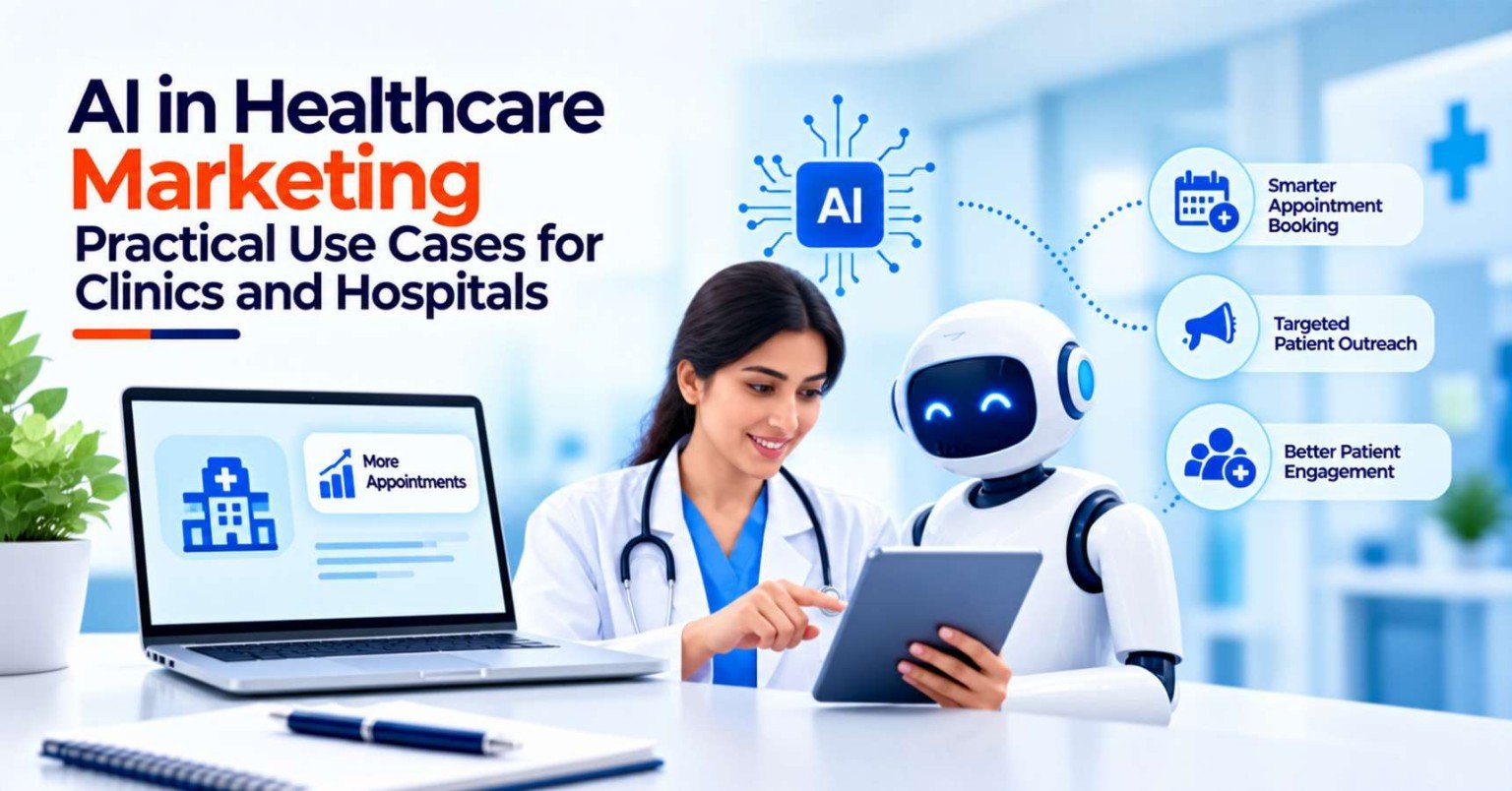
Artificial intelligence is changing the way businesses understand audiences, create content, analyze data, and communicate online. Healthcare is also becoming part of this transformation. Hospitals, clinics, diagnostic centres, specialty practices, and other healthcare organizations are exploring AI to make their digital marketing more efficient, relevant, and responsive.
However, using AI in healthcare marketing is not simply about generating more content or automating every marketing task. Healthcare organizations deal with sensitive information and audiences who expect accuracy, privacy, transparency, and trust. This makes responsible use of AI especially important.
For clinics and hospitals, the most useful applications of AI are often found in areas such as content planning, patient communication, search optimization, audience analysis, personalization, lead management, and marketing performance analysis.
A well-planned approach can help healthcare brands understand what people are searching for, create more useful digital experiences, and improve marketing efficiency while keeping human oversight at the centre.
What Is AI in Healthcare Marketing?
AI in healthcare marketing refers to the use of artificial intelligence technologies to support marketing activities for healthcare organizations.
Instead of replacing marketing teams, AI can assist them with tasks that involve large amounts of information, repetitive processes, pattern recognition, content analysis, and data-driven decision-making.
Depending on the organization’s requirements, AI can support areas such as:
- Healthcare content planning
- Search intent analysis
- SEO research
- Patient communication
- Lead qualification
- Personalization
- Social media planning
- Advertising optimization
- Reputation monitoring
- Website analytics
- AI search and AEO strategies
The important distinction is that AI marketing tools support decisions; they should not automatically make sensitive healthcare decisions on behalf of patients or professionals.
The World Health Organization has highlighted both the potential of AI in health and the need for appropriate governance, privacy, transparency, and ethical safeguards.
Why Are Clinics and Hospitals Exploring AI Marketing?
Healthcare marketing involves a large amount of information.
A hospital may have dozens of departments, hundreds of services, multiple locations, numerous specialists, and different patient audiences. A specialized clinic may have a smaller service range but highly specific search behaviour.
At the same time, patients may search across several platforms before contacting a provider.
They may:
- Search Google for a healthcare service
- Read educational articles
- Compare providers
- Check reviews
- Visit a website
- Look at social media
- Ask questions through online channels
- Search using AI-powered tools
Managing all of these touchpoints manually can become time-consuming.
AI can help marketing teams process information faster, identify patterns, and prioritize activities. But the quality of the result still depends on the data, strategy, human expertise, and review process behind it.
1. AI Can Help Identify Patient Search Intent
One of the most practical applications of AI is understanding what people are actually searching for.
Healthcare search behaviour can be complicated because the same service may be searched in many different ways.
For example, someone looking for fertility care might search:
- fertility clinic near me
- IVF specialist in Jaipur
- IVF treatment information
- fertility treatment options
- IVF consultation
- how to choose a fertility clinic
These searches represent different stages of the patient journey.
AI-assisted analysis can help marketers group large numbers of search queries into themes and identify patterns such as:
- Informational intent
- Local intent
- Service intent
- Comparison intent
- Appointment intent
This can make keyword research more strategic.
Instead of creating content around every individual keyword, healthcare marketers can understand the broader questions and needs behind those searches.
2. AI Can Support Healthcare Content Planning
Creating useful healthcare content requires more than publishing articles regularly.
A healthcare brand needs to know which topics are relevant to its audience, which questions are commonly asked, and where information gaps exist.
AI can help marketing teams organize large amounts of search and content data to identify potential topics.
For example, a hospital offering orthopedic services might identify content themes around:
- Common orthopedic concerns
- When to consult a specialist
- General treatment information
- Recovery-related questions
- Preventive care
- Specialist selection
- Frequently asked patient questions
The marketing team can then turn these insights into articles, FAQs, service pages, videos, and social media content.
However, AI-generated suggestions should be reviewed by knowledgeable professionals. Healthcare content should not be published simply because an AI system produced it.
Google’s guidance emphasizes people-first content that provides useful information and satisfies the user’s purpose rather than content created primarily to manipulate search rankings.
3. AI Can Make Healthcare SEO Research More Efficient
Healthcare SEO involves much more than finding keywords.
Marketers need to understand search intent, competitors, related topics, content gaps, internal linking opportunities, page structures, and user behaviour.
AI can assist with organizing this information.
For example, an SEO team can use AI-assisted analysis to identify relationships between:
Keyword → Search Intent → Topic → Service Page → Supporting Content
This can help create a more connected website structure.
Suppose a clinic has a core service page for cardiology. Supporting content could cover general questions about heart health, specialist consultations, diagnostic services, and common patient concerns.
AI can help identify potential topic relationships, but the final SEO strategy should be based on actual search data, healthcare expertise, website goals, and audience needs.
4. AI Can Help Improve Website Personalization
Not every website visitor has the same needs.
A person visiting a hospital website to find a doctor has a different objective from someone researching a diagnostic service or looking for general healthcare information.
AI-powered systems can potentially help websites understand user behaviour and deliver more relevant experiences.
For example, a website may use behavioural signals to improve:
- Recommended content
- Service navigation
- Frequently asked questions
- Search results
- Relevant calls to action
- Content suggestions
Personalization should always be handled carefully in healthcare.
Organizations should avoid creating experiences that feel invasive or expose sensitive information. Any use of personal data should follow applicable privacy requirements and the organization’s data governance policies.
5. AI Can Support Healthcare Chat and Patient Enquiries
AI-powered conversational tools can help healthcare websites answer common non-clinical questions.
For example, a website assistant may help a visitor find information about:
- Clinic timings
- Department locations
- Available services
- Appointment processes
- Contact details
- Basic facility information
- General website navigation
This can reduce the time visitors spend searching for basic information.
However, there is an important boundary.
A marketing chatbot should not be treated as a substitute for a qualified healthcare professional. Questions requiring diagnosis, personalized treatment recommendations, or urgent medical assessment should be directed to appropriate healthcare professionals or emergency services.
The role of AI should be clearly defined so users understand what the system can and cannot do.
6. AI Can Help With Lead Management
Healthcare marketing is not complete when someone fills out a form.
A healthcare organization may receive enquiries through websites, calls, social media, advertisements, messaging platforms, and other channels.
AI-assisted systems can help marketing teams organize and categorize these enquiries.
For example, leads may be grouped according to:
- Service requested
- Location
- Source of enquiry
- Stage in the decision journey
- Follow-up status
- Campaign source
This can help teams identify which marketing channels are generating relevant enquiries.
The objective should not be to make assumptions about a person’s medical condition. Instead, AI can help organize the administrative and marketing information already provided through appropriate channels.
7. AI Can Support Healthcare PPC Campaign Optimization
Paid advertising generates large amounts of performance data.
A healthcare marketing team may need to analyze:
- Search terms
- Click-through rates
- Conversion rates
- Cost per enquiry
- Geographic performance
- Landing page performance
- Campaign-level trends
AI-assisted analytics can help identify patterns within this data more quickly.
For example, a campaign may generate many clicks but very few relevant enquiries. Another campaign may generate fewer clicks but better-quality leads.
This type of analysis can help marketers decide where budget and attention should be focused.
However, AI recommendations should always be reviewed before major campaign changes are made, especially when healthcare advertising rules or platform policies apply.
8. AI Can Assist With Social Media Content Planning
Healthcare organizations often need to maintain a consistent social media presence.
AI can help marketing teams brainstorm content themes, organize publishing calendars, repurpose approved information into different formats, and identify recurring audience questions.
For example, one approved educational topic could be adapted into:
- A short social media post
- A carousel
- A short video script
- An FAQ
- A website article
- A newsletter topic
This can make content production more efficient.
But healthcare brands should not allow AI to create sensitive patient stories, medical claims, or professional communications without appropriate human review.
Authenticity matters. Social media should educate and communicate rather than become a stream of automated promotional posts.
9. AI Can Help Monitor Online Reputation
Online reputation is especially important for hospitals and clinics because people often check reviews before choosing a provider.
AI-assisted tools can help organizations monitor large volumes of feedback and identify recurring themes.
For example, reviews may repeatedly mention:
- Appointment delays
- Communication issues
- Staff behaviour
- Facility experience
- Website or booking difficulties
Marketing teams can use these patterns to understand where the digital or service experience may need improvement.
AI should not be used to manufacture reviews or create fake patient experiences. The purpose of reputation analysis should be to understand genuine feedback and identify opportunities for improvement.
10. AI Can Help Healthcare Brands Prepare for AI Search
Search behaviour is evolving.
People are increasingly asking longer and more conversational questions rather than relying only on short keywords.
For example, instead of searching:
“best cardiologist Jaipur”
a user might ask:
“What should I consider when choosing a cardiologist in Jaipur?”
This creates new opportunities for healthcare brands to organize their content around complete questions and useful answers.
AI-focused search optimization and AEO can involve:
- Direct answers to common questions
- Clear heading structures
- Well-organized FAQs
- Natural language
- Relevant supporting information
- Strong topic coverage
- Clear service information
- Trust-focused content
The goal should not be to create content specifically to manipulate AI results. The better approach is to provide information that is genuinely useful, clear, well-structured, and easy for both people and search systems to understand.
11. AI Can Help Analyze Healthcare Marketing Performance
Healthcare organizations generate data from multiple marketing channels.
SEO, PPC, social media, websites, local search, and lead-generation campaigns can all provide different performance signals.
AI-assisted analytics can help marketers identify patterns across these channels.
For example, an organization may discover that:
- Certain service pages attract highly relevant visitors
- Some content generates strong organic engagement
- Particular locations produce more enquiries
- Certain advertising campaigns have better conversion rates
- Some website pages cause users to leave quickly
This information can support better marketing decisions.
The key is to use AI as an analysis assistant rather than relying on automated conclusions without checking the underlying data.
12. AI Can Help Repurpose Approved Healthcare Content
Healthcare organizations already have valuable information across their websites, brochures, FAQs, videos, and educational resources.
AI can help transform approved material into different content formats.
For example:
One approved healthcare article → FAQ → social post → video outline → email topic
This can save time for marketing teams while keeping communication more consistent.
The original information should remain the source of truth. AI should not introduce new medical claims or change the meaning of professionally approved information.
What AI Should Not Replace in Healthcare Marketing
AI can improve marketing efficiency, but there are areas where human involvement remains essential.
Healthcare organizations should be particularly careful with:
- Medical claims
- Patient-specific advice
- Sensitive personal information
- Clinical recommendations
- Patient testimonials
- Professional credentials
- Healthcare advertising claims
- High-risk communication
AI-generated content can contain incorrect or misleading information. Human review is therefore especially important when content relates to health.
The WHO has emphasized that AI in health needs strong attention to ethical principles, governance, privacy, safety, and accountability.
It is also important to distinguish AI used for marketing support from AI-enabled medical technologies used for clinical purposes. Medical AI systems can involve separate regulatory and safety considerations.
How World SEO Services Can Use AI in Healthcare Marketing
AI can be valuable, but it works best when it is connected to a clear marketing strategy.
At World SEO Services AI-focused healthcare marketing can be approached as an extension of broader digital marketing rather than as a replacement for SEO, content expertise, website strategy, or human decision-making.
A healthcare marketing strategy may combine:
- Healthcare SEO
- AI-assisted keyword and search-intent research
- Healthcare content marketing
- AEO and AI-search optimization
- Website optimization
- Local SEO
- Social media marketing
- PPC campaign analysis
- Lead generation
- Reputation management
- Marketing performance analysis
The exact approach should depend on the healthcare organization’s services, audience, location, competition, digital maturity, and objectives.
For example, a local clinic may benefit more from AI-assisted local search analysis and content planning, while a large hospital may require a broader system involving multiple departments, locations, services, and marketing channels.
The technology should support the strategy—not become the strategy itself.
How to Implement AI Responsibly in Healthcare Marketing
Healthcare organizations can begin with practical, low-risk applications instead of trying to automate everything at once.
1. Start With a Clear Objective
Identify the marketing problem AI is expected to solve.
2. Use AI for Repetitive Tasks
Begin with activities such as research organization, content ideation, reporting, and data analysis.
3. Keep Human Review in the Process
Healthcare-related information should be checked by appropriate people before publication.
4. Protect Sensitive Information
Do not place confidential or personally identifiable patient information into tools without appropriate authorization, security, and privacy safeguards.
5. Measure the Results
Track whether AI-supported activities actually improve efficiency, content quality, engagement, visibility, or relevant enquiries.
6. Review AI Outputs Regularly
AI systems can make mistakes. Processes should include quality checks and clear responsibility for final decisions.
Common Mistakes When Using AI for Healthcare Marketing
The biggest mistake is treating AI as a shortcut for everything.
Healthcare brands should avoid:
- Publishing unchecked AI-generated medical content
- Creating large volumes of repetitive articles
- Using AI simply to insert keywords
- Sharing confidential patient information with inappropriate tools
- Creating fake reviews or testimonials
- Automating sensitive patient communication without safeguards
- Assuming AI-generated information is automatically accurate
- Removing human expertise from healthcare content
Google’s guidance continues to emphasize helpful, reliable, people-first content rather than content created mainly to attract search traffic.
This is especially relevant when healthcare brands use generative AI at scale.
The Future of AI in Healthcare Marketing
AI will likely become a more integrated part of healthcare marketing as organizations collect more digital data and patients use more AI-powered search and communication tools.
The strongest healthcare brands will not necessarily be the ones using the most AI.
They will be the ones that know where AI adds value and where human expertise is essential.
AI can help identify patterns, organize information, support research, improve efficiency, and personalize digital experiences. Human teams remain responsible for strategy, judgment, accuracy, empathy, privacy, and responsible communication.
This balance will become increasingly important as AI becomes a normal part of digital marketing.
Conclusion
AI in healthcare marketing has moved beyond being a purely experimental concept. Clinics, hospitals, diagnostic centres, and other healthcare organizations can use AI in practical ways across search research, content planning, SEO, website experiences, lead management, PPC analysis, social media, reputation monitoring, and AI-search optimization.
However, effective AI marketing is not about generating the largest amount of content or automating every interaction. Healthcare requires a careful balance between technology and human expertise.
The best approach is to use AI where it can improve efficiency and insight while keeping accuracy, privacy, trust, and patient needs at the centre.
For healthcare organizations working with World SEO Services, AI can become one part of a broader digital marketing strategy—supporting healthcare SEO, content, website development, local visibility, paid campaigns, lead generation, and emerging AEO opportunities.
When technology is combined with responsible strategy and human oversight, AI can help healthcare brands build a more useful, efficient, and patient-focused digital presence.
FAQs
1. How is AI used in healthcare marketing?
AI can support healthcare marketing through search-intent analysis, content planning, SEO research, website personalization, lead organization, PPC analysis, social media planning, reputation monitoring, and marketing performance analysis.
2. Can AI create healthcare content for hospitals and clinics?
AI can assist with research, outlines, content ideas, and repurposing approved information. However, healthcare content should be reviewed by qualified or knowledgeable professionals before publication to reduce the risk of inaccurate or misleading information.
3. How can AI help healthcare SEO?
AI can help organize keyword research, identify search-intent patterns, discover related topics, analyze content gaps, and support internal content planning. It should complement a broader SEO strategy rather than replace SEO expertise or actual search data.
4. Is AI safe to use for healthcare marketing?
AI can be useful for healthcare marketing when it is implemented responsibly. Organizations should protect sensitive information, maintain human oversight, verify important information, and follow applicable privacy, healthcare, and advertising requirements.
5. How can AI help hospitals and clinics with patient enquiries?
AI-powered tools can help answer basic non-clinical questions, guide website visitors to relevant information, organize enquiries, and support lead-management workflows. They should not replace qualified healthcare professionals for diagnosis, personalized medical advice, or urgent clinical decisions.