
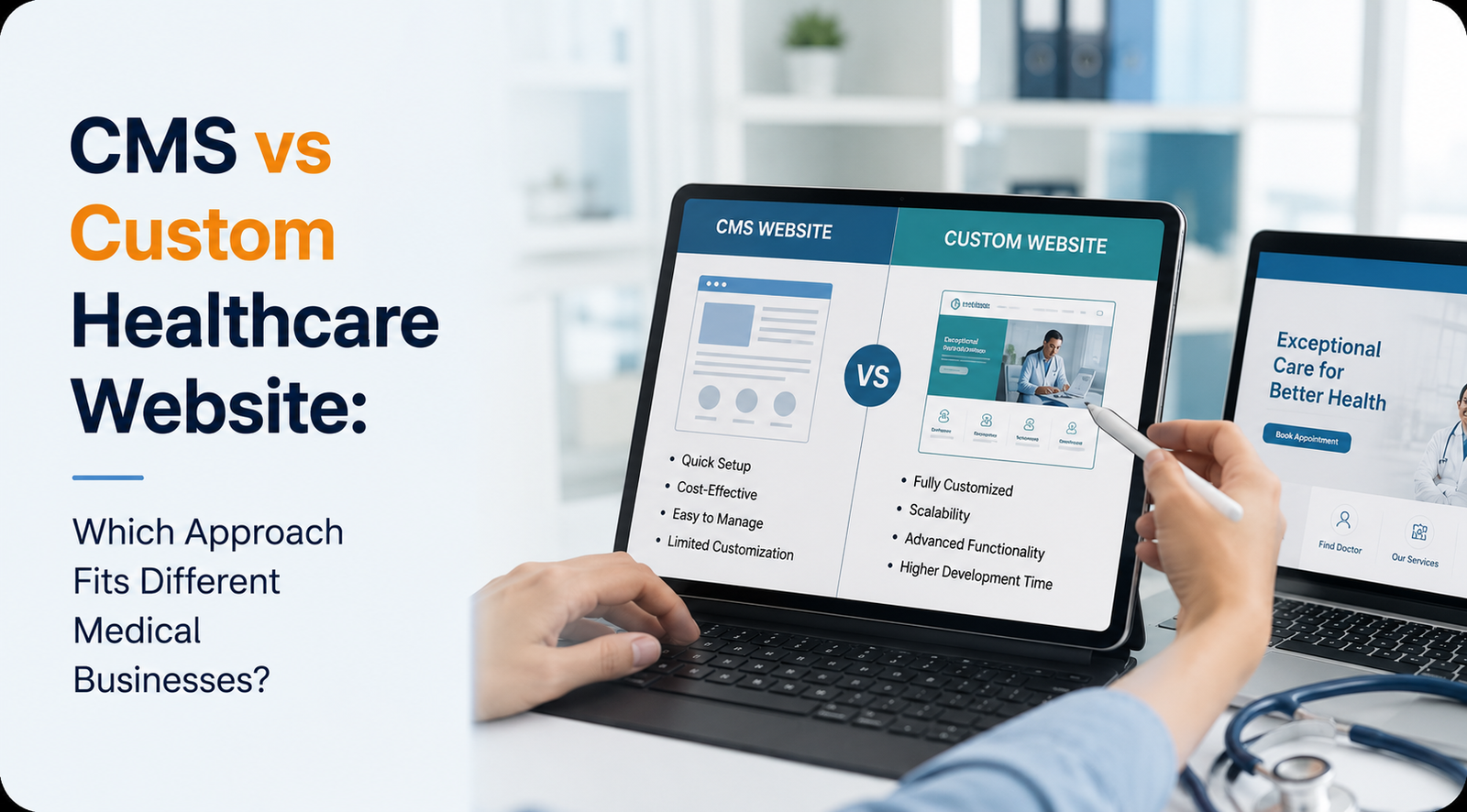
Choosing the right technology for a healthcare website is not simply a question of whether a CMS or custom development is better.
The right approach depends on what the healthcare business needs from its website today, how complex those requirements may become in the future, who will manage the content, and whether the website needs specialised integrations or workflows.
A small doctor’s clinic may need a straightforward website with service information, doctor details, location information, and appointment enquiries. A multi-location hospital may require a much more complex platform with department structures, doctor directories, appointment systems, patient portals, integrations, and multiple content managers.
These two businesses should not necessarily use the same development approach.
This is why healthcare organisations should understand the differences between a CMS-based healthcare website and a custom healthcare website before starting development.
What Is a CMS-Based Healthcare Website?
A Content Management System (CMS) is software that allows authorised users to create, edit, organise, and publish website content without manually coding every page.
Common CMS-based websites can be built using platforms such as WordPress or other content management systems.
A healthcare CMS website may include:
- Home page
- Service pages
- Doctor profiles
- Department pages
- Location pages
- Blog or resources section
- Contact forms
- Appointment enquiry forms
- FAQs
- Image galleries
- Basic integrations
One of the major advantages of a CMS is that the healthcare organisation can manage a significant amount of content through an administrative interface.
W3C recognises content management systems as examples of authoring tools and provides accessibility guidance specifically relevant to such tools.
What Is a Custom Healthcare Website?
A custom healthcare website is developed specifically around the requirements of the organisation.
Instead of relying primarily on pre-built themes, plugins, and standard CMS functionality, developers can create custom components, workflows, integrations, and interfaces.
A custom solution may be appropriate when a healthcare business requires:
- Complex appointment workflows
- Advanced doctor directories
- Multiple healthcare-system integrations
- Patient portals
- Custom dashboards
- Specialised search
- Complex user permissions
- Custom data structures
- Large-scale multi-location architecture
- Unique operational workflows
Custom development does not necessarily mean that every component is built from scratch. A project can still use established frameworks, libraries, APIs, or a CMS while customising the parts that require specialised functionality.
CMS vs Custom Website: The Basic Difference
The simplest distinction is this:
CMS = use an established content-management foundation and customise it according to the website’s requirements.
Custom development = build more of the website’s functionality and architecture specifically around the organisation’s requirements.
The practical difference becomes clearer when comparing individual factors.
1. Development Time
A CMS can generally provide a ready-made foundation for common website functions.
Instead of developing every content-management feature from the beginning, a team can configure the CMS and customise the required components.
This can make CMS development suitable for businesses that want to launch a professional website within a relatively defined scope.
Custom development usually requires more planning and development because the team has to create or configure more components around the organisation’s specific requirements.
However, development time depends heavily on the project’s complexity.
A highly customised CMS project can take longer than a simple custom-built website, while a large custom healthcare platform can require considerably more development work than a standard CMS website.
Therefore, technology alone does not determine the project timeline.
2. Initial Development Cost
Cost is another major consideration.
A CMS can reduce development effort for standard functionality because many fundamental website-management capabilities already exist.
A typical CMS project may therefore require investment in:
- Design
- Development
- Theme or component customisation
- Plugins or extensions
- Hosting
- Security
- Integrations
- Maintenance
Custom development can involve greater initial investment because more functionality may need to be designed and developed specifically for the business.
Costs can include:
- Architecture
- UX design
- Front-end development
- Back-end development
- Database development
- API integrations
- Testing
- Security
- Deployment
- Maintenance
But the cheapest initial option is not automatically the most cost-effective long term.
The organisation should consider the total cost of ownership, including future changes, maintenance, integrations, content management, and scaling.
3. Ease of Content Management
This is one area where CMS platforms can be particularly practical for healthcare organisations.
A CMS can allow authorised staff to update:
- Doctor profiles
- Services
- Blog articles
- FAQs
- Locations
- Images
- Contact information
without requiring developers for every routine content change.
This can be useful for hospitals and clinics where information changes regularly.
Custom websites can also include content management systems, but the content-management interface may need to be developed or configured according to the project.
If a healthcare business expects non-technical staff to manage content frequently, content editing should be an important factor when selecting the development approach.
4. Design Flexibility
A common misconception is that CMS websites cannot have unique designs.
That is not necessarily true.
A CMS can be customised significantly through:
- Custom themes
- Custom components
- Design systems
- Custom templates
- Custom CSS
- Custom functionality
However, some CMS platforms or themes may impose limitations depending on how they are configured.
Custom development can provide greater control over the user interface because the development team can build the interface specifically around the required experience.
This can matter for healthcare organisations with highly specialised workflows or complex digital products.
5. Functionality and Feature Requirements
This is where the difference between CMS and custom development can become more important.
A CMS can handle many common healthcare website requirements, including:
- Service pages
- Doctor profiles
- Blog content
- Contact forms
- Basic appointment enquiries
- Location pages
- FAQs
However, more specialised requirements may need custom development.
For example, a healthcare organisation may need a system where:
Patient → selects speciality → selects location → selects doctor → checks availability → selects appointment → receives confirmation
If this workflow needs to communicate with an external scheduling system and follow specific organisational rules, custom development or substantial CMS customisation may be required.
6. Scalability
Scalability means the website can continue supporting the organisation as its requirements grow.
A small clinic may begin with ten pages and later add:
- More doctors
- More services
- Additional locations
- More content
- Online booking
- New integrations
A CMS can support substantial growth when properly configured and maintained.
However, large healthcare organisations may eventually require more specialised architecture.
For example, a healthcare group operating multiple locations may need:
- Centralised content management
- Multiple administrators
- Location-specific information
- Advanced search
- Custom permissions
- Integrated systems
- High traffic capacity
At that point, architecture becomes more important than simply choosing “CMS” or “custom.”
7. Security Considerations
Security matters for every healthcare website, regardless of the development approach.
A CMS can be secure when it is properly configured, maintained, updated, and hosted.
However, third-party plugins, themes, extensions, and integrations introduce additional components that need to be managed.
A custom website gives developers greater control over the application architecture, but custom code also needs careful security testing, maintenance, patching, access control, and monitoring.
Neither approach should be treated as automatically secure.
For websites handling sensitive patient information, security requirements should be defined before development begins.
8. Accessibility
Accessibility should not be considered a CMS-only or custom-development issue.
A CMS can provide accessible components and authoring capabilities, but the final website still depends on how templates, content, forms, navigation, images, and interactive elements are implemented.
Custom development can provide precise control over accessibility implementation, but that control is useful only when developers actually follow accessibility requirements.
W3C recommends considering accessibility throughout design and development and highlights areas such as form labels, alternative text, semantic markup, error handling, and keyboard accessibility.
Therefore, healthcare businesses should ask:
“How will accessibility be handled?”
rather than simply:
“CMS or custom?”
9. SEO Flexibility
Both approaches can support SEO.
A CMS can provide functionality for:
- Editable page titles
- Meta descriptions
- SEO-friendly URLs
- Internal linking
- XML sitemaps
- Image optimisation
- Structured data
- Content publishing
- Redirect management
A custom website can also implement these functions.
The key factor is implementation quality.
Google’s current Search documentation covers areas such as structured data, page appearance, crawling, indexing, JavaScript, and other technical aspects of Search. Google also notes that its systems can render JavaScript, meaning the choice of technology alone does not determine whether a website can be understood by Google.
For healthcare businesses, SEO requirements should therefore be included in the architecture and development process from the beginning.
10. Website Performance
Performance depends on implementation rather than simply whether the website uses a CMS.
A poorly configured CMS can become heavy because of:
- Too many plugins
- Unoptimised themes
- Large images
- Excessive scripts
- Unnecessary features
- Poor hosting
A custom website can also perform poorly if developers create inefficient code, excessive JavaScript, or poorly optimised database queries.
The better question is:
Can the chosen architecture deliver the required functionality efficiently?
Performance should be tested on important healthcare pages such as service pages, doctor profiles, location pages, and appointment journeys.
11. Integrations
Healthcare businesses may need integrations with:
- Appointment systems
- CRM platforms
- Patient portals
- EHR systems
- Laboratory systems
- Payment gateways
- Telehealth platforms
- SMS
- Analytics
- Marketing platforms
A CMS can integrate with many external systems through plugins, APIs, or custom development.
Custom development may provide greater control over how these systems communicate.
The complexity of the integration should therefore influence the technology decision.
A simple contact form and a complex real-time appointment system should not be treated as the same development requirement.
12. Maintenance Requirements
Every healthcare website requires maintenance.
For CMS websites, maintenance can include:
- CMS updates
- Plugin updates
- Theme updates
- Security patches
- Backups
- Compatibility testing
- Performance monitoring
Custom websites require maintenance too.
This can include:
- Framework updates
- Dependency updates
- Security patches
- Code maintenance
- Server management
- Database maintenance
- API updates
- Bug fixes
A common mistake is assuming that custom development means the website will require less maintenance.
Custom systems still need ongoing technical management.
13. Content Publishing Requirements
A healthcare organisation that publishes educational content regularly may benefit from a strong CMS workflow.
For example, a hospital may publish:
- Healthcare articles
- Doctor updates
- Health awareness content
- News
- Events
- New services
- Location updates
A CMS can make this publishing process easier for authorised teams.
A custom platform can also support these workflows, but they may need to be specifically designed.
If content publishing is central to the marketing strategy, the content workflow should be considered during platform selection.
14. Who Should Consider a CMS-Based Healthcare Website?
A CMS may be suitable for healthcare businesses with relatively standard website requirements.
Independent Doctors
A doctor may primarily need:
- Professional profile
- Qualifications
- Speciality information
- Services
- Consultation details
- Location
- Appointment enquiry
- Educational content
A CMS can often support this type of website efficiently.
Small Clinics
A clinic with a limited number of services and one or a few locations may need a manageable website without complex software requirements.
A CMS can provide a practical foundation.
Dental Practices
Dental clinics often need:
- Service pages
- Doctor profiles
- Before-and-after galleries where appropriate
- Location information
- Appointment enquiries
- FAQs
- Blog content
A CMS can support these requirements when implemented properly.
Small Diagnostic Centres
A diagnostic centre may need service information, test-related pages, locations, contact details, and enquiry functionality.
If advanced laboratory integrations are not required, a CMS may provide sufficient functionality.
Healthcare Startups With Simple Initial Requirements
A startup may want to launch quickly and validate its service model before investing in a complex custom platform.
A CMS can provide flexibility while the organisation’s requirements are still developing.
15. Who May Need Custom Healthcare Development?
Custom development can become more relevant as requirements become more specialised.
Large Hospitals
Hospitals may have:
- Multiple departments
- Large doctor directories
- Multiple locations
- Appointment workflows
- Patient services
- Careers
- Extensive content
- Multiple administrative teams
Complex architecture may justify custom development or significant customisation.
Multi-Location Healthcare Groups
A healthcare group operating across cities or regions may require centralised management combined with location-specific content and functionality.
This can create requirements that go beyond a standard website.
Healthcare Platforms
A platform connecting patients, doctors, clinics, laboratories, or other healthcare participants may require custom functionality.
Examples can include:
- User accounts
- Role-based access
- Dashboards
- Search systems
- Booking workflows
- Notifications
- Payments
- Secure communication
These requirements may justify a custom application architecture.
Telehealth Platforms
Telehealth services can involve more complex technical requirements than a standard healthcare website.
Depending on the platform, these may include:
- User authentication
- Video functionality
- Scheduling
- Payments
- Notifications
- Secure data handling
- Practitioner dashboards
Such systems often require specialised development.
Healthcare Businesses With Complex Integrations
If a website needs to communicate with several internal systems, custom development may provide greater control over integration architecture.
16. When a Hybrid Approach Makes Sense
The decision does not always have to be completely CMS or completely custom.
A hybrid approach can combine both.
For example:
CMS for content + custom development for specialised functionality
A healthcare organisation might use a CMS for:
- Blogs
- Service pages
- Doctor content
- Location pages
- FAQs
while using custom development for:
- Appointment workflows
- Patient dashboards
- Advanced search
- External integrations
- Custom calculators or tools
- Specialised internal systems
This can provide a balance between content-management convenience and application-level flexibility.
CMS vs Custom: What Should Healthcare Businesses Compare?
Instead of asking which technology is universally better, compare the approaches against the actual project requirements.
Development Speed
CMS platforms can be practical when standard website functionality is required.
Custom development may require more planning and development for specialised functionality.
Budget
CMS projects can be cost-efficient for standard websites, while custom projects may require higher initial investment.
The long-term cost should also include maintenance and future changes.
Content Management
CMS platforms generally provide an established content-management interface.
Custom platforms can provide tailored workflows but may require more development.
Flexibility
Custom development generally offers greater control over specialised functionality.
CMS platforms can still be highly customisable when properly implemented.
Scalability
Both can scale, but the required architecture depends on traffic, functionality, integrations, data, and organisational complexity.
Maintenance
CMS requires platform and extension maintenance.
Custom development requires application, dependency, server, and integration maintenance.
Integrations
Both approaches can support integrations, but complex healthcare workflows may require custom engineering.
SEO
Both can support SEO when technically implemented correctly.
Accessibility
Both can support accessible experiences, but accessibility depends on implementation, content, components, and testing. W3C emphasises that multiple web components need to work together for accessibility.
A Simple Decision Framework
Healthcare businesses can start with five questions:
Question 1: How complex is the website?
If the requirement is mainly informational, a CMS may be sufficient.
If the website behaves more like a software application, custom development may be more appropriate.
Question 2: Who will manage the content?
If internal teams need to publish and update content frequently, CMS capabilities become especially important.
Question 3: What integrations are required?
List every external system before choosing the technology.
Question 4: How much custom functionality is needed?
Standard pages and forms are different from complex booking, patient, or operational systems.
Question 5: What will the website need in three to five years?
Technology should not be selected only around today’s requirements.
Consider expected:
- Locations
- Services
- Doctors
- Traffic
- Content volume
- Integrations
- User accounts
- Digital services
Questions to Ask a Healthcare Web Development Company
Before selecting an approach, healthcare businesses can ask their development partner:
- Why are you recommending CMS or custom development for this project?
- What functionality can be handled using existing components?
- Which requirements will need custom development?
- How will the website be maintained?
- How will security be handled?
- How will accessibility be tested?
- How will SEO be incorporated?
- What integrations are supported?
- How easily can the website scale?
- Who will manage content after launch?
- What happens if the business needs new functionality later?
- What are the expected ongoing maintenance costs?
The answers can reveal whether the proposed technology actually matches the organisation’s needs.
How World SEO Services Can Help With Healthcare Website Development
Choosing a technology platform is only one part of creating an effective healthcare website.
World SEO Services can help healthcare businesses assess website requirements across structure, functionality, SEO, content management, patient experience, and long-term digital marketing needs.
Depending on the project, this can include:
- Healthcare website planning
- CMS-based website development
- Custom website development
- Website architecture
- Service and speciality page structures
- Doctor profile systems
- Location page planning
- Responsive development
- Healthcare SEO foundations
- Performance optimisation
- Conversion-focused design
- Analytics and tracking
- Ongoing website support
The recommended approach should depend on the healthcare organisation’s actual requirements rather than applying the same technology to every business.
Final Thoughts
There is no universal answer to whether a CMS or custom healthcare website is the better choice.
A solo doctor, small clinic, diagnostic centre, multi-location hospital, and healthcare technology platform can have completely different technical requirements.
A CMS can provide a practical foundation when a healthcare business needs a manageable content-driven website with standard functionality. Custom development can become more relevant when the organisation needs specialised workflows, complex integrations, advanced user systems, or application-like functionality.
A hybrid model can also make sense when a business wants CMS-based content management alongside custom-built features.
The most important decision is therefore not choosing a technology because it is popular. It is choosing an architecture that supports the organisation’s current requirements, future growth, security, accessibility, content workflow, SEO needs, and patient experience.
For healthcare businesses, the best development decision is the one that creates a website that is usable for patients, manageable for internal teams, technically sustainable, and flexible enough to support future digital requirements.
FAQs
1. Is a CMS suitable for a healthcare website?
Yes. A CMS can be suitable for doctors, clinics, dental practices, diagnostic centres, and other healthcare organisations with standard website requirements such as service pages, doctor profiles, blogs, locations, FAQs, and enquiry forms.
2. When should a healthcare business choose custom website development?
Custom development may be considered when a business requires specialised functionality such as complex appointment workflows, patient dashboards, multiple system integrations, advanced user roles, telehealth functionality, or other application-level features.
3. Is a CMS website less secure than a custom website?
Not automatically. Security depends on architecture, configuration, hosting, updates, code quality, access controls, integrations, monitoring, and ongoing maintenance. Both CMS and custom websites need appropriate security practices.
4. Can a CMS healthcare website support SEO?
Yes. A properly developed CMS website can support technical SEO, content optimisation, internal linking, structured data where applicable, metadata, search-friendly URLs, and other SEO requirements. The quality of implementation matters more than simply choosing a CMS.
5. Can a healthcare website combine CMS and custom development?
Yes. A hybrid approach can use a CMS for content such as service pages, doctor profiles, blogs, and locations while custom development handles specialised features such as appointment workflows, dashboards, advanced search, or integrations.