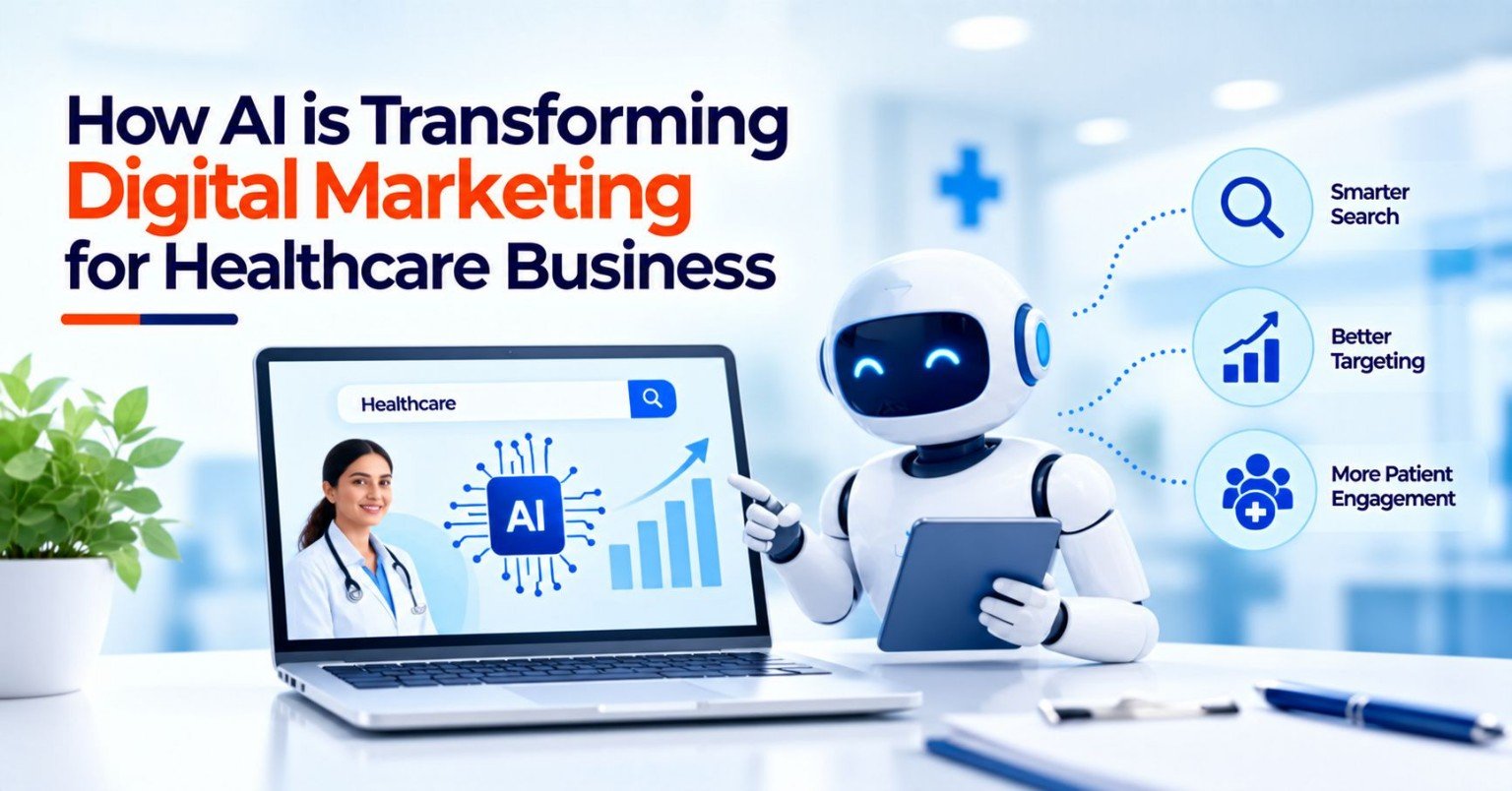
Artificial intelligence is changing how healthcare businesses approach digital marketing.
Hospitals, clinics, diagnostic centres, speciality practices, and healthcare brands now have access to AI-powered tools that can help analyse search behaviour, organise marketing data, personalise communication, assist with content creation, automate repetitive tasks, improve advertising workflows, and understand how patients interact with digital channels.
But healthcare marketing is different from many other industries.
Marketing content can involve sensitive subjects, medical terminology, patient concerns, and information that people may use when making healthcare decisions. Because of this, AI should not simply be used to produce more content or automate every interaction.
Instead, healthcare businesses need to understand where AI adds genuine value, where human expertise remains essential, and how AI can be integrated responsibly into digital marketing workflows.
The American Medical Association’s 2026 research shows that AI adoption among physicians is already widespread, while concerns around privacy, transparency, and the patient-physician relationship remain important.
For healthcare marketers, this creates an opportunity to use AI as an assistive technology while keeping accuracy, trust, patient needs, and human oversight at the centre of the strategy.
What Does AI Mean for Healthcare Digital Marketing?
AI in healthcare marketing refers to using artificial intelligence and machine-learning technologies to support marketing-related activities.
These can include:
- Search and keyword analysis
- Content research
- Content drafting and editing
- Audience segmentation
- Personalisation
- Campaign analysis
- Advertising optimisation
- Social media workflows
- Chat and communication
- Lead qualification
- Sentiment analysis
- Marketing automation
- Data analysis
- Search trend identification
- Performance forecasting
AI does not necessarily replace the marketing team.
In many cases, its practical role is to help marketers process information faster, identify patterns, automate repetitive work, and spend more time on strategy and human judgement.
Why AI Is Becoming Important in Healthcare Marketing
Healthcare businesses generate and manage large amounts of digital information.
A hospital, for example, may have:
- Hundreds of service pages
- Multiple departments
- Doctor profiles
- Several locations
- Educational resources
- Social media content
- Paid advertising campaigns
- Patient enquiries
- Search performance data
Analysing all of this manually can take considerable time.
AI can help marketing teams process large datasets, identify patterns, organise information, and support decisions.
At the same time, healthcare AI adoption is expanding beyond purely clinical applications. The AMA’s 2026 research reports physician use of AI for activities including research summaries, documentation, translation, and draft responses to patient portal messages.
This broader adoption demonstrates why healthcare organisations need a thoughtful approach to AI rather than treating it as a short-term marketing trend.
1. AI Is Changing Healthcare Keyword Research
Keyword research is one of the areas where AI can assist digital marketers.
Traditional keyword research often involves reviewing:
- Search terms
- Search volume
- Competition
- Related queries
- Search intent
- SERP features
AI can help marketers organise large keyword sets into meaningful themes.
For example, instead of looking at individual searches separately, an AI-assisted workflow can group queries around:
Cardiology services
Heart specialist searches
Doctor-related searches
Location-based searches
Appointment-related searches
Educational questions
This can help a healthcare SEO team understand the different stages of a patient’s search journey.
However, AI-generated keyword suggestions should still be validated using real search data and business knowledge.
AI can identify patterns, but it should not automatically decide which keywords are commercially or medically appropriate.
2. AI Helps Identify Search Intent
Healthcare searches can have very different purposes.
Consider these examples:
“What does an ECG test show?”
This is primarily informational.
“Cardiology clinic near me”
This has a local discovery intent.
“Book cardiologist appointment”
This is closer to an action-oriented intent.
AI can help marketers classify large keyword datasets into intent categories.
This can make it easier to create content that answers the actual question behind a search rather than simply inserting keywords into a page.
3. AI Is Changing Healthcare Content Workflows
Content creation is one of the most visible applications of generative AI.
AI can help marketers with:
- Topic research
- Content outlines
- Headline ideas
- Question discovery
- First drafts
- Content summaries
- Social media variations
- Content repurposing
- Metadata suggestions
However, healthcare content requires additional review.
AI-generated text can contain:
- Inaccuracies
- Outdated information
- Missing context
- Overconfident statements
- Incorrect medical terminology
- Unsupported claims
For that reason, AI should assist the content workflow rather than replace subject-matter review.
Google’s current Search guidance specifically warns against producing large amounts of AI-generated content without adding value for users. Its spam policies identify scaled content abuse as a problem when many pages are generated primarily to manipulate rankings rather than help users.
The objective should therefore be better healthcare content, not simply more healthcare content.
4. AI Can Support Patient-Centred Content
Healthcare audiences ask questions in many different ways.
One person may search:
“What happens during a health check?”
Another may ask:
“How long does a diagnostic test take?”
Another may search:
“Which specialist should I consult?”
AI can help marketers analyse common questions and organise them into content themes.
This can support:
- FAQs
- Service pages
- Blog topics
- Educational guides
- Short-form videos
- Social posts
- Website resources
The final content should still be reviewed for accuracy, clarity, relevance, and appropriate healthcare communication.
5. AI Is Supporting Personalised Marketing
Personalisation means presenting relevant content or communication based on available user or audience information.
AI can help identify patterns in:
- Website behaviour
- Content interests
- Campaign interactions
- Search themes
- Location
- Previous marketing interactions
For example, a healthcare organisation may identify that visitors interested in a particular speciality frequently view related service pages and appointment information.
This can inform how the website, email campaigns, or advertising messages are structured.
However, healthcare personalisation requires additional caution.
Marketing teams should understand what data they are collecting, why they need it, how it is stored, who can access it, and what permissions or legal requirements apply.
6. AI Can Improve Social Media Workflows
Healthcare brands often manage multiple social channels.
AI can support social media teams with:
- Content ideas
- Caption drafts
- Content calendars
- Topic clustering
- Repurposing
- Audience-question analysis
- Performance summaries
- Creative variations
For example, one healthcare article can potentially become:
A LinkedIn post
An Instagram carousel
A short educational video
A patient-friendly FAQ
A newsletter section
AI can speed up this repurposing process.
Human review remains important because healthcare social media content should not accidentally make misleading claims, create unnecessary fear, or present general information as personalised medical advice.
7. AI Is Changing Healthcare PPC Advertising
AI is also becoming part of paid search advertising.
Google’s current advertising tools include AI-powered features designed to help optimise search campaigns, expand search-term matching, customise creative assets, and improve campaign performance.
For healthcare businesses, AI-assisted advertising can help with:
- Audience signals
- Search-term analysis
- Creative variations
- Bid optimisation
- Campaign insights
- Landing-page optimisation
- Conversion analysis
But automation does not remove the need for campaign controls.
Healthcare marketers should still define:
- Target audiences
- Geographic areas
- Budget limits
- Service priorities
- Exclusions
- Brand messaging
- Landing pages
- Conversion goals
AI can optimise within a strategy, but it should not be treated as the strategy itself.
8. AI Can Help Analyse Marketing Performance
Healthcare marketing can generate large amounts of performance data.
AI can help identify patterns across:
- Organic traffic
- Search impressions
- Click-through rates
- Paid campaigns
- Conversion data
- Landing pages
- Social engagement
- Lead sources
- Content performance
Instead of manually reviewing every report, marketers can use AI-assisted analysis to identify potential areas that deserve investigation.
For example:
A service page may receive substantial search impressions but relatively few clicks.
An AI-assisted workflow may flag the page for further review.
The marketer can then investigate the title, search intent, content relevance, SERP competition, or other factors.
AI helps identify the question.
Human analysis determines the appropriate response.
9. AI Can Support Healthcare Lead Management
Not every enquiry has the same level of intent.
A healthcare website may receive:
- General questions
- Appointment requests
- Callback requests
- Location enquiries
- Service enquiries
- Existing-patient queries
AI-assisted systems can help categorise incoming enquiries based on predefined rules.
For example:
Appointment request → appointment workflow
General service question → information response
Location enquiry → location information
This can reduce repetitive manual work.
However, sensitive healthcare information should be handled carefully, and organisations should define clear rules for what automated systems are allowed to process or communicate.
10. AI Chatbots Can Improve Website Communication
AI-powered chat interfaces can help visitors navigate information.
A healthcare website chatbot might help users find:
- Services
- Departments
- Doctors
- Locations
- Appointment information
- Opening hours
- General website information
The goal should be navigation and information support rather than pretending to replace a healthcare professional.
The AMA has highlighted that AI health chatbots can help patients learn, compare information, and prepare for care, but they should not replace professional medical guidance.
Healthcare organisations should therefore establish clear boundaries for chatbot functionality.
11. AI Can Improve Local Healthcare Marketing
Local search is particularly important for clinics, hospitals, diagnostic centres, and speciality practices.
AI can help analyse local search patterns around:
- Service + city
- Service + neighbourhood
- Doctor + location
- Clinic + near me
- Hospital + speciality
- Diagnostic service + location
This information can support:
- Location pages
- Google Business Profile optimisation
- Local content
- Local landing pages
- Review analysis
- Local advertising
However, businesses should avoid automatically generating large numbers of near-identical location pages.
Useful local content should contain genuinely relevant information for the location and audience.
12. AI Is Influencing Healthcare SEO and Search Visibility
Search itself is becoming more AI-driven.
Google’s Search ecosystem now includes AI features, and in September 2026 Google also introduced reporting for web multimodal searches in Search Console, covering experiences such as Lens, Circle to Search, image uploads, and related visual searches.
This means healthcare marketers need to think beyond traditional ten-blue-link search results.
Content should be:
- Clear
- Well structured
- Relevant
- Accurate
- Easy to understand
- Supported by appropriate evidence
- Organised around genuine user questions
AI search does not mean healthcare websites should simply create AI-generated content.
It makes useful, trustworthy, well-structured information even more important.
13. AI Can Support Answer Engine Optimisation
Healthcare users increasingly ask complete questions rather than entering only short keywords.
Examples include:
- “What services does a cardiology clinic offer?”
- “How do I choose a dermatologist?”
- “What should I know before booking a diagnostic test?”
- “Which healthcare services are available at this hospital?”
AI can help marketers identify question patterns and organise content around them.
This supports an answer-oriented content strategy.
A useful page can provide:
Direct answer → supporting explanation → relevant details → next step
This structure can make information easier for both people and AI-driven search systems to understand.
14. AI Can Help With Content Personalisation at Scale
Large healthcare organisations may have different audiences.
For example:
- Patients
- Caregivers
- Doctors
- Corporate clients
- International patients
- Local visitors
AI can help adapt content formats and messaging to different audience segments.
However, personalisation should remain appropriate.
Healthcare marketing should avoid making assumptions about an individual’s medical condition or creating messages that feel intrusive.
The safest approach is to personalise based on legitimate audience and behavioural information while respecting privacy and applicable requirements.
15. AI Can Help Identify Reputation Trends
Healthcare reputation is influenced by:
- Reviews
- Social comments
- Search results
- Patient feedback
- Online discussions
AI-assisted sentiment analysis can help organisations process large volumes of feedback and identify recurring themes.
For example, a healthcare organisation might discover repeated comments about:
- Appointment communication
- Waiting experience
- Website usability
- Location information
- Customer support
The purpose should not be to automatically dismiss negative feedback.
Instead, AI can help identify patterns that deserve human review.
16. AI Can Make Marketing Reporting More Efficient
Marketing teams often spend significant time preparing reports.
AI can help summarise:
- Traffic trends
- Campaign performance
- Keyword changes
- Conversion patterns
- Content performance
- Social metrics
It can also help turn raw data into questions such as:
Why did organic traffic change?
Which landing pages generated more enquiries?
Which campaign produced the strongest qualified leads?
Which topics attracted engagement?
These questions can guide deeper analysis.
AI-generated summaries should still be checked against the original data before being used for important business decisions.
17. AI Can Support Multilingual Healthcare Marketing
Healthcare businesses serving multilingual audiences may use AI-assisted translation and localisation tools.
This can help with:
- Content translation
- Social media localisation
- Campaign variations
- Website content
- Patient communication
However, direct machine translation is not always sufficient for healthcare content.
Medical terminology, cultural context, tone, and meaning should be reviewed by an appropriately qualified human where accuracy matters.
AI can speed up the process, but human language and subject-matter review remain important.
18. AI Is Changing the Role of Healthcare Marketers
As AI handles more repetitive marketing tasks, marketers can spend more time on:
- Strategy
- Audience understanding
- Brand positioning
- Content quality
- Data interpretation
- Creative direction
- Patient communication
- Campaign planning
This represents a shift from:
Manual execution → AI-assisted execution + human strategy
The marketer’s role does not disappear.
It becomes increasingly focused on deciding what should be done, why it should be done, and whether the output is actually useful.
19. Human Oversight Is Essential in Healthcare Marketing
Healthcare is a high-trust environment.
AI systems can make mistakes.
They may:
- Generate incorrect statements
- Misinterpret context
- Present outdated information
- Create unsupported claims
- Produce inappropriate recommendations
- Misrepresent a source
- Use overly confident language
For this reason, healthcare organisations should establish human review processes.
Important content should be checked for:
- Accuracy
- Medical terminology
- Sources
- Dates
- Context
- Claims
- Brand suitability
- Patient safety
The AMA’s current guidance emphasises transparency, responsible use, privacy, and maintaining appropriate human oversight as AI becomes more embedded in healthcare.
20. Data Privacy Should Be Part of the AI Strategy
Healthcare marketing can involve sensitive information.
Before using AI tools, organisations should understand:
- What data is being processed
- Where it goes
- Who can access it
- Whether it is retained
- What permissions apply
- What security measures are available
- Whether the tool is appropriate for the intended information
Marketing teams should avoid putting sensitive patient information into general-purpose AI systems unless the organisation has assessed the tool, its controls, and the applicable requirements.
AI adoption should never come at the expense of patient privacy.
21. AI Should Not Replace Medical Expertise
Digital marketing AI has an important limitation:
Marketing automation is not medical expertise.
AI can assist with:
- Organisation
- Research
- Drafting
- Analysis
- Personalisation
- Automation
But medical claims and patient-facing healthcare information require appropriate human oversight.
The AMA has repeatedly emphasised that AI tools should complement, rather than replace, physicians and professional healthcare guidance.
Healthcare marketers should therefore maintain a clear separation between AI-assisted marketing tasks and clinical decision-making.
Common Mistakes Healthcare Businesses Make With AI Marketing
Publishing AI Content Without Review
Generating an article is not the same as producing accurate healthcare content.
Creating Hundreds of Similar Pages
Large-scale automated content with little original value can create search-quality problems. Google explicitly identifies scaled content abuse as a spam practice when content is generated primarily to manipulate Search.
Treating AI Output as Fact
AI-generated information should be verified before publication.
Sharing Sensitive Data With Unapproved Tools
Privacy should be considered before entering any healthcare-related data into an AI system.
Automating Everything
Not every patient interaction should be automated.
Using Generic AI Content
Healthcare audiences need useful, specific, trustworthy information rather than generic text.
Ignoring Brand Voice
AI output can sound repetitive or generic when there is no clear editorial direction.
Focusing Only on Tools
Buying an AI tool does not automatically create an AI strategy.
The strategy should come first.
How to Build an AI-Powered Healthcare Marketing Workflow
A practical workflow can look like this:
Step 1: Identify the Problem
Start with a genuine marketing challenge.
For example:
Content research takes too long.
Step 2: Decide Where AI Can Help
Use AI for research organisation, topic clustering, or initial content planning.
Step 3: Define Human Review
Decide which parts require marketer, healthcare professional, legal, or compliance review.
Step 4: Establish Data Rules
Define what information can and cannot be processed by the AI system.
Step 5: Test the Workflow
Start with a limited use case.
Step 6: Measure Results
Track whether AI actually improves:
- Time efficiency
- Content quality
- Campaign performance
- Lead quality
- Productivity
- User experience
Step 7: Expand Carefully
Only scale an AI workflow after it has demonstrated practical value.
How World SEO Services Can Help as an AI Healthcare Marketing Company
AI works best when it is integrated into a broader healthcare digital marketing strategy.
World SEO Services can help healthcare businesses explore AI-assisted approaches across:
- Healthcare SEO
- Keyword research
- Content strategy
- AEO and AI-search optimisation
- Social media marketing
- PPC campaign support
- Website content
- Marketing analytics
- Audience research
- Content repurposing
- Performance reporting
The objective should not be to replace human marketing teams with automated output.
Instead, AI can be used to make research, analysis, content workflows, and repetitive marketing tasks more efficient while human experts remain responsible for strategy, accuracy, quality, and healthcare-sensitive decisions.
A Practical AI Healthcare Marketing Checklist
Before introducing AI into healthcare marketing, ask:
Strategy
- What problem are we trying to solve?
- Will AI actually improve the workflow?
- What outcome will we measure?
Content
- Is AI-generated content reviewed by humans?
- Are healthcare claims verified?
- Does the content provide original value?
- Is the content written for real users?
SEO
- Are we avoiding mass-produced low-value pages?
- Does content satisfy search intent?
- Is the website structured clearly?
- Are AI-search and traditional SEO considered together?
Data
- What information is being entered into the AI tool?
- Does it contain sensitive information?
- Are appropriate permissions and safeguards in place?
Patient Experience
- Does automation make the experience easier?
- Can users reach a human when necessary?
- Are AI-generated responses clearly within appropriate boundaries?
Governance
- Who reviews AI output?
- Who is responsible for errors?
- How often are workflows reviewed?
- What happens when the AI tool changes?
Final Thoughts
AI is transforming healthcare digital marketing by helping organisations analyse information, understand search intent, create and repurpose content, personalise communication, optimise advertising workflows, analyse performance, and support digital patient journeys.
But the most valuable use of AI is not simply producing more marketing material faster.
It is using technology to help healthcare marketing teams work more intelligently while preserving the qualities that matter most in healthcare: accuracy, trust, privacy, clarity, human oversight, and patient-centred communication.
AI should support marketers rather than remove strategic judgement.
For healthcare businesses, a responsible AI strategy can combine automation with expert review, data analysis with human interpretation, and efficient content workflows with genuine value for patients.
As search becomes increasingly AI-driven and healthcare organisations continue adopting AI across their broader operations, businesses that build thoughtful, well-governed workflows can use the technology without losing sight of the people their marketing is meant to serve.
World SEO Services can help healthcare brands explore this changing digital landscape by combining AI-assisted marketing workflows with SEO, AEO, content strategy, paid marketing, analytics, and human-led quality control.
The future of healthcare marketing is not simply about AI-generated marketing.
It is about human-led healthcare marketing, strengthened by AI.
FAQs
1. How is AI transforming healthcare digital marketing?
AI is helping healthcare marketers with keyword research, search-intent analysis, content workflows, personalisation, social media, advertising optimisation, lead categorisation, performance analysis, and marketing automation. Its role should be supportive, with appropriate human review for healthcare-related content and communication.
2. Can AI create healthcare content for SEO?
AI can assist with research, outlines, drafts, and content optimisation, but healthcare content should be reviewed for accuracy, relevance, originality, and appropriate claims. Google warns against scaled content created primarily to manipulate Search, including AI-generated pages that provide little value to users.
3. Can AI replace healthcare marketing professionals?
AI can automate or assist with some repetitive tasks, but it does not eliminate the need for strategy, creative judgement, healthcare knowledge, content review, data interpretation, and responsible decision-making. Human oversight remains particularly important for healthcare marketing.
4. Is it safe to use AI with patient information?
Healthcare businesses should be cautious when using AI tools with patient or other sensitive information. Before doing so, organisations should assess the tool’s data handling, security, permissions, retention, and applicable privacy requirements. Sensitive information should not be entered into an AI system simply because the tool is convenient.
5. How can healthcare businesses start using AI in marketing?
Start with a specific, low-risk marketing workflow such as keyword clustering, content research, reporting summaries, or social content repurposing. Define human review and data-handling rules, measure the results, and expand the workflow only when it demonstrates genuine value.