
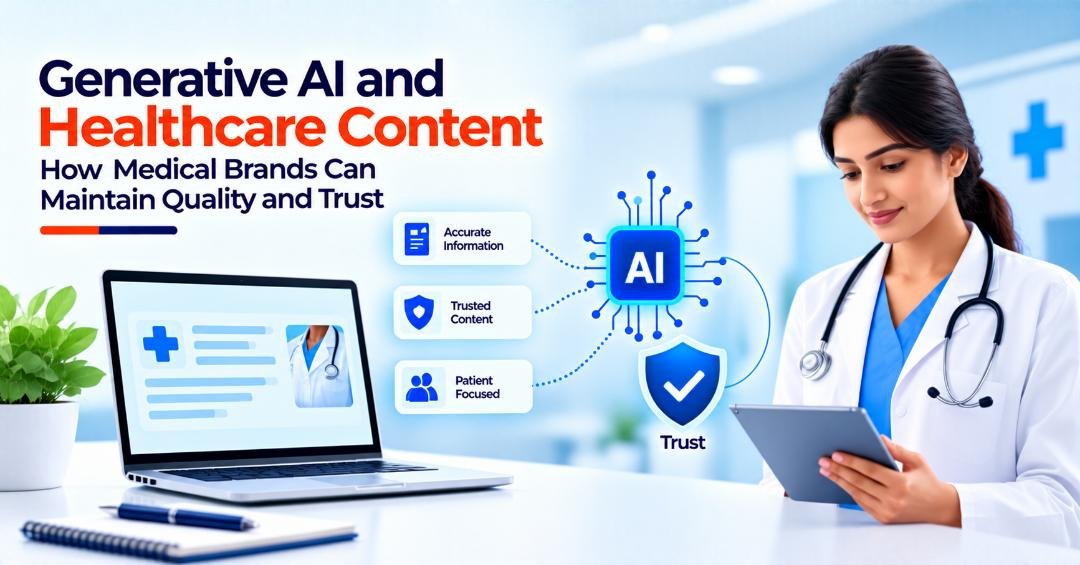
Generative artificial intelligence is changing how businesses create and manage digital content. Healthcare brands are also exploring AI tools to research topics, develop content ideas, create drafts, summarize information, and support large-scale content operations.
For hospitals, clinics, diagnostic centres, specialty practices, and healthcare organizations, this can create significant opportunities. A marketing team can use generative AI to speed up repetitive tasks and organize content more efficiently.
But healthcare content requires a higher level of responsibility.
People may read a healthcare article because they are worried about a symptom, researching a condition, comparing providers, or trying to understand a treatment or medical service. If the information is inaccurate, misleading, outdated, or presented without appropriate context, it can damage both patient trust and the healthcare brand’s reputation.
This is why the question is no longer simply whether healthcare brands should use generative AI.
The more important question is:
How can healthcare organizations use generative AI while maintaining content quality, accuracy, credibility, and trust?
A strong approach combines AI-assisted efficiency with human expertise, careful fact-checking, clear editorial standards, and a patient-first content strategy.
What Is Generative AI in Healthcare Content?
Generative AI refers to artificial intelligence systems that can create new content based on the information and instructions provided to them.
In healthcare marketing, these systems may assist with:
- Blog outlines
- Topic research
- Content ideas
- FAQ development
- Social media drafts
- Website copy
- Content summaries
- Search-intent analysis
- Content organization
- Meta title and description ideas
- Content repurposing
The technology can be useful for accelerating the content workflow.
However, AI-generated content should not automatically be treated as expert healthcare information.
There is an important difference between using AI to assist with content production and allowing AI to independently decide what healthcare information should be published.
The first can improve productivity.
The second can introduce unnecessary risks.
Why Healthcare Content Needs Extra Care
Healthcare is an information-sensitive industry.
A person reading an article about a general consumer product may make a relatively low-risk decision. Someone reading about a health condition, treatment, procedure, or medical service may use that information when making a much more important decision.
This makes quality particularly important.
Healthcare content should aim to be:
- Accurate
- Clear
- Relevant
- Responsible
- Evidence-informed
- Up to date
- Easy to understand
- Appropriate for the intended audience
It should also avoid creating unrealistic expectations.
Statements suggesting guaranteed outcomes, unsupported medical claims, or overly confident recommendations can reduce credibility and potentially mislead readers.
Where Generative AI Can Help Healthcare Marketing Teams
Generative AI can be valuable when used for the right tasks.
1. Generating Initial Content Ideas
Healthcare marketing teams need to consistently identify topics that are relevant to their audiences.
AI can help generate potential topic ideas based on:
- Healthcare services
- Common patient questions
- Search intent
- Existing website content
- Frequently asked questions
- Related topics
For example, a hospital offering cardiology services may need content covering several aspects of the patient journey.
AI can help brainstorm related questions, which the content team can then evaluate for relevance and accuracy.
The final topic selection should still be based on genuine audience needs and the organization’s expertise.
2. Creating Content Outlines
A well-structured outline can make content production more efficient.
AI can help organize a topic into logical sections, such as:
Introduction → Key Concepts → Important Considerations → Practical Information → FAQs → Conclusion
For healthcare content, the outline should then be reviewed to ensure that important context has not been omitted.
A good outline should serve the reader rather than simply create space for keywords.
3. Supporting Content Repurposing
Healthcare organizations often have useful information that can be presented in different formats.
For example, a detailed educational article could potentially become:
- A short social media post
- An FAQ
- A video topic
- A newsletter section
- A website resource
- A series of educational posts
Generative AI can help transform existing material into different formats.
However, the source content should remain accurate, and every adapted version should be reviewed before publication.
4. Helping With Content Organization
Large healthcare websites can contain hundreds of pages.
AI can help marketing teams identify relationships between content topics and organize resources around broader themes.
For example:
Specialty → Service → Educational Content → FAQs → Related Resources
This can support a more organized content structure and improve the overall user experience.
The Biggest Challenge: AI Can Sound Confident Even When It Is Wrong
One of the most important limitations of generative AI is that fluent writing does not guarantee factual accuracy.
An AI system can produce a response that sounds professional and convincing while containing:
- Incorrect facts
- Missing context
- Outdated information
- Unsupported statements
- Incorrect terminology
- Misleading conclusions
This is particularly important in healthcare.
A polished paragraph should never be treated as evidence that the information is correct.
Healthcare brands should therefore build a verification process into their content workflow.
Human Review Should Remain Central
Human oversight is one of the most important principles for responsible generative AI use in healthcare content.
AI can assist with drafting and organization, but people should remain responsible for reviewing the final information.
Depending on the topic, review may involve:
- Healthcare subject-matter experts
- Doctors or qualified professionals
- Experienced content editors
- SEO specialists
- Brand and compliance teams
The level of review should depend on how sensitive the content is.
A page explaining appointment timings may require a different review process from an article discussing a medical condition or treatment.
How to Maintain Accuracy in AI-Assisted Healthcare Content
A strong editorial process can significantly reduce the risk of publishing incorrect information.
Step 1: Start With Reliable Information
AI should not be the only source used to establish healthcare facts.
Content teams should work from reliable information and appropriate professional sources.
Step 2: Verify Important Claims
Claims involving treatments, symptoms, procedures, risks, outcomes, or healthcare recommendations should receive particular attention.
Step 3: Check Dates and Updates
Medical information can change.
Content teams should periodically review older pages to identify outdated information.
Step 4: Remove Unsupported Statements
If an AI-generated statement cannot be verified, it should not automatically remain in the article.
Step 5: Review the Final Version
The published content should be evaluated as a complete piece rather than checking only individual sentences.
This helps identify contradictions, missing context, and unclear explanations.
Generative AI Should Not Replace Healthcare Expertise
AI can process information quickly, but it does not have the same professional responsibility as a qualified healthcare expert.
For healthcare brands, this distinction is critical.
An AI tool may help explain a topic in simpler language, but it should not independently determine what treatment is appropriate for an individual.
Similarly, content teams should avoid turning AI-generated general information into personalized medical advice.
A healthcare article can educate a reader while still encouraging them to seek professional guidance when their individual situation requires it.
How AI-Generated Content Can Affect Patient Trust
Trust is one of the most valuable assets for a healthcare brand.
Patients want to feel that the information they read has been created carefully.
If a website contains:
- Repetitive articles
- Generic explanations
- Obvious factual errors
- Excessive promotional language
- Contradictory information
- Unclear sources
readers may question the credibility of the entire organization.
This is why publishing a large amount of AI-generated content is not necessarily a successful content strategy.
More content does not automatically mean better healthcare marketing.
The quality, usefulness, accuracy, and relevance of the information matter much more.
Avoid Creating Generic AI Content
One common problem with generative AI is that different brands can end up publishing very similar content.
For example, if several healthcare websites ask AI to explain the same topic using similar instructions, their articles may have:
- Similar introductions
- Similar headings
- Similar explanations
- Similar conclusions
- Similar FAQs
This creates little differentiation.
Healthcare brands should instead add information that reflects their genuine expertise, audience, services, location, and experience.
Original insights can make content more useful and more distinctive.
Patient-First Writing Is More Important Than AI-First Writing
Healthcare content should be written for people first.
A patient may not understand complex medical terminology.
Instead of using technical terms without explanation, content should use simple language wherever possible.
For example, if a medical term is necessary, the article can explain what it means in straightforward language before continuing.
This makes the content easier to understand without removing important information.
A patient-first approach asks:
What does the reader actually need to know?
rather than:
How much content can we generate around this keyword?
Generative AI and Healthcare SEO
AI can support healthcare SEO, but it should not become a shortcut for SEO quality.
Search optimization still requires:
- Relevant keyword research
- Search intent analysis
- Strong website structure
- Useful service pages
- Internal linking
- Technical SEO
- Local SEO
- Quality content
- Good user experience
Generative AI can help with some research and content tasks, but publishing large quantities of poorly reviewed AI content is not a sustainable SEO strategy.
Search visibility should come from relevance and usefulness rather than content volume alone.
AI Content and E-E-A-T Principles
Healthcare content benefits from demonstrating expertise, experience, authoritativeness, and trustworthiness.
AI alone cannot establish these qualities.
Healthcare brands can strengthen credibility by providing:
- Clear information about the organization
- Appropriate author or reviewer information
- Accurate service details
- Reliable references where relevant
- Transparent communication
- Up-to-date information
- Professional expertise
Where appropriate, healthcare content can also indicate that medical information has been reviewed by a qualified professional.
The exact approach will depend on the type and purpose of the content.
Generative AI and AEO for Healthcare
AI-powered search is changing how people ask questions.
Instead of typing:
“fertility clinic Jaipur”
a user might ask:
“What should I consider when choosing a fertility clinic in Jaipur?”
This means healthcare content should be able to answer complete questions clearly.
Answer Engine Optimization can benefit from:
- Direct answers
- Descriptive headings
- Well-structured sections
- Relevant FAQs
- Natural language
- Clear explanations
- Strong topical coverage
Generative AI can help identify possible questions and organize content around them.
But the answers themselves still need to be accurate and useful.
The goal should be to create content that works well for people and is also understandable to modern search systems.
Privacy Considerations for Generative AI
Privacy is another major concern.
Healthcare organizations may handle sensitive patient information. That information should not be entered into an AI tool simply because the tool is convenient.
Before using an AI platform, organizations should understand:
- What information is being processed
- How data is stored
- Who can access it
- Whether information is retained
- How the provider uses submitted data
- What security measures are available
Marketing teams should also establish internal guidelines explaining what information employees are permitted to use with AI systems.
Privacy should be treated as part of the AI strategy from the beginning.
Best Practices for Using Generative AI in Healthcare Content
Healthcare brands can follow several practical principles when using AI.
1. Use AI as an Assistant
AI should support research, organization, and drafting rather than independently control the publishing process.
2. Verify Healthcare Information
Every important healthcare claim should be reviewed and verified before publication.
3. Add Human Expertise
Use qualified professionals and experienced editors to improve accuracy, context, and usefulness.
4. Avoid Unnecessary Medical Claims
Do not use exaggerated statements or guarantee outcomes simply to make content more persuasive.
5. Write for Real Questions
Use AI to identify questions, but create answers based on reliable information and genuine audience needs.
6. Keep Content Original
Add unique insights, relevant examples, organizational expertise, and useful context.
7. Review Existing Content
AI-assisted content should not be the only focus. Older website pages should also be reviewed for accuracy and usefulness.
8. Maintain a Clear Editorial Process
Define who creates, reviews, approves, and updates healthcare content.
9. Protect Sensitive Information
Establish clear rules for how AI tools can be used with healthcare-related data.
10. Measure Quality, Not Just Quantity
Track whether content improves useful engagement, search visibility, enquiries, and the overall digital experience.
How World SEO Services Can Use Generative AI Responsibly
At World SEO Services generative AI can be treated as a supporting technology within a broader healthcare digital marketing strategy rather than as a replacement for human expertise.
AI-assisted workflows can help with areas such as topic research, search-intent analysis, content planning, FAQ identification, content organization, and AEO preparation.
However, the final content strategy should remain focused on quality and patient needs.
For healthcare brands, this means combining AI-assisted efficiency with:
- Healthcare SEO
- Human content review
- Search-intent analysis
- AEO-focused structure
- Website optimization
- Local SEO
- Healthcare-specific content planning
- Quality control
This approach helps ensure that AI is being used to improve the workflow rather than simply increase the number of articles published.
A Practical AI Content Workflow for Healthcare Brands
A structured workflow can make generative AI safer and more useful.
Research
Understand the audience, topic, search intent, and available reliable information.
Plan
Create a content brief and decide what the reader needs to understand.
Assist
Use AI for brainstorming, organization, outlines, or other appropriate supporting tasks.
Write
Develop the content with accurate information and a clear patient-focused approach.
Review
Check facts, medical claims, language, tone, relevance, and completeness.
Optimize
Improve headings, internal linking, search intent alignment, FAQs, and readability.
Approve
Have the appropriate reviewer approve the final version before publication.
Update
Review important healthcare content periodically to ensure it remains relevant and accurate.
This workflow allows healthcare organizations to benefit from AI without allowing automation to become a substitute for editorial responsibility.
What Healthcare Brands Should Avoid
Generative AI can become problematic when organizations use it without clear guidelines.
Healthcare brands should avoid:
- Publishing unreviewed AI-generated medical content
- Creating content only to increase page count
- Using AI to invent statistics or references
- Making unsupported treatment claims
- Copying generic AI-generated explanations
- Entering sensitive patient information into inappropriate tools
- Using AI-generated fake testimonials or reviews
- Replacing qualified healthcare review with automated approval
- Focusing on keywords at the expense of reader value
These practices may create short-term efficiency but can damage long-term credibility.
The Future of Generative AI in Healthcare Content
Generative AI will likely remain an important part of digital content workflows.
As the technology improves, healthcare marketing teams may use it for more sophisticated tasks involving content analysis, personalization, search insights, workflow automation, and digital communication.
But healthcare brands will still need human expertise.
In fact, as AI-generated content becomes more common across the internet, reliable and genuinely useful information may become an even stronger differentiator.
Healthcare organizations that combine AI with expertise, accuracy, transparency, and patient-focused communication can build a stronger foundation for long-term digital growth.
Conclusion
Generative AI can make healthcare content production faster and help marketing teams with research, planning, organization, and content workflows. It can also support SEO, AEO, website experiences, and broader digital marketing activities.
But healthcare content cannot be judged only by how quickly it can be produced.
Accuracy, trust, clarity, privacy, expertise, and responsibility must remain central.
AI can help create an outline, identify questions, organize information, or support content production. It should not be treated as the final authority on healthcare information.
For healthcare organizations exploring Healthcare AI Solutions, the strongest approach is a balanced one: use AI where it improves efficiency, add human expertise where judgment is required, verify important information, protect sensitive data, and always consider what the patient actually needs to understand.
With the right process, generative AI can become a useful part of healthcare content marketing without compromising the quality and trust that patients expect from medical brands.
Frequently Asked Questions
1. Can healthcare brands use generative AI to create content?
Yes. Healthcare brands can use generative AI to support tasks such as topic research, content outlines, FAQs, drafting, content organization, and repurposing. However, healthcare content should receive appropriate human review before publication, especially when it includes medical information.
2. Is AI-generated healthcare content reliable?
AI-generated content is not automatically reliable. AI can produce information that sounds accurate but may contain factual errors, outdated information, missing context, or unsupported claims. Important healthcare information should therefore be verified using reliable sources and reviewed by appropriate professionals.
3. How can healthcare brands maintain trust when using AI?
Healthcare brands can maintain trust by using AI as an assistant rather than the final authority, fact-checking important claims, adding human expertise, protecting sensitive information, avoiding exaggerated medical promises, and creating genuinely useful content for patients.
4. Does AI-generated content affect healthcare SEO?
Using AI does not automatically make content good or bad for SEO. The important factors include usefulness, accuracy, relevance, search intent, website quality, originality, and overall user experience. Publishing large volumes of low-quality or repetitive AI content is unlikely to create sustainable search value.
5. How can AI help with AEO for healthcare websites?
AI can help content teams identify common questions and organize information around them. Healthcare websites can then create clear answers, descriptive headings, relevant FAQs, and well-structured content. The information should still be accurate, useful, and reviewed appropriately before publication.